 Hieronymus Bosch, John of Patmos, 1489. If not for the little black half-scorpion, it would be hard to believe it’s Bosch; note also the crustacean appendages of the angel’s wings. I love the rose-like folds of John’s pink robe.
Even though Bart Ehrman’s compelling view of Jesus as an apocalyptic preacher finished him off for me as an inspiring figure, I can see that the end of the world will happen for each of us. For me it’s a reminder to feast on the world while it exists.
**
But, Master, what shall I dedicate to you,
who taught all creatures to hear?
My memory of an evening in Russia,
in springtime — a horse . . .
From the village came the white horse alone,
on one front leg the hobble,
to be alone on the meadow at night;
how the mane beat against his neck
to the rhythm of his perfect joy,
in that rudely hindered gallop.
What leaping went on in his stallion-blood!
He felt the distances and he sang and he heard —
your cycle of myths was enclosed in him.
His image: I dedicate.
~ Rainer Maria Rilke, Sonnets to Orpheus, XX, Part I
This poem has a peculiar tension (poems, too, need dramatic tension). The horse, known to us from hundreds of poems, statues, and paintings as an image of strength and thundering speed, is hobbled, dragging an awkward wooden weight that prevents him from full gallop. In spite of that, the horse appears spirited and happy.
And that, it seems to me, is an image of life: we are hobbled by various circumstances. To be so “rudely hindered,” and yet capable of joy — that’s the condition of those who refuse to be defeated by circumstances (even though, in the end, we must lose to aging and mortality; and yet it need not be called a defeat).
And this is the image that Rilke dedicates to Orpheus, the supreme poet and musician: not an image of a horse running freely, but of a horse that remains joyful in spite of hobbled.
 driftwood sculpture by Jeffro Uitto
PARIS VERSUS NEW YORK (James Baldwin)
~ “Well,’ I said, ‘Paris is old, is many centuries. You feel, in Paris, all the time gone by. That isn’t what you feel in New York — ’ He was smiling. I stopped.
‘What do you feel in New York?’ he asked.
‘Perhaps you feel,’ I told him, ‘all the time to come. There’s such power there, everything is in such movement. You can’t help wondering — I can’t help wondering — what it will all be like — many years from now.”
~ James Baldwin, “Giovanni’s Room”
When I first saw Manhattan, I was prepared for the skyscrapers. I wasn’t prepared for the old buildings with water towers and fire escapes, though I must have seen photographs of those as well. “Nobody thinks of New York as an old city,” my hostess remarked. “But it is quite old.”
And the antique elevators in those buildings, and the rather antique and noisy plumbing. What a symphony of noise that old, futuristic city was!
Again a reminder of how complex things are, how in some ways “the empire never ended” (to steal from P.K. Dick), while in other ways, let’s not forget how the mighty are fallen.
Neither a city of the past nor a city of the future, but an astonishing flight of perspectives.
 New York in 1937
WHY 2017 WAS THE BEST YEAR IN HUMAN HISTORY ~ Nicholas Kristof
We all know that the world is going to hell. Given the rising risk of nuclear war with North Korea, the paralysis in Congress, warfare in Yemen and Syria, atrocities in Myanmar and a president who may be going cuckoo, you might think 2017 was the worst year ever.
But you’d be wrong. In fact, 2017 was probably the very best year in the long history of humanity.
A smaller share of the world’s people were hungry, impoverished or illiterate than at any time before. A smaller proportion of children died than ever before. The proportion disfigured by leprosy, blinded by diseases like trachoma or suffering from other ailments also fell.
We need some perspective as we watch the circus in Washington, hands over our mouths in horror. We journalists focus on bad news — we cover planes that crash, not those that take off — but the backdrop of global progress may be the most important development in our lifetime.
Every day, the number of people around the world living in extreme poverty (less than about $2 a day) goes down by 217,000, according to calculations by Max Roser, an Oxford University economist who runs a website called Our World in Data. Every day, 325,000 more people gain access to electricity. And 300,000 more gain access to clean drinking water.
Readers often assume that because I cover war, poverty and human rights abuses, I must be gloomy, an Eeyore with a pen. But I’m actually upbeat, because I’ve witnessed transformational change.
As recently as the 1960s, a majority of humans had always been illiterate and lived in extreme poverty. Now fewer than 15 percent are illiterate, and fewer than 10 percent live in extreme poverty. In another 15 years, illiteracy and extreme poverty will be mostly gone. After thousands of generations, they are pretty much disappearing on our watch.
Just since 1990, the lives of more than 100 million children have been saved by vaccinations, diarrhea treatment, breast-feeding promotion and other simple steps.
Steven Pinker, the Harvard psychology professor, explores the gains in a terrific book due out next month, “Enlightenment Now,” in which he recounts the progress across a broad array of metrics, from health to wars, the environment to happiness, equal rights to quality of life. “Intellectuals hate progress,” he writes, referring to the reluctance to acknowledge gains, and I know it feels uncomfortable to highlight progress at a time of global threats. But this pessimism is counterproductive and simply empowers the forces of backwardness.
President Trump rode this gloom to the White House. The idea “Make America Great Again” professes a nostalgia for a lost Eden. But really? If that was, say, the 1950s, the U.S. also had segregation, polio and bans on interracial marriage, gay sex and birth control. Most of the world lived under dictatorships, two-thirds of parents had a child die before age 5, and it was a time of nuclear standoffs, of pea soup smog, of frequent wars, of stifling limits on women and of the worst famine in history.
What moment in history would you prefer to live in?
F. Scott Fitzgerald said the test of a first-rate intelligence is the ability to hold two contradictory thoughts at the same time. I suggest these: The world is registering important progress, but it also faces mortal threats. The first belief should empower us to act on the second.
Granted, this column may feel weird to you. Those of us in the columny gig are always bemoaning this or that, and now I’m saying that life is great? That’s because most of the time, quite rightly, we focus on things going wrong. But it’s also important to step back periodically. Professor Roser notes that there was never a headline saying, “The Industrial Revolution Is Happening,” even though that was the most important news of the last 250 years.
I had a visit the other day from Sultana, a young Afghan woman from the Taliban heartland. She had been forced to drop out of elementary school. But her home had internet, so she taught herself English, then algebra and calculus with the help of the Khan Academy, Coursera and EdX websites. Without leaving her house, she moved on to physics and string theory, wrestled with Kant and read The New York Times on the side, and began emailing a distinguished American astrophysicist, Lawrence M. Krauss.
I wrote about Sultana in 2016, and with the help of Professor Krauss and my readers, she is now studying at Arizona State University, taking graduate classes. She’s a reminder of the aphorism that talent is universal, but opportunity is not. The meaning of global progress is that such talent increasingly can flourish.
So, sure, the world is a dangerous mess; I worry in particular about the risk of a war with North Korea. But I also believe in stepping back once a year or so to take note of genuine progress — just as, a year ago, I wrote that 2016 had been the best year in the history of the world, and a year from now I hope to offer similar good news about 2018. The most important thing happening right now is not a Trump tweet, but children’s lives saved and major gains in health, education and human welfare.
Every other day this year, I promise to tear my hair and weep and scream in outrage at all the things going wrong. But today, let’s not miss what’s going right.
New York Times, Opinion, 1-7-2018

from another source:
~ “Declining infectious disease is a major factor behind progress against premature death. The latest global data suggests life expectancy at birth has climbed by 10 years over the past four decades; it now stands at 72 years. The proportion of children who die before the age of five has halved since 1998.
Consider the issue from a slightly different perspective: In 1950, about one in five children died before the age of five. Since the average woman worldwide in 1950 had five children, the typical woman had about a two-thirds chance of losing at least one child. Today, the average woman has 2.5 children and the mortality risk is one in 25, meaning that the average woman now has only a 10 percent chance of experiencing the pain of losing a child.” ~
[the article goes on to list eight other reasons for cautious optimism]
https://www.vox.com/the-big-idea/2018/1/3/16843404/good-news-2017-global-health-development-war
Mary:
Certainly there is enough danger, violence, grief and loss in our daily news to push us into despair, but the statistics presented in 2017 as “Best year ever” show enormous actual progress in the lives of all human beings, something that only rarely comes up in the news. I have great faith in the capacity of science and technology to address and find solutions that we can’t yet imagine. When I was a college student computers took up a whole floor, and few had access to them. Now most ordinary people in most of the world, not just the most developed countries, but all countries, carry computers in their pockets and have access to world wide connections. Totalitarian regimes, repressive states, can attempt to curtail this kind of access, but not completely successfully, and not for long. We may be surrounded by hurricanes of lies, but I do not think we will be fooled for long, or that great majorities can be easily misled.
So these are both dangerous and exciting times, but in that lies enormous opportunity for real and positive change. I have great hopes.
A little instance here—I brought my orchids with me when we moved, and it was in the middle of a real cold spell. Some died, some did not appear to have been hurt at all. For this past year I have kept up a faithful watering schedule, noting most had roots that would green up when watered. I lost a few more in the course of the year—but now I have 6 of them “in spike” for the first time since the trauma of the move. They are preparing to bloom again. Humanity is, I think, at least as stubborn and hardy as those orchids.
Oriana:
Steven Pinker, perhaps the most eminent bringer of “good news,” says he puts his hope in “numeracy.” Numbers, if presented clearly enough, repeatedly enough, are bound to have an effect. If the average woman used to have eight children, but now has only two or three, you can’t keep saying that there hasn’t been a change in family size — which has a huge effect on prosperity and practically everything else.
And yes, it’s become more difficult to lie. If Trump tweets that his approval rating among black people has doubled to 16% while sources show that it has fallen to 3%, his disconnect with reality becomes a tad more obvious. Sure, nothing has an effect on his deluded base, but those people become increasingly isolated in their twilight zone.
**
But I like better the way Kafka put it:
“It was because of impatience that [humans] were expelled from Paradise; it is because of impatience that they do not return.”
 Expulsion from the Garden of Eden, Thomas Cole, 1828
WHEN NORWAY WAS A SHITHOLE COUNTRY
~ “In the Thursday meeting in which President Trump complained about "having all these people from shithole countries come here" — and singled out Haiti, El Salvador and Africa as examples — he also added that, "we should have more people from Norway."
In fact there was a time when we did.
From 1870 to 1910 a quarter of Norway's working-age population emigrated, mostly to the United States. You read that right — one-fourth of its workers left the country.
Back then Norway was quite poor. Wages were less than a third of what they were in the United States. And the wave of emigration out of the country quickly benefited those who remained. That's because it reduced the supply of workers in Norway, so those left behind could demand higher wages. And this helped narrow Norway's wage gap with the U.S. by 25 percent over that same 40-year period, putting Norway on the path toward its status today as one of world's most prosperous nations.
It turns out that the immigrants that Norway sent to the U.S. during that great migration wave of the 1870s were its poorest and least educated citizens. Researchers were able to determine this thanks to newly digitized census data from Norway. (Other European countries have embarked on similar efforts but Norway, with only around 2 million residents in its early census data, finished the task first. That has made Norway the go-to nation for researchers of historical economics.)
those who left Norway came from "some of the lowest skilled families. They are coming from either rural areas or they are [the product of fathers holding] lower skilled laborer positions in cities," she says.
And on arrival in the United States these Norwegian immigrants remained at the bottom of the socioeconomic ladder. Compared to immigrants from the 15 other European nations that contributed to this great wave of arrivals, "the Norwegians held the lowest paid occupations in the U.S.," says Boustan.
"They tended to be farm laborers. They were also fishermen. If they were in cities they were just sort of in the manual labor category — what today you would think of as a day laborer."
"So when you look at the people leaving Norway you do pick up quite a bit of evidence of the poor, huddled masses," she says, referring to the famous Emma Lazarus poem at the foot of the Statue of Liberty.
And although their descendants would eventually catch up to the rest of the U.S. population, it took a while. Twenty years after their arrival in the United States, the Norwegian immigrants were still making 14 percent less than native-born workers.
In other words, they shared a lot in common with many of today's immigrants from ... El Salvador, Haiti and Africa.” ~
https://www.npr.org/sections/goatsandsoda/2018/01/12/577673191/trump-wishes-we-had-more-immigrants-from-norway-turns-out-we-once-did?utm_source=facebook.com&utm_medium=social&utm_campaign=npr&utm_term=nprnews&utm_content=20180112
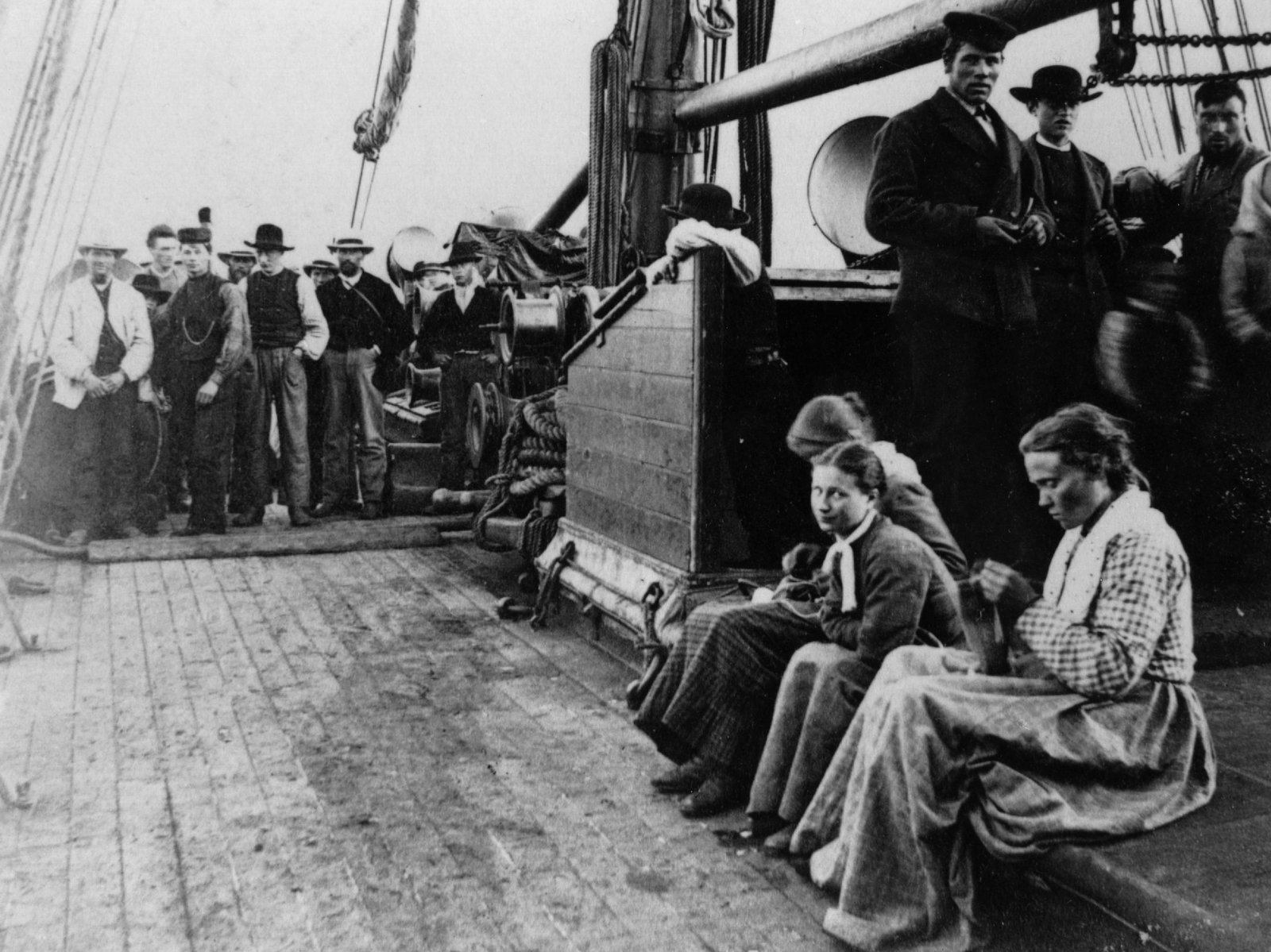 Norwegian immigrants
Oriana:
There is some similarity here to the effects of Black Death during the Middle Ages. Black Death, having severely reduced European population, was followed by an economic boom since there were more resources for the survivors.

**
“Over 25% of Nigerian-Americans have a graduate degree, as compared with only about 11% of whites.” ~ New York Times
Oriana:
Today a lot of immigrants are more educated than the locals — but the old prejudices die hard.

~ “ Birgit Schwarz: In my opinion, people have underestimated the notion that Hitler considered himself an artist, in fact, an artistic genius, and that much can be deduced from this self-image, this overheated artist's ego. However, this has hardly played a role in the research to date. That's the starting point, from my perspective, because it can help us gain a better understanding of Hitler as a person, as well as his system of power. Hitler's deluded view of himself as a genius is based on the confused system of thought emerging in the late 19th century, which centered on the idea that a genius — a strong personality who outshone everything else — could do anything and could do anything he pleased.
SPIEGEL: Hitler's relationship with art is well-documented. He earned money with his watercolors and wanted to become a painter. Later he became an insatiable collector, a passion which turned into the most brutal art theft of all time. All of this is well known. What, then, is supposedly incorrect about the current image of Hitler?
Schwarz: There is a widespread view that he was not truly fascinated by art, and that although he collected art and used it to cultivate his image, he then hid it away in basements and mines. Someone like Göring was constantly bragging about his collection, but many believe that Hitler wasn't actually that interested. But it was very deeply ingrained in his personality.
SPIEGEL: What makes you so certain?
Schwarz: The previously underestimated observations of his contemporaries, for one. For example, there was the Italian archeologist and art historian Ranuccio Bianchi Bandinelli, an accomplished expert who was not on Hitler's side. He became one of Italy's great intellectuals after the war. In 1938, Bianchi Bandinelli was asked to play the role of tour guide during one of Hitler's state visits, and Hitler spent hour after hour admiring paintings. According to Bianchi Bandinelli, it was evident in Hitler's body language that he was truly entranced by the art.
SPIEGEL: But Mussolini was simply annoyed by the time Hitler spent looking at art.
Schwarz: Yes, but sources like Bianchi Bandinelli's account show that there is something important missing from our picture of Hitler, something we still need to understand and that hasn't been taken into account until now. In fact, a very different image was built up over decades, namely of Hitler and his fight against so-called degenerate art.
SPIEGEL: But that too is an important part of his relationship with art.
Schwarz: Of course, and it was probably fueled by real hatred. At the same time, art was very important to him throughout his entire life.
SPIEGEL: Doesn't the perception of Hitler as an artist make him seem less evil?
Schwarz: No. In fact, his love of art led directly into the heart of evil. But neither is it the root of everything else. His fanatical pursuit of his own cause, and his self-image as a genius, contributed to his powers of persuasion and, therefore, his success. Art was part of his life until his last hours, even playing a role in his private will, in which he mentions his collections. This was someone who issued the so-called Nero Decree (Ed's note: Hitler's Nero Decree, issued in March 1945, ordered the destruction of any infrastructure which could be of use to the Allies.) while at the same time making sure art treasures were rescued. But no one is willing to admit to his obsession with art.
This obsession with art was interpreted as nothing but a cultivation of his image and propaganda. When you look at his biography, you understand that art was vitally important to him much earlier, and that he needed it for self-affirmation.
SPIEGEL: Prominent historians, particularly the brilliant Ian Kershaw, see the young Hitler primarily as a failed painter. He wanted to study painting, but he was rejected by the Vienna Academy of Fine Arts twice, in 1907 and 1908. Why don't you accept this interpretation?
Schwarz: Of course, being turned down was a fundamental shock to him. But the Hitler research community believes that he accepted his failure, and that he gave up the artistic world. But in reality he always retained his self-image as an artist and as someone obsessed with art. The rebuff from the academy was probably what prompted him to consider himself a genius.
SPIEGEL: In your opinion, he saw himself as someone who had been underestimated. But where is the difference between "failed" and "underestimated," which is so critical to understanding Hitler?
Schwarz: If he had seen himself as failed, he would have had to abandon his idea of being an artist. That's what Ian Kershaw, for example, claims. And (German historian and Hitler biographer) Joachim Fest didn't take Hitler's self-image as a genius seriously enough. Many believe that Goebbels didn't start consistently referring to Hitler as a genius until later on.
SPIEGEL: And that was indeed the case.
Schwarz: But for Hitler it was more than a propaganda strategy. He seriously believed he was a genius, long before Goebbels referred to him as such. And it makes sense that Goebbels constantly described him as a genius. A genius shouldn't refer to himself as a genius. He needs a community of admirers. His conviction that he was a genius, in my interpretation, was at the center of his entire worldview.
SPIEGEL: For a time, Hitler survived by painting watercolor scenes of Vienna. He was apparently fired by an architecture firm where you believe he worked, because his performance wasn't good enough. He then moved to Munich, where he hung around in cafés. That doesn't sound like someone with the creative urges of a genius.
Schwarz: On the contrary. Let me give you an example. A competition for an imposing building project of the late Kaiser period was announced in Berlin. The opera house was going to be rebuilt. We don't know if Hitler attempted to officially enter the competition — in fact, it's unlikely — but it appears that he did draw some of his own designs. He believed that he could hold his own with the most famous architects.
SPIEGEL: Why didn't he seek public attention?
Schwarz: A genius can shine in secret, hoping that he will make a big splash one day.
SPIEGEL: Could Hitler seriously have considered himself a genius? His talent as a draftsman was moderate at best.
 Hitler: White Orchid
Schwarz: He apparently felt differently, and it was important for his ego that he was self-taught. After the humiliation of being rejected by the academy, he developed an aversion to all professors, and to all academic study. He referred to himself once as a minor painter, but that was at a time when he believed he was a great architect. On the whole, he saw himself as a creative genius. You mustn't forget that the concept we have today of a genius is so much more harmless than it was back then.
SPIEGEL: In what sense?
Schwarz: We define a genius on the basis of his talent. At the time, talent was not the main focus. A genius had to have a strong personality. He was a larger-than-life talent who was permitted to do anything, including evil things. The genius has outstanding ideas, and they must be implemented, even if they are completely amoral. Hitler admired the work of dour philosophers like Arthur Schopenhauer and Friedrich Nietzsche. One important aspect is often overlooked, namely that the concept of genius had long been colored with racism. Houston Stewart Chamberlain, a Briton by birth who had married into the family of Richard Wagner, was a significant figure. He published his views in a book, which became a bestseller. Chamberlain, who promoted the great Aryan personality, was a key figure for Hitler.
SPIEGEL: Are you going so far as to draw a line between the concept of genius and the Holocaust?
Schwarz: Let me say it one more time: The genius was allowed to be above morality. The amorality of the Nazis represents taking this position to its unthinkable extreme. Goebbels wrote the brutal sentence: "Geniuses consume people." Part of Hitler's concept of a genius was the image of an enemy. In his case, it even needed to be a mortal enemy.
SPIEGEL: But his worldview was strongly influenced by World War I and his own drastic experiences at the front.
Schwarz: Naturally that was a turning point. However, he believed that the world war proved that it was possible to overcome all odds. But I don't see an absolute shift in his life. Even before World War I, he had the self-image of a genius, and he kept it up after that. That's continuity. In the early 1920s, he even declared that what was needed was "a dictator who is a genius." Of course, the population also yearned for a genius.
SPIEGEL: But shouldn't the word "genius" be replaced with "Führer" ("leader")?
Schwarz: No. The Führer concept arose from the genius concept in the first place. Once again, too great a distinction has been drawn between Hitler the artist and Hitler the politician until now. The research describes Hitler as a man who was a failure during his first 30 years before suddenly, as if in a new life, managing to captivate the masses as a politician. It's a divided biography, in other words. But the question is: Where did he get his self-confidence, and the certainty that he was an exceptional figure?
SPIEGEL: Hitler himself described a split in his biography, "Mein Kampf," in which he famously wrote: "But I decided to become a politician."
Schwarz: It wasn't a split, but a development. His career as a politician doesn't contradict his self-image as a genius by any means. And that was what he considered himself to be, first an artist, and then a politician and strategist. But without the self-image as an artist, he would never have been able to see himself as a genius. That's why he constantly had to reaffirm his love for art.
 Hitler: The Vienna Opera House
SPIEGEL: You describe which paintings Hitler hung, re-hung or removed in his private and official rooms, including works by the Swiss painter Arnold Böcklin and the German painter Carl Spitzweg. These two painters represent very different styles: overblown and aggressive versus detailed and contemplative, respectively. And then there were the neo-classical portraits of women by painters like Anselm Feuerbach. How does all this fit together?
Schwarz: It doesn't fit together at all. I have reconstructed his collection of paintings, including the ones in his private rooms. Hitler's taste cannot be pinned down. There is no aesthetic lowest common denominator. But what his favorite painters do have in common is that Hitler saw them as misunderstood geniuses.
 Hitler Schloss-und-Kirche-Perchtoldsdorf
 SPIEGEL: Does a genius need a muse? If so, was Hitler's muse Eva Braun — or perhaps his favorite architect, Albert Speer?
Schwarz: Perhaps an artist needs a muse, but a genius doesn't, because a genius's creative strength comes from within. And a genius, as Hitler explained to his secretary, could not have any children. However, he did have role models, including Frederick the Great, who became increasingly important to him. Hitler felt that he was an incarnation of this art-loving ruler, who was both a collector and a military strategist. He imitated everything about him, including his love for dogs and, later, his shuffling walk and stained uniform. It was even obvious to the terribly banal Eva Braun, who chided him for his excessive efforts to imitate Frederick. In the end, he insisted on having a portrait of the king nearby at all times, even in the bunker. Academics are familiar with this adoration and with how alarmingly deep it went, but it probably hasn't been adequately studied.
SPIEGEL: In the end, how much did he retain of his belief that he was a genius?
Schwarz: It was everything at the end. In fact, Hitler, in his delusions of being a genius, is best understood by studying the last months of his life. The period in the Führer's bunker is very illuminating. It was only a few steps from his quarters to the cellar of the New Reich Chancellery, where the model of his architectural plans for Linz was displayed. He had to reaffirm his status as a genius, and he could only do so through his close connection to art and architecture. These final attempts at creating a certain image for himself had a fatal effect. He made a strong impression on many of the people around him. Many believed that Hitler would succeed in the end, just as his role model and supposed fellow genius Frederick the Great managed to win certain battles, even emerging from wars as the victor despite having suffered military defeats.
SPIEGEL: So art never opened Hitler's eyes — he saw only what he wanted to see?
Schwarz: That was always his intention, right from the start.
http://www.spiegel.de/international/germany/the-fuehrer-s-obsession-with-art-hitler-considered-himself-an-artistic-genius-a-644210-2.html

Oriana:
I found this article to be quite eye-opening. By the way, when Hitler would describe someone as "completely inartistic," it was a big insult. While in America an artist is seen as something of a fool and, if male, effeminate or even likely to be gay, to Hitler an artistic genius was a Nietzschean Übermensch to the most exalted degree.
These days we regard someone as an artistic genius based on the quality of his or her work and the unique style that makes it like no one else’s. But the nineteenth and early twentieth century was strongly influenced by the idea of an “artistic personality” — akin to the Byronic hero. Being a passionate, stormy, obsessed, unconventional, often misunderstood person — which somehow automatically translated into “superior” — seemed to count most of all.
You may recall that Raskolnikov held the view that to a “great man” nothing is forbidden. He is above law and morality.
Mary:
Hitler’s self identification as a “genius,” an exceptional, great man, for whom all things are permissible, certainly has its roots in the romanticism of the 19th century, and immediately calls to mind Byron, the perception of Milton’s Satan as heroic, and the theories personified in Dostoyevsky’s Raskolnikov — that for the great, nothing is forbidden, all is possible, they live and act beyond the dictates of morality. Raskolnikov’s genius allows him murder, Hitler’s allows mass murder, genocide.
Leaders of this type, and I am thinking Putin, Hitler, Trump, operate by calling on humanity’s most primitive fears, the fear of the Other, the Not Us, the Enemy, and establishing a situation where those fears and hatreds can be openly expressed and acted on, eventually becoming part of the mechanism of the State—pogroms, massacres, Holocausts, genocides, lynchings, bombings, gulags—all become legitimate, either ignored as crimes or sanctioned under the operations of the State itself.
And these mythologies always turn on the idealization of some golden remembered past, a lost eden, a time of “greatness” and security, unthreatened by any challenges from the identified Other, who are so marginalized and powerless they fairly cease to exist. History and science retold and reshaped to suit, all but the chosen invented narrative refused, government and law reworked to become an apotheosis of lies.
What is further disturbing is that we seem to have devolved from the idea of “genius” to that of “celebrity’” — since Trump is unsatisfactory, let’s have Oprah! So we go down the endless slide from what may once have been the idea of the “philosopher king” — maybe the first colossal error in our thinking.
Oriana:
Plato came up with the notion of the “noble lie” (let’s skip here the scholarly dispute about the accuracy of the translation) that was supposed to justify class differences. “Alternative facts” may work for a while — for a whole generation, say. But ultimately nothing of lasting value can be built on lies. The corruption that began with even the best-intentioned single lie starts eating the system from the inside. The Nazi Reich was supposed to last for a thousand years, but in fact lasted only eleven years; the delusional basis of fascism (Jesus was presented as an Aryan, for example) doomed it from the start. Soviet-style communism collapsed as reality became more and more removed from the proclaimed ideal of the workers’ paradise; Rome fell for many reasons, but one of them, I think, was that the lie about the divinity if caesars wasn’t sustainable.
The common thread here is megalomania — call it genius, the great man, or, in Putin’s diminished version, simply a “strong man” — society needs not democracy, but a strong man as its leader. He may be vile, a killer, but — don’t touch the strong man on whom the country depends! Don’t even think of removing him from power!
And the devolution to “celebrity” is indeed pathetic — but perhaps also a sign that since we can't go lower than that, change has to happen. The change will also carry the seed of its own undoing, but that’s unavoidable. No Utopia is possible — or desirable. If humanity, after so many blood-stained millennia, learns at least this much, there is hope.
**
“Beware of the pursuit of the Superman: it leads to an indiscriminate contempt for the human.” ~ George Bernard Shaw, Don Juan in Hell, 1903 (toward the end of his life, in the nineteen twenties and thirties, GBS developed an unfortunate infatuation with Mussolini — like many intellectuals, he failed to grasp the true nature of fascism and Stalinism, mistaking both for progress)
**
~ “What makes the comparison between Hitler and Trump so poignant is not just the rhetorical marginalization [“OTHERING”] of groups, lifestyles or beliefs, but the fact that both men represented their personal character as the antidote to all social and political problems.
Neither Hitler nor Trump campaigned on specific policies, beyond a few slogans. Instead, both promised a new vision of leadership. They portrayed the existing political systems as fundamentally corrupt, incompetent, and, most importantly, unable to generate decisive action in the face of pressing problems.
In this scenario, democracy has less to do with representative institutions than with a leader who is intuitively 'in tune' with the sentiments of the people.” ~
http://www.newsweek.com/just-how-similar-donald-trump-adolf-hitler-501252?rx=us

So members of the Central Committee used to have their own buildings, their own dachas behind tall fences, their own sanatoriums. Their children went to separate schools, and they got their food and clothes at distribution centers that were behind unmarked doors in the city. A lot of those walls disappeared or developed windows, and the distribution centers closed and people started buying food in supermarkets. So other people were walking by those supermarkets and seeing the food in the windows that they couldn’t afford.
All of that together made the ’90s for a lot of people a time of deep psychological misery, resentment, envy—a feeling of having been both clobbered and cheated.
~ What is your sense of how those psychological wounds played a role in the rise of Putin and how he either exploited that or was a product of it?
I think it was actually both. That’s a very insightful way to ask the question because I think Putin shared a lot of that resentment. He shared a lot of the nostalgia for an imaginary past in which he felt a kind of certainty and had a clear vision for his own future, in his case as a KGB agent. So he was able to effortlessly tap into that longing among so many Russians to return to an imaginary time of certainty and security.
~ When most people think of totalitarianism, they think of 1984, North Korea, or something like that. Why is totalitarianism the word that you chose to use in your title?
What I think happened in Russia is that Putin has built a mafia state. There are different terms that have been applied to his regime. Some people have used kleptocracy. Some people have called it an illiberal democracy.
The thing is that that mafia regime exists not in a vacuum, but on the ruins of a totalitarian society. Putin felt that his power was endangered after the popular protests of 2011–12, and he began his crackdown. The signals that that crackdown sent out were interpreted by Russian society in totalitarian ways, right? The mechanisms that kicked back in were mechanisms inherited from totalitarian societies.
A totalitarian regime is profoundly political. Everything becomes political. Private life disappears as such because even private action becomes political, and people are basically urged to be out in the squares demonstrating their support for the mission of their country.
That’s the kind of regime that Russia has turned into. It’s a highly mobilized country. It’s a country in which everything has become political. It’s expansive, and that’s why it’s fighting wars in Ukraine and Syria. What they’re pursuing is the sense of constant movement, the sense of expansion that is essential to totalitarianism.
But once they establish the structure that’s necessary for a totalitarian regime, they tend to flail. Even if you read about Stalin—it was a mess, as much as he tried to project the image of somebody who was in control of every single thing in the country. And certainly by the time Soviet society had aged and entered what we call the stagnation period, it was a pretty convoluted and just shockingly incompetent kind of state apparatus that was fragmented, had a lot of different people pursuing their own interests, had no clear direction, and had highly problematic command centers.
~ One concept that you talk a lot about in the book is Homo Sovieticus. What’s behind that idea?
The explicit project of the Bolshevik revolution — as is the case with every totalitarian society — is to create a new kind of man. This was going to be the perfect man, a man who lived in perfect harmony with his society. But in the late 1980s, a great Soviet sociologist named Yuri Levada had this hypothesis than the Soviets had indeed created a new kind of man, not necessarily perfect, but very much shaped by the experience of Stalinist terror. His hypothesis was that since it had been 30 years since terror ended, Homo Sovieticus — that person characterized by doublethink and his very strong identification with the state — had to be dying off and that Soviet institutions had to crumble once Homo Sovieticus died out.
He conducted the survey in 1989. It was this great big survey, the first real study of Soviet people. They concluded that Homo Sovieticus was on its way out and it seemed that they correctly predicted the collapse of the Soviet Union, which came two years later. The problem was they went back to the survey in 1994 and came back with pretty disturbing results that suggested that Homo Sovieticus hadn’t quite gone away and maybe wasn’t as generationally bound as they thought. When they did the survey again in 1999, they came to the conclusion that Homo Sovieticus was not only surviving but also reproducing. They actually predicted as early as 1999 that there was a possibility of totalitarian revanche.
You can’t expect a society that has been subjected to terror for decades to suddenly shake that experience off and develop an entirely new set of skills and a new kind of baseline trust and live as a happy democracy, right? And I think that’s what’s happened to Russia.
Because we’re reading history books, we think that autocracy is developed linearly in the pursuit of an autocratic project. I don’t think that’s true. I think that humanity has stumbled into awful moments of history, and this may well be one of those moments. Trump has an instinct for manipulating people and for making them feel powerless, and that’s an instinct that drives a lot of his actions. He also has an instinct for self-aggrandizing, which happens to dovetail with that instinct [for manipulation]. He has the habit of advancing his brand by making a lot of loud gestures and contradictory things. He doesn’t need to be pursuing a grand strategy in order to be consolidating a kind of psychological power.
http://www.slate.com/articles/news_and_politics/interrogation/2017/10/masha_gessen_on_putin_s_russia_totalitarianism_and_her_new_book_the_future.html

from another source:
~ “Will Putin last forever? When and how can we expect things to change in Moscow?
Nothing lasts forever, so Putin won’t. But he has created a closed system that is virtually impervious to outside pressure. It will collapse from the inside, likely, though not necessarily, when Putin dies. After that, things will be in disarray. Putin plans to live forever, so there will be no succession plan. There will be a scramble (for some detail on what it might look like, I recommend Joshua Rubenstein’s terrific book Last Days of Stalin). I think that the borders of Russia will be redrawn—it’s a tense and complicated federation now, held together by pressure, fear, and habit. But I don’t hold out a lot of hope, because I think that damage that’s been done to that society is just unspeakable.
~ Could Putin’s rise have happened in any other country? Every other country?
Sure, and I think this is important: mediocre men become leaders of nations by accident. This happens—it’s not an exceptional event. And if these mediocre men have a talent for trafficking in fear and nostalgia, they get to hold on to power. Now, I think that the particulars of what has happened to Russia have a lot to do with what happened to Russia before Putin: I think he set out to build a mafia regime but ended tapping into a reservoir of totalitarian customs and institutions. In a different country, he would have done a different kind of damage.” ~
http://lithub.com/meet-national-book-award-finalist-masha-gessen/
Oriana:
I'm not sure if Masha Gessen has the same thing in mind when she speaks about the redrawing of Russia’s borders, but it seems to me that the tension between the Slavic population and the expanding Turkic and other ethnic populations may eventually become too great.
PUTIN’S AND TRUMP’S WAR ON MODERNITY IN THE NAME OF PAST “GREATNESS” AND “TRADITIONAL VALUES” VERSUS HUMAN RIGHTS
~ “Putin views Trump’s victory as the triumph of a particular world view: “a large number of Americans share our ideas of what the world should be like” and even of “right and wrong.” The phrase “traditional values” is crucial here: the instrumentalization of some vague idea of past greatness is something Putin and Trump share.
In the last few years, the Kremlin has framed the battle for global domination as a conflict between a “Western civilization” rooted in the idea of human rights and a “traditional values civilization.” Putin’s “traditional values” campaign has included a virulent antigay offensive, an insistent effort to raise the birth rate in order to save the 145-million Russian nation from extinction, and, most important, a systematic discrediting of any idea that is viewed as connected with contemporary Western culture. This is where Putin sees a kindred spirit in Trump, with his flailing against political correctness and his defense of Christmas against a fictitious threat. “Traditional values” becomes a catchall term for an imaginary past—which goes a long way toward explaining Trump’s seamless symbiosis with the American Christian Right.
Putin has declared victory in his war on modern culture, which gives him the right to call himself the most powerful man in the world. But, of course, that description has generally been part of the definition of a different job—the one to which Trump has in fact been elected.
But Putin is reveling in the idea that he is “the most powerful man in the world.” He is right: it doesn’t matter if Russian hacks were decisive in the election—what matters is that many people believe that they were. If Americans perceive Putin as the ultimate winner of the presidential race, then that is what he is.
Trump and Putin lack a concept of the future. In Putin’s version of the clash of civilizations, we have only a threatening Western present versus an imaginary Eurasian past. In Trump’s case, the threatening present is global while the alluring past is American. Both men traffic in appeals to the local and the familiar from the past against the frighteningly strange future. They are also both short-tempered, thin-skinned, not very bright, and disinclined to listen to advisers—all major risk factors for escalation. But it is their shared inability to look ahead that poses the greatest danger to the world.” ~
http://www.nybooks.com/daily/2016/12/28/most-powerful-men-in-the-world-trump-putin/

It's a good summary: Trump rejects modern Western civilization in favor of "traditional values," e.g. the sole role of women is to serve men and cater to their fantasies (hence they have to “dress like women”); Putin rejects democracy in favor of a "strong leader."
EXERCISE AFFECTS YOUR MICROBIOME
The results provide novel insights into how exercise can affect even those portions of our bodies that seem uninvolved in workouts, perhaps providing another nudge to stick with our exercise resolutions this year.
This microbiome includes countless different species of microbes in varying proportions that interact, compete and busily release various substances that are implicated in weight control, inflammation, immune responses and many other aspects of health.
In broad terms, our microbiomes tend to be relatively stable, most studies show. But our microbiomes can change as our lifestyles do. Diet clearly affects the makeup of a person’s microbiome, as do illness, certain drugs, how much we weigh and other factors.
Exercise also has been associated with variations in the microbiome. Past studies have shown that endurance athletes tend to have a somewhat different collection of microbes within their intestines than sedentary people do, especially if the athletes are lean and the sedentary people are not.
The [new] study was designed as a follow-up to an earlier, interesting animal study by the same scientists. In that work, the researchers had allowed some lab mice to run and others to sit around for most of their adult lives. Gut material from the mice was then transplanted into animals that had been bred to be germ-free, so that their guts would easily incorporate these new tribes of bacteria. After the animals’ microbiomes were established, the scientists exposed the mice to a substance that can cause tissue irritation and inflammation in the colon.
The scientists found that the animals with gut bugs from the runners were better able to resist and heal tissue damage and tamp down inflammation than those whose microbes had come from sedentary mice.
Now the scientists wished to see if exercise would likewise affect the functioning of microbes in people.
They began by recruiting 32 men and women who did not exercise. About half were obese and the rest of normal weight.
The scientists took blood and fecal samples and tested everyone’s aerobic fitness. Then they had the men and women begin supervised workouts, during which their efforts increased over time from about 30 minutes of easy walking or cycling to about an hour of vigorous jogging or pedaling three times per week.
After six weeks, the scientists collected more samples and retested everyone, and then asked the volunteers to stop exercising altogether.
Six weeks later, the tests were once again repeated.
The subsequent analysis showed that the volunteers’ gut bugs had changed throughout the experiment, with some increasing in numbers and others declining. The researchers also found changes in the operations of many microbes’ genes. Some of those genes were working harder now, while others had grown silent.
Most of these changes were not shared from one person to the next. Everyone’s gut responded uniquely to exercise.
But there were some similarities, the researchers found. In particular, they noted widespread increases in certain microbes that can help to produce substances called short-chain fatty acids. These fatty acids are believed to aid in reducing inflammation in the gut and the rest of the body. They also work to fight insulin resistance, a precursor to diabetes, and otherwise bolster our metabolisms.
Most of the volunteers had larger concentrations of these short-chain fatty acids in their intestines after exercise, along with the microbes that produce them.
These increases were greatest, though, among the volunteers who had begun the experiment lean compared to those who were obese, the scientists found.
And perhaps not surprisingly, almost all of the changes in people’s guts dissipated after six weeks of not exercising. By and large, their microbiomes reverted to what they had been at the study’s start.
Still, the study’s overall results suggest that even a few weeks of exercise can alter the makeup and function of people’s microbiomes.
In theory, Dr. Woods continues, these changes could contribute to some of the broader health benefits of exercise, such as its ability to reduce inflammation throughout the body.
He also hopes that future research can explain why the obese volunteers showed smaller gains in their fatty-acid producing microbes than the leaner men and women. Additional study could also help to determine whether and how people’s microbiomes might continue to change if they exercise for longer than six weeks.
https://www.nytimes.com/2018/01/03/well/move/exercise-microbiome-health-weight-gut-bacteria.html

ending on beauty
TREE
It is foolish
to let a young redwood
grow next to a house.
Even in this
one lifetime
you will have to choose.
That great calm being,
this clutter of soup pots and books —
Already the first branch-tips brush at the window.
Softly, calmly, immensity taps at your life.
~ Jane Hirshfield


