skip to main |
skip to sidebar
Antonio Allegri da Correggio: Le Tre Grazie, fresco, Camera di San Paolo, Parma
**
FOURTH OF JULY, ATLANTIC CITY BOARDWALK
It was the money night —
the fake Gypsy fortune-tellers
tugged on sweaty Gypsy scarves.
On every block someone was
performing: a raggae band
with dreadlocks bleached to rust,
a kazoo player, a one-man orchestra
pounding on a washboard
with a foot-strung drum.
Then the fireworks, twice:
the family show at nine,
and the midnight extravaganza.
Rockets from an off-shore boat
burst into cartwheels, rings and hearts —
even a wobbly peace sign.
The full moon rose from the ocean,
orange-pink like a salmon.
When fireworks fizzed their last gasp,
we turned toward the casinos:
Caesar’s Palace lined with its giant
statues saluting Caesar, and the gilded,
candy-striped Taj Mahal.
High over the sprawling edifice,
in floodlights shifting across the dark,
spiraled an eddy of seagulls.
More than a hundred seagulls, luminous,
soaring three hundred feet up!
At first I thought they too
were only part of the show —
perhaps trained doves,
or a laser fantasy of flight.
But the birds were too high,
and they didn’t
advertise anything.
A passer-by explained,
“They are attracted by the lights.”
We couldn’t stop watching them:
against that circus night,
the white birds,
incomprehensible as artists,
high above greed.
Over the garish casino,
seagulls spiraled in shifting beams,
their bodies weightless,
as if made of light.
~ Oriana © 2016
 photo: Hayley Hyatt
**
For an interesting contrarian view of the American Revolution as a mistake, click here (I'm not saying I agree, but it’s still a fascinating article — and yes, practically everything is both good and bad, so it’s not the least surprising that the American Revolution would have some dark consequences as well.)
photo: Hayley Hyatt
**
For an interesting contrarian view of the American Revolution as a mistake, click here (I'm not saying I agree, but it’s still a fascinating article — and yes, practically everything is both good and bad, so it’s not the least surprising that the American Revolution would have some dark consequences as well.)
http://www.vox.com/2015/7/2/8884885/american-revolution-mistake/in/5654656
*
COURAGE AND CORREGGIO
I had this dream more than a year ago, I think, and yet it’s with me still. I am in Italy, in a courtyard of what may be a monastery — and yet I'm not sight-seeing. I don’t know what place this is or what my purpose is — perhaps to study. A sweet-looking dog is wandering about the courtyard, and I “know” that the dog’s name is Correggio. In the dream I assume that the name means “courage.”
After waking, I consulted the dictionary: the Italian name for courage is CORRAGGIO. That’s fairly close, and fits the idea that at this time of transition in my life I need courage. But then at what stage of life we don’t need courage? So at first “courage” seemed a rather trite interpretation — though I liked the idea of a dog named Courage.
Pursuing the matter further, I learned that there is a town named Correggio. It’s in Northern Italy, near the better-known town of Reggio Emilia, in the Emilia-Romagna region. And in that town there is this courtyard of the Palace of the Princes:
Yes, it did look like the courtyard in my dream, but then such courtyards with columns and gentle arches are pretty generic. Still, I was amazed that the name of an Italian town, previously unknown to me, at least on the conscious level, came up in my dream. It reminded about another dream that continues to haunt me, a dream in which I was to move from Rome to Pistoia — from the capital to the provinces, in some ways the irony of losing Warsaw for the American suburbia.
But the main way the name of Correggio is known is for its famous painter, Antonio Allegri da Correggio (1489-1534), generally known as Correggio. He was a master of sensual beauty. It’s likely that before I had the dream, I’d come across this rapturous depiction of Jupiter and Io:

Recently I discovered another painting of Correggio that I like: The Mystical Marriage of St. Catherine of Alexandria. The saint is as fictitious as Jupiter and Io, but so what? It’s the beauty that matters. Beauty and tenderness.

Beauty and tenderness — we always need those, but especially when the daily news brings us ugliness and violence. And it strikes me that my dream confusion of courage and Correggio wasn’t all that confused after all. During violent times, the times of hate-filled rhetoric, it takes courage to stay loyal to the values of beauty and tenderness.
I have often pondered the meaning of courage. With war heroes in my family, and heroic women like my grandmother, mother, and one of my aunts — those “pillars of strength” who certainly paid a price but never needed to doubt what they stood for or their willingness to die for it — I felt like a small, nervous, bumbling little girl. Sure, people think it took courage to come to America by myself at seventeen. It didn’t take courage as much as colossal ignorance.
But look, I didn’t commit suicide. I used to think about it every day, but didn’t do it. And past a certain age, I knew it would be absurd, because now it was too late and you might as well live. It takes courage just to keep on living in a culture that brutally divides people into winners and losers. But then it takes courage to keep on living simply it in the face of mortality.
There is no denying that “life is an accident waiting to unhappen” and that we live on borrowed time — just so many decades before non-being. To know that and not to sink into bitterness — that is the courage of any typical human being. Even people who profess to believe in some kind of afterlife are not too sure about it, and in no rush to enter the “better place.” To be one of the chosen few sitting at the side of the Lord — an eternity of that sitting — an eternity of anything, for that matter — has a limited appeal at best.
So if even heaven is no solution, how do we cope? Again my answer is beauty and tenderness. Against the white-out of death, we summon the most splendid colors. Against nothing happening, we tell the wildest stories, never mind how made-up those are. And Correggio comes to me in a dream, and leads me to discover those colors and those stories. Instead of despair, delight. Thank you, Antonio Allegri da Correggio.
 a close-up of Io
*
SHARING A MOMENT WITH GALILEO
~ In 1610, Galileo shattered the prevalent cosmic view with his telescope. One of his most remarkable discoveries was that Jupiter had moons (he could see only the four largest), something that flew on the face of the then dominant Aristotelian worldview, where the Earth was the center of the cosmos and everything revolved around it. If Jupiter, a planet, could have moons, Earth wasn't that special.
Historians write about the strong emotions Galileo must have felt when he realized he was the first human to see something new about the universe. The result, after his work was combined with that of Johannes Kepler in Isaac Newton's universal law of gravitation, was a completely new way to look at the cosmos and, as a consequence, at ourselves. Only 400 years later, we are actually sending probes directly to that distant world, to get a closer look.
Some of the scientists in Juno's mission will be the first ones to see things about Jupiter no one has ever seen before. In the brief moments before they make their discoveries public, as the new torch bearers of our enduring search for knowledge, they will share a silent bond with the Italian pioneer. And yet it moves!
Given the planet's gaseous composition, scientists hope to be able to "see" features in the magnetic field that here remain buried under Earth's thick rocky crust. In particular, the goal is to understand the "dynamo" mechanism that generates Jupiter's magnetic field, that must share many properties with our own. But there are many unknowns, and the sheer violence of the local conditions can be deadly to the mission. Juno is the most heavily shielded spacecraft ever launched, so that it can — hopefully — sustain the bombardment of radiation and particles that it's sure to encounter. ~
http://www.npr.org/sections/13.7/2016/07/06/484904639/unveiling-the-mysteries-of-unfriendly-giant-jupiter

*
CHARISMATIC ORGANIZATIONS AND THE HUNGER FOR THE HEROIC IDEAL (OPPOSITE OF CONSUMERISM)
~
The Catholic church and the Communist party in formal terms are very much alike. In the Middle Ages, the Catholic church said outside the church there was no salvation. The Communist party said the exact same thing. ~
(Oriana: This reminded me of a self-made Chinese woman billionaire who was used to work in Western high finance, but decided to go back to China: “I missed the idealism.” I also love the way that Jowitt sees an essential similarity between St. Augustine and Stalin, and Aquinas and Khrushchev. The Catholic church is a perfect example of a totalitarian institution that used to be charismatic but then went into decline.)
~ "From one perspective that's neglected, Leninism and Nazism were each, in different ways, perverse attempts to sustain and restore a heroic ethos and life in opposition to a liberal bourgeois individualistic system, which I obviously prefer. But if you look at the Bolshevik cadre and you look at the Nazi SS, both of whom were perversely murderous in the course of their histories, what one sees is an attempt to co-opt features of the industrial, urban, educated, scientific, technologically advanced world, while rejecting the liberal notion of individual liberty, of rational methodical acquisition, of the bourgeois, the entrepreneur, of law as procedure, of merit defined in terms of achievement, in favor of a fundamentally irrational, charismatic, ecstatic sense of being able to overcome the necessities of life. And in that sense they were attempted substitutes.
Nazism did not demand much in the way of intellectual conversion and intellectual commitment. It was fairly easy to join. Leninism intrigued me because it was, in a sense, a sociological discipline. It formally tried to understand what was happening in history. It had an empirical orientation. It had an intellectual corpus to it in Marx. And what fascinated me was that these modern elements were systematically subordinated to, not related to, but subordinated to this charismatic, heroic notion, not in an individual. I'm aware of Stalin and Mao and Ho Chi Minh and all the rest of them, but the defining principle of Leninism is to do what is illogical, and that is to make the impersonal charismatic.
What Lenin did was remarkable. He did exactly what he claimed to do: he created a party of a new type. He made the party charismatic. People died for the party. It's as if people would die for the DMV. Most people don't get too excited about the Department of Motor Vehicles because it's a bureaucracy. What Lenin did was combine the attributes of personal heroism and the efficiency of impersonal organization, and created a charismatic organization. That's been done before. It's been done by Benedictines, it's been done by Jesuits, but it's never been done by a political party before. That intrigued me. When things that logically don't go together practically work, I'm intrigued.
Furthermore, what it did was compel the allegiance of people all the way from Peru to Kenya to Brooklyn. That's extraordinary, by definition. History, for the most part, is protestant. It is diverse. People are diverse, cultures are diverse. When you get an Islam or Roman Catholicism, or Leninism or a British liberalism, that, in effect, in some real way standardizes book cover diverse cultures over time, that's one of the remarkable moments in history, and I wanted to study this remarkable moment." ~
Ken Jowitt, author of New World Disorder: The Leninist Extinction, argues that Lenin created a charismatic political party that gave people a heroic ideal. He compared it to monastic orders: the Benedictines and the Jesuits. I think the Marines are another charismatic organization, looking for “superior” men capable of total dedication. No one joins the Marines to get rich. It’s about being a hero.
That’s also why fundamentalist religions that make extreme demands keep attracting followers while the toothless, non-demanding churches lose membership. Charismatic organizations actually negate the individual: the group is everything. Forget your inner life, your individualism. You get your identity from the group to which you give yourself totally: “Totus tuus.” Idealism pushed to an extreme (being willing to die and kill for the cause) results in evil, but I don’t think we can ever rid human nature of the longing to live for a great cause and be a hero.
Renunciation, asceticism, total dedication, the heroic ethos — nothing could be more opposite of consumerism.
Jowitt also makes a point that sooner or later a charismatic organization loses its charisma. This is reflected in attempts to reform the system (Vatican II comes to my mind), but the more you reform, the less you demand of the faithful, the lesser the opportunity to be a hero and the greater the loss of the organization’s charisma. It doesn’t matter if it’s a right-wing or left-wing organization: both kinds feed the emotional hunger for heroism.
Jowitt: “I think in every ideology you'll find an Augustine and an Aquinas. The Augustines are those who argue that they represent the superior and that the rest of the world is inferior; you have to attack the inferior, maintain the cohesiveness and the bounded quality of the superior. The city of God versus the city of man. Now, I'm not arguing Stalin was a Roman Catholic or an Augustinian, but in analogous terms they were the same.
As soon as you dissolve the tension between that superior group and the society, unless the group is willing to allow those people in society to be equal as individuals, there's only one thing that can happen to that group: it becomes corrupt. Aquinas, in effect, tried to revise the church to deal with the fact that the society had become more Christian. Khrushchev was Communism's Aquinas, but neither Aquinas nor Khrushchev allowed for the individual to become the major figure. Rather, the church stayed superior, even under Aquinas; the party stayed superior. What happened in the church? You got a Luther. What happened in the Communist Party? You got a Lech Walesa and an Adam Michnik. And what did they stand for? They stood for the appearance of the individual against the domination of that group.”
There is also a need for an enemy: “You have to have a combat quality, there has to an enemy to sustain your need to convert the world. If you've converted the world, charismatics go out of business.”
Jowitt says that Gorbachev really thought he could reform the system; he didn’t realize he was dismantling the Soviet Union. ~
http://globetrotter.berkeley.edu/people/Jowitt/jowitt-con3.html
 Luther throwing an inkpot at the devil
Oriana:
One can argue that the early communists exhibited a tragic version of heroism. They were fighting for the wrong cause, but they were heroic nevertheless. Aleksander Watt, a Polish poet and an ex-Communist ("My Century" is his fascinating tale of Soviet prisons, which cured him of both Communism and dadaist poetry) remarked that the most attractive individuals he’d ever known were pre-war Polish Communists, a fairly small and persecuted group. Their courage and devotion were total. When the party was embattled it was not corrupt. It took coming into power to corrupt it — just one more variation on the eternal theme.
This is a reprise of an article I found in 2013, and find all the more fascinating on re-reading. The similarities between the Roman Catholic Church and Islam were of course very interesting to me. Currently the most charismatic organization seems to be ISIS, alas.
The hunger for a cause can lead to what seems very strange to most, e.g. certain white people want to pass as black. When a group is seen as an underdog, it will attract its champions.
**
Still thinking about the church/party similarities and opposites: both required blind obedience. But the party (in its heroic, persecuted stage) made the members feel they were heroic and wonderful. The church chose to make the members feel worthless, rotten. Maybe the Jesuit priests — the elite — felt they were heroic and wonderful, but not the average devout Catholic. I understand the need to make people feel guilty and ashamed of themselves, but I wonder if making people feel wonderful about themselves might not work even better? I guess the doctrine of sin and salvation stands in the way. And it's hard growing up when you get the message of being worthless. Not just “unworthy," but completely bad, a reject, hellfire fodder.
It’s different in countries where there is no competition from other churches. The Catholic church knows that many Protestant churches offer a more pleasant prospect — you go to heaven without needing to suffer in Purgatory, your fare has been prepaid, and you don’t have to go through the unpleasantness of confession (by the way, it’s been pointed out that the communist parties developed sessions of “self-criticism” as a parallel with confession). In Protestant countries, the Catholic church has to try harder to be attractive, and to insist on its monopoly to being the sole true religion. But all of this is crumbling. The real world is beginning to win against the imaginary world.
*
LAST-DAYS HYSTERIA VERSUS THE LONGING FOR PEACE DURING THE MIDDLE AGES

~ [During this period there was] almost universal expectation of the imminent end of all things, of the Last Days and Final Judgment predicted by Jesus and accepted throughout the early church. About every thirty years from the tenth century onward, this fear took possession of various, sometimes large bodies of men and women and inspired them to form mass movements. Collective penance, pentecostal enthusiasm, irregular crusades, unauthorized pilgrimages, messianic mobbing—all these engaged Christians who feared it might soon be too late.
This was a recurrent electrical charge both in politics and in religion, and Fried does it justice although it sits ill with his insistence on the period as an Age of Reason. He seems reluctant to concede that hysteria kept pace and outstripped the achievement of the thought collective. By 1500 art, printing, theater, and song had enriched the West with a vivid backdrop on which the presence of Antichrist, the Last Judgment, the Devil, Hell’s Mouth, and torments were made clearer than ever before. Individual consciousness of sin was so intense that the attempted reformation of the church would turn into hell on earth.
Of course, the longing for peace and quiet deserves equal treatment. Limitations on war and restrictions on violence took on new forms in the Middle Ages, and the rejection of gross materialism inspired both the contemplative orders of monks and the bare-foot friars who went among secular men and women. This was the time of peacekeeping associations of all kinds, of hermits, and of the benevolent ladies called beguines; of places set apart for refuge and asylum, of hospices and leper houses; of quite long silences, which cannot play much part in the story of dynamism, innovation, and cupidity that Fried tells.
“De-hierarchization” began to predominate in many fields during the fourteenth and fifteenth centuries. Popes and emperors still claimed universal authority, but with decreasing success. Marsilius of Padua was arguing that sovereignty lay with bodies of virtuous citizens. Other clerics held that in spiritual matters the whole church in council trumped the authority of its now duplicated heads at Rome and Avignon. ~
Eric Christiansen, from http://www.nybooks.com/articles/2015/07/09/two-cheers-middle-ages/
 medieval couple, 15th century
Oriana:
I used to hold mostly the “hell on earth” view of the Middle Ages: filth, disease, cruelty, constant warfare and other violence, theocracy (including the burning of “witches” and heretics), illiteracy. Sure, over so many centuries there are bound to be positive developments as well, but what with outbreaks of religious-apocalyptic hysteria (and no wonder, life being so horrible it could easily make one think those were the Last Days), it’s amazing Europe survived . . .
AND YET. Yes, there were those positive developments, and we mustn’t forget that (some extreme instances aside) nothing is all bad or all good. Each historical era is so complex that its impossible to apply a single label. The twentieth century, with its unprecedented mass slaughter, also gave us unprecedented progress not only in technology, but also, paradoxically, in human rights.
And the paradoxes continue in the twenty-first century. When the new millennium was still ahead, predictions about the year 2000 tended to focus on on space exploration and the victory over cancer and other dreadful diseases. War and poverty would be no more, and nations would cooperate in turning this earth into paradise. Who could have ever predicted that the twenty-first century would start with . . . religious wars? That radical Islam would try in earnest to return to the Middle Ages? Let’s hope that these are the last vicious attacks of a cornered beast — but then all predictions of the future have usually proved ridiculous. Once more we are not sure if humanity can survive — though this time the horror of the Last Days would most likely be along the lines of a climate disaster. But another scenario has a madman with a finger on the nuclear button. Either way, this time it won’t have anything to do with the invisible man in the sky.
Perhaps every century is like that: it’s both hell on earth and paradise on earth, almost side by side. Hence the need for a more balanced view. I’ve noticed that some people (and this includes not just the religious right but those who’d call themselves liberal and progressive) hold a very dark view of human nature. Things can only get worse because humans are inherently evil. Others, a minority, point to the achievements of the collective human genius and dare to be optimistic.
I dream of a world where everyone would be try to be kind. I think if people had more access to giving and getting affection and doing creative work and useful service work, we could have such world. Remnant aggression could go into sports. And that would be as close to heaven as we can get. When life is fulfilling, we don’t need the lie of a paradise in the beyond, that “pie in the sky after you die.”
Even the Middle Ages somehow understood that you can’t just wait for heaven to begin after you die. You have to actively create sacred spaces here on earth. Hence the splendid cathedrals and the peaceful monastery courtyards, always neatly swept. The streets might be filthy and violent; but there were places of order and quiet.
It’s fashionable to say that it’s ALWAYS the worst of times and the best of times. But during the Middle Ages the worst was really horrific, the levels of daily cruelty astonishing. I already hear a chorus of voices reminding me of the Nazis. The Nazis shock because they were the exception, not the rule. The world was becoming more humanitarian. And now, after even more progress toward universal human rights, we have ISIS. Yet somehow we are still here. Somehow we have made it . . .

An Italian medicinal garden, recreated in New York
*
FAST-AGERS AND SLOW-AGERS — RESEARCHERS FOUND A VARIANCE OF UP TO 30 YEARS IN PARTICIPANTS' BIOLOGICAL AGE
A study of 38-year-olds in New Zealand found their "biological age" — the state of their organs, immune system, heart health and chromosomes — ranged from as young as 30 to as old as 60.
And the older their biological age, the older they looked, the researchers added.
The study team focused on 954 men and women who had been participating in an ongoing New Zealand study since their birth in 1972-1973.
In 2011, the participants, then 38, underwent tests of kidney function, liver function, lung capacity and metabolic and immune system strength. Cholesterol, blood pressure, dental status, eye structure and heart health were also assessed, as was the length of chromosomal caps known as telomeres. Telomeres are known to shorten with age.
The researchers found a variance of up to 30 years in the different participants' biological age, although all were still free of any age-related disease.
The team conducted a secondary analysis, comparing biomarker information collected in 2011 with information gathered six and 12 years earlier.
That showed that between ages 26 and 38 *most* participants aged at an equal biological pace. But some were gaining three biological years for every one chronological year. Still others had essentially stopped getting older, as their biological age was essentially on "pause."
What's more, the older [the fast-agers’] biological age, the worse they fared on physical and mental acuity tests.
The fast-agers showed worse balance and poorer motor coordination, and reported having more trouble with tasks such as climbing stairs or carrying groceries. They had a weaker grip.
"This showed that already early in life we can see symptoms of advanced age in young people, symptoms that correspond to declining physical and cognitive function, long before age-related disease actually develops," Belsky said.
Dr. Rosanne Leipzig, a professor of geriatric and palliative medicine at Icahn School of Medicine at Mount Sinai in New York City, described the investigation as a "landmark" effort to better understand the aging process.
"If we can identify why some people have more rapid biological aging, it may be possible to intervene and reduce the risks of complications and diseases related to aging," said Leipzig, who was not involved in the study.
Belsky said the findings might propel scientists in a new direction. "This can help us as we start to come around to the idea that instead of trying to prevent individual illnesses like heart disease or cancer," he said, "we need to try to find ways to treat the common cause of all these things: aging.”
http://health.usnews.com/health-news/articles/2015/07/06/some-people-do-age-faster-than-others
 Oriana:
Note that most people are “average agers.” But most information about aging may come from the fast-agers and slow-agers. It won't be easy to separate out genetic vs environmental influences, given that environment certainly affects gene expression. Still, we already know that longevity runs in the family — just as certain cancers can run in the family.
ending on beauty
My room and this vastness as one
wake over a darkening land.
I am a string, stretched tight
over wide resonances.
Things are violin-bodies
filled with murmuring darkness:
the weeping of women dreams in it,
the resentment of whole generations
stirs in its sleep.
~ Rilke, “At the Shore of the Night”
I immediately thought of Coleridge’s “Aeolian Harp”:
And what if all of animated nature
Be but organic Harps diversely framed,
That tremble into thought, as o’er them sweeps
Plastic and vast, one intellectual breeze,
At once the Soul of each, and God of all?
Both Rilke and Coleridge hold a similar idea, a kind of collective consciousness sweeping over all that lives. Coleridge has in mind a kind of universal spirit, while Rilke seems to imagine collective human experience, including the weeping of women and the resentment of whole generations — since we are far from achieving paradise on earth, though arguably closer than previous centuries (in spite of the news, statistics bear that out). To Rilke, a human being is never just an isolated person, but part of the vast human story, and part of nature as well.

“I just flew by the Coronado Library. The reference librarian was wearing bumblebee antennae in patriotic colors. This is what I like about America: it’s entertaining.” This owl is so accepting. Angelic even.
**
ANOTHER COUNTRY
I love these raw moist dawns with
a thousand birds you hear but can’t
quite see in the mist.
My old alien body is a foreigner
struggling to get into another country.
The loon call makes me shiver.
Back at the cabin I see a book
and am not quite sure what that is.
~ Jim Harrison
This may be the most lyrical poem about aging that I’ve ever read. Harrison imagines death as joining nature — but it could be argued that he’s already done that, in his great love for the countryside around him, and especially all the birds — birds turn up in poem after poem in his latest collection, “Dead Man’s Float.”
But this poem, full of nature’s and human fury, is also an unforgettable part of the collection:
WOLVES OF HEAVEN
It had been very hot for three weeks
so I worked well into a cool night
when at three a.m. a big thunderstorm hit.
I went out in the yard naked and sat
at the picnic table for a rain bath
careful about the rattlesnake on the sidewalk.
The sky drowned the mosquitoes
feeding on me. The lightning was relentless
and lit up the valley so I could see
the ghosts who had me ill this past year.
Then I was part of a battle from two
hundred years ago when the Cheyenne
from the east attacked the Absaroka,
the Crow, in this valley. A group of the Cheyenne
were masaum, the wolves of heaven,
warriors who painted themselves solid yellow.
One on a black horse stopped at our gate
but decided not to kill me.
I want to be a yellow wolf of heaven.
They disappeared into the lightning.
~ Jim Harrison
“Unforgettable” isn’t exactly accurate, at least in my case. After I first read the poem about two weeks ago, and was deeply affected by it, I remembered best the speaker sitting naked at the picnic table, the rain running down his body — I imagined this as a delightful bodily “downpour.” I remembered it was a big thunderstorm, and the drowned mosquitoes. I too love thunderstorms.
But upon rereading the poem (which I had trouble finding, having forgotten the dramatic title — dramatic, and yet also abstract, imaginary), I discovered that I had quite forgotten about the battle and the ghost warriors. Battles don’t interest me, though I learned about so many during my history classes. They are a male specialty, I think. I want the lightning and thunder naked. I want nakedness.
Whatever the reason for my first forgetting, now I’ll probably remember the battle for a while longer. The Native-American names struck me as beautiful — but then I always loved the sound of “Cheyenne.” Absaroka as “Crow” — I won’t remember Absaroka for very long, but at the moment it makes me appreciate the compact sound of Crow. And it wouldn't surprise me if a year from now I remember only that the speaker sat naked at a picnic table in a thunderstorm — that and nothing else. That part is so real and visceral. The battle is tacked on and imaginary — though skillfully handled.
(But how about possible splinters? At least put a plastic bag on the bench. And maybe he did, but in a poem you have to be selective about details. Besides, a plastic bag has no dignity, while a naked human body is always interesting.)
In terms of craft, this moment, describing a ghost warrior, stands out as a master touch:
One on a black horse stopped at our gate
but decided not to kill me.
That’s how you create reality through words — you create detail. Still, a man naked in a thunderstorm — that’s as real — or more so — as the thousand birds in the mist at dawn (their loud dawn cries are certainly real).

A WORLD WITHOUT WORK: TOWARD A POST-WORK FUTURE?
~ Even leaving aside questions of how to distribute that wealth, the widespread disappearance of work would usher in a social transformation unlike any we’ve seen. If John Russo is right, then saving work is more important than saving any particular job. Industriousness has served as America’s unofficial religion since its founding. The sanctity and preeminence of work lie at the heart of the country’s politics, economics, and social interactions. What might happen if work goes away?
The hope that machines might free us from toil has always been intertwined with the fear that they will rob us of our agency. In the midst of the Great Depression, the economist John Maynard Keynes forecast that technological progress might allow a 15-hour workweek, and abundant leisure, by 2030. But around the same time, President Herbert Hoover received a letter warning that industrial technology was a “Frankenstein monster” that threatened to upend manufacturing, “devouring our civilization.” (The letter came from the mayor of Palo Alto, of all places.) In 1962, President John F. Kennedy said, “If men have the talent to invent new machines that put men out of work, they have the talent to put those men back to work.” But two years later, a committee of scientists and social activists sent an open letter to President Lyndon B. Johnson arguing that “the cybernation revolution” would create “a separate nation of the poor, the unskilled, the jobless,” who would be unable either to find work or to afford life’s necessities.
The share of prime-age Americans (25 to 54 years old) who are working has been trending down since 2000. Among men, the decline began even earlier: the share of prime-age men who are neither working nor looking for work has doubled since the late 1970s, and has increased as much throughout the recovery as it did during the Great Recession itself. All in all, about one in six prime-age men today are either unemployed or out of the workforce altogether. This is what the economist Tyler Cowen calls “the key statistic” for understanding the spreading rot in the American workforce. Conventional wisdom has long held that under normal economic conditions, men in this age group—at the peak of their abilities and less likely than women to be primary caregivers for children—should almost all be working. Yet fewer and fewer are.
Economists cannot say for certain why men are turning away from work, but one explanation is that technological change has helped eliminate the jobs for which many are best suited. Since 2000, the number of manufacturing jobs has fallen by almost 5 million, or about 30 percent.
UNDEREMPLOYMENT OF THE YOUNG
Young people just coming onto the job market are also struggling—and by many measures have been for years. Six years into the recovery, the share of recent college grads who are “underemployed” (in jobs that historically haven’t required a degree) is still higher than it was in 2007—or, for that matter, 2000. And the supply of these “non-college jobs” is shifting away from high-paying occupations, such as electrician, toward low-wage service jobs, such as waiter. More people are pursuing higher education, but the real wages of recent college graduates have fallen by 7.7 percent since 2000. In the biggest picture, the job market appears to be requiring more and more preparation for a lower and lower starting wage. The distorting effect of the Great Recession should make us cautious about overinterpreting these trends, but most began before the recession, and they do not seem to speak encouragingly about the future of work.
To paraphrase the science-fiction novelist William Gibson, there are, perhaps, fragments of the post-work future distributed throughout the present. I see three overlapping possibilities as formal employment opportunities decline. Some people displaced from the formal workforce will devote their freedom to simple leisure; some will seek to build productive communities outside the workplace; and others will fight, passionately and in many cases fruitlessly, to reclaim their productivity by piecing together jobs in an informal economy. These are futures of consumption, communal creativity, and contingency. In any combination, it is almost certain that the country would have to embrace a radical new role for government.
 LOW CURRENT JOB SATISFACTION
Frase belongs to a small group of writers, academics, and economists— they have been called “post-workists”— who welcome, even root for, the end of labor. American society has “an irrational belief in work for work’s sake,” says Benjamin Hunnicutt, another post-workist and a historian at the University of Iowa, even though most jobs aren’t so uplifting. A 2014 Gallup report of worker satisfaction found that as many as 70 percent of Americans don’t feel engaged by their current job. Hunnicutt told me that if a cashier’s work were a video game—grab an item, find the bar code, scan it, slide the item onward, and repeat—critics of video games might call it mindless. But when it’s a job, politicians praise its intrinsic dignity. “Purpose, meaning, identity, fulfillment, creativity, autonomy — all these things that positive psychology has shown us to be necessary for well-being are absent in the average job,” he said.
The post-workists are certainly right about some important things. Paid labor does not always map to social good. Raising children and caring for the sick is essential work, and these jobs are compensated poorly or not at all. In a post-work society people might spend more time caring for their families and neighbors; pride could come from our relationships rather than from our careers.
COLLEGES AS CULTURAL CENTERS; A MORE NOURISHING LEISURE
The post-work proponents acknowledge that, even in the best post-work scenarios, pride and jealousy will persevere, because reputation will always be scarce, even in an economy of abundance. But with the right government provisions, they believe, the end of wage labor will allow for a golden age of well-being. Hunnicutt said he thinks colleges could reemerge as cultural centers rather than job-prep institutions. The word school, he pointed out, comes from skholē, the Greek word for “leisure.” “We used to teach people to be free,” he said. “Now we teach them to work.”
The transition from labor force to leisure force would likely be particularly hard on Americans, the worker bees of the rich world: Between 1950 and 2012, annual hours worked per worker fell significantly throughout Europe—by about 40 percent in Germany and the Netherlands—but by only 10 percent in the United States. Richer, college-educated Americans are working more than they did 30 years ago, particularly when you count time working and answering e-mail at home.
Less passive and more nourishing forms of mass leisure could develop. Arguably, they already are developing. The Internet, social media, and gaming offer entertainments that are as easy to slip into as is watching TV, but all are more purposeful and often less isolating. Video games, despite the derision aimed at them, are vehicles for achievement of a sort. Jeremy Bailenson, a communications professor at Stanford, says that as virtual-reality technology improves, people’s “cyber-existence” will become as rich and social as their “real” life. Games in which users climb “into another person’s skin to embody his or her experiences firsthand” don’t just let people live out vicarious fantasies, he has argued, but also “help you live as somebody else to teach you empathy and pro-social skills.”
 No corporate ladder to climb?
COMMUNAL CREATIVITY: THE ARTISANS’ REVENGE
Artisans made up the original American middle class. Before industrialization swept through the U.S. economy, many people who didn’t work on farms were silversmiths, blacksmiths, or woodworkers. These artisans were ground up by the machinery of mass production in the 20th century. But Lawrence Katz, a labor economist at Harvard, sees the next wave of automation returning us to an age of craftsmanship and artistry. In particular, he looks forward to the ramifications of 3‑D printing, whereby machines construct complex objects from digital designs.
It’s possible that information technology and robots eliminate traditional jobs and make possible a new artisanal economy … an economy geared around self-expression, where people would do artistic things with their time.” In other words, it would be a future not of consumption but of creativity, as technology returns the tools of the assembly line to individuals, democratizing the means of mass production.
 Isabelle Adjani and her familiar spirit
Bandar thinks that a digitally preoccupied society will come to appreciate the pure and distinct pleasure of making things you can touch. “I’ve always wanted to usher in a new era of technology where robots do our bidding,” Bandar said. “If you have better batteries, better robotics, more dexterous manipulation, then it’s not a far stretch to say robots do most of the work. So what do we do? Play? Draw? Actually talk to each other again?”
Isabelle Adjani and her familiar spirit
Bandar thinks that a digitally preoccupied society will come to appreciate the pure and distinct pleasure of making things you can touch. “I’ve always wanted to usher in a new era of technology where robots do our bidding,” Bandar said. “If you have better batteries, better robotics, more dexterous manipulation, then it’s not a far stretch to say robots do most of the work. So what do we do? Play? Draw? Actually talk to each other again?”
The demise of the formal economy could free many would-be artists, writers, and craftspeople to dedicate their time to creative interests—to live as cultural producers. Such activities offer virtues that many organizational psychologists consider central to satisfaction at work: independence, the chance to develop mastery, and a sense of purpose.
As late as the mid-19th century, though, the modern concept of “unemployment” didn’t exist in the United States. Most people lived on farms, and while paid work came and went, home industry—canning, sewing, carpentry—was a constant. Even in the worst economic panics, people typically found productive things to do. The despondency and helplessness of unemployment were discovered, to the bafflement and dismay of cultural critics, only after factory work became dominant and cities swelled.
The 21st century, if it presents fewer full-time jobs in the sectors that can be automated, could in this respect come to resemble the mid-19th century: an economy marked by episodic work across a range of activities, the loss of any one of which would not make somebody suddenly idle. Many bristle that contingent gigs offer a devil’s bargain—a bit of additional autonomy in exchange for a larger loss of security. But some might thrive in a market where versatility and hustle are rewarded—where there are, as in Youngstown, few jobs to have, yet many things to do.”
http://www.theatlantic.com/magazine/archive/2015/07/world-without-work/395294/
 Malevich: Knifegrinder, 1913
Oriana:
Malevich: Knifegrinder, 1913
Oriana:
One out of six prime-age men in the US is not working? And yet overwork is a real problem too — people putting in crazy hours, or working two jobs just to make ends meet. Change will have to come, perhaps with productive, satisfying things to do becoming more important than paid work.
“The demise of the formal economy could free many would-be artists, writers, and craftspeople to dedicate their time to creative interests—to live as cultural producers. Such activities offer virtues that many organizational psychologists consider central to satisfaction at work: independence, the chance to develop mastery, and a sense of purpose.”
I am all for artisanal communities. Abandoned manufacturing plants are perfect for a community of artists and craftsmen. And they'd figure out where to put the communal kitchen, what kind of garden to plant, how to furnish the child-care center or a small school. People are smart when given the autonomy, and when things are kept relatively small, not overwhelming. To some extent it's started -- e.g. the empty factories downtown L.A. -- but it could be developed even more. People want meaningful, fulfilling work. That usually means skilled work for the benefit of the immediate community -- e.g. people who love to cook could prepare wonderful meals for others, cabinet makers would provide furniture, artists would decorate the space, stained-glass artists would create the windows, musicians would give concerts, and so on.
 Malevich: Woodcutter, 1912-1913
*
JUNE 28, 1914: A TRAGEDY OF ERRORS
~
The assassination in Sarajevo, on June 28, 1914, triggered World War I and changed the course of the 20th century. The consequences of that act were devastating. But the beginning of the story sounds almost like a farce — complete with bad aim, botched poisoning and a wrong turn on the road.
"It would be a comic tragedy of errors," Lyon says, "and it would have made for a good Peter Sellers film.”
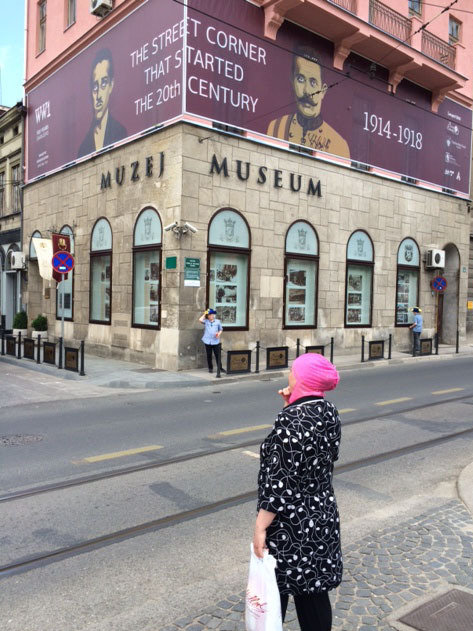
 The Latin Bridge in Sarajevo ends at the street corner where Serbian nationalist Gavrilo Princip assassinated Archduke Franz Ferdinand and his wife, Sophie
The events of the archduke's assassination make for an unlikely story at every turn. It starts with the almost total lack of security — at the time, Sarajevo had a police force of 200.
"Approximately half or slightly less than half of the police force had turned out that day to provide security for the visit of the crown prince of the entire empire," Lyon says. "And the army was not turned out at all."
"The official reason was that the army had been out on maneuvers for the previous two days," he explains. "Their uniforms were muddy and dirty, and they were not presentable.”

Also, the people in charge of the archduke's visit decided that it was a good idea to publish the motorcade route in advance. So the path was crowded with people. Bunting, flags and brightly colored carpets hung out the windows — and the would-be assassins knew exactly where to stand.
There were seven of them along the parade route, carrying bombs and guns. Most chickened out altogether.
Nedeljko Cabrinovic was one exception. He threw a bomb and missed, wounding an official in the motorcade behind the archduke.
Franz Ferdinand ordered the driver to stop. He got out and walked back to inspect the damage and the wounded people.
Today, if something like that happened, the vehicles would race away from the scene as fast as they could, Lyon says. But not in 1914: "This was European nobility at the turn of the century."
Meanwhile Cabrinovic, who threw the bomb, swallowed some poison and jumped into the river below.
At that time the river would have been about 6 inches deep, 15 feet below the level of the road. Cabrinovic sprained his ankles and was unable to move.
The poison didn't work, either — it just made him sick.
The furious archduke arrived at City Hall, where the mayor of Sarajevo delivered some totally inappropriate remarks that were written before the assassination attempt.
The archduke snapped, "What kind of welcome is this? I'm being met by bombs!" Then he wiped the blood off his prepared speech and addressed the crowd.
Afterward, the heir to the Austro-Hungarian throne got back into his motorcade with his wife, Sophie. They had decided to visit the hospital to see the people who were wounded in the bomb attack.
But no one told the driver.
At that fateful intersection, the car was supposed to go straight — but it turned right. A general in the motorcade shouted, "You're going the wrong way!"
And the driver stopped the car ... right in front of assassin number seven.
Gavrilo Princip, who had missed his chance the first time, was standing on the sidewalk 4 feet away from the car — at the only place on the route where the car stopped.
Princip stepped forward and fired two shots. One of them hit Sophie, and the other hit the archduke. Both shots were fatal.
As they lay dying in the car, Franz Ferdinand pleaded with his wife, "Stay alive, Sophie, for the sake of the children.”
In the photos at the museum on the corner, the would-be killers hardly look dashing. They're dirty, sickly, skinny.
"Two of the seven people lying in wait were students," Lyon says. "The other five were professional revolutionaries, people who were unemployed or people who were agitating for national causes.”
They all seem to have had slightly different motivations — Serbian nationalists, anti-monarchists. But Lyon says they never intended to start a global war.
By the time the assassins' trial began, World War I had already broken out.
"Every one of them said at the trial, and later said during their imprisonment, that had they known that such a horrendous war would ensue, they would never have taken part in the activities of June 28," Lyon says.
Some of the conspirators were executed. Others died in prison. All but one are now buried just outside Sarajevo's old city, next to a highway overpass.
http://www.npr.org/2014/06/27/325516359/a-century-ago-in-sarajevo-a-plot-a-farce-and-a-fateful-shot
Oriana:
Yes, talk about the ironies. Another irony: the Archduke had been warned of the conspiracy to kill him in Sarajevo. He chose to ignore the warning. It was like the crew of the Titanic ignoring the iceberg warnings.
And the horrific war, the “suicide of Europe,” ground on in spite of the generals on both sides predicting a quick victory — the soldiers would be home for Christmas. The generals’ experience had been in colonial wars, against poorly armed natives.
Without the assassination, would the war had broken out at some later date anyway? We’ll never know. As Milosz said, just because something did happen, people assume that it had to happen — but that’s not true.
We see similar tribal hatreds in our era. Similar, but not the same — perhaps because the two world wars have changed the psyche of Europe and America forever.

*
THE AGNOSTIC WIFE AND THE SIN AGAINST THE HOLY GHOST
A few years ago the New York Times published an essay by an agnostic woman whose husband was a practicing Christian (I forget the denomination — something mild, possibly Episcopalian). One Sunday he came home from church and said, “You were right. There is no evidence. It’s all a bunch of nonsense. I'm done with it.” The wife blanched. Rather than embrace her husband with joy, now that they were fellow travelers helping each other carry the questions, she responded with an anxious, “Are you . . . sure?”
She felt anxious for a long time. She knew why. Her husband’s faith had been for her as a kind of Pascal’s wager. The probability of god’s existence was small, but just in case . . . She herself felt incapable of belief, but there was always her spouse, praying for her, pleading that she not be consigned to the flames of hell. There was no hell, the agnostic wife thought, but . . . just in case . . . this man praying for her might turn out to be enough to save her from it. Now what?
This reminded me of a man who explained that going to church was his “fire insurance” — just in case.
I confess that ten years or so after leaving the church I too pondered the question of “fire insurance” and whether it might be enough to “repent” at some unspecified later time (Don’t count on repenting in the last moment, priests warned; you could die suddenly, or grow feeble-minded; then what?) But the longer I lived, the more certain I grew that I could repent neither my non-belief nor the most beautiful moments in my life. Flames were already licking at the edges of my despair. “So be it,” I thought, knowing I could never regret thinking or loving.
Those moments were infrequent, but they did happen. And I’d been taught that to doubt one’s salvation, to think that you were damned forever and nothing could save you, was to sin against the Holy Ghost. And the sin against the Holy Ghost would not be forgiven.
Oddly enough, to be sure that you were going to heaven was not a sin. Such certainty seemed a lot more presumptuous to me than the humble resignation to eternal punishment — hadn’t we been told again and again that we were miserable sinners? In the case of an average Catholic, you’d first spend centuries in the fires of Purgatory, but in the end you’d be as pure as the saints and worthy of whatever lay behind the pearly gates.
It was far easier for Protestants, I later found out: it was enough to be convinced that one was saved through faith. The proof of the heaven to come was belonging to the right congregation. The Protestants held that Christianity was not about doing anything for god; it was about what god has done for you. (I used to think that the central message of Christianity was compassion, but apparently not.)
Where I lived, there were no Protestant churches I could sneak into (that of course would have been a sin), no other doctrines to explore. It was Catholicism or damnation. Luckily, when I turned fourteen, I experienced a paradigm shift — a fundamental, transformative shift in perception. I remember the exact moment, or rather the exact thought about the Judeo-Christian tradition: “It’s just another mythology.”
In that moment I saw what so many had seen before me: that all gods were a human invention, a product the collective human psyche. They evolved in parallel with the general cultural evolution: first gods in the shape of animals, then human but with animal heads, then totally human; first many, then fewer, and in some cultures, one: a male god with a beard, sitting on a golden throne somewhere in the clouds, all alone; the aged father without a mother at his side. True, the son was supposed to be seated at his right hand, with the Holy Ghost hovering above the two, but I don’t remember a single painting showing two thrones; the painter generally settled on either the father or the son. (Eventually I did find one painting showing the two seated on a kind of wide throne or love seat — but that’s a recent find.)
And the cognitive dissonance that tormented me before, the disconnect between the modern world and the old-style S&M Catholicism, the all-non-Catholics-go-to-hell Catholicism, was over. My thinking brain was at peace; I was happy to be free of ghosts and demons. No supernaturalist argument has ever held the slightest appeal to me since.

Titian: Assumption of the Virgin, 1518. Mary -- in the body, since the ancient Hebrews didn't believe in disembodied souls -- is being carried to god the father on a cloud. I especially like the little angels who seem to be pushing the cloud upward.
But my emotional brain seemed to have its own beliefs, strongly imprinted in childhood, and the certainty of going to hell for non-belief was one of them. And that certainty was itself a sin against the Holy Ghost, the only sin which would not be forgiven. This was a kind of background torment which would now and then come to my consciousness. My way of dealing with it was to assert, in silent debate with myself, that if god indeed was the kind of tormentor who tossed the majority of humanity (i.e. all the non-Catholics) into the fires, then, even if he existed, he didn’t deserve to be worshiped. That would be worse than worshiping Hitler. Thus, in the worst-case scenario, I was indeed without “fire insurance” and would suffer for eternity — but that had more dignity than eternally singing hymns of praise to a sadistic deity.
But what about the teaching that the central message of Christianity is compassion? That was the son, but I doubted he had as much power as the old one, the god of punishment. The father commands, the son obeys, and the Holy Ghost inspires.
It took more than two decades, but eventually the emotional brain seems to have let go. One day the second set of shackles fell off as I thought, with great and pure joy, “The monster doesn’t exist. He really doesn’t exist.” And then, with profound relief, “No punishment. No punishment.”
Strange, how long that soft voice of reason had to keep working on the neural networks governing emotion to become free of toxic beliefs. I realized also that all that time I was wrestling not with some higher and more noble concept of god, some non-anthropomorphic cosmic intelligence, but with Iron-Age Yahweh and later the medieval theology of Yahweh’s alleged son. Meanwhile my friends assumed all the while that the universe is indeed friendly, and that the afterlife, if any, has nothing to do with either “correct” belief or with reward and punishment, but is some kind of wonderful cosmic journey.

And this is the close-up of Titian's god the father. It's presumably windy up there, so the beard and hair billow in a pleasant way. Note that god's nose is large, thick, and not straight; unlike Jesus in so many paintings, Titian's Yahweh does not have idealized features.
**
“I doubt every religion,” one woman said. “But the universe, never.”
For my part, I’ve learned to trust my own brain function; given enough time, the unconscious will provide an answer that generally is the opposite of despair. At last I know that I am no sinning, not blaspheming — not against the Holy Ghost, but against the powers of the human brain, most of them having to do with unconscious cognitive processing. The sense of inspiration is indeed my favorite brain function.
 How is this for Madonna and Child? There is something so touching about animals, almost heart-rending.
*
“WHEN A MAN SELLS HIS DAUGHTER AS A SLAVE,
she shall not be go out [be freed in the seventh year] as the male slaves do” ~ Exodus 21:7
I have come across this in the morning, thought, it was terrible to be a woman, then immersed myself in other things. But for some reason the verse keeps haunting me. Of course we know that thousands of years ago it was terrible to be a woman, but we may forget just how terrible.
And there are parts of the world where this still goes on . . . and worse.
What pure luck, to have been born in the West this late in history.
*
BRAIN INJURY AMONG PRISONERS
In the weekly sessions, attended by a half-dozen men with many stories of being pummeled in the head with fists and baseball bats, the inmates discuss prompts like: Does having a traumatic brain injury change who we are? What triggers symptoms? And what aids or services can help?
Over a two-year period, [a researcher’s] graduate students assessed 80 inmates in the Van Cise-Simonet Detention Center in Denver, which houses arrestees as they await sentencing. The findings from the pilot study were staggering: Ninety-six percent of inmates screened had suffered moderate or severe brain trauma. It was a sharp contrast to the estimated 6 percent of the general population with similar brain injuries, but it did match up with previous, similar studies from the past two decades. A 2008 study of 990 Minnesota inmates found a rate of 80 percent; a 2006 analysis of 200 Australian prisoners found 82 percent; and a 2007 survey of 107 male and 118 female inmates from six federal prisons found 87 percent.
Convincing the general public to care about the mental health of society’s cast-offs is no easy task. But in the past decade, the interplay of brain disorders and criminal behavior has started to become a topic of popular discussion, partly because some athletes and soldiers—society’s heroes—have turned criminal, suicidal, emotionally volatile or violent, and a common denominator may be traumatic brain injury.
In December 2012, Jovan Belcher, a linebacker for the Kansas City Chiefs, killed his girlfriend in a murder-suicide. An autopsy of his brain found that he suffered from chronic traumatic encephalopathy, or CTE, the progressive degenerative brain disease caused by repeated brain trauma and concussions. In a 2015 study, researchers at Boston University found the disease—which is associated with anger, aggression, depression, impaired judgment and poor impulse control—in 131 of 165 former NFL, college and semipro football players, some of whom shot themselves.
Head injuries early in life can lead to aggressive behavior later on. An eight-year study that followed ninth-graders in Flint, Michigan, into adulthood found that young people who had endured head injuries were more likely to engage in violent acts later—fighting, hurting someone badly enough that they required medical attention or threatening someone with a knife, gun or club—than those who had not. Adults with a history of traumatic brain injuries also tend to enter prison at a younger age, according to an analysis in Brain Injury. A 2009 study of head trauma patients in Maryland found that within three months after a head injury, 28 percent of patients became aggressive.
http://www.newsweek.com/2016/07/08/prison-inmate-traumatic-brain-injury-research-475615.html?utm_medium=email&utm_source=Istanbul-Airport-Attack-What-We-Know-So-Far&utm_campaign=newsweek_email_newsletter

Oriana:
I did some work in prisons, teaching creating writing. Aside from my own experience of poverty, teaching in prison was tremendously instructive of how circumstances -- child abuse in particular -- end up shaping lives. I'm so glad the study of brain injury in athletes and war veterans has opened a way to take seriously brain injury among the inmates. Of course there is also chemical brain injury, e.g. fetal alcohol syndrome.
ending on beauty:
The mind is a city like London,
Smoky and populous: it is a capital
Like Rome, ruined and eternal,
Marked by the monuments which no one
Now remembers. For the mind, like Rome, contains
Catacombs, aqueducts, amphitheaters, palaces,
Churches and equestrian statues, fallen, broken or soiled.
The mind possesses and is possessed by all the ruins
Of every haunted, hunted generation’s celebration.
~ Delmore Schwartz, “Narcissus”
 Rome, Bernini: Triton
 Zayed Mosque, Abu Dhabi
*
WHILE READING THE NEWS ABOUT ORLANDO, I HEAR THE CALL TO PRAYER
Not metaphor, but outside
the window, the muezzin
calling from town, his voice faint
as a phantom arrived in the room.
How many times have I felt
shame at those words—Allahu
akbar—felt it twist
like a knife inside me?
Once, lonely, I listened
for hours to recordings
of the adhan through
Macbook speakers,
wept and knew myself
in the presence of God.
My God, during this all holy
month, when I am so far
everything back home
seems like a dream, its violence
only a wakeable sleep—
where are you to refuse those
who call out to you, who undo
what you’ve made in your name?
I am not asleep and they are
not waking. Again there is blood
on the floor in your name
and there is no god
but you, so answer.
~ Leila Chatti —Poets Respond
June 19, 2016
_______
Leila Chatti: “I am currently in my second home, Tunisia, where I return each summer to visit my family. It is Ramadan and I was preparing for the evening meal (iftar), during which one breaks their fast, when I first read the news about Orlando. And as I was reading, the adhan—the call to prayer–came drifting in from town. I was so startled by the juxtaposition I had to sit for a long time. I thought of the line by Naomi Shihab Nye: ‘What does a true Arab do now?’ And what does a true Muslim do, too? I wrote this poem.” (website)
Oriana:
Again there is blood
on the floor in your name
and there is no god
but you, so answer.
Here is an example of how the personal and the political can be flawlessly married. Rare, but possible. And it feels absolutely authentic. I suspect the personal element has to be dominant for that to happen — it's the intimate tone. It allows the reader to understand the speaker’s suffering.
How many times have I felt
shame at those words—Allahu
akbar—felt it twist
like a knife inside me?
Of course it’s humans who create a god in whose name they then proceed to oppress and kill. But it may take another century before that reality is acknowledged. Here the speaker may be on the verge of facing the truth. At the very least, she feels deeply wounded that the people of her religious tribe are causing mayhem again and again.
I am not asleep and they are
not waking.
~ beautifully said.
She is not denying that religion can have positive aspects. The call to prayer is beautiful and can even lead to a mystical experience. That’s why she feels all the more betrayed by the misuse of religion by those who want the power to impose their will and oppress others. The poet’s voice is a crying in the wilderness, a desperate plea to an absent god to answer, explain, perhaps even do something to stop future atrocities. But only humans can find answers — if they try hard and are lucky.
 When something horrible happens, the best answer is not an answer at all. It’s presence. The only true comfort is another human being who will be there with you in it. ~ R.J. Twain
TRUMP RESEMBLES THE BIBLICAL YAHWEH, THE POLAR OPPOSITE OF JESUS
~ “One way that biblical literalism screws with people’s heads is this: Children are taught from a young age that God is perfect—the essence of Love and Truth. But when you look a little closer at the stories in the Bible, it turns out that he’s an awful lot like Trump.
“He is powerful, and He wants us all to know it…
“I am the Lord, and there is no other; besides me there is no god. I arm you, though you do not know me, so that they may know—from the rising of the sun and from the west—that there is no one besides me; I am the Lord, and there is no other. I form light and create darkness, I make weal and create woe; I the Lord do all these things . . . To me every knee shall bow, every tongue shall swear. . . ” (Isaiah 45:5-7 KJV).
Me, me, me, I, I, I, I, I.
He’s an insatiable attention seeker. From Genesis through Revelation, the Bible lays out precisely how people should grovel and sing God’s praises and otherwise kiss up. God wants his adoring followers to beg for things that he already knows they need. He loves the smell of burnt offerings and dictates just what should be burnt and when. He demands proof of loyalty, like cutting off the cover of your penis, or whacking relatives who don’t think he’s awesome, or being willing to turn your child into a human sacrifice…
He’s racist and able-ist. God may claim credit for making us all, but that doesn’t prevent him from picking favorites or finding some people repugnant simply by accident of birth. The Old Testament narratives are about favored blood lines, whites—I mean Hebrews—who get the right to claim land already occupied by other ethnic groups. According to God’s rules, even slaves must be treated better if they are Hebrew slaves.
But being Hebrew won’t help if you’re handicapped. Jehovah, like Trump thinks that arthrogryposis is just gross. Stay away! “No one of your offspring throughout their generations who has a blemish may approach to offer the food of his God. For no one who has a blemish shall draw near, one who is blind or lame, or one who has a mutilated face or a limb too long, or one who has a broken foot or a broken hand, or a hunchback, or a dwarf, or a man with a blemish in his eyes or an itching disease or scabs or crushed testicles.” (Leviticus 21:17-21)
He demeans women. If a guy with crushed balls might contaminate Jehovah’s inner sanctum, a menstruating woman would be far worse. Whatever you do, don’t let Megyn Kelly sit on the furniture! And by the way, a woman who gives birth to a girl baby is nasty for twice as long as one who gives birth to a boy. But don’t get too insulted. Women can be saved through childbearing.”
There’s much more, please read the whole thing. And he fulfills the psychological need for a big daddy/protector as well. Just as the people of the Bible cried out to [Yahweh] to protect them and destroy their enemies, so today’s conservatives cry out to Trump for the same thing." ~
http://www.patheos.com/blogs/dispatches/2016/06/23/tarico-trump-is-a-lot-like-the-biblical-god/?ref_widget=trending&ref_blog=godlessindixie&ref_post=faq-advice-about-coming-out-to-my-spouse
O
riana:
We shrug and say that’s just the archaic tribal mentality — boosting “us” — the chosen people, the greatest country in the world, the exceptional nation among inferior humanity — against the “other.” We say that god is dead — meaning specifically the vengeful, wrathful, nationalist, sexist, narcissistic, petty, jealous, infantile, and altogether distasteful Yahweh. But when this mentality suddenly crops up in the 21st century, there is reason to wake up — and lament.

THE DOUBLE LIVES OF HASIDIC ATHEISTS
The tome in [Solomon’s {the names have been changed}] hands was Alan Dershowitz’s The Genesis of Justice (2000), which used Talmudic and Hasidic interpretations of the Bible to argue that stories in the book of Genesis, from Adam and Eve eating the apple to Noah and his ark, constituted God’s learning curve — a means of establishing a moral code and the rules of justice that prevail today.
What struck him about the book was its depth, and a complexity of thought that he had been raised to believe was the exclusive domain of the rabbis whose authority commanded his community of ultra-Orthodox Jews. The book’s brilliance, coupled with its unabashed heresy, created the first of many cracks in Solomon’s faith. Seeing the scriptures interpreted in methods so compelling and yet entirely inconsistent with the dogmas of his youth caused Solomon to question everything he believed to be true.
. . . Yanky’s study partner took Yanky to a presentation by the British scientist and New Atheist Richard Dawkins, author of The God Delusion (2006). ‘It wasn’t so much that Dawkins was so convincing, or interesting even,’ Yanky told me between short sips of beer. ‘It was just, I was sitting there with this whole group of people who were having this one viewpoint.’ He experienced for the first time what religion looked like from the outside, a series of often ridiculous and always questionable ideas shattering its absolute hold on his psyche.
And as Dawkins spoke, Yanky realized that there was one answer that took care of all of his questions — God did not write the Torah because He does not exist.
Yanky was devastated by his realization that there is no God. ‘It was very upsetting,’ he said, talking quickly. ‘I remember laying in bed and feeling like the world had come to an end. It wasn’t a relief. It was very painful.’
He was so upset that his first move after this realization was to search out the smartest and most learned rabbis, hoping that they would have answers for him and be able to convince him that he was wrong — that there is a God, that the Torah is true. He wrote anonymous letters to a few respected rabbis, and posted them snail-mail (though this was 2000, he had little to no contact with the internet, as the most pious Jews don’t). The letters contained his questions, mostly culled from the contradictions between the first chapters of the Old Testament and evolutionary theory.
The explanations he got from rabbinic scholars were weak and obscure. One rabbi sent him a bizarre note, including a story about sitting in a boat, ‘an elaborate allegory intending to describe how we only coast along over the deep waters of the Torah,’ Yanky recalled. ‘It was cool, but it didn’t help me. Thanks Rabbi.’ With nowhere left to turn, he was finally forced to admit what he was: an atheist leading a double life, forced to stay under wraps lest his boss fire him, his wife divorce him, and his children get thrown out of school.
Wherever there is an insular Jewish enclave, there are individuals who have come to the conclusion that God does not exist, and yet they maintain their religious cover for social, familial and economic reasons. Many are well-established in their communities, even leaders. Many are financially successful, family men and women, moral people. ‘I am your neighbor with kids in your children’s class,’ wrote one undercover atheist anonymously on a blog. ‘I am one of the weekly sponsors of the Kiddush club… I was your counselor in camp… I do not believe in God.’
Moishe’s journey from believer to atheist happened in a matter of weeks, after a few passages from Maimonides convinced him that the greatest Jewish scholar was, like himself, an undercover atheist.
‘I’m desperate to tell my kids the truth,’ Moishe confessed. And yet, he doesn’t dare. Moishe is not alone. Many I spoke to stay inside the confines of their Orthodox lives for fear of harming their children, opting instead to let them continue to believe what they themselves now consider to be fairy tales.
‘To me, lying to my children was the worst part,’ said another undercover atheist – I’ll call him Yisroel. Yisroel has a very good job – he makes in the high six figures – and is very attached to his wife and children, the opposite of the stereotype that prevails in religious communities surrounding those who lose the faith, namely that they are ‘liars who want to do drugs, cheat on their wives and eat cheeseburgers’, as he put it. Yisroel’s greatest wish is that his children will learn to think critically and figure things out for themselves. But he has no plans to accelerate that process. ‘I take it one day at a time; I don’t have any long-term goal about that,’ he told me when we met in a Manhattan deli on a rainy afternoon.
A few lucky men convinced their wives of their new-found convictions, giving them a partner in crime. One man I spoke to — Yechiel — who lives in Jerusalem told me it was not as painful for his wife when he convinced her. ‘Women are in a much more minor role in the community,’ he said. ‘Women are expected to express religious devotion by raising the kids, by much more physical things – getting a job, supporting their husband’s learning. Much less a direct spiritual experience, so for her to give it up wasn’t giving up much.’
But it was for him. He remembered the direct aftermath of his loss of faith. ‘I was praying to Hashem [God]: Give me back my belief, prove to me that it’s true, begging and begging. At some point, I realized it’s just plain stupid.’ Still, he said: ‘If you would see me in the street, my white shirt and black yarmulke, you wouldn’t know anything at all.’ His wife is now pushing for more changes to their lifestyle, but fear of hurting his parents keeps Yechiel in line.
As long as ultra-Orthodox communities continue to marry people off at such young ages, doubters will remain stuck, Solomon contends. ‘Religion has survived a lot of major challenges,’ he said, and the recent turn towards fundamentalism within ultra-Orthodox Jewish communities is just that – a coping mechanism to weed out the non-conformists. ‘The radicalization of ultra-Orthodox Judaism is a sign of its success, not its failure.’
But Moishe believes that the phenomenon of atheism is deeply entrenched in the Orthodox way of life. ‘Everybody’s faking,’ he insisted. ‘I think it’s all going to come crashing down. I say 20 years.’
https://aeon.co/essays/secretly-seduced-by-science-hasidic-atheists-lead-a-double-life

Oriana:
As humans acquire knowledge and culture evolves, they change their concept of god — sometimes going through of stage of claiming, like Dershowitz, that god too learns through his mistakes — or that it’s our consciousness that’s actually building divine consciousness (Rilke: “We are building god”). From there it’s only a short step to perceiving that we might as well jettison the concept of an external god altogether — it’s humans who are evolving to be more just and compassionate.
But it’s sobering to consider just how recent the idea of human rights is, or the still radical notion of not seeking revenge, or that punishment should not be torture — perhaps we shouldn’t even have punishment, just rehabilitation?
The ability to openly discuss such topics is also very recent. The freedom of thought and speech exists side by side with the remnants of archaic religions. The harm they cause is especially blatant in the case of radical Islam.
But — there are underground atheists in Islam and in other “extreme religions.” The conflict between orthodox teachings and the modern world is only growing. It is not too far-fetched to ponder that perhaps “Moishe” is right: ‘Everybody’s faking,’ he insisted. ‘I think it’s all going to come crashing down. I say 20 years.’
Scholars are divided: some say that at least in the affluent countries religion will disappear by 2050 (or sooner), while others lament that fundamentalist Islam and the other fundamentalist movements (e.g. the African kind of Catholicism, with its emphasis on Satan and exorcism) will take over.
If atheism wins, it will be what Nigel Barber calls “the triumph of earthly pleasures over pie-in-the-sky.” For me, the foremost earthly pleasure is beauty. In Warsaw I had lilacs in May and chestnut-tree blossoms in June — and that was enough to make me perceive the earth as the real paradise. Later came the Pacific Ocean, the Eastern Sierra and the Rockies — the splendor of the American wilderness.
An imperfect paradise, but a real one. As for “holy scriptures,” there is great literature. Now if only we figured out how to significantly fight aging so as to gain more time for the richness of life. The project is doable — now if only we didn’t have to waste resources struggling against what remains of archaic tribal mentality.
http://www.huffingtonpost.com/nigel-barber/atheism-to-defeat-religion-by-2038_b_1565108.html

**

LAST CHANCE FOR UNBRIDLED HEDONISM
I see it more and more clarity: this is my last chance for unbridled hedonism. Recently I was reminded of that again: there was an opportunity to see the sea lions in La Jolla. It meant the ache of walking a longer distance than I usually do (though finally there is hope of improvement), but both the sea lions and the beauty of the ocean — all the layers of aquamarine and indigo — were totally worth it. What a privilege to live near such beauty!
What initially touched off the insight was far from poetic. I was looking for the all-fat diet in the first book that Atkins wrote on the ketogenic regimen for weight loss. I did not find it, by found this question: “Are you eating luxuriously enough?” A rhetorical question — Atkins knew that the reader, terrorized by decades of anti-fat propaganda, thought that weight-loss would come from subsisting on non-fat cottage cheese.
Of course unbridled hedonism is pretty individual. I am not into orgies. I'm not into “luxury cruises.” Maybe my horizons will expand if I turn out to be a candidate for knee replacement. But for now, unbridled hedonism is whipped cream and purple dahlias.
And something interesting to read, of course. Intellectual and esthetic debauchery combined.
It’s also taking the time to lie down. THE SACREDNESS OF LYING DOWN.
Time to read slowly, for pleasure.
Slow swimming.
Slow everything. Savoring, knowing there will be an end to it. Only so many mornings, only so many amber afternoons.
I am just beginning to explore my kind of unbridled hedonism. I expect other items will be added to the list as I remember them. My memory of pleasure has become dull over the years of struggle — the kind of effort that Buddhism and Taoism warn against almost as their most important principle: don’t struggle! And all the well-meaning friends who were telling me not to give up. More than anything else, I needed to give up.
Twenty years ago, I know exactly what I’d have predicted: that I’d now be saying, “This is my last chance for significant achievement.” Now I know that “significant” is pointless — I am not in control of that. What I write, what I’ve written — ephemera that must give me and my readers pleasure in the now. We are of the moment and we live for the moment. Rather than lament our "momentariness," let us give ourselves fully to the moment.

Digital art, Catrin Welz-Stein
No famous person from the past, no matter how great, would make sense now. Lincoln wouldn’t. Queen Victoria wouldn’t. Julius Caesar or Lenin, none of them would make sense. To be resurrected would be the most terrible punishment — so much for people who pay incredible sums to have themselves frozen, in the crazy hope that a future humanity would be interested in re-animating them.
We are of the moment and live in the moment. And besides, can I complain about over 190,000 page-views of my blog, and an international audience? One of life’s ironic but ultimately pleasant surprises: it’s my prose that has gained me readers. But not the posts that I regard as my best. How little we control.
I love the phrase: “We have to redefine victory.” I’ve redefined achievement so that the inner slave-driver is now pretty irrelevant.
“God is not dead. He is alive and working on a much less ambitious project.” ~ graffito
Yes, even god can finally come to his senses. Nietzsche lost his before he could grow older and wiser. This is what the world lost: a sane Nietzsche at sixty — working on much less ambitious projects. Imagine: Nietzsche — happy.
And this by Nietzsche reminds me of my youth: “What do you love in others? — My hopes” (The Joyful Wisdom, III, 272). Yes, my own hopes and ambitions was what I used to project on men — who, with one final exception, weren’t even a fraction as ambitious as I used to be.
Speaking of others, what about service? Yes (this is offered as the abridged version of Molly Bloom’s “yes” soliloquy). Unbridled hedonism would be insufferable without feeling a part of a network. I hope my doing the Poetry Salon and my blog are my current way of serving, providing the mental nourishment of beauty and poetry and whatever wisdom I can muster. Above all, beauty. I try to nourish others with beauty.
Ultimately, life is meaningful only through touching the lives of others. That’s why I never saw god as providing any kind of meaning. Only doing something for other humans has ever given me a sense of meaning and fulfillment. Even just chatting with a neighbor provides meaningful pleasure the way prayer never could. My hope is that I can continue to be of use.
If god existed, what kind of meaning could he find it his own existence, with no equals to talk to, and his inability to answer prayers, since that would violate the laws of nature? He’d die of boredom and uselessness.
What a journey it’s been: from great expectations to a very modest goal of being of some small use and enjoying life. Enjoying life! — how intensely I used to despise that idea.

SATURATED FAT IMPROVES THE LIPID PROFILE; CARBS AND POLYUNSATURATED FATS WORSEN IT
~ so are you still denying yourself the goodness of sour cream, butter, full-fat milk and yogurt (not the kind with added sugar)?
First we had the marvelous news that full-fat milk and other dairy products lower blood pressure and reduce the risk of heart disease, stroke, and cancer. How can this be? It turns out that saturated fats don’t increase the small, dense LDL cholesterol, easily oxidized and thus dangerous. They increase the big. “fluffy” cholesterol particles, considered benign and possibly even protective.
“In addition to raising LDL cholesterol, saturated fat also increases high-density lipoprotein, or HDL, the so-called good cholesterol. And the LDL that it raises is a subtype of big, fluffy particles that are generally benign. Doctors refer to a preponderance of these particles as LDL pattern A.
The smaller, more artery-clogging particles are increased not by saturated fat, but by sugary foods and an excess of carbohydrates, Dr. Chowdhury said. “It’s the high carbohydrate or sugary diet that should be the focus of dietary guidelines,” he said. “If anything is driving your low-density lipoproteins in a more adverse way, it’s carbohydrates.”
When the researchers looked at fatty acids in the bloodstream, for example, they found that margaric acid, a saturated fat in milk and dairy products, was associated with lower cardiovascular risk. Two types of omega-3 fatty acids, the polyunsaturated fats found in fish, were also protective. But a number of the omega-6 polyunsaturated fatty acids, commonly found in vegetable oils and processed foods, may pose risks, the findings suggested.
“My take on this would be that it’s not saturated fat that we should worry about” in our diets, said Dr. Rajiv Chowdhury, the lead author of the new study and a cardiovascular epidemiologist in the department of public health and primary care at Cambridge University.
In the new research, Dr. Chowdhury and his colleagues sought to evaluate the best evidence to date, drawing on nearly 80 studies involving more than a half million people. They looked not only at what people reportedly ate, but at more objective measures such as the composition of fatty acids in their bloodstreams and in their fat tissue. The scientists also reviewed evidence from 27 randomized controlled trials – the gold standard in scientific research – that assessed whether taking polyunsaturated fat supplements like fish oil promoted heart health.
The researchers did find a link between trans fats, the now widely maligned partially hydrogenated oils that had long been added to processed foods, and heart disease. But they found no evidence of dangers from saturated fat, or benefits from other kinds of fats.
http://well.blogs.nytimes.com/2014/03/17/study-questions-fat-and-heart-disease-link/?_php=true&_type=blogs&_r=1

ending on beauty
now that, more nearest than your fate
and mine (or any truth beyond perceive)
quivers this miracle of summer night
her trillion secrets touchably alive
~ ee cummings, #37

Julian Alden Weir: Nocturne, Queensboro Bridge

 photo: Hayley Hyatt


 a close-up of Io
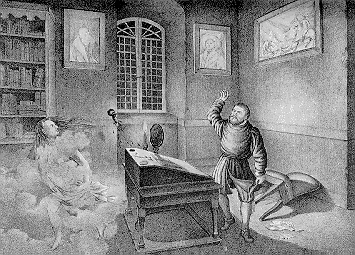 Luther throwing an inkpot at the devil
 medieval couple, 15th century