skip to main |
skip to sidebar

WHY I DIDN’T COMMIT SUICIDE
Let us then begin
to walk toward infinity.
~ Chuang-Tzu, The True Book of the Southern Flower
I slipped into my body’s warmth
as into a snug glove,
closed my eyes,
tucked in the blanket’s soft dark.
Suddenly a blackness
blacker than the night,
blackness like black lightning,
the edge of a scream:
my death.
I sat up, mouth open –
blackness
poured out of my throat.
Then far away I saw
a light brighter than any star.
Stepping on nothing
I began to walk
toward it until I fell sleep.
It was not a white fire
on the other shore,
pointing to something else.
There was nothing else.
I didn’t believe in God.
But a question had been asked.
My answer was blackness,
and that light
seemed another answer.
A friend once asked
why I didn’t commit suicide.
There was no need to.
In death I’d seen my life:
a pathless way across darkness
and the calm, inexhaustible light.
~ Oriana © 2013
The event described here took place when I was 25. I didn’t write the poem until I some ten years later. And even then I didn’t have the complete clarity I have now: this vision was produced by my brain in order to soothe me. It was effective at that moment. Later I thought a lot about it -- unforgettable! But I never equated it with external reality.
Years later I read Jung on salvation being a journey toward the star within. I wouldn’t use the word “salvation,” but I did experience something of this journey. Knowing which way to go meant everything.
If someone wants to call my “cosmic vision” a hallucination, I have no problem with that. Extreme emotions can cause hallucinations, often very interesting ones. The human brain has its amazing ways.
*
Yesterday I entered a cloud bank enveloping the Coronado Bridge. The fog was thick enough to require headlights. And the city of Coronado was in fog too. With events of my life making me think of limbo, I thought, “I’ve entered the cloud of unknowing.”
Twenty minutes later, Coronado basked in the beautiful November sunlight, warm, almost coppery. You can’t be completely unhappy in light like that.
*
Mystical explanations are considered deep. The truth is that they are not even superficial. ~ Nietzsche
It still takes Nietzsche to say something as politically incorrect as this, and as exhilarating. Do we need “mystical” explanations of the universe? I think we can enjoy the mysterious without multiplying useless metaphysics.
I am thrilled that it's finally OK to reject mysticism and not provoke a storm by saying there is no soul nor the "beyond." When someone dies, he remains in the memory of others -- and that to me is an awe-inspiring neurobiological mystery. The underworld of our dreams is stranger and more fascinating than any idea of the afterlife.

*
I remember a TV interview with Ayn Rand, a public atheist. I’m not a fan of most of Rand’s ideas, but I admit I was impressed with her intelligence and her courage not to hide in agnosticism. “Now that you’ve become a widow,” the host began, “now that you’ve lost your husband, do you understand why people believe in god?” I admit I don’t remember Rand’s exact reply, and realize that I’m using her striking statement because that’s the one that engraved itself in my memory: “I define god as that which is the highest, and you don’t lose that.”
“That which is the highest” will of course differ from person to person. I’m also reminded of Ezra Pound’s
That which thou lovest best
remains,
that which thou lovest best
shall not be reft from thee.

*
~ After becoming disabled in an accident I did wish there was a consciousness -- or whatever you want to call a god -- to bargain with. That was a stressful, life altering event, but it did not change my beliefs that stem from logical reasoning and education.
I am an atheist in a fox hole.
~ I'm sorry to hear of your accident and subsequent disability. I was diagnosed with stage III/IV cancer two weeks ago (I'm 47 years old, the cancer will be better staged tomorrow when I have major surgery) -- and as an atheist I also didn't have even the teensiest tiniest little bit of epiphany or conversion or repentance or whatever it is that these people think I was supposed to have. I'm not in a foxhole although I am facing my own mortality in a very real way. I definitely have fears (mostly about how my death would affect my wife's life), but I'm still rational. To your good health (and mine too) -- cheers.
~ I live marginally above the poverty level on disability income due to an organ transplant. I have a number of health problems resulting from the illness that caused me to need a transplant including brittle bones which have resulted in my spine slowly collapsing upon itself leading to chronic pain. I have to take very expensive medications and that leads to anxiety over losing medical benefits through budget cuts, bureaucratic whim, or other things. I have problems with hernias from the transplant operation that need to be surgically corrected every few years. My partner does not have health insurance and is a cancer survivor. That leads to a lot of anxiety because we can't afford to pay out of pocket for the yearly screenings he needs to be sure his cancer is not returning.
So, I'd say my life isn't very "comfortable." I have a lot of stress both physical and mental to deal with and yet, I do not run to a god praying. I rely on my own wits, the help of family and friends when necessary. I'll leave the begging and pleading to imaginary friends up to charlatans like [name omitted]
~ I don't know about anyone else but when I'm under severe amounts of stress, religion and God are the last things that I think about. Then people use the phrase with you that “God never gives a person more than they can handle.” To which I always replied “God's pushing their luck then.” To appease them. The whole time thinking that God's not the one giving me all this stress. My boss is giving me these piles and emails. Bills are taking all my money. Time is breaking down my home so it needs repairs. It’s not God. It’s people, weather, and time. Medicine and science makes me better, not God. Praying for God to help me doesn't do anything. Asking my family and friends to help me does. I believe in karma not God. I believe in being a good person & helping others less fortunate. That will make me stronger, not praying for strength. I have a hard time understanding, sympathizing, or empathizing with my family of religious driven people.
~ readers’ comments following an article rebutting the idea that under severe stress non-believers rush to religion (the old “No atheists in foxholes” argument)
http://www.psychologytoday.com/blog/our-humanity-naturally/201104/rebutting-more-outlandish-statements-about-atheists
an abandoned church (St. Boniface in Chicago)
*
Is suffering a test of atheism? Yes, this is a deliberate play on the old phrase that suffering is a test of faith (cf the story of Job). Studies indicate that the more suffering (poverty, illness, job insecurity), the more religiosity, and the more contentment in one’s life, the less interest in the supernatural. Atheism has been called the ultimate white privilege and a luxury stemming from a comfortable, secure life. The idea of “no atheists in foxholes” has been questioned; not so the finding that, aside from the rich districts of Johannesburg, there are virtually no atheists in sub-Saharan Africa.
Study after study has found religiosity correlated with hardship. Among the comfortable no one seems to miss the missing god. Who needs god when you are happy? You’re too busy being happy to think about metaphysics. If you have a strong need to express gratitude, you can always thank the universe and the people you love.
Happiness makes god as unnecessary as Stephen Hawking says he is. No new lovers wish to put Jesus at the center of their relationship (Jesus, let’s not forget, advised people to leave their spouses and children and follow him, since the end of the world was about to begin). But the argument as old as that of Satan in the Book of Job insists: just something take away your happiness and security, and we’ll see what happens to your faith (or atheism).
In the case of Job, however, Satan’s logic was the opposite of modern thinking: the Adversary (introduced as one of the sons of god) pointed out to Yahweh as the latter boasted of his faithful servant Job, that Job had every reason to be pious: he’d been blessed in every way. But take away his blessings, and he’ll CURSE god to his face. Not beg for mercy, but CURSE.
But Job’s response turned out to be quite complex. He continued to protest his innocence, which, his friends warned him, was to accuse god of injustice. Eventually he cursed the day he was born -- a milder form of cursing god, who presumably willed it that Job be born. And then, receiving no rational answer about the true cause of his suffering but only a narcissistic rant boasting particularly of the leviathan the behemoth as supreme marvels of creation, Job realized that he’s dealing with a dangerous lunatic who needs to be appeased with praise.
In a milder, modern version of Job, popularized by Rabbi Kushner, when bad things happen to good people, those good people who have enough remnant belief can turn to a new concept of god for comfort. Not for physical help -- this god will not break the laws of nature -- but for emotional solace of knowing that god cares and suffers with you (the idea of a happy, serene god is Eastern, not Western -- not counting the old pagan gods enjoying themselves to the hilt).
Making god suffer with me is the last thing I’d want. So I turn to music instead. In fact, my brain does it automatically, playing its own selections. Recently I was hit with major stress. I was startled to hear the International in my head, in Polish. I always loved the tune. Then I heard the Ode to Joy. And the Marseillaise. A Chopin impromptu. And on and on, until only Happy Birthday to You was left, which I quickly dismissed in favor of more Ode to Joy, all the time marveling at my brain’s attempts to soothe me. I don’t feel alone: I have myself.

*
My own experience of suffering has had a convoluted history. It’s not even been entirely about suffering versus contentment, but about ideas versus ideas.
I suffered most during my twenties. I cried a lot (daily) and thought about suicide a lot (daily). Still, I never prayed. It simply didn’t occur to me. I don’t remember ever thinking of god during those years. There is some possibility that maybe I did, but later forgot. If so, I probably asked, “Why have you abandoned me?” (But I don’t remember asking that; I had real abandonments to come to terms with.)
The theist temptation emerged later, when I was in my thirties and my suffering lessened from acute to chronic. Thinking about religion was a luxury stemming from easier life. In my late twenties, I was too busy suffering to think about religion. Only later, when I was less desperate, I had enough leisure and material security to indulge in a “spiritual quest.”
Equally important, or possibly most important, the New Age movement was exploding. We were deluged with books on astrology, Tarot, synchronicity, intuitive healing, visualization as a tool for accomplishing “anything you want in life,” chanting for prosperity, and the “course in miracles.” You want a miracle? Scores of authors presented their recipes for “manifesting” a miracle.
How seductive those ideas were! Relax: life should be effortless and magical. “How to Live a Magical Life” was an actual book title, typical of the mentality of those years. It's enough to think about something and you'll “attract it” into your life. Suddenly I heard and read the opposite of what I had in childhood: not condemnation for being sinful, but "You are wonderful! You are magnificent! You have unlimited potential! You can be anything you want to be!” And of course the enormously seductive idea that what we are REALLY afraid of is our greatness.
And those books and magazines, even though I was browsing in them “just for fun,” smuggled in a new concept of god (sometimes called the Source or the Universe, which made it a lot more palatable): a totally benevolent deity (or universe) that wants you to be happy. Not the vengeful archaic deity, not the angry god. This was a friendly, happy, serene god, vaguely having something to do with quantum physics (or whose existence could allegedly be proved if only we understood quantum physics). The door of theist doubt was creaking open. Possibly the “real god” was somehow inherent in the universe, a friendly “ground of being” -- all you needed to know was the “laws of life” such as the Law of Attraction.
The priests and nuns of my childhood never suggested that god wants us to be happy. On the contrary, “God sends suffering to those he loves.” Suffering was holy; it was good for you. If Jesus suffered, then you should be glad you are suffering also. And the more you suffer in this life, the less time in Purgatory, since you have already “pre-suffered.” When I left the church, I thought this embrace of suffering went by the wayside, along with seeing myself as a wretched sinner and the rest of the masochistic nonsense.
But did it? True, I never saw suffering as redemptive. I knew it too well to think of it as ennobling. Did a bad knee ever make anyone a better person? Or a headache raise anyone’s thoughts to a higher plane? Or chronic depression lead to altruism?
*
Hangs by a thread --
Whatever it is. Stripped naked.
Shivering. Human. Mortal.
On a thread thinner than starlight.
By a power of a feeling
Hangs, impossible, unthinkable,
Between the earth and the sky.
I, it says. I. I.
And how it boasts
That everything that is to be known
About the wind
Is being revealed to is as it hangs.
~ Charles Simic, section I of “Two Riddles”
Yes, that boasting about how suffering imparts insight and knowledge. As if insight and knowledge never came from positive experiences.
*
Yet how come I had no interest in happiness, and in fact despised it? Why was the image of a fasting nun a lot more attractive than the image of a foodie enjoying dessert? The ascetic/heroic ideal always had more appeal. When a friend said, “My number one goal is to enjoy life,” I quickly turned away to hide my bottomless contempt.
And yet, strange to say, the same friend, who happened to have asthma, said she didn’t want to see a cure for asthma. Science should not try to find cures for diseases, she said. “Suffering is good for us. It makes us more spiritual.” Otherwise, I guess, we’d just enjoy life, which was supposedly her greatest desire. Of course all of us are bundles of contradictions, but in some that condition is more blatant.
I think there are two opposite currents in the modern culture, though they have less and less to do with religion.
SPIRITUAL NO MORE
Whatever the hidden influences, the short answer to the question of whether my atheism was tested by suffering is no. Intense suffering did not “lead me to god.” Would even more intense suffering had done so? No, it would have simply killed me. Instead of walking out of the hospital, I would have been rolled into the morgue.
(And there is no “mystery of death.” When a pet dies, no matter how beloved -- no matter how much we acknowledge the animal’s consciousness, feelings, and unique personality -- do we ever speak of the mystery of a dog’s death?)
New Age concepts had much more impact, I blush to confess. Ah, the joy of seeing of signs and wonders everywhere, the sweet feeling of being “guided by the universe”! Who wants to let go of that? And how sweet it was to hear that I was not a worthless sinner, but a magnificent being! Again, it wasn’t a matter of what I wanted. As before, with time new ideas entered my psyche, and the wishful thinking of my borderline New Age phase fell to pieces.
Spiritual no more! The surprise was that hard-core atheism was not a bleak desert. An increased appreciation of life has followed my second “de-conversion.” A mellowing, yes, in the sense of greater affection for myself and loving my quiet life -- all this after decades of thinking that my life went wrong, that I made a fatal wrong turn into nowhere instead of the rich life I so much desired and had the intelligence and education to lead. Me, loving my life and interested in enjoying that quiet? Not desiring the noise of fame? It still shocks me to realize that I have reached a Yes on that.
THE GREATEST HERESY: NO AFTERLIFE
It's amazing how much follows from accepting that this life is it: it's now or never. For Dante and for Dostoyevsky, heresy did not mean saying there is no god; the real heresy was saying that there is NO AFTERLIFE. Once you accept this "heresy," you don't want to waste time! Or opportunities for rich, memorable experiences. I had to reinvent myself once I truly accepted that "this is it."

Gustave Doré: The Circle of the Heretics: Farinata in a flaming tomb. Farinata did not believe that the soul was immortal.
*
Another important thing that follows from the insight that this life is all there is is what could be called "the culture of empathy." It's not just our earthly life that becomes infinitely precious to us. Others also become more dear. We are in this together, so the only thing is to help one another and be as affectionate as possible. War makes no sense. Not building flood protection makes no sense, and a lot of other things that now imply we don't fully value human life.
I’ve lost the attractive promises of Catholicism, and the even more attractive lies of New Age. But “that which is the highest” has remained.
ANOTHER DREAM ABOUT MY EXECUTION
All of us at a long school desk.
We’re told to tilt back our heads
and slowly say, “Ouch, mother.”
A capsule is dropped down our throats
sometime during the vowels.
I fade out. Yet soon I walk, I love
the ash trees silver after rain.
The downtown hovers, half-cloud,
the bridge across the bay
spun with beams of light.
This is my world, my pearl,
my kingdom within and without.
And dying in the night, what is it
but a new self being born
to help us carry the questions.
I wake up refreshed
in the Valley of the Shadow of Death.
Since childhood I have climbed
mountains; my sinews and bones
know that going downhill is the killer,
not the drunkenness of heights.
I have died more than once,
and look: I walk, I dream.
Siehe, ich lebe, “See, I live,”
I repeat after Rilke,
in the exquisite, horrifying tongue
of those who were executioners.
How close leben sounds to
lieben, the long liquid notes
of the same song:
Siehe, ich liebe,
See, I love: it’s the story
of my life, of many lives.
~ Oriana © 2013
*
Wittgenstein: Don’t think. Look!


It was near midnight. The late-risen moon,
like a brass bucket polished bright as fire,
thinned out the lesser stars, which seemed to drown.
~ Dante, Purgatorio, Canto 18; tr. John Ciardi
This is the most delightful tercet in a rather forgettable canto that deals with the “slothful” -- those who, while alive, have not shown sufficient zeal for their tasks. These are not the “sullen,” or the deeply depressed souls who end up in a muddy bog in hell. These are the slackers, the unmotivated, those at the portal of depression because they see no meaning and no reward in their work; sometimes they literally don’t know what to do and how to do it. When meaning arises, as during a flood or another emergency, the supposed slackers gain a sense of purpose as quickly as others.
In Purgatory, the purpose arises in the form of wanting to get to heaven. The former “slothful” now keep running to show their zeal.
“Faster! Faster! To be slow in love
is to lose time,” cried those who came behind;
“Strive on that grace may bloom again above.”
“To be slow in love is to lose time” -- nice and aphoristic, but not what we seek in poetry. And even the arrow-minded Abbot of San Zeno who, without stopping, barks back his reply to Virgil and Dante, can’t quite break away from the preachiness that mars the Purgatorio and especially Paradiso. Perhaps we need to be slow in love -- slow and silent and without the go-go-go spirit.
In Canto 18, the only tercet that rises to true poetry is the one about the moon. That one obeys Wittgenstein’s commandment: “Don’t think. Look.” Or, as Larry Levis taught his students, “Gaze at the world.” A poet is a “gazer at the world.”
Here is the moon tercet again:
It was near midnight. The late-risen moon,
like a brass bucket polished bright as fire,
thinned out the lesser stars, which seemed to drown.
Lyricism starts already with “It was near midnight.” I am astonished that such a simple statement touches us in a special way. It’s “gazing at the world.” Suddenly we are connected with the hushed beauty of a moonlit night. We can forget ourselves in it as those “lesser stars, which seemed to drown.” There is no sadness to this drowning, only dissolving into light.
And note the image of fire rather than water, which we’d expect to go with “bucket.” Yet the image water forces itself in, with the word “drown.” But the drowning is into light, a more unusual proposition. That’s of course how the stars “drown” -- they are invisible if one central light is too bright. As for the connotations of light, it would take many pages. It’s often associated with the divine. I don’t see why the soothing nature of darkness would be excluded as a manifestation of a benign deity, a soft-good night blanket -- but the cultural evolution of images has strongly privileged light.
Consider, for instance, the description of sunrise in the first canto of the Inferno, when Dante finds himself in una selva oscura, the dark woods of error:
I raised my head and saw the hilltop shawled
in morning rays of light sent from the planet
that leads men straight ahead on every road.
~ tr. Mark Musa
Planet? I checked Ciardi’s translation: it’s planet. In Ptolemaic astronomy the sun was regarded as a planet. Yet elsewhere Dante speaks of the sun as a star, as confirmed by the famous last line of the Commedia: “the Love that moves the sun and the other stars.” It’s just the first smudge of dawn of the modern worldview here, but that smudge will eventually become a supernova destroying the scholastic certainties. Dante was already a heretic. His savior was Beatrice, and he knew that the sun is a star.
But back to Purgatory and Canto 18. Another taste of lyricism is not granted to us until the next canto, where we meet the Angel of Zeal, “with swanlike wings outspread.” But that’s straining at it. It’s not the same lyrical splendor, which needs to seem effortless like sleep. As Milosz says, “Even asleep we partake in the becoming of the world.” Cognitive processing is unconscious, and forcing a system on one’s imaginings deprives us of deeper thinking, which tends to be both unpredictable and metaphoric. Let the images come could be a poet’s sole prayer.
 Gustave Doré Geryon
Of course there are many imagistic passages in the Inferno, in my eyes the best part of the Comedy. When Virgil and Dante climb onto the back of Geryon, Monster of Fraud, the winged creature that will fly them from Circle Seven to Circle Eight, we get this beauty in Canto 16 (“he” is Virgil):
Then he called out: “Now, Geryon, we are ready:
bear well in mind that his is living weight
and make your circles wide and your flight steady.”
As a small ship slides from a beaching or its pier,
backward, backward — so that monster slipped
back from the rim. And when he had drawn clear
he swung about, and stretching out his tail
he worked it like an eel, and with his paws
he gathered in the air, while I turned pale.
Dali’s Geryon is a must here:
But Geryon is my shameless digression in this post. Let’s consider more light. In Canto 28 of Paradiso, Dante reaches the Ninth Heaven, the Primum Mobile, “the first mover,” the outermost concentric sphere in Dante’s earth-centered model of the universe. This sphere imparts movement to all the inner spheres surrounding the motionless earth.
Here Allen Mandelbaum’s translation is the most inspired:
I saw a point that sent forth so acute
a light, that anyone who faced the force
with which it blazed would have to shut his eyes,
and any star that, seen from the earth, would seem
to be the smallest, set beside that point,
as star conjoined with star, would seem a moon.
Around that point a ring of fire wheeled,
a ring perhaps as far from that point as
a halo from the star that colors it
when mist that forms the halo is most thick.
It wheeled so quickly that it would outstrip
the motion that most swiftly girds the world.
But let’s also look at Ciardi’s rendition of that ring of fire:
so close around the Point, a ring of fire
spun faster than the fastest of the spheres
circles creation in its endless gyre.
Rhyme can be wonderful. But I also love the image of the earth “girded” by the multiple layers of motion.
Dante
the Pilgrim proceeds to the Empyrean, pure light (literally: “fire”)
which is arranged like an immense white rose, often called Dante’s
“mystic rose.” The souls of the saved are seated on the “petals,”
immersed in bliss.
We
know that our perception of bliss depends on change, and we’d soon grow
bored doing nothing but staring at a point of light. Yet obviously
boredom could not exist in heaven, since that would detract from bliss.
One solution that has been suggested is that the souls gazing at god
have no memory, and thus are immersed in the eternal Now.

Dante, however, retains his memory. As the climax of his journey, he is granted the sight of the Trinity as three overlapping circles of colored light. Here Mark Musa’s translation is regarded by critics as the most sublime:
Within its depthless clarity of substance
I saw the Great Light shine into three circles
in three clear colors bound in one same space.
. . .
O Light Eternal fixed in Self alone,
known only to Yourself, and knowing Self,
You love and glow, knowing and being known!
That circling which, as I conceived it, shone
in You as Your own first reflected light
when I had looked deep into It a while,
seemed in Itself and Its own Self-color
to be depicted with man’s very image.
My eyes were totally absorbed in It.
Frustrated Reader of the Sublime, if you expected a clear description of the Trinity with fewer capital letters, you obviously had not been warned enough in childhood that the mystery of the Trinity is beyond human grasp.
But on the page I have a helpful note affixed in a stranger’s hand: “Perfect self-sufficient ecstasy.” This is powerful, since Christianity has presented us with a suffering god. Dante imagines a happy god.
Trinity is a Greek rather than a Hebrew concept. In fact in Judaism it amounts to the highest blasphemy. But let’s not worry about the jealous god of vengeance. Neither jealous nor vengeful nor suffering, god is three happy circles of light. Three happy circles of gaily colored light! How could those circles have memory, or anything to do with human suffering?
But wait, the light emits love as it glows. There are those who claim to have experienced divine love. Is there a hint here of Einstein’s “friendly universe”? Not that Einstein ever claimed the universe was friendly; he only suggested that it’s an important question facing humanity. But perhaps all that matters if whether humanity is progressing toward being more friendly.
Still,
I admire Dante having come up with this geometry rather than presenting
the painters’ cliché: a double throne in the clouds, two bearded men,
one of them older, the dove hovering above, added for the sake of the number three.
The dove was the best part. I miss the dove. But enough unreality. Since la luce etterna is beyond human grasp, let’s walk out into the night and look at the moon.

Davos, Switzerland, the site of Thomas Mann's "The Magic Mountain"
A MAGIC MOUNTAIN
I don’t remember exactly when Budberg died, it was either two years
ago or three.
The same with Chen. Whether last year or the one before.
Soon after our arrival, Budberg, gently pensive,
Said that in the beginning it is hard to get accustomed,
For here there is no spring or summer, no winter or fall.
“I kept dreaming of snow and birch forests.
Where so little changes you hardly notice how time goes by.
This is, you will see, a magic mountain.”
Budberg: a familiar name in my childhood.
They were prominent in our region,
This Russian family, descendants of German Balts.
I read none of his works, too specialized.
And Chen, I have heard, was an exquisite poet,
Which I must take on faith, for he wrote in Chinese.
Sultry Octobers, cool Julys, trees blossom in February.
Here the nuptial flight of hummingbirds does not forecast spring.
Only the faithful maple sheds its leaves every year.
For no reason, its ancestors simply learned it that way.
I sensed Budberg was right and I rebelled.
So I won’t have power, won’t save the world?
Fame will pass me by, no crown, no tiara?
Did I then train myself, myself the Unique,
To compose stanzas for gulls and sea haze,
To listen to the foghorns blaring down below?
Until it passed. What passed? Life.
Now I am not ashamed of my defeat.
One murky island with its barking seals
Or a parched desert is enough
To make us say: yes, oui, si.
“Even asleep we partake in the becoming of the world.”
Endurance comes only from enduring.
With a flick of the wrist I fashioned an invisible rope,
And climbed it and it held me.
What a procession! Quelles délices!
What caps and hooded gowns!
Most respected Professor Budberg,
Most distinguished Professor Chen,
Wrong Honorable Professor Milosz
Who wrote poems in some unheard-of tongue.
Who will count them anyway. And here sunlight.
So that the flames of their tall candles fade.
And how many generations of hummingbirds keep them company
As they walk on. Across the magic mountain.
And cold fog creeps in from the ocean, for once more it is July.
Berkeley, 1975
~ Czeslaw Milosz, translated by Czeslaw Milosz and Lillian Vallee
This is one of my favorite poems by Milosz. Remember that he lived in Berkeley, where it can be quite cool in summer -- yes, that cold fog blowing in from the Pacific, the heavy cloud-banks obliterating the beautiful bridges. The title refers to Thomas Mann's masterpiece set in a TB sanatorium high in the Swiss Alps, where it can be suddenly freezing during summer, and relatively warm on a sunny, cloudless day in winter.
Of course the introductory theme here is not the confused seasons, but the whole feeling of unreality that can be part of living in exile. In another poem written in that period, “To Raja Rao,” Milosz writes,
For years I could not accept
the place I was in.
I felt I should be somewhere else.
A city, trees, human voices
lacked the quality of presence. . . .
There was, somewhere else, a real city,
with real trees and voices and friendship and love.
**
But exile is not the main theme there -- unless we extend the meaning of “exile” to “being a poet without an audience” -- and, to make it even worse, one who writes “in some unheard-of tongue.” It’s a confession that youth’s heroic ego project has been shattered, and “I the Unique” surrenders to the common fate of remaining unknown.
Things were to change dramatically for Milosz, but for many years he seemed to be one of the thousands of poets who dream of an audience, and they dream in vain. The poem was written five years before Milosz won the Nobel Prize. There is a story that one year before the Nobel, Milosz and C.K. Williams gave a reading at UC Berkeley, and only ten people showed up -- all of them to hear the American poet.
“A Magic Mountain” is Milosz as Ecclesiastes, announcing that all is vanity. First we have two Berkeley professors, Budberg and Chen, the latter apparently an exquisite poet in Chinese, dying without having won recognition, the year of their disappearance now even certain in memory. Jorie Graham says, “We must be unforgettable or not at all” -- a cruel piece of advice for 99.9 percent of humanity.
Budberg, a specialist in a field Milosz deliberately leaves blank to make him even more anonymous, does leave a trace in the speaker’s consciousness. He is the one who tells Milosz that Berkeley is a “magic mountain” without clear seasons of the year:
“I kept dreaming of snow and birch forests.
Where so little changes you hardly notice how time goes by.
This is, you will see, a magic mountain.”
. . .
Sultry Octobers, cool Julys, trees blossom in February.
Here the nuptial flight of hummingbirds does not forecast spring.
Only the faithful maple sheds its leaves every year.
For no reason, its ancestors simply learned it that way.
The faithful maple still sheds its leaves even though frost doesn’t come. Afterwards the new leaf buds in what was to be the golden-green festival of spring are hardly noticed, outdone by hummingbirds diving into the deep throats of tropical hibiscus, or the shallow chalices of flowers displaced from their climate.

At first the speaker rebels against the idea of being “stuck” on this academic Magic Mountain. This is the heart of the poem, and it beats close to despair, never mind the tone of casual self-mockery:
So I won’t have power, won’t save the world?
Fame will pass me by, no crown, no tiara?
Did I then train myself, myself the Unique,
To compose stanzas for gulls and sea haze,
To listen to the foghorns blaring down below?
Until it passed. What passed? Life.
Life is now practically over, and the future has been stolen away. Milosz exaggerates to drive the point:
So I won’t have power, won’t save the world?
Fame will pass me by, no tiara, no crown?
To complete this self-mockery we get an academic procession, as if to say: “Here come the clowns”:
What a procession! Quelles délices!
What caps and hooded gowns!
Most respected Professor Budberg,
Most distinguished Professor Chen,
Wrong Honorable Professor Milosz
Who wrote poems in some unheard-of tongue.

Every poet yearns for fame. This is true of all creative fields, of course. Picasso said about painters, “They all want to be Rembrandt.” It’s not a question of having an oversize ego. True, that’s a part of it: creative people need more than average narcissism to be able to isolate themselves from others to whatever extent it takes to develop their talent and master the craft. Otherwise they risk becoming “service persons” who live to serve the immediate needs of others, and never become the larger self that can then provide great gifts to many.
Let me amend the previous statement: poets, like all artists, dream of greatness and fame. True, if presented with a choice, the serious ones would choose greatness over fame, which they pretend to scorn, at least as an outward show of artistic purity -- but no matter what they say, every artist yearns for fame because fame means having an audience. No, it’s not about having a wonderful opinion about yourself -- I’ve met people who thought very highly of themselves without having any accomplishment to justify it, much less fame. Fame -- or at least recognition -- reinforces one’s sense of purpose. It provides the opportunity to give to others a unique gift rather than writing in a vacuum, “for gulls and sea haze.”
How can a poet survive being unknown? Milosz supplies a melancholy answer:
Now I am not ashamed of my defeat.
One murky island with its barking seals
Or a parched desert is enough
To make us say: yes, oui, si.
“Even asleep we partake in the becoming of the world.”
Endurance comes only from enduring.
With a flick of the wrist I fashioned an invisible rope,
And climbed it and it held me.
Remember, in this poem Milosz is five years away from the Nobel Prize, for which he has no hope. He has no hope even for minor prizes. He prides himself on having adapted to obscurity: “Now I am not ashamed of my defeat.” He says the landscape is enough, the generations of hummingbirds that accompany the procession of the unrecognized across their magic mountain. He also reminds the reader that we contribute to the world in ways unknown to us: “Even asleep we partake in the becoming of the world” -- a motto reminiscent of Milton’s “They also serve who only stand and wait.”

(A shameless and self-serving digression: One of my poems ends “They also serve / who perish in the desert” -- ah, the consolations of the desperate. I was once introduced as “the best least-known poet in America.”)
But after the passive consolation -- we are the children of the universe, we contribute something to the world simply by existing -- Milosz says something more interesting:
With a flick of the wrist I fashioned an invisible rope,
And climbed it and it held me.
The rope that made him endure the lonely years of obscurity was his ability to recognize that his work had value, even in the absence of acclaim. “Had I not granted recognition to myself, I could not have survived so long without the recognition of my fellow men, besides a chosen few.” (Unattainable Earth, p. 39)
But “self-recognition” is a thin, creaky rope. It holds, but underneath it lies the abyss of despair. When one’s audience consists mainly of a handful of friends (“a chosen few”), falling into the abyss of depression, that dark side of ambition, is a constant danger. Only immigrant bitterness seems to me greater than the bitterness of poets who’ve been entering manuscript contests for twenty-thirty years. When they add up the entry fees -- if they dare perform this frightful exercise -- they see they could have traveled instead, or bought a mountain cabin. And worse, all those years, life was passing. What can they say to the spouses and children they neglected, the mournful voices of things that went undone?
Nevertheless, “self-recognition” is in fact an important factor. When I began to see with more and more clarity that I was a stronger poet than many of the contest judges, journal editors, and workshop instructors, I could no longer ignore the role of sheer luck when it comes to external success. When I began to hear this summary of poetry conferences: “The participants were as good as, or better than, the presenters,” I realized that others had a similar perception. My peers told me over and over: “Talent is not enough. Hard work is not enough. It’s about luck and having the right connections. It’s about who you know.”
Those are pitiful consolations. The dark side of ambition is depression. Though the Middle Ages conflated depression and “sloth,” many of those who suffer from depression began as anything but slothful. On the contrary: they (I mean a specific subgroup, not all cases) started out ambitious and energetic, driven by a vision of high-achieving future. Once the vision is shattered and replaced by the perception of “you can’t win no matter what,” depression arrives, beating its dark wings.
Dark wings? Let me amend that. The wings of depression are blank.
 DON'T DREAM, WORK
And yet the Middle Ages did know something important about depression. What’s the opposite of sloth? The answer is found in Ecclesiastes: “Whatever thy hand finds to do, do it with all thy might.”
My cousin Franek, who did a lot of hiking in his youth, taught me the first rule of survival in the wild: “If lost, follow a river.” A river always leads to a bigger river -- and thus to a bridge, road sign, highway. But first: follow a river.
Work too always leads somewhere. As Sister Corita Kent said, “The only rule is work. If you work it will lead to something.” Not necessarily to fame, but maybe to a different and more fulfilling field or venue. Again: “The only rule is work. If you work it will lead to something.”
That’s why, in certain fields, the heretically un-American advice -- DON’T DREAM -- makes supreme good sense. Nor should we encourage children to "dream big." Are you kidding? We should take another look at “great expectations.” They can be deadly. What works on a daily basis is micro-ambition -- concentrating on the project at hand. That can still be done at the level of excellence, and bring the delight of intellectual stimulation and esthetic beauty to others. And that is enough.
*
Milosz has another poem, a tender one, that ends by praising “diminished expectations.” It’s one of his best-loved poems.
Archangel Gabriel, Gerard David, early 1500s.
ON ANGELS
All was taken away from you: white dresses,
wings, even existence.
Yet I believe in you,
messengers.
There, where the world is turned inside out,
a heavy fabric embroidered with stars and animals,
you stroll, inspecting the trustworthy seams.
Short is your stay here:
now and then at a matinal hour, if the sky is clear,
in a melody repeated by a bird,
or in the smell of apples at close of day
when the light makes the orchards magical.
They say someone has invented you
but to me this does not sound convincing
for the humans invented themselves as well.
The voice — no doubt it is a valid proof,
as it can belong only to radiant creatures,
weightless and winged (and why not?),
girdled with lightning.
I have heard that voice many a time when asleep
and, what is strange, I understood more or less
an order or an appeal in an unearthly tongue:
day draws near
another day
do what you can.
Berkeley 1969
*
Note that this poem too was written long before fame, in loneliness and obscurity. Yet it’s certainly not a poem of despair (“Magic Mountain” comes much closer, for all its assurances of endurance). Milosz’s “angels” are what he calls “eternal moments”: birdsong at dawn, the smell of apples and the magical light in the orchards toward evening.
In another poem, “I Should Now Be Wiser,” he says:
The shames I closed inside myself, but the amazements,
at a sun-streak on a wall, at the trill of an oriole, a face,
an iris, a volume of poems, a person, endure and return in brightness.
Such moments lifted me above my lameness.
Thus, beauty was one element of his salvation from despair. The other one was work. In “On Angels,” we see the importance of both beauty and work. Aside from the witty aphorism that human beings also invented themselves, it’s the last line that presents the main message: DO WHAT YOU CAN.
This message is not “think big.” It’s not “follow your dream.” It’s definitely not “Never settle for less than your dream.” It’s simply “Do what you can.” Work without asking about where you are going. Work will lead to something. Usually. Whatever else we may say about Milosz, he was certainly a workaholic.
And he had the last laugh. After giving up hope, but not work, he won the highest literary prize. He was sixty-nine. Suddenly he was reading to packed auditoriums. Strong American poets stepped in to help with translations. He became not just a famous Polish poet, but a world poet. (“You have to be translatable,” he slyly remarked.)
And the old but vigorous poet made the best of his old age. He produced an enormous amount of work in the last twenty-plus years of his life, never apologizing for the contradictions of having “two souls” -- one of them leaning to asceticism and rejection of the world, the other one Dionysian, “glorifying things.” That too is part of The Magic Mountain -- I mean now Thomas Mann’s great novel. But more on that in the blogpost to follow.

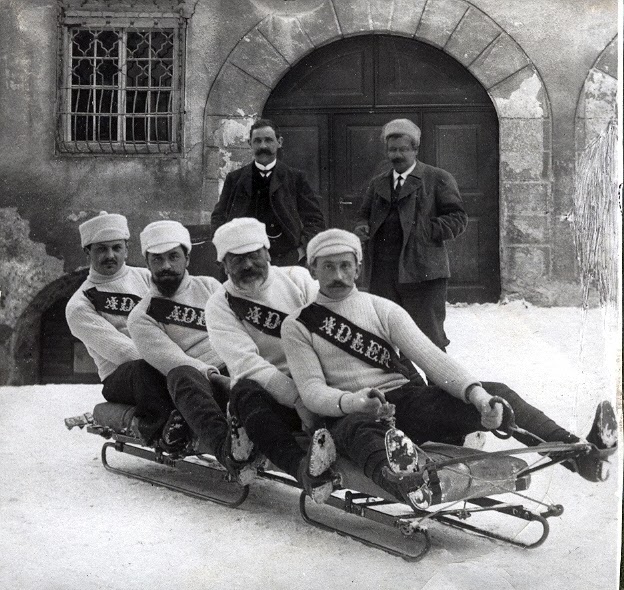
Davos Bobsled team, 1910. "Adler" means "eagle." The TB sanatoria described by Mann were located at such high altitude that the bodies of those patients who died during winter had to be transported down by bobsled. Why the thin mountain air, deficient in oxygen, was believed to be good for TB was a mystery.
In our Salon archives I found this interchange pertaining to the first part of Milosz’s “Magic Mountain” -- the unreality of California for someone who grew up in Lithuania.
Kate:
I just loved that moody Berkeley poem and M reciting to the gulls. Made me think of Po Chu-i's "Madly Singing in the Mountain" reciting to the monkeys and birds. I'm so happy M found that living is the real prize. [Kate is referring to “The Poet at Seventy”; the poem ends on “the pleasure of being alive”]. It's so interesting that he felt that Berkeley to him wasn't a real city with real trees or kindred spirits when for young people like me it became the real city, the city of poetry because of him and the others who were there.
Oriana:
Here is Po-Chu-I’s poem:
MADLY SINGING IN THE MOUNTAIN.
There is no one among men that has not a special failing;
And my failing consists in writing verses.
I have broken away from the thousand ties of life;
But this infirmity still remains behind.
Each time that I look at a fine landscape,
Each time that I meet a loved friend,
I raise my voice and recite a stanza of poetry.
And marvel as though a God had crossed my path.
Ever since the day I was banished to Hsun-yang
Half my time I have lived among the hills.
And often, when I have finished a new poem
Alone I climb the road to the Eastern Rock.
I lean my body on the banks of white stone,
I pull down with my hands a green cassia branch.
My mad singing startles the valleys and hills;
Monkeys and birds all come to peep.
Fearing to become a laughing-stock to the world,
I choose a place unfrequented by men.
~ PO CHU-I. c.AD 816
translated by Arthur Waley
**
For the Chinese poet, nature, religion, and poetry all unite as his spiritual sustenance. Milosz had a much more difficult time, having been raised in old-time Catholicism, and then, out of desperation, trying to forge his own neo-Catholic faith, dipping into Swedenborg and the Gnostics, never quite free of doubt.
Maybe you are wondering: why is PCI so lyrical and Milosz so conceptual? Milosz too felt close to nature, but it was the meadows and lakes and forests of Lithuania, and later the French countryside; he had trouble feeling at home in California’s landscape, so different from the lush green of the rain-rich north.
I did not choose California. It was given to me.
What would a man of the north
have to do with parched emptiness?
Grayish clay, dry streambeds,
hills the color of straw and clumps of boulders
like prehistoric reptiles – that’s for me
the soul of these regions.
And fog creeping out of the ocean,
begetting greenness in the ravines.
And spiny oak and thistles.
Where was it said that we would possess
the earth like a beloved,
and plunge into her deep, clear rivers,
and flow on fertile currents?
**
But then he had his beloved cat, and the deer that came to his yard, treating it as their salad bar. One time a doe gave birth to twin fawns on his lawn, and decided to stay there for a while. As for “parched,” he didn’t have it so bad there on Grizzly Peak. Worse by far was the near-complete lack of recognition (until 1980 and the Nobel Prize) and the loneliness he felt among the leftist academics in Berkley (though he knew from experience that France was even worse).
And there were his metaphysical wrestlings, now reading Swedenborg, now Simone Weil, now trying to feel at home again in the Catholic church (if my own experience is any guide, once you leave, you can’t quite return; once you have had a certain perception with the force of insight, there is no going back. On the other hand, as priests love to claim, that you can never fully leave: the emotional imprint of a Catholic childhood cannot be deleted). PCI at least had the serenity of his spiritual practice, though he too hints at loneliness, at guests who were invited, but did not come.
About the feeling of unreality: this is part of what goes with exile, with living in a place that’s very unlike your country of origin. The first landscape also establishes neural circuits that dictate what reality is supposed to be like. The differentness of another place creates a pleasant feeling of novelty as long as it’s a vacation and you have a home to go back to. Once that home is lost, the loss of familiarity is traumatic: the limbic system, based on attachment, goes into a shock of grief.
Even minor things come back as bits of grief, such as my literally gut-level thinking, during the first weeks, “This is not real milk”; “This is not real food”; “Why does the meat have no taste?” etc; and later, in California, much as I appreciate both palm trees and eucalypts, “These are not real trees.” Even Catholic churches were not real churches but shabby substitutes. I fell in love with Los Angeles, but fully knowing that this was not a real city. Let me share a short poem from long ago:
THE INNER REACTIONARY
I miss real trees. The eucalypts
are not enough, not even their incense
after rain. I’m outraged the bark
peels off in raggedy patches.
A right-wing homunculus sits
in the middle of my brain, screaming
that everything looks wrong:
the houses look wrong, the lawns,
the schools, the children, the stores.
The libraries look like libraries,
but that’s not enough. The streets
look wrong, their lunar emptiness.
I try to appease the homunculus
with roses; yawning
with contempt he'll ask,
“But where is the scent?
These are not real roses.
And if your heart flips over that
scentless fabrication of false petals,
that’s not your real heart.”
~ Oriana
**
I hasten to say that the local pine trees, with their magnificent long needles, did win my false heart, as did bougainvilleas (in spite of not being real flowers). The sense of unreality would come and go, and finally come over me less and less often.
But I perfectly understand why Milosz settled in Krakow for the last years of his life. He went to Krakow to die because that city most reminded him of Vilnius (always Wilno for him). The general rule is that we love the familiar: a little trickle of a waterfall in the local mountains and not Niagara Falls (do I need to point out that that’s not real water?)
 Frozen Niagara Falls, 1911
Charles:
Frozen Niagara Falls, 1911
Charles:
Milosz's style is surprisingly like your poetry style. At first I thought that you wrote the poem.
Must have been devastating for him to be a reader and not one person showed up for him. Doesn't say a lot about his ability to make friends. You would expect at least one person to show up if you are a featured reader.
Love the concept of the larger self as opposed to a person serving others.
I think Milosz has a mild sense of humor in his poetry. I can see how Milosz is an inspiration to you.
I love how you steer the blog to Ecclesiastes.
Love Archangel Gabriel’s blue outfit.
Best of all I love Milosz’s (and your) wisdom at the end, DO WHAT YOU CAN.
Oriana:
Hmm . . . The similarity in poetic styles may derived simply from the fact that many modern poets tend to sound alike: relaxed, colloquial almost, but with nature imagery to impart lyricism.
Ecclesiastes just happens to deliver the philosophy of life that’s become my own: drop expectations (“vanity of vanities”), work hard with all your heart, and enjoy life as best you can.
In early paintings, angels tend to be colorful -- both their wings and robes. Archangel Gabriel is particularly color co-ordinated.
 The Milky Way gladdened them
like a birch-lined road.
~ Czeslaw Milosz
Asked on his 90th birthday if he'd had a happy life, Milosz replied, “No.”
(I confess I almost hate going on with this post; how could my many, too many words possibly match the eloquence of this reply?)
One Polish writer commented that Milosz had the luxury of admitting to having had an unhappy life because he’d attained the pinnacle of success: the Nobel Prize (1980). He could afford to say that because he’d never be seen as a failure. To be inundated with admiration and adulation, and then to say you have not had a happy life -- now that is a regal gesture, the defiance not of petty clerk, the Man from the Underground, but of a literary celebrity. Ungracious perhaps, but it takes being part of the elite. As Oscar Wilde remarked, “It’s always nice to be invited and not to come.”
Still, one doesn’t say, “I’ve had an unhappy life” just for the fun of it. It’s not anything to be proud of, once past the young and foolish stage when suffering can be romanticized. The young can be forgiven for being unhappy. But continuing past youth in the state of unhappiness is a kind of failure. A wise man, a mature man should master the art of contentment.
Yet Dickens was not happy in his personal life either. What of it, we may say -- maybe the unhappiness was part of the drive to write those great novels with comic scenes precariously poised over almost unbearable darkness and cruelty.
Was Lenin a happy person? Was Lincoln? Dante?

THE SENSE OF WORTHLESSNESS; WRITING AS REDEMPTION
Almost 20 years after winning the Nobel Prize, and consequently receiving an enormous amount of adulation both in the U.S. and in Poland, Milosz wrote this:
Meditating on my hereditary flaws, I have moments of relief any time I think of my grandfather; I had to have taken something from him, so I cannot be completely worthless.
His grandfather was a decent but rather ordinary man; Milosz writes about him in the brief prose piece, “My Grandfather Sigismund Kunat,” in THIS, his last volume, 2000. And in an earlier (1986) volume, Unattainable Earth, he states:
From the beginning writing was for me a means of redeeming my true or imaginary worthlessness.
I have some empathy with this view that writing can redeem the badness, the worthlessness of a writer as a human being. We are raised in the ethos of altruism. We are supposed to serve others, live for others. Yet every committed artist realizes that he must be aloof at least some of the time in order to protect his creative solitude against the demands of the family, for instance. A writer has to put writing ahead of everything else in his or her life, including friends and family. If he does not, if he lacks the strength to shut the door and forbid anyone to enter his sacred space, he is not a real writer.
Bukowski put it best:
writers are indecent people
they live unfairly
saving the main part for the page
jesus christ would have been
a duller writer than Theodore Dreiser
jesus christ would have been a
very lousy writer
the beard and hair fit
but he was too good at
conversations and
miracles
a good human being may save the world
so the bastards can keep creating art
if you read this after I am long dead
it means I made it
and
it’s your turn now
to misuse your wife
abuse your children
love thyself
live off the funds of others
dislike all art created before and
during your time,
and dislike or even hate humanity
singly or en masse.
bastard, if you read this after I am long dead
shove me out of here. I
probably wasn’t that
good.
~ Charles Bukowski, from “Measurements from the Creation Coffin”
*
And here we are, reading this long after Bukowski is dead, and know that he’s telling the truth. No writer would want his daughter or sister to marry a writer. That much conscience is still left: the thought that someone dear to you might get involved with a writer turns you into Munch’s Scream.
But on the redemptive side, there is the hope that our work will be of use.
A friend of mine said that she always misreads the title of Adrienne Rich’s famous poem, “Diving into the Wreck,” as DYING INTO THE WORK. This is the death of the ego in the service of honesty. If you speak honestly enough, with no respect for things that don’t deserve respect, you may, with luck, say something worth saying.
 DECADES OF LACK OF RECOGNITION
Until he won the Nobel, Milosz was practically unknown as a poet in the US, and little known in Poland. He wrote about this lack of recognition in the poem “Magic Mountain”:
So I won’t have power, won’t save the world?
Fame will pass me by, no tiara, no crown?
Did I then train myself, myself the Unique,
To compose stanzas for gulls and sea haze,
To listen to the foghorns blaring down below
Until it passed. What passed? Life.
Fame came to him when he was 69. Until then, as Robert Hass put it, “He was living in intolerable obscurity and loneliness. He had to invent the idea that there was still somebody to read his poems.”
(A shameless digression: once I realized that my idea of happiness was precisely being alone in a room, that amounted to the discovery that I’ve had a fabulous life! Solitude is a rare privilege for which I am infinitely grateful.)
AND AN UNHAPPY FAMILY LIFE
I love two things in life: gossip and metaphysics. ~ Anna Akhmatova
Milosz made no secret of his unhappy first marriage. He met Janina Dluska (Janka) in the late thirties; both of them worked for the Polish radio in Warsaw. Like Milosz at the time, she was leftist and anti-clerical (Milosz objected to the nationalist and anti-Semitic right-wing Catholicism in pre-war Poland. But he never lost his passionate interest in metaphysics, and was beginning to see hope in religion). They got married in 1944. Janina died in 1986 after suffering for ten years from a spinal tumor that led to almost total paralysis (she was bed-ridden), depression and paranoia (some sources refer to the dementia as Alzheimer’s disease).
Both Milosz and his wife were alcoholics. He famously said, “Heaven is the third vodka.” But excess of alcohol is worse for women, who detoxify it poorly, especially past the age of forty; women alcoholics tend to go downhill much faster than men.
One of the startling things Milosz said was, “For Janka, my winning the Nobel Prize was a tragedy.”
A few of his poems also make it plain that he had affairs, but those poems do not express love for his partners. Rather, he seems to feel sorry for the women.
In one source I learned that the main reason he left Vilnius, a city he loved, for Warsaw, where he already felt in exile, was that in Vilnius he got a woman pregnant; he didn’t want to marry her. He always felt guilty about this abandonment. Later, when he was teaching at Berkeley, he even suggested to a Polish-speaking graduate woman assistant who was about to make a trip to Poland that she introduce herself as his illegitimate daughter.
To make things worse, his younger son began to suffer from mental illness.
In 1992 Milosz married his second wife, Carol Thigpen, a former associate dean at Emory University, thirty years younger than Milosz. She unexpectedly died of leukemia in 2002.
I don’t know just how affectionate Milosz’s second marriage was. But I’m sure there was a huge gap between them, not through anyone’s fault. In a partner we seek someone who can know us and understand us. Marrying an American woman who was much younger meant facing unavoidable differences in background.
In a number of poems Milosz seems to hint that the right woman for him would come from one of the white manors in Lithuania, and be of the same generation. They would share the same native culture, language, landscape. She’d be a dryad almost, with milky skin and chestnut hair. And he also knew that real women who grew up in those white manors likely met with a tragic fate, deported to slave labor in Siberia or Kazakhstan.
Still, Milosz’s second marriage was probably vastly more happy than the first one. How uncanny that the second wife would also succumb to a terrible illness. But perhaps that’s not so unusual when you live in the shadow of a dominant partner.

THE FAILURE OF CATHOLICISM TO PROVIDE COMFORT
Nor was the official Catholicism, which Milosz left in his teens and to which he later returned (for political reasons, I strongly suspect), a safe emotional harbor. In his essay, “On the Turmoil of Many Religions,” Milosz says:
Today the “turn to religion” probably is less social conformism than fear: let us react to the collapse of traditional norms as if everything religion, the guardian of mystery, teaches us were truth. You suspend your judgment and sing along with the others in church, precisely because you doubt your ability to unravel all those intricate questions. Only I have difficulties, only my mind remains empty no matter how many times I try to extract something from my imagination. The others here beside me have no such difficulties. Though I will not admit it to myself, each of them is thinking the same about me. And thus collective belief accumulates from the disbelief of individuals. (emphasis mine)
He also wrote:
The Catholic upbringing I received imposed a severely repressive morality. This is one reason why I tend to distrust my own judgments. I can say nothing good about repression, which crippled me in some ways and poisoned me with pangs of conscience.
How well I know this poisoning of everything with obsession over sin and the supposedly innate human wickedness that dooms us to hell, and the pangs of conscience over minor and at times entirely imaginary sins! Bishop Spong’s definition of religion as a “guilt-inducing control mechanism” applies here. Yes, guilt, shame and the threat of eternal punishment -- those tools were used incessantly to poison childhood’s natural inclination to enjoy life.
The conviction that you are a morally bad person who deserves eternal damnation is hard to uproot. That’s why religions who instill it in children are emotionally abusive.
(Another shameless digression: I love the contrast between Protestantism and Catholicism in the chart below: “If I work harder shit won’t happen” versus “If shit happens, I deserve it.”)

SETTEMBRINI AND NAPHTA
Milosz refused to be an orthodox Catholic, espousing the positions of the church. Already in his youth he wrote, “In a Roman Catholic country intellectual freedom always goes hand in hand with atheism.” Even after his return to Catholicism he saw himself as a heretic, with tendencies toward Gnosticism. He always refused to call himself a Catholic writer.
The problem of evil bothered Milosz to the end. In one of his late poems, “An Alcoholic Enters the Gates of Heaven,” he says, addressing god, “It seems to me that people who cannot believe in you / deserve your praise.” He didn’t accept Dostoyevski’s idea that it’s better to give up the truth than Christ. He wanted to get through to the truth, no matter the pain.
Milosz was fascinated by the Gnostics (the world was created by an evil demiurge, not the real god) and by Simone Weil. He was leaning toward Weil, who thought that god did create the world, but turned it over to the rule of Satan (the “prince of this world”), and never interfered with the laws of nature. So much for prayers of petition. Milosz also believed -- or at least stated the view -- that the world was ruled by Satan.
This non-interfering god (who reminds me of Kurt Vonnegut’s “Church of God the Utterly Indifferent”) could, however, send grace. After she had a couple of mystical experiences, likely brought about by her fasting (Weil was an anorexic; she died of self-starvation), her faith seems to have become quite intense. She believed that god lived just beyond earth’s atmosphere, in interplanetary space. Thus she too seems hopelessly dated, in spite of her admirable common sense -- of course the laws of physics are not going to be broken just because of a prayer.
Milosz never mentions having had mystical experiences. He was left with the perennial lack of evidence for god’s existence. Milosz knew only one thing with certainty: that no sign would be given. No statue in church would ever nod its head or move its hand, no matter how ardently he prayed -- he too had the common sense to believe in the laws of physics. At most, we may find the presence of god in human affection. But why involve god in it? Affection could be appreciated on its own merit, with credit going to the affectionate humans.
It’s interesting that in his early youth, Milosz experienced a Settembrini and Naphta (referring to the characters in Mann’s Magic Mountain) sort of combat for his soul. He had two mentors: a humanist and Latin scholar, and a priest who hated the world and the flesh. Milosz eventually had a violent disagreement with the priest and renounced Catholicism. In the end, however, he decided that optimistic rationalism could not be trusted. He’d seen so much evil and destruction that he desperately wanted god to exist, since that was a promise of the resurrection -- not just of the individual, but of all things that perished.
But can we truly say that the Jesuit won? No, Milosz became both Naphta and Settembrini. Though a public Catholic, he reserved the right to think for himself rather than blindly accept the doctrine. And though he turned away from Marxist philosophy, he was far from being right-wing. He detested nationalism, and decried the ugliness of commercialism and uncontrolled capitalism. He didn’t glorify the church, only the beauty of the earth.
Thus, neither Settembrini nor Naphta won the battle for the poet’s soul. Rather, he incorporated both. He was both a sensualist and an ascetic, a liberal rationalist and a pessimist who believed that the world was ruled by Satan. God, apparently beyond good and evil, allowed mass destruction; there was no atrocity that he’d prevent.
This is similar to Aleksander Watt’s mystical vision in a Soviet prison during WWII, which led to Watt’s conversion to Catholicism. Watt saw the world totally given over to the rule of Satan; but above it stretched the realm of a perfectly serene god.
Now, Catholicism does not see god as happy; on the contrary, Catholicism is obsessed with suffering and presents images of a suffering god. But the promise of a healing harmony has to be there somewhere. It should be noted that Milosz never mentioned having had a mystical experience or seeing an actual sign that god existed. However, he stated that we can choose to believe; reason rejects religion, but religion is based on feelings.

VICTORY OVER DEPRESSION BY “ESCAPING FORWARD” INTO WORK
Milosz called his depression “delectatio morosa” -- a morbid pleasure in brooding. He had much to brood about. What helped him, he says, is learning from his friend, the Polish-born Swiss philosopher Jeanne Hersch, about existentialism as a philosophy of freedom.
In Native Realm, Milosz writes: “I am not what I am. My essence escapes me. It is a durable achievement of existential philosophy to remind us that we should not think of our past as definitely settled, for we are not a stone or a tree. In other words, my past changes every minute according to the meaning given to it now, in this moment.”
“The present changes the past” is not an empty formula. The present changes our memory of the past. Memory is a reconstruction, and it continues to evolve. What we do today can change the way we perceive the past. Thus, sooner or later a writer usually recognizes that all his disasters are terrific material. For a writer, “even the bad is good.”
“The snare of happiness will never entangle you,” Milosz prophesied about his own happiness in one of his youthful poems. But it’s depression that is the real snare. Mild depression -- maybe we should call it just a “melancholy mood” -- can fuel creativity. Deep depression is paralyzing.
For Milosz, the first part of liberating himself from depression came from his love of nature:
I would never have been cured of it had it not been for the beauty of the earth. The clear autumn mornings in an Alsatian village surrounded by vineyards, the paths on an Alpine slope over the Isère River, rustling with dry leaves from the chestnut trees, or the sharp light of early spring on the Lake of Four Cantons near Schiller’s Rock, or a small river near Périgueux on whose surface kingfishers traced colored shadows of flight in the July heat–all this reconciled me with the universe and with myself.
Second, he was able to overcome the self-centeredness of depression by connecting with European culture:
But it was not the same as it had been in America; it was not only nature that cured me. Europe herself gathered me in her warm embrace, and her stones, chiseled by the hands of past generations, the swarm of her faces emerging from carved wood, from paintings, from the gilt of embroidered fabrics, soothed me, and my voice was added to her old challenges and oaths in spite of my refusal to accept her split and her sickliness. Europe, after all, was home to me. And in her I happened to find help. ~ Milosz, “Tiger 2,” Native Realm, 293
And third but perhaps the most important, he threw himself into work: writing and teaching. My guess is that ultimately it was his focus on work that kept depression at bay. He ceased to brood about the past and focused on what lay in front of him and in the future:
The philosophy of freedom, practiced by existentialists, took over the classical methods of confessors and spiritual guides, precisely in that it advises us to direct our sight always ahead, not backwards. Largely thanks to its counsels, I stopped meditating and set about my work, which has always been to me an escape forward.
~ Czeslaw Milosz, Unattainable Earth, 121-122. (emphasis mine)
Actually the advice about dedicated work goes back all the way to Ecclesiastes. After deciding that everything is vanity, the Preacher nevertheless says, “Whatsoever thy hand findeth to do, do it with thy might; for there is no work, nor device, nor knowledge, nor wisdom, in the grave, whither thou goest.” (Eccl 9:10). (other versions translate “device” as “planning.”
The Preacher also speaks about putting on clean garments and enjoying life. This is similar to what we find in a more ancient source, the Sumerian epic of Gilgamesh. Siduri, priestess of the waters Gilgamesh, tells the following to the king of Uruk:
. . . fill your belly with good things; day and night, night and day, dance and be merry, feast and rejoice. Let your clothes be fresh, bathe yourself in water, cherish the little child who holds your hand, and make your wife happy in your embrace; for this too is the lot of man.
In Gilgamesh it’s the little child that charms me. But it's interesting that Ecclesiastes adds the missing element, the pleasure of working with all your heart, in spite of the ultimate vanity (cf Freud on what is most important in life: "love and work").
Love in the sense of romantic love may not be available. It’s frightening to ponder Milosz’s family situation: a bed-ridden wife, a mentally ill son. One answer may be to try to be as affectionate as possible in spite of stress; being affectionate reduces stress. But we are barely beginning to study this. The other remedy is to “escape forward” into dedicated work. Focus on something challenging preempts worry and is healing to the brain.
*
Sometimes a change in circumstances can end depression. But usually what is required is a profound change in perspective. When I decided not to be depressed, my external life remained the same, except that I came to love it. As long as I am able to write, I am content. Reading about Milosz’s “escape forward” confirmed what I discovered about the healing nature of work.
A WORKER IN THE VINEYARD
What saved Milosz was longevity. He lived long enough not just to win the Nobel Prize, but to heal his wounds and conclude that there was some meaning to everything that happened: some lesson, some step in his development as a writer. He warns readers against the wishful tendency to believe that because something happened, it had to happen, and that it was somehow “for the best”; nevertheless, the older Milosz seems finally reconciled to his past. The suffering had its function, but there came a time to let go of the guilt, real and imaginary, and focus on the blessings. This is beautifully expressed in what is perhaps the best and most moving poem of Milosz’s old age:
LATE RIPENESS
Not soon, as late as the approach of my ninetieth year,
I felt a door opening in me and I entered
t
he clarity of early morning.
One after another my former lives were departing,
like ships, together with their sorrow.
And the countries, cities, gardens, the bays of seas
assigned to my brush came closer,
ready now to be described better than they were before.
I was not separated from people,
grief and pity joined us.
We forget – I kept saying – that we are all children of the King.
For where we come from there is no division
into Yes and No, into is, was, and will be.
We were miserable, we used no more than a hundredth part
of the gift we received for our long journey.
Moments from yesterday and from centuries ago –
a sword blow, the painting of eyelashes before a mirror
of polished metal, a lethal musket shot, a caravel
staving its hull against a reef – they dwell in us,
waiting for a fulfillment.
I knew, always, that I would be a worker in the vineyard,
as are all men and women living at the same time,
whether they are aware of it or not.
*
As a humanist, I need to translate this poem into secular terms. We are more than ourselves: we are humanity. The vast majority of us are good at heart, and just by being ourselves we contribute to the advancement and welfare of many. If that sounds rather dry, then by all means let’s keep the image of the vineyard.

THE PERSISTENCE OF CHILDHOOD
Between the ages of seven and ten I lived in perfect happiness on the farm of my grandparents in Lithuania . . . I lived without yesterday or tomorrow, in the eternal present . . . I was a little Adam, running all day in a garden under trees. ~ Milosz, “Happiness”
His happiness as “a little Adam” didn’t last, but his love of nature was to be life-long. It has been said that if we’ve been truly loved, we can never be completely unhappy. Perhaps once we’ve tasted paradise, we can’t be entirely unhappy either. In his essay "Happiness," written after visiting Lithuania at the age of 80, Milosz asserts that the experience of happiness in childhood retains a healing power throughout lifetime. Standing near the remains of his family estate, Milosz experienced that happiness in spite of everything:
"Much was going on inside me, and I was stunned by the strength of that current for which no name seemed adequate. It was like waking up from a long dream and becoming again the person whom I have never ceased to be. Long life, narrow escapes, my two marriages, children, my failures and triumphs, all flickered as if telescoped into a film running at a great speed. No, this is not a proper description, all all that existed in a big lump separated from me, placed in its own dimension of the past, while I was recovering my continuity from myself as a child to myself as an old man."
And he concludes:
"Then something happened -- and I must recognize that the myth of Ithaca stems from profound layers of human sensibility. I was looking at a meadow. Suddenly the realization came that during my years of wandering I had searched in vain for such a combination of leaves and flowers as was here, and that I have always been yearning to return. Or, to be precise, I understood this after a huge wave of emotion had overwhelmed me, and the only name I can give it now would be bliss."
He puts it more beautifully in this exquisite little lyric:
A MEADOW
It was a riverside meadow, lush, from before the day harvest,
On an immaculate day in the sun of June.
I searched for it, found it, recognized it.
Grasses and flowers grew there familiar in my childhood.
With half-closed eyes I absorbed luminescence.
And the scent garnered me, all knowing ceased.
Suddenly I felt I was disappearing and weeping with joy.
~ Czeslaw Milosz, Facing the River, 1995

IF MILOSZ WAS AN UNHAPPY ALCOHOLIC, HOW COME HE LIVED TO 93?
The answer is that Milosz was a writer first. His creativity came first -- his life of the mind. He lived long because he had something to live for. His "escape forward" into work was also an escape from early death.
Those who continue to be creative late in life show a longevity advantage. Their brain appears to reorganize to compensate for loss of speed. Creative work also generates positive emotions. This holds not just for the famous (Nobel Prize winners and Oscar winners tend to live longer), but also for those whose achievement is minor and fame local, if any. They write, paint, play music and so forth “for pleasure.” And pleasure -- deep, meaningful pleasure -- is vital for health.
Considering his immense creative output and his legendary vitality, I wonder if we should completely accept Milosz’s appraisal of his life as unhappy. After all, he spent most of his life doing the work he loved. And he also seems to have enjoyed teaching at Berkeley, even though he felt intellectual isolated among the leftist faculty. And I wasn’t surprised when a Polish poet told me, “Milosz really loved people.”
I think he became happier as he grew older, in his seventies and eighties. In Unattainable Earth, he writes from the perspective of being past seventy:
Love of life, passion for life. Perhaps one feels it also in one’s youth, but differently and with different words. One must liberate oneself, at least to some extent, from complexities, from taking one’s fate too much to heart, before being able to rejoice simply because one is alive among the living.
True, a disappointment in marriage is a sorrow, and alcoholism is certainly not a source of happiness. But in the end that’s not what will be remembered about Czeslaw Milosz. He will be known as someone who praised earthly life despite all the suffering he experienced and witnessed. And as someone who had an extraordinary, creative, and -- dare we say it? -- happy old age.
AN HOUR
Leaves glowing in the sun, zealous hum of bumblebees,
From afar, from somewhere beyond the river, echoes of lingering voices
And the unhurried sounds of a hammer gave joy not only to me.
Before the five senses were opened, and earlier than any beginning
They waited, ready, for all those who would call themselves mortals,
So that they might praise, as I do, life, that is, happiness.
**
John Guzlowski:
I wonder if he thought about happiness in his day to day life.
My experience is that only the truly unhappy, the clinically depressed, the lost children, think about happiness everyday. The rest of us -- even those who are poor and hungry and lonely -- go on and on, not thinking much about what our feelings are, instead thinking about the jobs we have to do, the lives waiting for us at home after those jobs are done.
I suspect Milosz was like this. Even factoring in the dark moments of his life, he probably spent most of his time just doing what he enjoyed doing, what gave him satisfaction, if not happiness.
PS -- I love the picture of Milosz and the Pope. Milosz seems wonderfully aware of the ironies in his situation.
Oriana:
And the Pope too may have been aware of those ironies. He was regarded as pretty sophisticated. Let’s not forget that he changed the definition of heaven and hell, but he had to play a subtle game of daring to downgrade supernaturalism just so far but no further.
(By the way, I find it wonderful that the morally repugnant idea of hell as eternal torment is finally being discarded by progressive Christians.)
I agree with you about people’s going on without constantly questioning whether or not they are happy. Maybe happiness is never needing to ask yourself if you are happy. Maybe it's the elemental joy of existence -- “life, that is, happiness.”
”
The New Age slogan, “You deserve to be happy,” really gave me a pause. No way -- not according to what I was taught in catechism classes. In the eyes of the Catholic church, you most emphatically did NOT deserve to be happy, either here on earth or in heaven. You were a sinner and what you deserved (except for the pardon bought by the “bloody ransom” of the crucifixion) was eternal punishment.
By the way, I discuss this and more in my latest blog post:
http://oriana-poetry.blogspot.com/2013/08/are-humans-evil-by-nature.html
Milosz believed that humans were innately evil, and that man could do no good by his own powers. This is the foundation of the of doctrine of grace. You can find the refutation of this demeaning of human nature in my blog. (“Religion defames human nature; humanism praises the human potential.”)
A 90-YEAR-OLD FRIEND SAID SHE HAS "NOT ONE HAPPY MEMORY FROM LIFE"
Michael:
I don't hear Milosz's NO as eloquent.
I have a 90 year old friend who has said on many occasions that she has "not one happy memory from life."
Odd. She has achieved much by any standard and has (and had) many loving relationships.
I recognize her denial of happiness as the dialog of the depressive personality. Nothing more. No existential exploration is needed. The sadness here is that my friend and Milosz were never able to drown the deceptive, yet predictable voices of depression.
--
To make a prairie it takes a clover and one bee,
One clover, and a bee. And revery.
The revery alone will do,
If bees are few.
~ Emily Dickinson
**
Oriana:
Milosz’s “No” was eloquent only because it came from a winner (I typed “sinner”) of the Nobel Prize. It’s as if he said, “Look, I won the greatest prize in the world, but if you think that winning the Nobel has anything to do with happiness, think again.”
On the other hand, photos of Milosz, and there are many, not to mention his poems and essays, and there are even more, seem to tell a different story: his life the usual mix of happiness and misery, with everything in between. And his old age was a time of great creative flowering; his diary, A Year of the Hunter, reveals an overwhelming richness. He had the proverbial energy of genius, and he needed it to deal with this richness.
His suffering and his joy (how many people get to win the Nobel Prize?) were perhaps more intense than those of a typical person -- but even here we can’t be sure. Our brain constructs happiness -- “contentment” might be a more accurate word. Studies found that a year after a very happy event (e.g. winning a lottery) or a very unhappy event (e.g. losing a limb), people tend to return to the level of contentment they had before the event. Dickinson was right: barring extremes, it’s more about our state of mind than the external circumstances.
Past a certain age, we know that no one ever gets everything they want -- and there is no special reason why we lose out on certain things. When it comes to the Big Three: love, fulfilling work, and health, an old saying claims you can have at most two of those, but never all three. “Deserve has nothing to do with it.”
But you are absolutely right about your 90-year-old friend’s depression-distorted perspective. Depression feeds on itself: we seek to enhance the sadness, often by thinking of yet another bad thing that happened to us in our late teens or early twenties (a period of life that is most vividly remembered). And once depression becomes a habit, the access to positive memories is blocked. I learned about this blockage when I experienced it; only later I discovered that it’s a typical depressive phenomenon. Nor can one receive love and affection -- it’s at odds with the depressive self-image as someone unloved and unappreciated, and this negative self-image is furiously defended -- how dare you say that my life is rich in friendship? I don’t have any friends; never had a single REAL friend in my WHOLE life. And this is often said to a friend who’s trying to offer affection and consolation.
At the same time, not to be too hard on Milosz, I need to confess that if someone asked me, “Have you had a happy life?” -- my instant impulse would also be to say No. The memory of catastrophes and suffering is powerful. Luckily, I have regained access to memories of happy moments. It was the slowest part of the recovery, nothing like the instant effect of the paradigm shift. But at this point I am aware of my blessings, and even call myself lucky. And I’m lucky at long last to have realized just how lucky I am.

Hyacinth:
So sadly true, his comments on religions and life.
It broke my heart to hear him speak of his drinking. I thought he was too sensitive and soulful to say that “Heaven is the third vodka.” So many poets suffer from doubt and taking all too seriously, and the resulting depression and addictions.
Oriana:
"Heaven is the third vodka" ~ it makes me shudder, that definition heaven. But to alcoholics, being drunk feels magical. A friend once told me, the glow of the first-time euphoria still lighting her face: “All anxieties are gone, all worries, all self-consciousness. You feel witty and brilliant, popular, a star. Life is wonderful and you are happy.”
I suspect that’s the meaning of “heaven is the third vodka” -- but only for an alcoholic. If you are genetically prone to anxiety and alcohol removes that anxiety more quickly and efficiently than anything else, I can see how being drunk seems “magical.”
You and I can't understand it -- it's not a normal experience. Of course we’ve had moments of happiness and even euphoria -- but not as a result of drinking. One reason I loved hiking was that care-free feeling -- at least partly a result of less oxygen, meaning less brain function, not enough for mulling over pedestrian worries. That constant chatter inside the head becomes less, and is blended with the chirping of birds and other sounds of nature -- the most exquisite music there is, at least while hiking. And later, no hangover -- just excellent sleep (exercise really is the best sleep inducer), so you feel great the next morning. That’s rather the opposite of the experience of getting drunk.
In order for addiction to develop, especially perhaps in the case of alcoholism (I think smoking is more socially influenced, and then nicotine is as addictive as heroin), there has to be a genetic susceptibility -- it always runs in the family. Milosz's mother drank, and other relatives (I don't quite remember, but he certainly stated alcoholism was in the family). And then on top of genes, there has to be enough stress, but then life always supplies that sooner or later. Alcohol is a fast-acting sedative -- all anxiety can be gone within minutes. It’s like Valium. And it raises serotonin.
But as alcoholism progresses, the reward is less and less, while the punishment now is “getting the shakes.” Brain damage, liver damage, heart-muscle damage . . . It’s amazing that Milosz lived as long as he did. But then Nobel Prize winners often do. Among actors, Oscar winners also live longer. It’s usually explained as an effect of increased social status. Apparently it’s not the increase in wealth. More likely it’s the sudden adulation. Milosz got plenty of that.
Hyacinth:
Perhaps I’m wrong, but don’t you find it crazy that a man of his intellect would accept predestination?
Oriana:
No, you're not wrong. It IS crazy that he fell for the most absurd deterministic metaphysics. Once you assume that everything that happens is god’s will, predestination (already in the instant of creation of the world) follows. Milosz must have been desperate at some point, wanting god to exist so much that all kinds of cruelties had to be accepted, including god's "experiment" in alcoholism. I think he wanted the afterlife so idiotically much (as if there would be something to do there for us) that a cruel god was better than none.
I can understand that his having witnessed massive destruction made him want to protect people and things from disappearing. Great art, including great literature, is a form of preservation, however imperfect. But that kind of preservation wasn’t enough for Milosz. He wanted everything restored: not just the birds he saw in childhood, but even the insects that sustained such a large population of birds. But everything changes. Somehow Milosz rebelled against this with all his being. He wasn’t interested in the immortality of the soul; to him the Christian promise was that the whole person would be restored, all the details and personality quirks.
What is crazy is that someone of his intelligence would not realize that of course any religion can make all kinds of attractive promises precisely to recruit followers. These promises are completely empty, but the priests can always say, “Not yet.”
I think the second reason Milosz fell into the trap of predestination was his poor knowledge of physics. At this point we accept probability rather than certainty. The future is not determined, at least not at the micro level of an individual. Also, evolution has progressed toward animals that have more and more freedom, rather than be “predestined.” So Milosz’s ignorance of modern science has done him in on that point. It’s sad that he was able to grasp the idea that the present changes the past, but wasn’t able to apply it more broadly, to rejoice in this “philosophy of freedom.”

Scott:
Happiness is what all humans hope to attain. And those that constantly worry, obsess or strive for it usually don't find it. I can see where some would be attracted to the Buddhist philosophy of non striving and simple acceptance. As I've said before, it would be interesting to see what would result from a meeting of leading Quaker, Sufi and Zen leaders. They could start in Damascus!
Oriana:
I think the best guidance for happiness -- though I’d prefer the term CONTENTMENT -- is contained in Ecclesiastes. That wisdom goes back thousands of years. It says that nothing lasts, everything passes away, all is vanity, don’t count on an external reward -- there is no justice, the wicked prosper, etc. Sounds pretty bleak, but then we suddenly get to the advice to enjoy life to the fullest -- and to work in a dedicated manner. “Whatever thy hand finds to do, do it with all thy might” -- this is my #1 favorite sentence in the entire bible. Dedicated work has been my salvation.
And yes, there is wisdom in other traditions as well. I instantly liked Daoism and that part of Buddhism that warns against “striving.” This may seem like contradiction of Ecclesiastes, but I have it figured out in terms of both the creative process and other kinds of work.