skip to main |
skip to sidebar
Colonel Salt Cave inside Sodom mountain, Israel
**
“On march the banners of the King of Hell,”
My Master said. “Toward us. Look straight ahead:
Can you make him out at the core of the frozen shell?”
. . . I stood now where the souls of the last class
(with fear my verses tell it) were covered wholly;
They shone below the ice like straws in glass.
Some lie stretched out; others are fixed in place
Upright, some on their heads, some on their soles;
Another, like a bow, bends foot to face.
When we had gone so far across the ice
That it pleased my Guide to show me the foul creature
Which once had worn the grace of Paradise,
He made me stop, and, stepping aside, he said:
“Now see the face of Dis! This is the place
Where you must arm your soul against all dread.”
. . . The Emperor of the Universe of Pain
Jutted his upper chest above the ice;
And I am closer in size to the great mountain
The Titans make around the central pit,
Than they to his arms. Now, starting from this part,
Imagine the whole that corresponds to it!
If he was once as beautiful as now
He is hideous, and still turned on his Maker,
Well may he be the source of every woe!
With what a sense of awe I saw his head
Towering above me! For it had three faces:
One was in front, and it was fiery red;
The other two, as weirdly wonderful,
Merged with it from the middle of each shoulder
To the point where all converged at the top of the skull;
The right was something between white and bile;
The left was about the color that one finds
On those who live along the banks of the Nile.
Under each head two wings rose terribly,
Their span proportioned to so gross a bird:
I never saw such sails upon the sea.
They were not feathers―their texture and their form
Were like a bat’s wings―and he beat them so
That three winds blew from him in one great storm:
It is these winds that freeze all Cocytus.
He wept from his six eyes, and down three chins
The tears ran mixed with bloody froth and pus.
In every mouth he worked a broken sinner
Between his rake-like teeth. Thus he kept three
In eternal pain at his eternal dinner.
For the one in front the biting seemed to play
No part at all compared to the ripping: at times
The whole skin of his back was flayed away.
“That soul that suffers most,” explained my Guide,
“is Judas Iscariot, he who kicks his legs
On the fiery chin and has his head inside.
Of the other two, who have their heads thrust forward,
The once who dangles down from the black face
Is Brutus: note how he writhes without a word.
And there, with the huge and sinewy arms, is the soul
Of Cassius.―But the night is coming on
And we must go, for we have seen the whole.”
~ Dante, Inferno, Canto 34 (excerpts), tr John Ciardi
 Gustave Doré, Satan in the Lake of Ice. Doré doesn’t literally follow Dante’s description in every detail; we can only faintly make out the three faces, a perverse parallel to the Trinity, and the legs of Judas dangling from his mouth. This marvelous, husky Satan is almost amiable. Note the souls nearest Satan, vertical in the ice "like straws in glass."
Never mind the popular idea that the eternal fires would be hottest at the center of hell. According to Dante, Satan is imprisoned in a lake ice! A giant being with three faces and three sets of bat-like wings, he’s frozen in ice up to the upper chest.
Dante isn’t shy about literary invention, to put it mildly. He invents not just the Lake of Ice, but also a whole alternate ending of the Odyssey — note the astonishing Canto 26, the Ulysses Canto, where instead of returning to Ithaca Odysseus sails westward until he glimpses Mount Purgatory and is shipwrecked for the final time.
Dante wrote this description of Satan in the Lake of Ice at the center of the earth around the year 1310. Given that we are talking about the early fourteenth century, we should give Dante credit for knowing that the earth was a giant sphere — this is long before “Columbus sailed the ocean blue.” What was on the other side of the globe? Only the ocean, and the giant mountain of Purgatory, directly opposite Jerusalem.
The human mind needs answers, and Dante formulated such answers as seemed reasonable to the educated people of his time and place. And hell, purgatory, and heaven were all actual places rather than “only” states of mind. We can psychologize Dante’s vision, but only to a degree. When he puts Satan at the center of the earth, it’s a literal Satan at the literal center of the earth.
The Lake of Ice is surprising, given that the Lake of Fire was the common assumption about hell, based on its mention the Book of Revelation. It’s hard to imagine that Dante didn’t know that particular verse. But, as with his heretical elevation of Beatrice to the status of a saint and his personal female savior, he had the courage to go against the established imagery. To be sure, we can always point to Dante’s symbolic meaning: Satan’s heart is closed to love, so it is symbolized by ice.
There is certainly fire imagery in the Inferno. The towers of Dis, the metropolis of hell, burn with eternal flame. A rain of fire is used to punish homosexuals. But more interesting by far are the inner flames of rage that burn within the wrathful — even though those eternally angry souls are presented as caked with mud “in a marshy flood,” rather than burning in fire. Thus they resemble the sullen (the depressed), who are sunk in a swamp, completely
submerged in mud.
(Jan van der Straet, also known as Stradanus or Stradano): Canto 8, The Wrathful. Dante the Pilgrim is leaning down, trying to identify one of the sinners.
Had Dante chosen to cast Satan into the Lake of Fire, there would be no originality. So he daringly went for the other extreme. In literary and psychological terms, it was the perfect move. In terms of what modern science knows about the center of the earth, however, it turns out that the Lake of Fire is a closer fit — minus the sinners.
A more traditional image of Satan, the City of Dis, and the fires of hell
WHAT REALLY LIES AT THE CENTER OF THE EARTH
When I googled the subject a few years ago, the first item to show was a creationist website about hell. But the real story is a lot more interesting. Here is the most fascinating part: ~ “Earth has a powerful magnetic field, and that is all thanks to the partially molten core. The constant movement of molten iron creates an electrical current inside the planet, and that in turn generates a magnetic field that reaches far out into space.
The magnetic field helps to shield us from harmful solar radiation. If the core of the Earth wasn't the way it is, there would be no magnetic field, and we would have all sorts of problems to contend with.” ~
Not that I think any of my readers believe in heaven and hell, except right here on earth. But it turns out that what lies in the center of the earth, along with the story of how we came to find out about it, is fascinating — arguably more so than any mythology of the Underworld. Here is the rest of the article:
“Humans have been all over the Earth. We've conquered the lands, flown through the air and dived to the deepest trenches in the ocean. We've even been to the Moon. But we've never been to the planet’s core.
We haven’t even come close. The central point of the Earth is over 6,000 km down, and even the outermost part of the core is nearly 3,000 km below our feet. The deepest hole we've ever created on the surface is the Kola Superdeep Borehole in Russia, and it only goes down a pitiful 12.3 km.
All the familiar events on Earth also happen close to the surface. The lava that spews from volcanoes first melts just a few hundred kilometers down. Even diamonds, which need extreme heat and pressure to form, originate in rocks less than 500 km deep.
What's down below all that is shrouded in mystery. It seems unfathomable. And yet, we know a surprising amount about the core. We even have some idea about how it formed billions of years ago — all without a single physical sample. This is how the core was revealed.
One good way to start is to think about the mass of the Earth, says Simon Redfern of the University of Cambridge in the UK.
We can estimate Earth's mass by observing the effect of the planet's gravity on objects at the surface. It turns out that the mass of the Earth is 5.9 sextillion tons: that's 59 followed by 20 zeroes.
There's no sign of anything that massive at the surface.
"The density of the material at the Earth's surface is much lower than the average density of the whole Earth, so that tells us there's something much denser," says Redfern. "That's the first thing."
Essentially, most of the Earth's mass must be located towards the center of the planet. The next step is to ask which heavy materials make up the core.
The answer here is that it's almost certainly made mostly of iron. The core is thought to be around 80% iron, though the exact figure is up for debate.
The main evidence for this is the huge amount of iron in the universe around us. It is one of the ten most common elements in our galaxy, and is frequently found in meteorites.
Given how much there is of it, iron is much less common at the surface of the Earth than we might expect. So the theory is that when Earth formed 4.5 billion years ago, a lot of iron worked its way down to the core.
That's where most of the mass is, and it's where most of the iron must be too. Iron is a relatively dense element under normal conditions, and under the extreme pressure at the Earth's core it would be crushed to an even higher density, so an iron core would account for all that missing mass.
But wait a minute. How did that iron get down there in the first place?
The iron must have somehow gravitated — literally — towards the center of the Earth. But it's not immediately obvious how.
Most of the rest of the Earth is made up of rocks called silicates, and molten iron struggles to travel through them. Rather like how water on a greasy surface forms droplets, the iron clings to itself in little reservoirs, refusing to spread out and flow.
A possible solution was discovered in 2013 by Wendy Mao of Stanford University in California and her colleagues. They wondered what happened when the iron and silicate were both exposed to extreme pressure, as happens deep in the earth.
By pinching both substances extremely tightly using diamonds, they were able to force molten iron through silicate.
The pressure actually changes the properties of how iron interacts with the silicate," says Mao. "At higher pressures a 'melt network' is formed."
This suggests the iron was gradually squeezed down through the rocks of the Earth over millions of years, until it reached the core.
At this point you might be wondering how we know the size of the core. What makes scientists think it begins 3000 km down? There's a one-word answer: seismology.
When an earthquake happens, it sends shockwaves throughout the planet. Seismologists record these vibrations. It's as if we hit one side of the planet with a gigantic hammer, and listened on the other side for the noise.
"There was a Chilean earthquake in the 1960s that generated a huge amount of data," says Redfern. "All the seismic stations dotted all over the Earth recorded the arrival of the tremors from that earthquake."
Depending on the route those vibrations take, they pass through different bits of the Earth, and this affects how they "sound" at the other end.
Early in the history of seismology, it was realized that some vibrations were going missing. These "S-waves" were expected to show up on one side of the Earth after originating on the other, but there was no sign of them.
The reason for this was simple. S-waves can only reverberate through solid material, and can't make it through liquid.
They must have come up against something molten in the center of the Earth. By mapping the S-waves' paths, it turned out that rocks became liquid around 3000 km down.
That suggested the entire core was molten. But seismology had another surprise in store.
In the 1930s, a Danish seismologist named Inge Lehmann noticed that another kind of waves, called P-waves, unexpectedly traveled through the core and could be detected on the other side of the planet.
She came up with a surprising explanation: the core is divided into two layers. The "inner" core, which begins around 5,000km down, was actually solid. It was only the "outer" core above it that was molten.
Lehmann's idea was eventually confirmed in 1970, when more sensitive seismographs found that P-waves really were traveling through the core and, in some cases, being deflected off it at angles. Sure enough, they still ended up on the other side of the planet.
It's not just earthquakes that sent useful shockwaves through the Earth. In fact, seismology owes a lot of its success to the development of nuclear weapons.
A nuclear detonation also creates waves in the ground, so nations use seismology to listen out for weapons tests. During the Cold War this was seen as hugely important, so seismologists like Lehmann got a lot of encouragement.
Rival countries found out about each other's nuclear capabilities and along the way we learned more and more about the core of the Earth.
We can now draw a rough picture of the Earth's structure. There is a molten outer core, which begins roughly halfway to the planet's center, and within it is the solid inner core with a diameter of 1,220 km.
How hot is it inside? In 2013 a team of French researchers produced the best estimate to date. They subjected pure iron to pressures a little over half that at the core, and extrapolated from there. They concluded that the melting point of pure iron at core temperatures is around 6,230 °C. The presence of other materials would bring the core's melting point down a bit, to around 6,000 °C. But that's still as hot as the surface of the Sun.
A bit like a toasty jacket potato, Earth's core has stayed warm thanks to heat retained from the formation of the planet. It also gets heat from friction as denser materials shift around, as well as from the decay of radioactive elements. Still, it is cooling by about 100 °C every billion years.
Knowing the temperature is useful, because it affects the speed at which vibrations travel through the core. That is handy, because there is something odd about the vibrations.
P-waves travel unexpectedly slowly as they go through the inner core – slower than they would if it was made of pure iron.
"Wave velocities that the seismologists measure in earthquakes and whatnot are significantly lower [than] anything that we measure in an experiment or calculate on a computer," says Vočadlo. "Nobody as yet knows why that is.”
That suggests there is another material in the mix.
It could well be another metal, nickel. But scientists have estimated how seismic waves would travel through an iron-nickel alloy, and it doesn't quite fit the readings either.
Vočadlo and her colleagues are now considering whether there might be other elements down there too, like sulphur and silicon. So far, no-one has been able to come up with a theory for the inner core's composition that satisfies everyone. It's a Cinderella problem: no shoe will quite fit.
She says the secret might lie in the fact that the inner core is nearly at its melting point. As a result, the precise properties of the materials might be different from what they would be if they were safely solid.
That could explain why the seismic waves pass through more slowly than expected.
Earth has a powerful magnetic field, and that is all thanks to the partially molten core. The constant movement of molten iron creates an electrical current inside the planet, and that in turn generates a magnetic field that reaches far out into space.
The magnetic field helps to shield us from harmful solar radiation.
None of us will ever set eyes on the core, but it's good to know it's there.
http://www.bbc.com/earth/story/20150814-what-is-at-the-centre-of-earth

And here is more stunning research news:
~ “Put simply, the Earth’s solid inner core spins eastward at an incredibly fast pace, while the molten outer core rotates the other way, but much slower.
Though scientists previously discovered that Earth’s inner core spins faster than the planet itself, the recent study is the first to find a connection between the two sections.
In May 2013, two Nature Geoscience studies indicated that the inner core of solid iron may be softer than previously thought. Its rotational speed can actually fluctuate over time. Research published a month earlier suggested that the core runs much hotter than previously measured, estimating the center’s temperature to be 6,000 degrees Celsius (about 10,800 degrees Fahrenheit), or roughly as hot as the surface of the sun.” ~
http://www.huffingtonpost.com/2013/09/17/earths-core-spins-direction-eastward-westward_n_3941183.html
THE MYTH OF CATHARSIS: VENTING INCREASES ANGER, NEGATIVITY
~ “Decades of research have shown that venting, far from releasing anger, actually makes it worse. The fact that venting actually increases rather than reduces anger indicates that Freud’s cathartic model is misguided. A more modern theory of anger, the cognitive neoassociation model, proposes that people associate violent, aggressive actions with angry thoughts (Bushman, 2002). Thus, aggressively styled behavior, such as hitting things, or ranting (basically saying nasty things about someone and wishing them ill) maintain a person’s attention on angry thoughts, rather than dissipating the anger. Venting and ranting effectively keep angry feelings in memory and increase rumination about the offending event.
Martin et al. performed an experiment to test the emotional impact of using rant sites. They found that reading another person’s rants online for five minutes had a negative effect on mood. Additionally, they asked participants to spend five minutes writing a rant of their own. As expected, after ranting, participants felt decreased happiness and increased anger.
These findings about ranting accord with previous research that showed that supposedly “venting” anger through such actions as hitting pillows or whatever actually increase anger levels, and, more troublingly, increase subsequent aggressive behavior as well. For example, one study (Bushman, 2002) found that doing nothing at all for two minutes was actually effective in reducing anger, whereas punching a sand bag for as long as one wanted while thinking of an offending person increased anger towards that person. Furthermore, when given an opportunity to punish another person in a game by blasting them with noise, people who had previously “vented” their fury on a punching bag were more aggressive (gave louder and longer blasts) than those who had done nothing to vent their anger.
The fact that venting actually increases rather than reduces anger indicates that Freud’s cathartic model is misguided. A more modern theory of anger, the cognitive neoassociation model, proposes that people associate violent, aggressive actions with angry thoughts (Bushman, 2002). Thus, aggressively styled behavior, such as hitting things, or ranting (basically saying nasty things about someone and wishing them ill) maintain a person’s attention on angry thoughts, rather than dissipating the anger. Venting and ranting effectively keep angry feelings in memory and increase rumination about the offending event.
Ranting may be an indulgence that weakens one’s ability to cope effectively with one’s emotions. In summary, doing nothing at all is a more effective way of dealing with anger compared to hitting a pillow, or posting rants on the internet. Perhaps better yet though would be to learn to use one’s anger constructively rather than mindlessly trying to blow it off as if one was a human pressure cooker.” ~
https://www.psychologytoday.com/blog/unique-everybody-else/201303/internet-ranting-and-the-myth-catharsis?tr=MostViewedTh

Oriana:
Buddhism has some interesting suggestions on anger management. As I understand it, you don't suppress, but you don't express either — you witness and watch it pass. Of course there are legitimate grievances as well as just an ego reaction, and those grievances can be calmly discussed. Self-control and not raising one’s voice — in the era of Trump, that can seem like a lost cause, I know.
Expressing anger by shouting hate-filled statements is not “healthy self-expression.” Verbalizing anger creates more anger. Calming down, deliberately softening one’s voice and especially one’s rhetoric, allows wisdom to enter.
I'm reminded of a very successful man who came from a poor Italian-American family. He said, “I owe everything I have achieved in life to my resolution, early on, never to raise my voice.”
For me “enlightenment” happened not through Buddhist practice (though I'm all for it — whatever works), but through realizing that I strengthen whatever it is that I “practice” doing, i.e. do it again and again so it becomes effortless and automatic. It grew to a huge problem with delusional thoughts like “I am a total failure.” I got so skillful at entering depression, eventually it was less than a minute from the thought to spiraling down the whole sequence of negative automatic thoughts. I could become depressed at will, whenever I wanted to disengage from having to cope with the world and just brood over the past catastrophes and wounds of my life. A terrible habit — but it took just one moment of insight to achieve a perception shift that closed that door forever (at first, would you believe it, I missed being depressed).
I have some knowledge of neuroscience (only as compared to the average person), and it's been helpful in this way: there are many competing neural pathways which can be weakened or strengthened by habitual activation. When people talk about the "higher self," that phrase can actually be translated as the activation of certain pathways. We have SOME degree of control over which pathways will become dominant (that's why I define myself as an agnostic on free will -- though I agree that we don't control our moment-to-moment motivation, and motivation is critical here, and attaining complete clarity about self-destructiveness versus productivity and being of some use). Again, in lay terms, if we “practice being emotionally strong,” we get stronger; if we practice having meltdowns, we get better and better at having meltdowns. I come from a family of strong women — something I've always been acutely aware of, a burden at times — and it was easy for me to step into that pattern when I saw it was needed — like Claudia, I always knew that, far from being hopeless and helpless, I was at core a very strong person — or else I risked wasting whatever life remained on "practicing being depressed" (I got excellent at being depressed! hey, no mediocre mild depression for me!)
A quick clarification: this is not about letting out an automatic curse when you stub your toe or spill coffee. It’s about aggressively ranting in response to complex problems. “Ranting may be an indulgence that weakens one’s ability to cope effectively with one’s emotions” — yes, because practice makes perfect. When we habitually activate certain neural pathways, it becomes easier and easier to access those pathways, and they become dominant.
Thus, one can become stuck in anger as one “practices” angry outbursts that only amplify anger — they don't diminish it. Just as people don't seem to realize that a depressed person is seeking to amplify the sadness, and is not interested in “cheering up”, so a chronically angry person keeps escalating the anger, whether consciously or not. Having experienced even some child abuse creates a special proneness to this.

*
But Freud did give us some important insights that changed our ways of understanding forever.
FREUD: WE LOVE OUR OWN SUFFERING
“It was through attention to the unconscious that Freud made his major discoveries, the most important being that from birth to death we are, every last one of us, divided against ourselves. We both want to grow up and don’t want to grow up; hunger for sexual pleasure, dread sexual pleasure; hate our own aggressions — our anger, our cruelty, our humiliations — yet these are derived from the grievances we are least willing to part with. The hope of achieving an integrated self is a vain one as we are equally divided about our own suffering; we do in fact love it and want — nay, intend — never to relinquish it. What Freud found most difficult to cure in his patients, Phillips tells us, “was their (mostly unconscious) wish not to be cured.”
[Freud] shows us how and why we bury the facts of our lives, and how, through the language of psychoanalysis, we can both retrieve these facts and describe them in a different way.” One of these ways has to do with the fantasy-ridden longing to see ourselves in a heroic (self-justifying?) light. “But heroism,” Phillips continues, “was another cultural ideal that would look different after psychoanalysis.” Freud would realize “that the idea of heroism was an attempted self-cure for our flagrant vulnerability.”
The best one can hope for in analysis is reconciliation, not cure. But oh! that reconciliation. What a gift it is.”
http://www.nytimes.com/2014/08/10/books/review/becoming-freud-by-adam-phillips.html?mabReward=RI%3A6&action=click&pgtype=Homepage®ion=CColumn&module=Recommendation&src=rechp&WT.nav=RecEngine&_r=1
Oriana:
So true! I loved my depression, but at least I knew that I did. I sought to increase sadness (a pretty universal symptom of depression); I didn’t want to relinquish it; I didn’t want to relinquish the grievances that sustained it. The breakthrough came only when I became ashamed of being depressed and finally decided to be done with the brooding and the crying fits — because it was too late in life not to be happy and to waste what little time was left. “It’s too late in life for depression” — that insight put a sudden end to my self-destructive behavior.
Now and then I hate having to cope, but — what is the alternative? Sitting on a park bench talking to myself, as in Blue Jasmine? That was only one step beyond what I was doing behind the closed doors of my study or in the privacy of my car (it’s my great good luck not to have had an accident when driving while crying, and I mean crying vehemently).
“You can practice falling apart — or you can practice being strong.” And as we know, practice makes perfect.
“We long to see ourselves as heroic” — this can be a saving factor. In the end — I hate to confess how late in life — I chose to perceive myself as almost heroic rather than victimized. Or, to put it more simply, to practice being strong and capable of coping.
Actually something of this sort happened once before in my life — during the time that I became more and more committed to poetry. I semi-understood that seeking my “real self” was simply not important. Even romance was suddenly and wonderfully not that important. What I looked like, how I dressed — not that important. What counted was my poems — the quality of my poems.
Discovering my vocation was the best therapy, and the only kind I needed. At first I was sure that I’d be a always be a poet and never run out of inspiration. That turned out to be a false belief. I felt I was a total failure and did slide into depression. Eventually I had an insight that ended the depression — and I also broadened my self definition to “writer.” And again, what counted was not my personality type but the quality of my writing.
 Bosch: The Ascent of the Blessed. The nudity — the soul is tends to be nude in art — but without genitals. But why are the angels almost always dressed? Note the strange globe at the top, with the entrance to heaven — it has a ceramic look.
THE LOSS OF THE VOICE OF GOD AND THE RISE OF INTROSPECTION
“Two developments in the history of the Bible are deeply related, and not merely coincidental. One is the lamentation of the loss of the experience of hearing God’s voice. The other is the rise of the language of introspection: an interiorized subjective dialogue with oneself.
In our own time, we are acculturated from infancy on, to understand our mental life as a narratized interior mind-space in which we introspect in a ceaseless conversation with “ourselves.” Our ancestors, however, were acculturated to understand their mental life in terms of obedient responses to auditory prompts, which they projected outwards as the external voice of God. Although these “bicameral” people could think and act, they had no awareness of choices or of choosing — or of awareness itself.
In 1976, Julian Jaynes proposed that that as recently as 3,000 years ago, human beings were non-introspective. Jaynes claimed that one could trace this cultural transformation over the course of a scant millennium by analyzing the literature of the Hebrew Scriptures (“Old Testament,” OT). This book tests Jaynes’s assertions by examining the OT text in Hebrew, as seen through the lens of the Documentary Hypothesis and modern critical historical scholarship.
Did the writers of the oldest biblical texts have words in their cultural lexicon to correspond to our words such as “mind” or “imagination” or “belief?" Or do the translations into English that employ such mentalistic words (such as the King James Bible) tell us more about the minds of the translators than the minds of the biblical authors?
In sharp contrast to the early OT texts, the later texts of the OT display a lexicon of profound interiority. The writers have become acculturated to experience their mental life as a rich introspective consciousness, full of internal mind-talk and “narratization,” and perceiving their own actions as the result, not of obedience to an external voice, but of self-authorized, internal decisions.”
~ “The Minds of the Bible” by Rabbi James Cohn, book description on Amazon
 I continue to be fascinated by the question we wanted to ask already during the first year of religion lessons — and one daring little boy did in fact ask — “How come god speaks so much in the bible stories, but then he stops speaking? How come he doesn’t speak to us?” As I’ve related before, the nun smiled sadly and, after a suspenseful silence, replied with a disappointing generality: “Times were different then.”
But times really WERE different then. The archaic human mentality was so vastly different from ours that we can never quite enter it. Some thinkers valiantly keep trying. Among them is the Hebrew scholar Richard Elliott Friedman. In “The Disappearance of God,” he traces the gradual disappearance of the highly active, talkative god of the Torah to the hidden, silent god of the last books of the Hebrew Bible.
Rabbi James Cohn goes a step farther as he analyzes the Hebrew text from the early books onward. Influenced by the “bicameral mind” theory of Julian Jaynes, Cohn suggests that the early biblical figures commonly “heard voices,” including the voice of god. Or rather, that is how they interpreted their experience. They apparently lacked “mentalistic” words, the language of introspection. They acted in obedience to what modern psychiatry would label as “command hallucinations.” Those would later be confined to a small group of people known as the prophets; by our standards, those prophets often appear to be psychotic.
Is that too extreme an interpretation? Currently we have nothing more plausible. “Times were different then.” Cultural evolution happens. Could it affect brain function itself? If we gain a new word, and the concept that goes with it, can that word change the way we think and act? Apparently so.

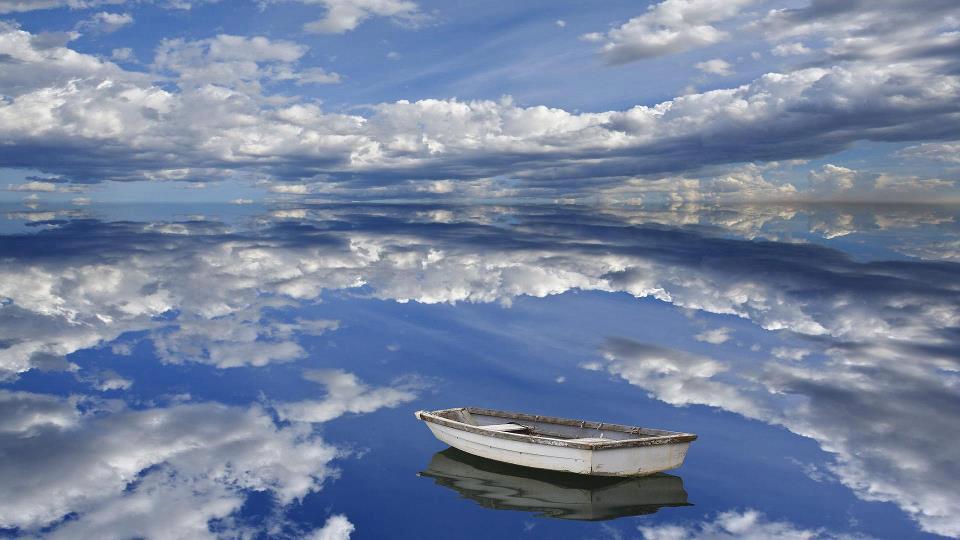
Salar de Uyuni, salt flats in Bolivia, under water
SUMMER SQUASH AND PECTIN (known to be healing in inflammatory intestinal disorders, and now linked to protection against diabetes)
~ “We tend to think about squashes, both summer and winter, as starchy vegetables. This thinking is correct, since about 85-90% of the total calories in squashes (as a group) come from carbohydrate, and about half of this carbohydrate is starch-like in composition and composed of polysaccharides. But we also tend to think about polysaccharides as stagnant storage forms for starch that cannot do much for us in terms of unique health benefits. Here our thinking is way off target! Recent research has shown that the polysaccharides in summer squash include an unusual amount of pectin—a specially structured polysaccharide that often include special chains of D-galacturonic acid called homogalacturonan. It's this unique polysaccharide composition in summer squash that is being linked in repeated animal studies to protection against diabetes and better regulation of insulin. We expect to see future studies on humans confirming these same types of benefits from consumption of
summer squash.” ~

ending on beauty
Let me not mar that perfect Dream
By an auroral stain
But so adjust my daily Night
That it will come again.
Not when we know, the Power accosts —
The Garment of Surprise
Was all our timid Mother wore
At Home — in Paradise.
~ Dickinson #1335

Frederic Edwin Church: River of Light, 1877
Rob Gonsalves: The Sun Sets Sail
**
THE FIRST RADIO
My great-aunt Regina’s
husband, Edmund, a math teacher,
bought the first radio in town.
The kilohertz apparatus
took up the whole table.
Tall, domed, with the latticed
window of the speaker,
it was the new cathedral.
The tuning knob was the size
of a door-knob; a mustache of light
radiated from the dial.
The back panel could be taken off,
revealing a futuristic
city of vacuum tubes,
some slender and some squat, aglow.
Edmund didn’t listen
to the radio; he only tuned it.
For hours he’d turn the knob,
the red-green arrow stuttering back and forth.
He leaned close, hovering over the frequencies,
adjusting his precision instrument.
The radio blinked and spewed
whines and whistles dopplering
from a squeak to a roar: buzz and clicks,
wheezes, gurgles, crackles, growl;
hysterical snatches of voices
in a Babel of tongues.
When his wife dared to suggest,
“Why don’t we just listen to the news?”
he’d scold her in his most severe
schoolmaster’s voice: “Renia, please —
you don’t understand about these things.”
She didn’t. They were the first
couple in town to get a divorce.
~ Oriana © 2016

Ah, how quickly "futuristic" becomes obsolete, and then forgotten. Thirty or at most forty years from now, who will know what vacuum tubes were?
TRUMP’S INFATUATION WITH PUTIN
~ “Trump is a deeply insecure, emotionally unsettled, psychologically repressed, attention-starved boy from a well-off family with a domineering father and acquiescent mother — an obsessive liar, BS-artist, serial exaggerator, ceaseless braggart, cruel punisher of smaller kids, torturer of defenseless animals.
Putin is a local teen hoodlum from across the wrong side of the tracks, from a poor and archetypically dysfunctional household, strong and laconic, cunning and manipulative, ruthless and implacably vindictive, colorlessly sinister, leader of a tightly knit gang of criminally minded youths.
Trump is fairly infatuated, smitten with Putin. He wants to be like Putin, seeks Putin's benevolent notice, longs to be Putin's favorite acolyte and someone viewed as Putin’s near-equal by the rest of town.” ~ Mikhail Iossel

Oriana:
What is really astounding is that Trump even claimed to have actually met Putin, “who couldn’t have been nicer.” Fact checkers quickly established that no such meeting ever took place. “We were on 60 Minutes together.” True, but one interview was recorded in Moscow, and another in New York. This is not exactly a meeting. Can a feeling of intense affinity lead to a formation of a false memory? Trump is so divorced from reality, so sunk in wishful thinking, that it’s impossible to tell if he’s deliberately lying or believes his own delusions.
I like articles that point out the likely origin of Trump’s narcissism, attention deficit, and other disorders that have been suggested. However imperfect our understanding, the attempt to understand is the opposite of raw, reflexive hatred.
“TRUMP SAYS HE’D ONLY USE NUCLEAR WEAPONS IN A SARCASTIC WAY” ~ Andy Borowitz

HARRIS: ABANDONING THE ILLUSION OF FREE WILL UNDERMINES HATRED
“Hatred . . . is powerfully governed by the illusion that those we hate could (and should) behave differently. TRUE HATRED REQUIRES THAT WE VIEW OUR ENEMY AS THE ULTIMATE AUTHOR OF HIS THOUGHTS AND ACTIONS. Love demands only that we care about our friends and find happiness in their company. It may be hard to see this truth at first, but I encourage everyone to keep looking. It is one of the more beautiful asymmetries to be found anywhere.”
https://www.samharris.org/blog/item/free-will-and-the-reality-of-love
I remain an agnostic when it comes to free will — maybe it’s more a question of degree. At this point, however, the Western culture ascribes a lot of free will to people when none — or only a small degree — can be applied. And if we believe that the person deliberated on his actions ahead of time and decided to do evil while having the other options, then of course we are likely to hate this person.
Less attachment to free will would also mean less self-hatred. Sometimes the most loving thing we can say to ourselves (or to someone else) is “It’s not your fault.”

WHY WE BLAME OURSELVES
~ “Barbara Fried points out that the last four decades have been “boom years for blame,” with neoliberal policy increasingly holding the individual solely responsible for his fate. Freedom and dignity have become intertwined with personal responsibility—and blame is our new rallying cry. The growing fragility of our communities and families over the same time period has solidified the notion that one has only oneself to rely on.
Blame is clearly implicated in power and inequality, as its attribution favors the powerful. But the puzzling question is why people who do not benefit from a system of blame—that is, most Americans—cling so fiercely to its creed. Seeking an answer, I spent several years researching the American working class, the very people whose homes are underwater and whose college debt goes unpaid. I witnessed how blame was deployed in everyday life to solve problems—to anchor the self, judge worthiness, grant dignity, and make sense of failures. In short, I learned that blame is a strategy to make certain what is uncertain.
Blame proves a vital mechanism for coping with the chaos, hopelessness, and insecurity that threatens daily to strip our lives of dignity and order. We numb the ache of betrayal and the hunger for connection by reaching for images of ourselves as masters of own fates.
Self-blame is shored up by a multi-million dollar self-help industry. But its true power lies in its promise that we can will ourselves to happy and successful lives, in its ability to make a virtue out of failure, insecurity, and uncertainty. Those who embrace blame tend to have little empathy for those who cannot pull themselves up by their bootstraps. If I have to go it alone, the logic goes, then everyone else should, too.
As Fried argues, blame is costly, both socially and politically. Blame divides potential communities of solidarity into winners and losers. Even more worrisome, the quest for personal responsibility and the eagerness to blame oneself for failure obscures the larger forces that have weakened our social safety net, our communities, and our families. Doing away with gratuitous blame—directed at others and at ourselves—requires building institutions that restore, carefully and thoughtfully, our collective supply of meaning, trust, and dignity.
http://bostonreview.net/blog/why-people-blame-themselves

Bruegel, Netherlandish Proverbs
WHEN ARE WE READY TO GET MARRIED?
~ “1. When we give up on perfection
We should not only admit in a general way that the person we are marrying is very far from perfect. We should also grasp the specifics of their imperfections: how they will be irritating, difficult, sometimes irrational, and often unable to sympathize or understand us. Vows should be rewritten to include the terse line: ‘I agree to marry this person even though they will, on a regular basis, drive me to distraction.’
One must conclusively kill the idea that things would be ideal with any other creature in this galaxy. There can only ever be a ‘good enough’ marriage.
For this realization to sink in, it helps to have had a number of relationships before marrying, not in order to have the chance to locate ‘the right person’, but so that one can have ample opportunity to discover at first hand, in many different contexts, the truth that everyone (even the most initially exciting prospect) really is a bit wrong close up.
2. When we despair of being understood
Love starts with the experience of being understood in a deeply supportive and uncommon way. They understand the lonely parts of you; you don’t have to explain why you find a particular joke so funny; you hate the same people; they too want to try out a particular sexual scenario.
This will not continue. Another vow should read: ‘However much the other seems to understand me, there will always be large tracts of my psyche that will remain incomprehensible to them, anyone else and even me.’
3. When we realize we are crazy
This is deeply counter-intuitive. We seem so normal and mostly so good. It’s the others…
If we are not regularly and very deeply embarrassed about who we are, it can only be because we have a dangerous capacity for selective memory.
4. When we are ready to love rather than be loved
Confusingly, we speak of ‘love’ as one thing, rather than discerning the two very different varieties that lie beneath the single word: being loved and loving. We should marry when we are ready to do the latter and are aware of our unnatural, immature fixation on the former.
In adulthood, when we first say we long for love, what we predominantly mean is that we want to be loved as we were once loved by a parent. We want a recreation in adulthood of what it felt like to be ministered to and indulged. In a secret part of our minds, we picture someone who will understand our needs, bring us what we want, be immensely patient and sympathetic to us, act selflessly and make it all better.
This is – naturally – a disaster. For a marriage to work, we need to move firmly out of the child – and into the parental position.
5. When we are ready for administration (the practical side of life)
The Romantic person instinctively sees marriage in terms of emotions. But what a couple actually get up to together over a lifetime has much more in common with the workings of a small business. They must draw up work rosters, clean, chauffeur, cook, fix, throw away, mind, hire, fire, reconcile and budget.
6. When we understand that sex and love do and don’t belong together
The Romantic view expects that love and sex will be aligned. But in truth, they won’t stay so beyond a few months or, at best, one or two years. This is not anyone’s fault. Because marriage has other key concerns (companionship, administration, another generation), sex will suffer. We are ready to get married when we accept a large degree of sexual resignation and the task of sublimation.
7. When we are happy to be taught and calm about teaching
We are ready for marriage when we accept that in certain very significant areas, our partners will be wiser, more reasonable and more mature than we are. We should want to learn from them. We should bear having things pointed out to us. We should, at key points, see them as the teacher and ourselves as pupils. At the same time, we should be ready to take on the task of teaching them certain things and like good teachers, not shout, lose our tempers or expect them simply to know. Marriage should be recognized as a process of mutual education.
8. When we realize we’re not that compatible
The Romantic view of marriage stresses that the ‘right’ person means someone who shares our tastes, interests and general attitudes to life. This might be true in the short term. But, over an extended period of time, the relevance of this fades dramatically because differences inevitably emerge. The person who is truly best suited to us is not the person who shares our tastes, but the person who can negotiate differences in taste intelligently and wisely.” ~
http://thephilosophersmail.com/relationships/when-is-one-ready-to-get-married/ Oriana:
I think the best foundation is a” deeply supportive relationship.” That’s what makes it all worthwhile. And if it’s missing, the marriage can go from “good enough” to “miserable” (even “hell on earth”) in a very short time. Fortunately, that deeply supportive attitude that seems to come so easily during the first months of love can be re-acquired and developed as we learn how to be truly kind.
As this wise article points out, compatibility is an illusion that breaks down “up close.” We have to stop insisting on it. To be sure, there are degrees — sometimes you take one look at a person and have a strong premonition that this is a Trump supporter. Similar levels of education and shared cultural interests help, but they are not a guarantee. I also think that a lot depends on one's stage of life. In youth we have more energy to deal with another person up close and on a daily basis; later we may treasure autonomy and peaceful solitude more than the so-called “companionship.”
Finding the right balance of closeness and distance is tricky but doable — if the motivation is there. For an older woman who is reasonably financially secure, the motivation isn't that strong, especially if she is creative and needs a lot of solitude.
Still, to have “someone who cares” is a treasure. It doesn’t have to be a domestic partner as long as it’s an affectionate, supportive friend.
**
So when are we ready for marriage? When are we mature enough? We mature DURING marriage, and thanks in part to marriage — but not rushing in too early makes sense. My parents waited until 35, and it seems to have been a factor in how happy they were with each other (of course there are no ideal marriages).
Maybe, as Margaret Mead observed, we need different kinds of marriage for different stages of life: a marriage devoted to parenthood is one thing, and a marriage that’s best for later-life companionship is another. With luck, the same marriage can evolve to suit our needs, but in practice we don't see that all that often — while we do see couples who wage marriage as warfare, or as silent desperation.
Emerson said something surprising for the Victorian era: that we shouldn’t blame ourselves if we end up in an unhappy marriage. And with that kind of self-compassion, compassion toward the spouse also develops, and peaceful coexistence and cooperation can be built. Or an amicable parting (back then, of course, people just waited for the spouse to die).
But there is no need for gloom. I’ve met a number of people who’ve ended up with “good enough” second or third marriages that they don’t hesitate to call “happy.” The first marriage, they tend to say, is a “learning experience.” And the wonderful thing is that we do
learn.

BIOLOGICAL EVIDENCE AGAINST “INTELLIGENT DESIGN”
~ “Sinuses. Blind spots. External testicles. Backs and knees and feet shoddily warped into service for bipedal animals. Human birth canals barely wide enough to let the baby's skull pass — and human babies born essentially premature, because if they stayed in utero any longer they'd kill their mothers coming out (which they sometimes do anyway). Wind pipes and food pipes in close proximity, leading to a great risk of choking to death when we eat. Impacted wisdom teeth, because our jaws are too small for all our teeth. Eyes wired backwards and upside-down. The vagus nerve, wandering all over hell and gone before it gets where it's going. The vas deferens, ditto. Brains wired with imprecise language, flawed memory, fragile mental health, shoddy cost-benefit analysis, poor understanding of probability, and a strong tendency to prioritize immediate satisfaction over long-term gain. Birth defects. 15-20% of confirmed pregnancies ending in miscarriage (and that's just confirmed pregnancies — about 30% of all pregnancies end in miscarriage, and as many as 75% of all conceptions miscarry).
And that's just humans. Outside the human race, you've got giraffes with a vagus nerve traveling ten to fifteen feet out of its way to get where it's going. You've got sea mammals with lungs but no gills. You've got male spiders depositing their sperm into a web, siphoning it up with a different appendage, and only then inseminating their mates -- because their inseminating appendage isn't connected to their sperm factory. (To wrap your mind around this: Imagine that humans had penises on their foreheads, and to reproduce they squirted semen from their testes onto a table, picked up the semen with their head-penises, and then had sex.) You've got kangaroo molars, which wear out and get replaced — but only four times, after which the animals starve to death. You've got digger wasps laying their eggs in the living bodies of caterpillars — and stinging said caterpillars to paralyze them but not kill them, so the caterpillars die a slow death and can nourish the wasps' larvae with their living bodies.
You're going to look at all this, and tell me it was engineered this way on purpose?
Yes, there are many aspects of biological life that astonish with their elegance and function. But there are many other aspects of biological life that astonish with their clumsiness, half-assedness, inefficiency, pointless superfluities, glaring omissions, laughable failures, "fixed that for you" kluges and jury-rigs, and appalling, mind-numbing brutality. (See Some More of God's Greatest Mistakes for just a few of the most obvious examples.) If you're trying to reconcile all this with a powerfully magical creator god who made it this way on purpose, it requires wild mental contortions at best, and a complete denial of reality at worst.” ~
http://www.alternet.org/belief/why-you-cant-reconcile-god-and-evolution

Oriana:
“The perfection of the world” was supposed to be the the strongest argument for the existence of god. I distinctly remember the idea from my religion lessons. Imperfection (e.g. disease, natural disasters) was ascribed to the fallen state of humanity and god’s inscrutable will. But the wonders of biology, e.g. the intricacy of the human eye, were supposed to be an obvious proof that a creator designed it all — that’s why perfection prevailed. Yet here is an example after example of “bungling” — explainable only by tracing evolution, a slow and imperfect process that can succeed marvelously given millions of years, or fail within a short time, the species going extinct.
I learned much of this in my first college biology class, decades ago, so for me this was just a neat summary. But I have met those who seriously argue that god "designed" evolution. This is a common cognitive bias: if something exists, it must have been "made" for some particular purpose by an intelligent agent. An excellent book on the types of cognitive bias underlying religious beliefs is Jesse Bering's “The Belief Instinct.” Of course one way out of this would be to posit an imperfect, limited, not especially talented deity — a bumbling sort of god who makes mistakes — but that’s not the kind of god that people want.
The more we discover about the workings of nature, the more we can see the independence of its processes from any deliberate design that would make sense to humans. Dawkins is at his best discussing evolution and how it doesn’t depend on an infinitely wise divine “watchmaker.” Eventually the argument that there simply had to be a creator will be seen as childish, on par with the flat-earth arguments of the sort, If the earth were round, then then on the opposite side would walk upside down.

Gauguin: The Yellow Christ
“Christianity: man is crucified upon his own body.” ~ Charles Baudelaire
THE MAN WHO DISCOVERED THE DWARF DINOSAURS OF TRANSYLVANIA
In 1895, Baron Franz Nopcsa’s sister Ilona was walking along a riverbank near the family home when she found an unusual-looking skull, and she brought it to her teenage brother. It soon became his obsession.
The skull belonged to a previously undiscovered duck-billed herbivore from the dusk of the Mesozoic, around 70 million years ago, and was buried in sediment before a mass extinction that would wipe out three-quarters of all plant and animal species on earth. Crushed by geological forces, the skull was in terrible shape.
In the fall, Nopcsa entered the University of Vienna and took the skull with him. Like a cat with a gift rat, he presented it to his professor, a famous geologist, expecting him to take it from there. But the professor sent Nopcsa back to Transylvania and told him to figure it out for himself. Whether it was lack of interest or funding or the cunning strategy of a master teacher, it was the making of a great scientist.
In the library of Sacel Castle, Nopcsa taught himself geology, physiology, anatomy and neurology. He wrote to scientists all over Europe asking for more books. At the time, very few European dinosaurs had been found. Unable to compare his fossils with others, he relied on his imagination. Working along the river strata, he began to excavate, preparing the fossils he found with homemade glue. From the tiniest scratch on the fossilized braincase, he speculated about the relationship between the pituitary gland, which regulates growth, and an organism’s size, applying what he’d learned of soft tissue and blood circulation. Drawing on the jaw mechanics of lizards and alligators, he rearticulated his dinosaur’s jaw and envisioned its musculature. In this, he was breaking new ground—comparing his dinosaur to living things.
In time, Nopcsa would identify 25 genera of reptiles and five dinosaurs—the duck-billed Telmatosaurus transylvanicus, the beaked and bipedal Zalmoxes robustus, the armored Struthiosaurus transylvanicus and Magyarosaurus dacus and the meat-eating Megalosaurus. Four of these would become the “type specimens” of their species, the fossil blueprints against which all examples would be judged.
The Hateg dinosaurs turned out to be unique. They were unusually small—in some cases nearly miniatures. Nopcsa’s titanosaur belonged to a family of massive sauropods reaching lengths of 100 feet and weights of 80 tons, yet M. dacus was the size of a horse. His Telmatosaurus was smaller than a crocodile. Others were roughly an eighth the size of their non-Romanian cousins. The question was, why?
The most obvious possibility was that Nopcsa had found juveniles. Yet he didn’t believe this to be the case, and he was determined to prove otherwise. Certain bones grow together with age, and a good comparative anatomist, which Nopcsa was, can tell the developmental age of an organism by examining these sutures—so long as he has the right bones. But paleontologists don’t get to choose their bones, and Nopcsa’s Transylvanian miniatures presented either the wrong ones or were crushed beyond analysis. Looking for other ways to discern age, Nopcsa began to examine slices of bone under a microscope to study cell structure.
“Bones grow from the inside out, like trees,” explains Weishampel. “It’s possible to guess an age by counting the rings.” Today this method is known as paleohistology, and Nopcsa’s significant early contributions, particularly in determining which bones are most useful for analysis, remain largely uncredited, according to Weishampel.
Certain that his dinosaurs weren’t juveniles, Nopcsa looked to explain why they seemed unable to grow beyond a certain size. And he began to formulate the argument that Hateg was once an island—another claim supported by research after his death. Hateg Island’s environmental pressures, he concluded, limited the dinosaurs’ development.
“Islands are unique places, where biology gets a free hand,” says Weishampel. “Large animals tend to get smaller—for example, the dwarf elephants of Malta, hippos in the Mediterranean.” And, as it happens, the dwarf dinosaurs of Transylvania. The theory is that fewer food options lead to the success of animals with smaller anatomies. “And small animals,” Weishampel continues, “tend to get larger, like Komodo dragons, boas and tortoises in the Galápagos.” Nopcsa correctly identified the first set of conditions, and the second, scientists now speculate, can be explained by the idea that animals whose body sizes are held in check by predators on large landmasses tend to expand on an island with fewer of them. Nopcsa’s theory of what he called “island insularity” developed into what scientists now know as the “island rule.”
It is easy for the intrigue and romance of Nopcsa’s exploits, and the manner of his tragic death [by suicide; he was manic-depressive], to obscure the quieter fact that the baron was one of the great scholars and scientific minds of his time—and was largely self-taught. He was one of the first scientists to look at fossilized dinosaur bones and see a living, social creature. In fact, he was a staunch believer in the evolutionary relationship between birds and dinosaurs, decades before the idea became widely accepted among paleontologists. His overall contributions to the field have led some to call him the forgotten father of dinosaur paleobiology. “Nopcsa was asking questions nobody else was asking,” says David Weishampel, a paleontologist at the Center for Functional Anatomy and Evolution at John Hopkins University School of Medicine.
Nopcsa was equally brilliant as a structural geologist. While most of the scientific community still scoffed at the theory of continental drift, he provided some of the strongest evidence for such movement. He mapped the geology of Albania and became one of the country’s foremost ethnographers and historians. “It would be no exaggeration to say that he knew the country and its people better than any foreigner of his day,” says Robert Elsie, a scholar of Albania and the translator and editor of Nopcsa’s memoirs, published in English in 2014.
Over his career, Nopcsa published several tomes and more than 150 scientific papers. Yet his name barely appears in textbooks. No historical plaque adorns any of the places he lived or taught. Even his grave is unmarked.
http://www.smithsonianmag.com/history/history-forgot-rogue-aristocrat-discovered-dinosaurs-died-penniless-180959504/?no-ist

opalized dinosaur jaw
ending on beauty:
Ah, the earth fooled
the singer, the many-voiced
Eurydice, from ravine,
from waters. She bows
our backs deeper in the
dank weed, before the year
goes out, with showers,
with angry rain.
~ Johannes Bobrowski
I love the way the earth becomes "the many-voiced Eurydice." This is a poem of the northern climate, so Eurydice, like Persephone, departs into rain and darkness . . . until the many-voiced springtime.
Note the musical repetition: “from ravine, from waters” and later “with showers, with angry rain.” There is something atmospheric, something that says “poetry” — and it results from
the mere omission of "and."


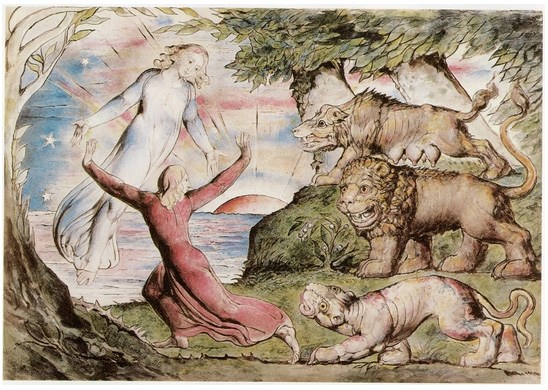
I faced a spotted Leopard, all tremor and flow
and gaudy pelt. And it would not pass, but stood
so blocking my every turn that time and again
I was on the verge of turning back to the wood.
This fell at the first widening of the dawn
as the sun was climbing Aries with those stars
that rode with him to light the new creation.
Thus the holy hour and the sweet season
of commemoration did much to arm my fear
of that bright murderous beast with their good omen.
Yet not so much but what I shook with dread
at sight of a great Lion that broke upon me
raging with hunger, its enormous head
held high as if to strike a mortal terror
into the very air. And down his track,
a She-Wolf drove upon me, a starved horror
ravening and wasted beyond all belief.
She seemed a rack for avarice, gaunt and craving.
Oh many the souls she brought to endless grief!
~ Dante, Canto I, tr John Ciardi
The three beasts are mentioned in Jeremiah, and probably refer to three different countries hostile to ancient Israel.
Mark Musa (regarded as Dante’s best annotator):
“The early critics thought of the three beasts that block the Pilgrim’s path as symbolizing three specific sins: lust, pride, and avarice, but I prefer to see in them the three major divisions Hell. The spotted leopard represents Fraud. The lion symbolizes all forms of Violence. The she-wolf represents the different types of Concupiscence or Incontinence.”

This is Blake, of course. Who else could create such distinctive and endearing, anatomically incorrect human and animal forms?
Oriana: The she-wolf made me think of the Hungry Ghosts, for whom nothing is ever enough. Maybe “greed” would be the best simple word for this.
However, the she-wolf (lupa) is also a word for prostitute, so lust has been suggested. And wolves have been unjustly accused of meanness in general — and yet a she-wolf can also be a symbol of nurturing, or else we wouldn’t have the myth of infants being adopted and raised by wolves. Animal symbolism can be tricky. There is nothing intrinsic about the wolf to suggest a specific category of sin.
Lions are widely represented in art. They look impressive — but are they any more violent than any other predator? They hunt only when hungry — it’s about the need for food, not any kind of joy in killing, or tendency to violent rage. In the wild, an enraged lion is probably extremely rare. These are cats. They sleep a lot.
They are the only social felines, and they form emotional bonds within the group.

 But, in the human mind, here is a possible link between lions and violence. What humans project on lions is PRIDE. And there is indeed a relationship between pride (think of an inflated ego) and the kind of violence that proceeds from wounded pride.
I’ll never forget the lecture on pride at the Los Angeles Jung Institute. It was the first one in the series on the Seven Deadly Sins. Pride is always listed as the first and greatest deadly sins — all other sins are said to follow from pride in some way. While the connection between pride and lust or gluttony could be questioned, there is indeed a connection — in humans, not among lions — between pride and violence, the lecturer, a former prison psychologist, pointed out. “If you want to see pride, visit a prison,” he said.
I have done some work in prisons, and I can confirm that. That’s where you find huge egos, and the demand for “respect.” Now, outsiders would say that criminals ought to feel shame, not pride — but the fact is that the inmates, having been nearly universally abused in childhood, disvalued and made to feel powerless, have a tremendous need to pretend that they are powerful and important. They’d rather be feared than liked — to be feared is a sign of “respect.” And to enforce that kind of fear-based respect, they are ready to use violence. Scarred from trauma, they are always defending their “honor.”
As for the leopard and fraud, the beauty of that animal’s coat also implies the negative associations of beauty that can be attached to a beautiful person. Their attractiveness implies the power to deceive. I'm reaching here, I know. Let’s face it: there is nothing obvious about seeing a leopard as a symbol of fraud. No wonder even critics are confused, not to mention the average reader.

Using animals to represent “sin” is ridiculous on the face of it. But the Middle Ages saw all living being as “fallen” and ruled by Satan. In the modern times, we are finally beginning to see that even humans are not inherently “sinful” or evil by nature. With rare exceptions (we don’t really understand true psychopathy; it may stem from brain abnormalities), a bad human being, like a “bad” dog, has been abused. They act out of their wounds.
Extreme stress can be another cause of violence. When starved men fight over food, there is no mystery about that.
Yet another cause is indoctrination with hate speech. Again, it’s the most emotionally damaged individuals who will be most susceptible.
**
The sun shone, having no alternative, on the nothing new. ~ Samuel Beckett, Murphy, 1938

This Black Iris by O'Keefe is less well known
Speaking of nothing new, there is also the sorrow of re-reading something you wrote in youth, thinking it was wisdom, while it was merely youth:
LOVE: IT DEPENDS ON YOUR STAGE OF LIFE
Youth:
“We don’t know what love is.
Why in our heads we love
someone quite different
from the one we say we love.
If we love the same person
in different guises
every time.
If that person is really
ourselves.
Is it all an illusion.
Is it only dressed-up sex,
as Tolstoy said —
how come we don’t fall in love
with a brilliant 80-year-old
who happens to share our spiritual interests?
Is it worth it.
Why is it so easy to love
a dog or a cat.
Maturity:
Because a dog or a cat will never criticize you.
One day you realize that Prince Charming would be a nightmare.
You come to agree with Kurt Vonnegut’s: “You learn to love whoever is there to be loved.”
And you feel blessed.

Chagall The Song of Songs
**
When marrying, ask yourself this question: Do you believe that you will be able to converse well with this person into your old age? Everything else in marriage is transitory. ~ Friedrich Nietzsche
My parents had that kind of marriage. got married at 35, after they have already “found themselves” and knew they wanted a companion with the same or very similar interests. They were lifelong best friends. They liked to take long walks, during which they talked, talked, talked.
My mother's birthday was August 4, and my father's, November 4 -- so she was 3 months older. He liked to joke that he liked older women.
 Diane Arbus, 1962
WILLIAM JAMES WAS RIGHT: WE FEEL SAD BECAUSE WE ARE CRYING
~ “LeDoux began his career in science working under the neuroscientist Michael Gazzaniga, well-known for his research on “split brain” patients, that is, patients whose left and right hemisphere are disconnected from one another in a surgical procedure designed to help control severe epilepsy. These individuals’ brains are unable to integrate information from both sides in the usual way — in experiments with split brain patients, it was possible to present information to only one half of the brain (by flashing it to only eye, and not the other) and watch as the other half struggled to create an elaborate story to explain away the behaviors it had no conscious awareness of having performed. For instance, if a humorous prompt were shown to the right hemisphere of the brain, the patient would burst out laughing, yet not know why. Instead of confessing their confusion, they would rush to say something like, “You guys are so funny.” LeDoux saw firsthand in these studies the brain’s tenacious need to cook up narratives to explain itself to itself. “The idea is that what’s consciousness does,” LeDoux says. “It creates these explanations or ideas about behavior.”
That early observation is foundational to what LeDoux now believes about why we experience emotions like fear and anxiety. In the face of danger, the brain kicks into defense mode, detecting the threat faster than our conscious awareness can ever operate, and sending a host of marching orders throughout the brain and the body, readying all systems to take action. It’s only after this process has begun that the emotions of fear and anxiety rise into consciousness — and only if, LeDoux says, “you have a brain that can be conscious of its own activity,” a brain with the “ability to conceptualize all of that, to label it linguistically, and to integrate it with thoughts and memories.” In other words, fear and anxiety are not wired into the brain as basic responses to the world around us — rather, the responses that lead to them are, and they only coalesce into fear when the brain interprets them as such.
To feel afraid is to be conscious of fear — so the question of where exactly feelings like fear and anxiety arise in the brain is intimately tied to nothing less than the ongoing mystery of how our brains pull off the great feat of consciousness itself.
LeDoux argues that the activities of this basic neural defense system do not account for the actual experience of fear, even though it has become commonplace in neuroscientific research to act as if they do, using, for instance, the instinctive, defensive behaviors of animals like fleeing or freezing to stand in for the larger, more complex phenomenon of being afraid. Rather, anxiety and fear arise only after the brain’s threat system has unconsciously picked up and responded to the first scent of danger — and not from any one single part of the brain, but from many.
Because there are both conscious and unconscious processes at work when anxiety spirals out of control, LeDoux believes that effective treatments would have to engage differently on each level — the whirling subliminal, automatic circuitry that patients aren’t even aware of needs to be subdued before the second-step project of addressing the higher level of conscious thoughts and feelings can begin.
LeDoux is well aware that in his struggle for precision and clarity, he’s taking on a serious challenge. It’s no easy task to undo decades of common usage. “Not everyone is happy with this,” he says, but “as a scientist you have some obligation to get as close to the truth as you can, and nothing gets in the way of truth as much as language does.” ~
http://nymag.com/scienceofus/2015/07/everybody-misunderstanding-fear-and-anxiety.html
Oriana:
William James was the first to promote an interpretation theory of emotions. According to James, body responses come first, e.g. a lump in the throat. Then we call it sadness. Consciousness lags behind the body. “You feel sad because there are tears in your eyes,” my first psychology instructor explained — and we found it a very strange, “backwards” explanation. Now neuroscience seems to be bearing it out: the automatic physiological response precedes the conscious interpretation. Block the adrenaline, and calm will persist.
The survival responses are faster than consciousness because they are ruled mainly by the brain stem, the oldest neural structure in terms of evolution. Consciousness comes after, with its “stories” and justifications. Suppose there is a sudden noise. We “jump” first — the startle response — then, primed with adrenaline for “fight or flight,” we look around to see if the danger is real.
Not that the stories we make up, the post-hoc explanations, are not important. We need to make sense of what is happening. We also need a “story of me.” Alzheimer’s victims lose that partly fictitious but nevertheless crucial “story of me” along with the ability to interpret their life and their environment. It’s striking how anyone with dementia starts making up stories — because stories are so essential to us.
But the story comes second. William James was brilliant — and totally ahead of his times.

DID ZEUS EXIST? WHY THE GREEKS BELIEVED IN THEIR GODS (the argument from personal experience, e.g. miracles)
~ “Why did belief in the gods persist in spite of critical challenges? What evidence seemed decisive to the ancient Greeks? Robert Parker, in his “On Greek Religion,” emphasizes the role of what the Greeks saw as experiences of divine actions in their lives. ”The greatest evidence for the existence of gods is that piety works . . . the converse is that impiety leads to disaster,” with by far the most emphasis given to the perils of ignoring the gods.
There were also rituals, associated with the many cults of specific gods, that for some worshipers “created a sense of contact with the divine. One knows that the gods exist because one feels their presence during the drama of the mysteries or the elation of the choral dance.” More broadly, there were “epiphanies” that could “indicate not merely a visible or audible epiphany (whether in the light of day or through a dream . . .) but also any clear expression of a god’s favor such as weather conditions hampering an enemy, a miraculous escape, or a cure; it may also be used of the continuing disposition of a god or goddess to offer manifest assistance.
Most of us do not find our world so filled with the divine, and we may be inclined to dismiss the Greeks’ “experiences” as over-interpretations. But the people who worshiped Zeus claimed to experience his presence in their everyday lives and, especially, in their religious ceremonies.”
From a comment: (this article elicited 744 comments)
Dionysos — the Zeus of Turkey's Mount Nysa — died each fall, was buried in the sanctuary of Apollo at Delphi, which he would abandon until Dionysos’ rebirth in the spring. “He is risen,” his believers cried out on the appropriate Sunday sunrise, and Apollo had returned.
The great advances of Greek civilization in the fifth and fourth centuries began quite suddenly when the sophists, whom Plato and Socrates despised, stripped the gods out of the myths. That left them with only the natural phenomena the gods were thought to personify and control. So much for the supernatural. The pagan Greeks made no sharp distinction between nature and any hyper-nature, though it is easy for us to see them edging towards it. Christianity defined the boundary.
And another comment:
If you believe in god, does it bother you that all gods that have even been created/worshiped have all acted in the same way as yours does? As though they don’t exist at all. And the reasons that you believe in your god, personal experience, believing that prayer or sacrifice actually work, filling your unanswered questions about the world with a god etc are the same reasons that people gave for believing in past gods. And are the same reasons given for believing in other current gods. The supernatural doesn’t exist, only questions do. And those questions won’t be answered until evidence leads us there. If you jump to supernatural conclusions every time you don't understand something you have a primitive mind and are thinking like people who lived thousands of years ago.
And another:
Does God cease to exist when there are no humans that believe in him? if so, how many does it take to sustain his reality? A million? A thousand? One?
And the inevitable one:
Amazing intellectual acrobatics to avoid the obvious conclusion that there is no more reason to believe in a Judeo-Christian god than there is to believe in Zeus.
http://opinionator.blogs.nytimes.com/2013/07/31/did-zeus-exist/?src=rechp&_r=2
Oriana:
It’s interesting that the arguments the ancient Greeks used to “prove” the existence of the gods are the same are those used today: prayer (and animal sacrifice) works, while lack of prayer brings on disaster; believers experience the god’s presence and receive signs and miracles . . . same stuff, pointing to human psychology rather than external reality. It’s known as the “argument from personal experience.”
“I sacrificed a bullock to Zeus, and my son came back from the war alive” — who could fail to be persuaded by that?
Here is an interesting exercise: replace the word “god” with “Zeus”:
Zeus works in mysterious ways.
Zeus sends suffering to those he loves.
Zeus never sends you more suffering than you can bear.
Man was created to serve Zeus.
**
Whether it’s Yahweh or Zeus, as long as an imaginary invisible Superman is put ahead of human beings and the principle of kindness, evil is inevitable. And the same goes for ideologies and institutions, whether it’s the Catholic church or the communist party.
THE “MALE WARRIOR” IN SPORTS
~ “The researchers concluded that men are much more likely than women to engage in friendly physical contact—such as pats on the back, hugs, and interlocking handshakes—following athletic competition. The duration and frequency of affectionate physical contact after competing against a rival served as a benchmark for rating the strength of someone's pro-social intentions.
Benenson believes these findings give credence to what evolutionary psychologists refer to as the "male warrior hypothesis." This is the notion that males purposely nurture warm feelings after conflict to increase their odds of having allies to help defend their group in the future. In a statement, Benenson said,
“Our results indicate that unrelated human males are more predisposed than females to invest in a behavior, post-conflict affiliation, that is expected to facilitate future intragroup cooperation. This finding feels very counterintuitive because we have social science and evolutionary biology models that tell us males are much more competitive and aggressive."
Throughout our evolution, prevailing in competitions has been a keystone of the survival of the fittest. The importance of post-conflict reconciliation between fierce opponents is often underestimated. This research suggest that making conciliatory physical gestures immediately after the dust has settled, might prevent someone from holding a grudge or being a sore loser.

Conclusion: Why Would Women Be Less Willing to Reconcile After a Conflict?
In today's world, sportsmanlike displays of affection after an athletic competition have the power to facilitate future cooperation and friendship when athletes become comrades off the court. This phenomenon has been demonstrated in both chimpanzees and humans. Typically, whomever invests more in post-conflict resolution by being physically affectionate fosters future cooperation more effectively.
The male warrior hypothesis proposes that the overall success of our ancestors’ in-groups relied on the ability of men to triumph in one-on-one conflicts—while maintaining cooperation within the group and solidarity with outside groups.
The whole community benefits when unrelated men triumph over threatening external groups. On the flip side, women gain more by sticking close to family members and having one or two close friends who can share the burden of raising children.
From an evolutionary perspective, the researchers believe these factors drive women to reconcile with fewer individuals, while men strive to keep the peace with a larger number of unrelated same-sex peers. Could this explain why the "old boys' club" is such a formidable and widespread fraternity?” ~
https://www.psychologytoday.com/blog/the-athletes-way/201608/harvard-study-gives-credence-the-male-warrior-hypothesis
WHO STILL SMOKES? THE POOR, THE UNEDUCATED, ALCOHOLICS AND THE MENTALLY ILL
In the 1960s, more than 40 percent of Americans smoked. Now, that's down to 18% . Not only are fewer people smoking, heavy smokers are consuming fewer cigarettes.
Smoking is far more common among those living below the poverty level, those with GED-level education, and among American Indian or Alaskan Natives. Rates are also much higher in the lesbian, gay and transgender community.
The Midwest has a higher smoking rate than other areas and nearly double the rate in the West.
West Virginia has the highest rate in the country.
Only 6% of those with post-graduate education smoke.
http://www.npr.org/sections/health-shots/2014/07/31/336386346/amid-smoking-decline-look-whos-still-lighting-up

(From a different source:) Surprisingly, few studies have addressed the association between smoking and drinking despite the fact that 80 to 95% of alcoholics smoke cigarettes. NIAAA estimates that alcoholism is 10 to 14 times more prevalent among smokers than non-smokers. Other studies estimate that roughly 70% of alcoholics are classified as "heavy smokers", smoking more than one pack a day.
Approximately 85% of people who have schizophrenia are also heavy cigarette smokers, and 60% to 70% of people with bipolar disorder. It’s been suggested that it’s self-medication, and it makes some sense: the long exhale is soothing.
ending on beauty:
“If God had been here this summer, and seen the things that I have seen—I guess that He would think His Paradise superfluous” ~ Emily Dickinson Letters, 1856.
This reminds me of Jack Gilbert's title, "We have already lived in the real paradise." An imperfect paradise, to be sure, but still a paradise.


 Gustave Doré, Satan in the Lake of Ice. Doré doesn’t literally follow Dante’s description in every detail; we can only faintly make out the three faces, a perverse parallel to the Trinity, and the legs of Judas dangling from his mouth. This marvelous, husky Satan is almost amiable. Note the souls nearest Satan, vertical in the ice "like straws in glass."


 Bosch: The Ascent of the Blessed. The nudity — the soul is tends to be nude in art — but without genitals. But why are the angels almost always dressed? Note the strange globe at the top, with the entrance to heaven — it has a ceramic look.