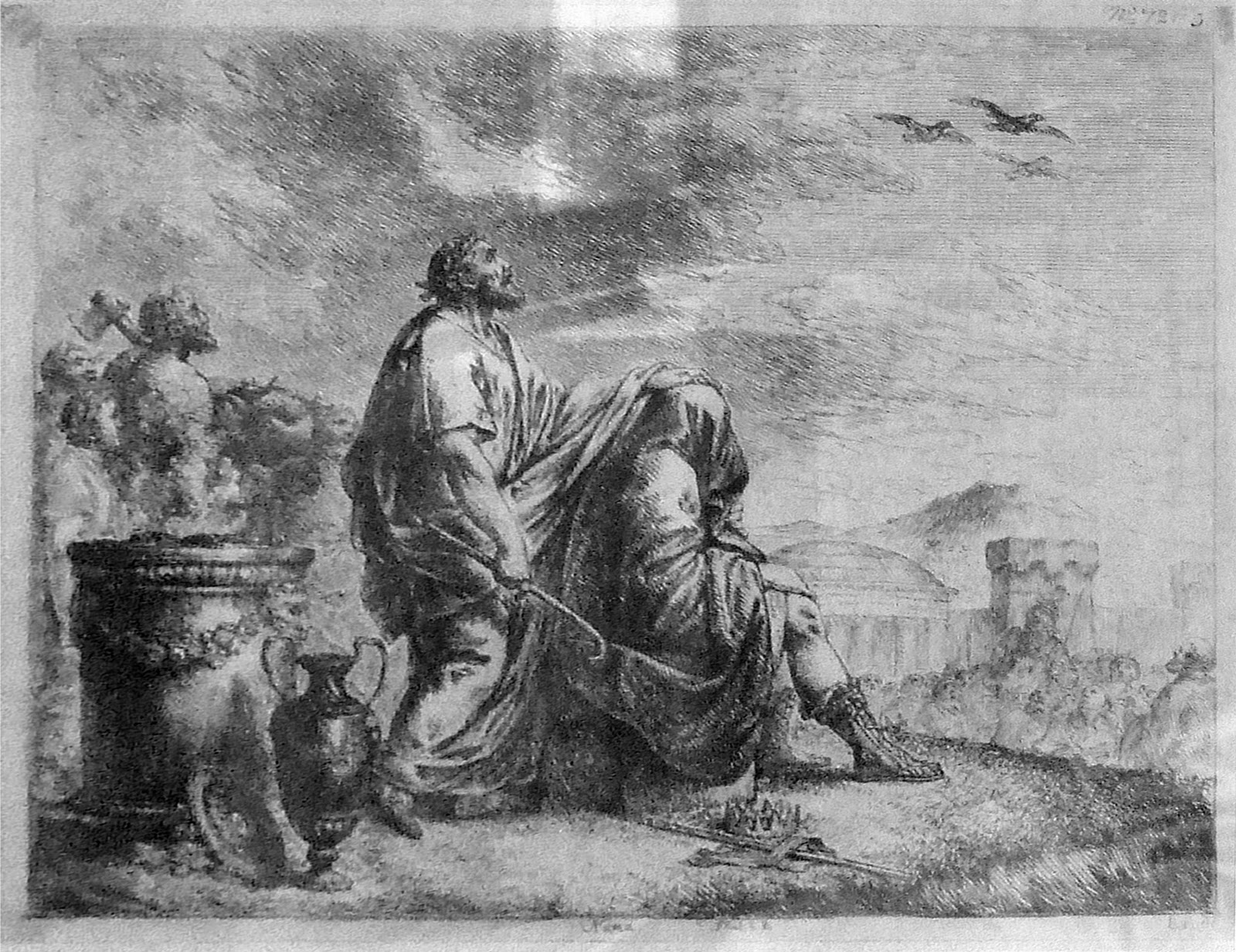
[Augur, Bernhard Rode, 1769]
Did you know in ancient Rome
priests called augurs studied
the future by carefully watching
whether birds were flying
together or alone, making what
honking or beeping noises
in what directions? It was called
the auspices. The air
was thus a huge announcement.
Today it’s completely
transparent, a vase. Inside it
flowers flower. Thus
a little death scent. I have
no master but always wonder,
what is making my master sad?
~ Matthew Zapruder, from “Erstwhile Harbinger Auspices”
Pardon the banality of this observation: we have long ago lost pagan animism, and the honking of wild geese in flight – if we ever even manage to see them – does not exactly announce anything specific to us, despite Mary Oliver’s assertion. We have lost the medieval “correspondences” as well, with everything somehow adding up to crucifixion and salvation. Wordsworth and Emerson tried to make us believe in the Oversoul and Nature (with a capital N), but except for a tiny percentage of the educated public (and there can be some doubts even about that tiny fraction), the transparent eyeball of Transcendentalism has not caught on, though remnant chunks of it may be found in the stew of New Age beliefs.
Here is the same poet mulling over his failure to feel at ease with the world.
Maybe the “chosen guide” Wordsworth
wrote he would even were it “nothing
better than a wandering cloud”
have followed which of course to me
and everyone sounds amazing.
All I follow is my own desire,
sometimes to feel, sometimes to be
at least a little more than intermittently
at ease with being loved. I am never
at ease. Not with hours I can read or walk
and look at the brightly colored
houses filled with lives, not with night
when I lie on my back and listen,
not with the hallway, definitely
not with baseball, definitely
not with time. Poor Coleridge, son
of a Vicar and a lake, he could not feel
the energy. No present joy, no cheerful
confidence, just love of friends and the wind
taking his arrow away. Come to the edge
the edge beckoned softly. Take
this cup full of darkness and stay as long
as you want and maybe a little longer.
~ Matthew Zapruder, from “The Prelude”
"Take this cup full of darkness" -- this is what the Jungian psychologist Robert Johnson calls the complex Hamlet consciousness, and Hamlet’s prospects for happiness are zero. He simply thinks too much.
Johnson proposes that we need to go beyond the modern Hamlet consciousness to enlightened consciousness, where we worship something again. He leaves it to the individual just what that might be:
Johnson proposes that we need to go beyond the modern Hamlet consciousness to enlightened consciousness, where we worship something again. He leaves it to the individual just what that might be:
Something of the subtle inner world becomes your center of gravity: poetry, music, a new perceptiveness while jogging, a blossoming of philosophic inquiry, a new religious understanding – something of this world captures you. (Transformation, p. 104)
For Johnson, this marks the transition from incompleteness to wholeness. I prefer the cognitive framework of James Hollis, who speaks of the transition from being centered in the ego and the question, “What can the world do for me?” to “How can I serve?” And this is where Buddha’s “Make of yourself a light” becomes relevant. You can become a bearer of light through your conduct toward others (respect, generosity, compassion, tolerance), your high ethical standards, your dedicated work, your reverence toward nature.
That answer – “Make of yourself a light” (“The Buddha’s Last Instructions,” p. 68) – appeals to me more than Oliver’s other statement, “There is only one question: how to love this world” (“Spring,” p. 70). Essentially, Oliver does not seem to follow up on “Make of yourself a light” – maybe because so much of it includes how you treat other people, not Oliver’s chief concern. Oliver rarely writes about human relationships. The relationship that concerns her is that of the solitary individual to the natural world.
That is also the primary relationship in much of classical Chinese poetry. But would Po-Chu-i ever say, “There is only one question: how to love this world”? I doubt it. He takes the love of the world (in Oliver’s sense of “nature”) for granted. We love it simply by looking at it, by asking friends to come over to “share the moon.”
There is, however, a deep similarity between Oliver and Po-Chu-I: both seem lonely. Oliver says “I think I will always be lonely in this world” (“Lilies,” p. 77). Ostensibly, within the context of the poem, that’s because the lilies wither or are eaten by cows and the hummingbird flies away, and there we remain, a solitary self, unconsoled by nature that we were hoping would make us happy. “The god of dirt” obviously doesn’t care about humans.
Po-Chu-i never says that he is lonely, but a poem such as “A Guest Doesn’t Come” makes us feel his hunger for friends who have kindred minds.
A Guest Doesn’t Come
Candle flame red and wine clear, I settle in and just wait.
At dawn’s first light, I’m wandering in and out of the gate,
stars thin and moon drifting low. No guest. Night’s now
sunrise lost in willow mist, a magpie taking flight, gone.
( ~ The Selected Poems by Po-Chu-I, translated by David Hinton)
It’s a painful poem. I think both Mary Oliver and Po-Chu-I often seem desperate, though in Oliver’s case it’s the casting around after some kind of sustaining faith and happiness, while Po-Chu-I seems happy enough to be meditating, drinking, and writing in his mountain home – except that he misses friends.
Mary Oliver is also very concerned with mortality. In her most popular volumes, there is a constant grappling with the transience of life. Let’s take a look at the poem in which “the god of dirt” makes an interesting cameo appearance.
One or Two Things
1.
1.
Don’t bother me.
I’ve just
been born.
2.
The butterfly’s loping flight
carries it through the country of the leaves
delicately, and well enough to get it
where it wants to go, wherever that is, stopping
here and there to fuzzle the damp throats
of flowers and the black mud; up
and down it swings, frenzied and aimless; and sometimes
for long delicious moments it is perfectly
lazy, riding motionless in the breeze on the soft stalk
of some ordinary flower.
3.
I’ve just
been born.
2.
The butterfly’s loping flight
carries it through the country of the leaves
delicately, and well enough to get it
where it wants to go, wherever that is, stopping
here and there to fuzzle the damp throats
of flowers and the black mud; up
and down it swings, frenzied and aimless; and sometimes
for long delicious moments it is perfectly
lazy, riding motionless in the breeze on the soft stalk
of some ordinary flower.
3.
The god of dirt
came up to me many times and said
so many wise and delectable things, I lay
on the grass listening
to his dog voice,
crow voice,
frog voice; now,
he said, and now,
and never once mentioned forever,
4.
came up to me many times and said
so many wise and delectable things, I lay
on the grass listening
to his dog voice,
crow voice,
frog voice; now,
he said, and now,
and never once mentioned forever,
4.
which has nevertheless always been,
like a sharp iron hoof,
at the center of my mind.
5.
like a sharp iron hoof,
at the center of my mind.
5.
One or two things are all you need
to travel over the blue pond, over the deep
roughage of the trees and through the stiff
flowers of lightning — some deep
memory of pleasure, some cutting
knowledge of pain.
6.
to travel over the blue pond, over the deep
roughage of the trees and through the stiff
flowers of lightning — some deep
memory of pleasure, some cutting
knowledge of pain.
6.
But to lift the hoof!
For that you need
an idea.
7.
For that you need
an idea.
7.
For years and years I struggled
just to love my life. And then
the butterfly
rose, weightless, in the wind.
“Don’t love your life
too much,” it said,
and vanished
into the world.
just to love my life. And then
the butterfly
rose, weightless, in the wind.
“Don’t love your life
too much,” it said,
and vanished
into the world.
~ Mary Oliver, from Dreamwork, 1986
**
Nevertheless, Oliver constantly urges us to love life. We could even argue that she “protests too much” – or at least too often. We teach (or preach) what we need to learn: in a confessional moment in the last stanza of this poem, Oliver admits that getting to love her own life has been a struggle. The poems that made her famous are those in which she presents nature as an oracle, a source of wisdom, somewhat the way that Wordsworth does, but in a contemporary style:
The god of dirt
came up to me many times and said
so many wise and delectable things, I lay
on the grass listening
to his dog voice,
crow voice,
frog voice; now,
he said, and now,
came up to me many times and said
so many wise and delectable things, I lay
on the grass listening
to his dog voice,
crow voice,
frog voice; now,
he said, and now,
and never once mentioned forever,
which has nevertheless always been,
like a sharp iron hoof,
at the center of my mind.
which has nevertheless always been,
like a sharp iron hoof,
at the center of my mind.
Given the human desire for immortality, can we ever be soothed by the wisdom of the god of dirt, which does not include the word “forever”? Even with the self-help best-sellers extolling “the power of Now,” can we deny that we also want the future? One way to be happy is indeed to be grounded in the now. Another way is to have a love affair with the future, common in the young. The elderly have only the now. If the now is a beautiful sunset, that’s wonderful. If the now is suffering from an incurable chronic disease, it would help to have a belief system (it doesn’t have to be religion in the traditional sense — it can be a personal philosophy to live by) that can sustain us in reasonable contentment no matter what life brings.
Oliver (and many other modern poets, including Jack Gilbert) offers the beauty of nature (which she equates with “the world”) as the closest thing to something that can sustain us. That beauty is one of the greatest gifts that life can offer – but is it enough? Can we exclude the human world as the source of happiness and meaning?
Here I am back to the Buddha’s “Make of yourself a light.” Relating to others in such a way that you are a light in the darkness of ever-present suffering seems to me more meaningful than simply watching a sunset – and make no mistake, I love sunsets, and sunrise, and the clouds, and the trees – I don’t think I love the world any less than Mary Oliver does.
*
A poem such as Plath’s “Poppies in July” is what I call an underworld poem. The inner world is central here, and the darker side of life. I don’t quite know how to classify Oliver’s poems. I think they are an attempt to leap into heaven, the heaven of nature, governed by the god of dirt (interesting that she never says “mother earth”) – but then she has not only swans but owls and vultures, and the leap is not entirely convincing.
As Hyacinth observed, “Thinking of Oliver and her obvious searching for the god she doesn't quite believe in made me think of the woman on the plane who said she never quite put her weight down on the flight. Mary Oliver seems to not quite put her faith down nor is she able to put it away.”
Nor is Po-Chu-I able to find consolation in nature when his little daughter, Golden Bells, dies when she is three years old – he weeps as he notes how tiny her coffin is, and the reader weeps with him.
Po-Chu-I went on as before, making a career of bamboo, lotus blossoms, and water – with the help Taoism and wine to keep him relaxed and accepting of everything, in harmony with the seasons. Mary Oliver converted to Catholicism; predictably, her more devotional poems have alienated some of her former fans.
Thirst
Another morning and I wake with thirst
for the goodness I do not have. I walk
out to the pond and all the way God has
given us such beautiful lessons. Oh Lord,
I was never a quick scholar but sulked
and hunched over my books past the
hour and the bell; grant me, in your
mercy, a little more time. Love for the
earth and love for you are having such a
long conversation in my heart. Who
knows what will finally happen or
where I will be sent, yet already I have
given a great many things away, expect-
ing to be told to pack nothing, except the
prayers which, with this thirst, I am
slowly learning.
for the goodness I do not have. I walk
out to the pond and all the way God has
given us such beautiful lessons. Oh Lord,
I was never a quick scholar but sulked
and hunched over my books past the
hour and the bell; grant me, in your
mercy, a little more time. Love for the
earth and love for you are having such a
long conversation in my heart. Who
knows what will finally happen or
where I will be sent, yet already I have
given a great many things away, expect-
ing to be told to pack nothing, except the
prayers which, with this thirst, I am
slowly learning.
**
Some readers can no longer accept a theistic religion, and, having lost a soul-mate who helped them carry the questions, they yearn for the earlier Oliver, who inspired them with passages such as this one from “The Summer Day,” p. 94:
I don’t know exactly what a prayer is.
I do know how to pay attention, how to fall down
into the grass, how to kneel down in the grass,
how to be idle and blessed, how to stroll through the fields,
which is what I have been doing all day.
Tell me, what else should I have done?
Doesn’t everything die at last, and too soon?
Tell me, what is it you plan to do
with your one wild and precious life?
I do know how to pay attention, how to fall down
into the grass, how to kneel down in the grass,
how to be idle and blessed, how to stroll through the fields,
which is what I have been doing all day.
Tell me, what else should I have done?
Doesn’t everything die at last, and too soon?
Tell me, what is it you plan to do
with your one wild and precious life?
The House of Light
**
“I do know . . . how to be idle and blessed, how to stroll through the fields” – now that’s where Mary Oliver and Po-Chu-I are in complete agreement.
As for myself, I find something I identify with in the photo below – maybe because some years ago, walking down the rocky beach near San Juan Capistrano

Lisa:
On the struggle to believe:
Oriana, I am captivated by this topic, of course, and I am first captivated by the koan, "I have no master but always wonder, what is making my master sad." I suppose this could most simply be interpreted as "I have no master...but/so I'm wondering what is making me sad." I think this being self-insulated, only believing in the self (with a small "s"), and only "following your own desire" (not the wandering cloud) is quite sad. Rather than having a "master" or a guru, I fall back on having the desire to "paint the variegated sky" (Milosz), to "make of yourself a light" (Buddha), or even to "bring the innocence of a gift" (Rumi).
Whoever wants to pain the variegated world
Let him never look straight up at the sun
Or he will lose the memory of things he has seen
Only burning tears will stay in his eye
Let him kneel down, lower his face to the grass,
And look at the light reflected by the ground.
There he will find everything we have lost:
The stars, the roses, the dusk and the dawn.
~ Czeslaw Milosz
The Gift of Water
Someone who doesn't know theTigris River
brings the caliph who lives near the river
a jar of fresh water. The caliph accepts, thanks him,
and gives in return a jar filled with gold coins.
"Since this man has come through desert,
he should return by water." Taken out by another door,
the man steps into a waiting boat
and sees the wide freshwater of theTigris .
He bows his head, "What wonderful kindness
that he took my gift."
Every object and being in the universe is
a jar overfilled with wisdom and beauty,
a drop of theTigris that cannot be contained
by any skin. Every jarful spills and makes the earth
more shining, as though covered in satin.
If the man had seen even a tributary
of the great river, he wouldn't have brought
the innocence of his gift.
Those that stay and live by theTigris
grow so ecstatic that they throw rocks at jugs,
and the jugs become perfect!
They shatter.
The pieces dance, and water...
Do you see?
Neither jar, nor water, nor stone,
nothing.
You knock at the door of reality,
shake your thought-wings, loosen
your shoulders,
and open.
~ Rumi
Someone who doesn't know the
brings the caliph who lives near the river
a jar of fresh water. The caliph accepts, thanks him,
and gives in return a jar filled with gold coins.
"Since this man has come through desert,
he should return by water." Taken out by another door,
the man steps into a waiting boat
and sees the wide freshwater of the
He bows his head, "What wonderful kindness
that he took my gift."
Every object and being in the universe is
a jar overfilled with wisdom and beauty,
a drop of the
by any skin. Every jarful spills and makes the earth
more shining, as though covered in satin.
If the man had seen even a tributary
of the great river, he wouldn't have brought
the innocence of his gift.
Those that stay and live by the
grow so ecstatic that they throw rocks at jugs,
and the jugs become perfect!
They shatter.
The pieces dance, and water...
Do you see?
Neither jar, nor water, nor stone,
nothing.
You knock at the door of reality,
shake your thought-wings, loosen
your shoulders,
and open.
~ Rumi
I am also captivated by the command, "You must never look straight up at the sun or you will lose your memory." It seems that we must always deal with reflections of light, with reflections on the ground we walk upon, with finding what we have lost- which, as Po Chu-I would say, is there all along, as you sit with your friends and watch the moon. Rumi would also say it is there all along in each object, each "jar overfilled with wisdom and beauty."
It seems to me that this "kneeling down" is also essential, this humbling yourself, and this sharing of humility. Yes, Mary Oliver certainly humbled herself when she said "I don't know what a prayer is," and asked the question, "Tell me what it is you plan to do with your one wild and precious life?" I believe that playing the trumpet for the sea is about as close as you can be to a prayer.
**
Oriana:
Thank you, Lisa, for the gift of this rich essay.
Toward the end of The Idiot, Dostoyevski says, “Beauty will save the world.” This statement has puzzled many. Solzhenitzyn took it as the title of his Nobel Prize lecture. I refuse to narrow Dostoyevski’s amazing prophecy to interpretations such as “by beauty, he means the glory of the resurrected Christ.” Never a timid writer, if Dostoyevski meant that, he would have said that. When Dostoyevski says “beauty,” I believe he means beauty in the broadest sense: the beauty of nature, the beauty of a ruined temple, the beauty created by painters, musicians, poets and so forth; and also the beauty of kindness, of generosity, of tenderness. And yes, that would include the beauty of Christ and Buddha, and Moses taking off his sandals when standing on holy ground.
Beauty – and Lisa brought us plenty of that – was called by Simone Weil, “God’s ambush for the soul.” It raises us out of the pedestrian daily self into that other, larger self that Zagajewski speaks about in “Three Angels.” Again taking inspiration from Zagajewski, beauty speaks not the language of petty emotions like envy, but the language of a great dream.
My take on Zapruder’s statement, “I have no master but I always wonder, what is making my master sad?” is that a poet, even if unaware of it, does in fact have a master. It is that larger self which is part of the collective psyche (was it Heraclitus who said, “Each mind is part of the same Logos, but every man thinks his mind is his alone”?) And if the poet is not creating beauty, and pronounces everything to be ruined, dead, devoid of meaning (what Robert Johnson calls the Hamlet consciousness), then the master, the larger self, is indeed sad.
This may not be the interpretation that Zapruder intended, but I don’t care, since now his poem belongs as much to me as to him. A poet doesn’t necessarily know his own message, which in fact belongs to the larger Logos – as well as the universal Eros.
The trumpet player offering his music, his innocent gift, to the sea – yes, that’s the purest expression of the human urge to create beauty. We can call it prayer, we can call it meditation – ultimately it is a deeply human act that transcends all labels. And we don’t laugh when we think of the contrast between the splendor of the Pacific and the man’s amateurish trumpet playing; this is the desert dweller’s gift of pure water to the emperor who lives on the banks of a great river. Nothing we do will impress the Universe, but we keep on adding our drop of beauty. And that makes the master glad.
John Guzlowski:
Beauty will not save the world. If it was going to, it would have done so long before now. I am not saying that there is less Beauty than there was or that Beauty today is in anyway inferior to previous Beauty. I am just saying that there has probably always been Beauty and that it has always failed to save the world.
I think when a poet says something like "Beauty will save the world" what he is in fact saying is that "Beauty has saved me, and since it has saved a wretch like me, it surely will save a wretch like you and all the other wretches in the world." Talking of relatively modern times only, we see this in Wordsworth, Emerson, Thoreau, Whitman, and other romantics and transcendentalists. They each felt the pull of Beauty/Transcendence/The Oversoul and felt wonderfully charged and changed. Each said, "Beauty has saved me and if you do what I did you will be saved."
They thus appear to offer us the hope of salvation through Beauty, but are we ever actually saved by reading writers like Wordsworth, Emerson, and Mary Oliver and doing what they tell us they have done to be saved?
I don't think so.
And were Wordsworth and the others actually saved? Reading the biographies of these men and women suggest they weren't.
Maybe what they meant was that "Beauty has saved me for a little while, or maybe just a bit."
It's a sad thing to say because I'm like everyone else. I want to say, "Beauty will save the world," and believe it.
I hope that tomorrow, when I wake up and look at the cold forests behind my house and the blue, autumn sky above it, I'll have forgotten this meditation on whether "Beauty will save the world."
Oriana:
You know, you’ve hit on something, because beauty (chiefly Mozart, but also the beauty of California
I remember reading various essays that advocated more cultural exchange programs, putting forth the argument that knowing the “enemy’s” dances and songs and poetry and fairy-tales and so-forth, the beauty and universality of art will lessen hostility.
On the other hand, I also realize that for me beauty is the supreme value; only some people treasure beauty even half as much, or even a quarter as much. Those who are “beauty-blind” are probably the ones most prone to violence.
This may sound frivolous, but to me Oscar Wilde’s “I know why there is so much violence in America
I wonder whether the sense of beauty can be developed in every human being. Maybe not. But when I see a man pull over to watch the sun go down into the Pacific, I don’t think this is the kind of man who batters his wife and kids and the dog. Likewise with hikers in the mountains, with their charming friendliness. So while I know that Dostoyevski’s prophecy is hardly guaranteed to come true, I think that he was following a deep intuition about the emotional power of beauty – at least on those who are sensitive to beauty.
Mary Oliver holds the unfashionable belief in beauty and its ability to elevate the soul. In a 2008 interview, she actually said, Beauty leads to virtue. (Ancient Greeks said it too; I’d never dare say it in today’s climate!) That’s why Mary Oliver ignores the critics who want her to put bulldozers in her poems. I think that Po-Chu-I loved beauty just as much – possibly even more. And I can’t help wondering how beautiful the faces of Mary and Jesus would have been if Michelangelo managed to finished the Rondanini Pietà.

John Guzlowski:
I felt bad about sending you the post after I sent it to you. I'm in the thrall of Timothy Snyder's book Bloodlands: Europe between Hitler and Stalin about
I want to be optimistic!
Here's an old poem I wrote about wanting to be optimistic:
My Students and Their Essays
They come to me with papers
on Down’s Syndrome, euthanasia,
grandfathers dying of liver cancer,
the stresses that break young people down
and turn them into suicides,
zombies, and alcoholics with no way out
but more booze and more pain.
And I smooth the pages,
pat them into neat piles, and say,
“Here, here you need a comma; there
a hyphen, and don’t forget to cite your sources
and alphabetize correctly the works cited.”
But this isn’t what I want to say.
I want to tell them the lies I want to tell myself:
Don’t worry, things will get better, life
turns the corner, diligence and
discipline will save us from death.
**
Oriana:
Thanks for the poem. I suspect every teacher has had the same experience endless times: you want to provide guidance, solace, inspiration, but stay in the safe realm of grammar and bibliography and similar matters that can seem awfully trivial in the context.
I never expected things to get better, so when they did, it was a magnificent surprise! And I am astonished still. Are you familiar with these lines by Zbigniew Herbert –
I know it’s hard to be reconciled
not everything is as it should be
but please turn around and step into the future
leave memories behind and enter the land of hope
-- and no one could accuse Herbert of being an optimist! And yet he believed in the human spirit.
Diligence and discipline won’t save us from biological death, but they may save us from the living death of depression (a deadly sin – this is where I admire the wisdom of the Church).
John Guzlowski:
Regarding what you wrote about Beauty of California saving you from suicide, I believe it absolutely. We find our own Beauty and Peace, and it saves us for the world. And if my Beauty and Peace are like yours, then you and I are brother and sister, and will walk in the fields of hope together.
Oriana:
I love what you wrote. Thank you for this marvelous gift.
Just this morning I was pondering the Catholic theodicy I was taught in catechism classes: God allows evil because he does not interfere with free will. This indicates (strangely, this is the first time I had this obvious thought) that God has rendered himself powerless over humans. And, if we follow Simone Weil, and various other thinkers, God does not interfere with the laws of nature. So we get a deity that is not going to stop a terrorist plot or a tsunami.
An invisible man with a beard, sitting on an invisible throne somewhere in outer space (now that the sky has been pre-empted by various airlines), this disembodied being who has allowed Auschwitz and all the other atrocities, seems very remote and hard to accept. On the other hand, reading the gorgeous poems of Po-Chu-I made me think: this poet had beauty, and he had Taoism, a non-theistic religion (or call it philosophy) that treasures beauty and peace, being in harmony with the universal laws – "going with the flow," as we used to say.
Thus, instead of thrashing about in agitated depression, we are told to drop the grasping, the clinging, the resistance. Stop walking in circles in the desert of resentment. Do what comes easily, naturally, without strain. Instead of the Pursuit of Happiness, think in terms of the Pursuit of Peace, and all else will follow. Enjoy beauty -- whether you call it the smile of Christ (as Simone Weil did) or the smile of the universe, or simply beauty.
Speaking of beauty, I’m reminded of Buddha’s famous “flower sermon,” where he sat in complete silence, holding up a flower.
In answer to Einstein's famous question, "Is the Universe friendly?" – we cannot know that, but it is within human power to create a more friendly world. "Peace starts with me" is the first step toward that. One lovely thing about an art colony – even though I am the opposite of a “colony rat” – is that you are surrounded by friendliness.
You of course put it much better, and yes, those of us who have found Peace and Beauty -- even if only sometimes, since we are not perfect -- do walk in the fields of contentment and feel more hope for the world.
Maja Trochimczyk:
I liked the line "make of yourself a light" that you wove into your rich commentary. That's the "beauty that saves" - the high moral, ethical standards, the nobility of conduct, the virtues... Where do they teach virtues these days? Whatever happened to the Fortitude? Prudence? Instead, we are smothered by an avalanche of gadgets, replacing one another faster than we can learn to use them to communicate. What are we using these things for, messages that are "immediate, short, direct" and idea-free on Twitter? Try saying something important in 140 characters or less... "I love you" is short, of course, but as Roland Barthes found out, it is its own message, no reference beyond itself. ...Make of yourself a light - now that's a challenge for a poet, for a human being. That's the way to live.
As for Oliver herself, the problem with post-conversion religious language is that it has, to such a great extent, become a rough, dead shell, defiled by its abuses... the word "Lord" or "Our Lord God" - or "Lord Jesus Christ" - just sounds lame in a poem. It is amazing to realize how limiting religious language is, how poor. It constantly points beyond itself, so it has the quality of a street sign? We had "Messiah" and we have "The Son of God" - all of these expressions are too large and too small simultaneously. Too large for poetry, too small to capture the mystery: they veil instead of revealing.
As for Oliver herself, the problem with post-conversion religious language is that it has, to such a great extent, become a rough, dead shell, defiled by its abuses... the word "Lord" or "Our Lord God" - or "Lord Jesus Christ" - just sounds lame in a poem. It is amazing to realize how limiting religious language is, how poor. It constantly points beyond itself, so it has the quality of a street sign? We had "Messiah" and we have "The Son of God" - all of these expressions are too large and too small simultaneously. Too large for poetry, too small to capture the mystery: they veil instead of revealing.
Re "beauty that saves" - someone said that "Mount Carmel" (religion) and Mount Parnassus
It is extremely hard to write good religious poetry, I keep trying and what comes out of it? People say "too familiar" when I paraphrase the Psalms, "too descriptive and vague" when I try to express the spirit of elation. It is better then, to focus on one blade of grass, singing in high mountains, like that:
From the Mountains
In flames,
smothered with charcoal
the mountains sing,
greening –
grass is their song
and sage and lily
resounding calm
rises from the slopes,
shapes the air
into inverted bells
they call to me and wait
for my small voice to dissolve
in their harmonies
and ring
In flames,
smothered with charcoal
the mountains sing,
greening –
grass is their song
and sage and lily
resounding calm
rises from the slopes,
shapes the air
into inverted bells
they call to me and wait
for my small voice to dissolve
in their harmonies
and ring
like a blade of grass
stirred by the breeze
on the high meadow –
passing into silence
(c) 2010 by Maja Trochimczyk
Oriana:
Thank you, Maja, for a thought-provoking and enlightening post. I'm particularly fascinated by what you say about the religious language, how it is too lame for poetry. I agree. It’s usually too abstract, too worn out.
In addition, a poem needs dramatic tension. When everything is sweet, the poem becomes cloying -- and when everything is bitter, we also rebel (as I sometimes say, Don't drop the reader into the latrine unless you know how to lift him up again).
Religious poems tend to be sweet throughout. They take salvation for granted. Good religious poems, however, have dramatic tension. For instance, in George Herbert's "Love bade me enter," the soul balks at partaking of the banquet.
I think the only way around the need for dramatic tension is to use unexpected language -- thus, a psalm that is all praise can work for us as poetry if it has unusual imagery or turns of speech. And yes, as you point out, if the poem is specific enough, if it takes a narrow slice and speaks of something small that at the same time is immense, once we turn to metaphorical thinking.
Pardon the digression, but it’s fascinating that one of the symptoms of schizophrenia is loss of metaphorical thinking. Literalism kills. Metaphorical thinking, like beauty, has the potential to save the world.
Hyacinth:
I've always liked Mary Oliver since Steve Kowit introduced his class to her years ago. Her "The Journey" influenced my life.
determined to do
the only thing you could do –
determined to save
the only life you could save.
However of the two, MO and PCI, I'm drawn to the brevity of his poetry. Charles Simic calls short poems "a match flaring up in a dark universe." For me they are like a still life or the "flying white" of Oriental art – the space left for god. For me it's space left for contemplation, for reaching beyond what is appears evident.
Oriana:
Oriana:
Thanks for great comment! Love the "flying white." Love Simic’s idea that a short poem is a match flaring up in a dark universe. Yes.
I care less and less for Oliver. But I can see that “The Journey” could influence someone's life. It's not necessarily good poems that have the greatest impact -- it's our own ripeness for the message, which may come even in bad art -- in fact it's more likely in bad art, because then it's so heavy and explicit, almost in a self-help style. But I know I'm too hard on Oliver -- I, who fell in love with American Primitive when it first came out. How we change . . .
Ursula:
I love what John Guzlowski said and how he said. I love the peace of it and the simplicity. It always seems to me that when it's right, it's always simple. "The Flower Sermon" will stay in my mind forever.
Michael Peterson:
I am nourished by your journey and life wisdom. Thank you for willingly peeling away pieces of yourself to share with others. I confess I don't connect with Orpheus, and wish for a less remote, more easily traveled bridge. Today's post will be a pleasure to respond to as it tugs at the natty fabric I work at each day at the loom of my life.
Your post is all about that soft place on which we fall, the center, the foundation, that Something. I've been in search of it since I was 12. I thought it was God. Then I decided it was service to all humankind (a heavy, narrow burden, this one). Then knowledge. Occupation. Sex. Writing and creativity. A studied atheism (meaning a dynamic celebration of nothingness). Agnosticism (I was softening). Consciousness (resonating with Rilke). And now? I'm leaning into the Moreness, the YOU, which moves more and more beyond an intellectual concept to a lived awareness of that-something-larger-than. I feel it. I know it. I think Rilke captures this so well with his use of the YOU, undefined (the YOU notation is mine).
Your post is all about that soft place on which we fall, the center, the foundation, that Something. I've been in search of it since I was 12. I thought it was God. Then I decided it was service to all humankind (a heavy, narrow burden, this one). Then knowledge. Occupation. Sex. Writing and creativity. A studied atheism (meaning a dynamic celebration of nothingness). Agnosticism (I was softening). Consciousness (resonating with Rilke). And now? I'm leaning into the Moreness, the YOU, which moves more and more beyond an intellectual concept to a lived awareness of that-something-larger-than. I feel it. I know it. I think Rilke captures this so well with his use of the YOU, undefined (the YOU notation is mine).
YOU, the great homesickness we could never shake off,
YOU, the forest that always surrounded us,
YOU, the song we sang in every silence,
YOU, dark net threading through us. (I.25 The Book of Hours)
And then Rilke's most beautiful line:
YOU run like a herd of luminous deer
and I am dark, I am forest. (I.45 The Book of Hours)
This is the only center I've found that works. Sometimes. But that's all I think I can expect. Sometimes. The YOU provides my interconnectedness (sometimes) and thus my compassion for others (sometimes), my purpose (sometimes), and the focus of my consciousness (sometimes). The trumpet player doesn't play to the sea everyday. Only sometimes.
Then, there's the sense that my center is all of the above, and that only as I circle am I complete. My life with this reality is one of loneliness, and one of never arriving, that life is in the doing, not the done. I taste, but I'm never filled. So I resonate with Oliver. And Po-Chu-I, and Zapruder, and Oriana, and Rilke, and Emerson... I circle. In widening circles, as Rilke wrote, that reach out across the world.
Oriana:
Thank you, Michael, for all the loveliness and insight here. Those lines by Rilke are indeed gorgeous, and please forgive my return to ordinary spelling:
You run like a herd of luminous deer,
and I am dark, I am forest.
The German of the second line is easy to re-create: und ich bin dunkel, ich bin Wald. How wonderful it sounds, that ending on the accented syllable of Wald, and the sound play of dunkel and wald. In the first line, it’s probably “shining” – German is earthy, without that airy Latin element of English. Pardon my getting hypnotized by the music of it. For whatever it’s worth, the bliss of music and eros and religious rapture are all processed in the right temporal lobe, the so-called “God area.”
I think that the Something you refer to could be called the sense of the sacred. Scientists have it too: there is no fear of running out of mystery. Oliver certainly had a sense of the sacred long before her conversion, but her longing for immortality ultimately prevailed over her earlier embrace of nature (maybe we should call it “Nature” with a capital N, as it was for the young Wordsworth).
Po-Chu-I had an easier time, since Taoism and Nature are a perfect blend. But even he often comes across as lonely, and of course even he grieves when his children die – the beauty of the autumn moon is not consolation enough.
I live for beauty, but I fully realize that if tragedy strikes, I won’t be saying, “Ah, but isn’t the ocean magnificent.”
And of course kindness to others is extremely important; that's certainly at the center of the commandment, "Make of yourself a light." If someone lacks kindness, I couldn't care less if he is a Trinitarian or Unitarian, a believer or an agnostic. It's kindness that is important. "By their fruit you shall know them."
And of course kindness to others is extremely important; that's certainly at the center of the commandment, "Make of yourself a light." If someone lacks kindness, I couldn't care less if he is a Trinitarian or Unitarian, a believer or an agnostic. It's kindness that is important. "By their fruit you shall know them."
And thus we keep on seeking and going through phases (we, the most moonlike of all, I can imagine Rilke saying – though probably the most radical thing he said was “We are building God.”) How surprising it is, this journey, how fascinating each entry into a new phase (I typed “phrase”). I agree that sometimes there is a sense of fulfillment, of having arrived at a place of confidence and contentment – but, as you emphasize, only sometimes. Then life changes and challenges us again. But the sense of the sacred remains. That’s what I am trying to convey in this poem:
From my bedroom window I watch
the magnolia glossy with morning,
its bulbs of blossoms
opening like white wings –
opening, bruising, and falling
so quickly I feel tempted
to speak the words forbidden
in the mortal state:
Stay, you are so beautiful.
If Faust pleaded like that,
he’d lose his restless soul.
That’s why we prefer
only fragments, white whispers,
the brush of a wing –
the longing still intact,
the calyx and corolla like veils –
but underneath, the glistening green
durance of leaves, as if to say,
How faithful we are to ourselves.
In days of drought, when I lean
to the rain in myself,
the melody of the magnolia
leans upon my senses:
mine forever, that morning light
in the face of a man in love;
mine, those unwilting petals.
~ Oriana
**
I thought I might never get over my longing for hands and feet, to be dandled by god, but I'm falling into the YOU, the Moreness, and it's enough. I guess I can change.

I remember my first and only Kabala class inLos Angeles
Michael Peterson:
Your response brings up much for me. Are you familiar with process theology? There are theistic and non-theistic process theologians, and other variations, particularly as it has washed down from Whitehead, Hartshorne, John Cobb, David Griffin and especially the Claremont School of Theology. My undergrad work was in theology and I have no patience for it today, BUT, if one needs a system, process theology offers a naturalistic theology in which G(g)od is not omnipotent--and that washes away nearly every problem we might have with G(g)od. They speak of god's primordial nature (unchanging aspects) and consequent nature (responsive and changing). With this god, the universe is a better, friendlier place.
Your response brings up much for me. Are you familiar with process theology? There are theistic and non-theistic process theologians, and other variations, particularly as it has washed down from Whitehead, Hartshorne, John Cobb, David Griffin and especially the Claremont School of Theology. My undergrad work was in theology and I have no patience for it today, BUT, if one needs a system, process theology offers a naturalistic theology in which G(g)od is not omnipotent--and that washes away nearly every problem we might have with G(g)od. They speak of god's primordial nature (unchanging aspects) and consequent nature (responsive and changing). With this god, the universe is a better, friendlier place.
We build god anyway, why not that one?
Our hands shake as we try to construct you,
block on block.
But you, cathedral we dimly perceive –
who can bring you to completion?
What’s Rome
What is the world? We are destroying it
before your towers can taper into spires,
before we can assemble your face
from the piles of mosaic.
Yet sometimes in dreams
I take in your whole expanse,
from its deepest beginnings
up to the rooftops’ glittering ridge.
And then I see: it is my mind
that will fashion
and set the last pieces in place.
Rilke, The Book of Hours, I.15
I thought I might never get over my longing for hands and feet, to be dandled by god, but I'm falling into the YOU, the Moreness, and it's enough. I guess I can change.
I am learning all is transition. I know a little about a concept the process theologians call concrescence (I think I have that right, Whitehead made up words) and the idea is that our existence, at every moment, is a constellation of events. I get it. I feel it. Life lurches from one conscresced moment to the next – the thousands of pieces that come together, painting and crafting my essence.
Oriana:
"We are building god" and our life as a constellation of ever-shifting events -- I like that very much. Sextillions of ever changing events underlie anything -- a single word that appears in this blog -- and that's an underestimate. The whole universe has to be a certain way. Staggering! And we will never run out of mystery. Scientists know that just as profoundly as mystics and poets do.
But life holds mystery for us yet. In a hundred places
we can still sense the source: a play of pure powers
that – when you feel it – brings you to your knees.
we can still sense the source: a play of pure powers
that – when you feel it – brings you to your knees.
There are yet words that come near the unsayable,
and, from crumbling stones, a new music
to make a sacred dwelling in a place we cannot own.
and, from crumbling stones, a new music
to make a sacred dwelling in a place we cannot own.
~ Rainer Maria Rilke, Sonnets to Orpheus II, X
(In Praise of Mortality, trans. A. Barrows and J. Macy)
**
That need for “hands and feet, to be dandled by god” – it’s a deep human yearning for the “Magical Other,” either a parent or a lover. Switching from the image of the powerful Magical Other to “cosmic intelligence” leaves an emotional gap. Who’ll be there to tuck us in at night, and I mean also Night?

[An interlude from Hyacinth:
There's something so human about the little sandal. Oriana: Yes, that’s one reason why people love this icon of Our Lady of Perpetual Help – the little sandal falling from the foot of the Divine Child. Our emotional brain can relate to this.]
I remember my first and only Kabala class in
It wasn’t the first time that I pondered the anthropomorphic image of god that the bible verbally creates, but it is perhaps the definitive time.
Nietzsche exclaims, “Two thousand years, and not a single new god!” True, the god-image, as Jung would put it, has been constantly evolving toward a more merciful deity, but a more radical leap seems needed, given the spread of the scientific worldview. As Schopenhauer observed, the giant feet of humanity can no longer fit into shoes made for a dwarf.
The gift of non-theistic religions has been the practice of meditation, a way to experience bliss without needing to believe any archaic dogma. But both theistic and non-theistic tradition have given us some marvelous poetry, art, and music.
When it comes to Moreness, with me it’s rather the constant struggle to remember that, most of the time, Less is More. Simplify, simplify! I preach what I need to learn. As for others, I say only “whatever works to make you peaceful and content.” Let’s walk in peace and beauty, holding on to whatever beliefs make it possible for us.
**
I wish to thank Debby L for inspiring me by saying, “The Pursuit of Peace: then everything else follows.”


