skip to main |
skip to sidebar
Michelangelo: Last Judgment: angels waking up the dead
What is that unforgettable line?
~ Samuel Beckett
This brought to my mind a different sense of “line” -- one that continues, but is now never as long as it used to be. Here is an evocative photo of the line to see Lenin’s mummy, 1959. People were willing to wait for hours. (Also, talk about a “stone baby” that any ideology or religion is doomed to become.)
photo: Dmitry Balternants
A STONE BABY (LITHOPEDION)
“Lithopedions [calcified fetuses] are extremely rare; less than 300 cases have been recorded. The most recent case was that of a 92-year-old Chinese woman who was found to be carrying a 60-year-old stone baby in 2009.”
This may serve as a poem prompt: are you carrying a stone baby? An earlier self that’s still harboring a horrific grudge, or any other way you might want to imagine it?
http://www.buzzfeed.com/tasneemnashrulla/an-82-year-old-woman-is-carrying-a-40-year-old-fetus-inside

THE CRUCIFIX AS A STONE BABY
I remember a Jungian lecture on the meaning of the Catholic mass, which is based on the rite of animal sacrifice in the Jerusalem temple. Placating god with mere animal sacrifice was over; now the priest offered god “the perfect sacrifice,” his son, in the form of the host -- from Latin “hostia,” meaning VICTIM, and wine = the blood of that victim, blood being the synonym of life.
My revulsion as I heard let me know that my remnant nostalgia for childhood liturgy was over. I always hated the heavy smell of incense; now I realized it was originally used to cover up the stench of blood. “Without shed blood there is no freeing from sin” (Hebrews 9:22). This was the “bloody ransom” that we needed to enter paradise.
(In New International Version: “In fact the law requires that nearly everything be cleansed with blood, and without the shedding of blood there is no forgiveness.” KJV uses the term “remission” -- “without shedding of blood there is no remission” -- the term for canceling a debt, bringing to mind a sort of economic exchange.)
I was also extremely disappointed to read the translation of the four eucharistic prayers the priest can choose from to perform the the miracle of transubstantiation. I’d expected something sublime, not these pedestrian words around the archaic concept of a sacrificial “victim.”
WHAT HAPPENED TO THE GOAT THAT TAKES AWAY SINS?
It’s interesting that the rite of the “scape goat” was omitted. No more transfer of the sins of the community onto a goat, the animal then driven out of the city. So convenient, and yet so entirely abandoned, that custom of simply loading the collective transgression onto an innocent animal, like cargo on a ship, and away! Imagine if Christians still sang hymns about “the goat that takes aways the sins of the world.”
But the Yom Kippur ritual of offering a perfect lamb remained, now elevated to a symbolic human sacrifice.
As for the objection that to kill an innocent man is a crime greater than the Original Sin, and that one crime doesn’t wipe out another, all we can say is that once we are trapped in a circular argument of unreality, we can’t possibly expect a rational solution. Why did Jesus die on the cross? To pay for our entrance ticket to paradise? Pay it to whom? This was a subject of many medieval theological debates. A popular answer was that the devil had to be paid; later this majority opinion was labeled a heresy. Imagining any kind of economic exchange only plunges are deeper into absurdity, so we must cease trying to understand. Who are we to question god’s master plan?
The whole thing has become a stone baby, and must go. No one can “save” us by being executed in our place. But -- and this is where the liberation by truth comes in -- we don’t need to be saved. We are not born in sin and wicked by nature. On the contrary, it’s high time to acknowledge that most people are good, and we are wired for empathy and even altruism.
Or, as George Eliot remarked about one of her characters in Middlemarch, “Celia didn’t need salvation anymore than a squirrel.”
No religious symbol is as revolting as the crucifix. This would be obvious if we “modernized” it to be an electric chair. Imagine an electric chair at the center of every altar.
Crucifixion was more cruel than electrocution, causing a drawn-out agony, but that makes the crucifix all the more revolting. Interestingly, the crucifix does not appear until the Middle Ages. In early Christian iconography, the preferred image was that of a triumphant risen Christ. How did that radiant image of hope come to be eclipsed by the image of death by torture? Scholars have their answers: yes, history dictated a cult of suffering. How different the emotional tone of Christianity might have become without the compulsory crucifixes . . .
SAVING JESUS FROM BEING A HUMAN SACRIFICE
I have come across an eye-opening book by Gary Wills, Why Priests? Wills quotes another author, René Girard, who argues against St. Anselm’s interpretation of the Passion as a substitute for animal sacrifice.
St. Anselm based based his argument on the dubious Letter to the Hebrews, which scholars established to be the work of an anonymous author passing himself off as St. Paul. “There is nothing in the Gospels to suggest the death of Jesus is a sacrifice, whatever definition (expiation, substitution) we may give for that sacrifice.”
The Letter to the Hebrews, Wills and Gerard argue, gives undue centrality to animal sacrifice as the way of worship. But if Jesus is trying to present a new concept of god as a god of non-violence, then the Roman soldiers who carried out the execution, or the high priest, or anyone else, could not be interpreted as offering a blood sacrifice to a god who rejects blood sacrifice.
Wills comments:
Girard’s claim was all the more striking since he thought most other societies and religions were based on violence, on coalescence around a “founding murder,” and that “Christianity . . . is the only body of belief to escape the need for violence.”
As a lesser point, animal sacrifice had to be carried out in the Temple of Jerusalem, while the execution of Jesus was carried out outside the walls of Jerusalem, and obviously not in the Temple. (Once we get involved in arguing about archaic rituals like animal sacrifice at the Jerusalem Temple, that’s the unfortunate literal and legalistic path we follow.)
As for medieval theologians like Anselm, “they read the Old Testament in the light of the New, in a regression to sacrificial concepts debunked by Jesus.”
THE TWELVE THRONES
So it’s possible to view the death of Jesus as simply the execution of a religious leader thought to be a danger to the Roman Empire, and not a “bloody ransom” for the Original Sin, or all sins. But is it possible to escape the view of Jesus as an apocalyptic preacher who thought the end of the world was imminent?
My heart sank when I saw the medieval image of the Twelve Thrones and the apocalyptic explanation of it:
I tell you solemnly in the New World, when the Son of Man is seated on his throne of splendor, you who have been with me will be seated on twelve thrones, to judge the Twelve Tribes of Israel. Mt (19:28)
(In KJV:
And Jesus said unto them, Verily I say unto you, That ye which have followed me, in the regeneration when the Son of man shall sit in the throne of his glory, ye also shall sit upon twelve thrones, judging the twelve tribes of Israel.)
In Luke 22:30, modern version:
so that you may eat and drink at my table in my kingdom and sit on thrones, judging the twelve tribes of Israel.
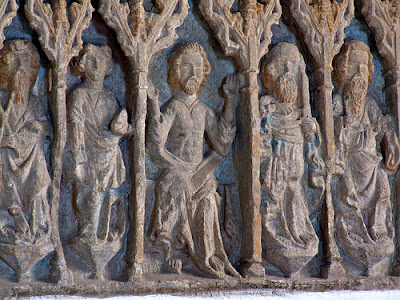
But back to Matthew:
And everyone who has left houses or brother or sisters or father or mother or children or fields for my sake will receive a hundred times as much and will inherit eternal life. Mt 19:29
Everyone who has left . . . children? (By the way, wives are curiously missing from this list. Why? Not important?)
What are we to do with such apocalyptic nonsense? It sends Jehovah's Witnesses door to door, and makes the lunatic fringe keep hoping for Rapture, no matter if constantly delayed for almost two thousand years. Sells books!
The apocalyptic perception of Jesus, which I have to admit has a high explanatory power, distresses me. Call me sentimental, but I was trying to cling to an admiration for Jesus. But the view of him as an apocalyptic preacher -- "let the dead bury the dead" finally makes sense, and a lot else besides -- and the view of the first Christians as end-of-the-world loonies -- one just can't argue with that.

Michelangelo: Last Judgment, St. Peter holding the key to heaven
SAVING JESUS FROM BECOMING A STONE BABY
BUT WAIT! There is a way that non-believers can translate “end of the world” so as to make it meaningful. It’s the “end of my life” perspective, a gift that those who believe in the afterlife are bereft of. Given that my personal world will indeed come to an end, there is absolutely no point carrying any “stone baby” of regret and resentment. When I decided that it was too late in life to be depressed, it also became too late to waste time complaining or accumulating useless things or delaying something for a “special occasion.”
There’s a man who stole a hefty sum from me by not delivering the goods. People advised me to sue him in small-claims court, but why should I go through that stress? I’d win, but collecting is another matter. It’s not worth it for me. Life is too precious for that, so I just let it go -- as close to “loving my enemy” as I can come. I know his life is a serious mess, and hope some resolution comes, some clarity so he can be an honest person again. It’s the same when I think of others who’ve hurt me -- what does it matter now? I feel mainly compassion for them. It’s too late in life for resentment.
So even if the wildly radical teachings of Jesus make sense only in the context of his expectation that the current world would soon be destroyed (“Take no thought for the morrow”) and New Jerusalem would follow, at least some of those teachings can still be applied in the context of our mortality.
*
FORMER GREAT LOVE AS A STONE BABY
Since this is officially a poetry blog, let me offer a poem related to the theme of a stone baby.
YEARS LATER
At first glance, there on the bench
where he’d agreed to meet, it didn’t seem to be
him -- but then the face of grim
friendliness was my former husband’s,
like the face of a creature looking out
from inside its Knox. No fault, no knock,
clever nut of the hearing aid
hidden in the ear I do not feel I
love anymore, small bandage on the cheek
peopled with tiny lichen from a land I don’t
know. We walk. I had not remembered
how deep he held himself inside
himself -- for fun, for thirty-two years,
to lure him out. I still kind of want to,
as if I see him as a being with a baby-paw
caught. His voice is the same -- low,
still pushed around the level-bubble
in his throat. We talk of the kids, and it’s
as if that will never be taken from us.
But it feels as if he’s not here --
though he’s here, it feels as if, for me
there’s no one there -- as when he was with me
it seemed there was no one there for any other
woman. For the first thirty years. Now I see
I’ve been hoping, each time we meet, that he would praise me
for how well I took it, but it’s not to be.
Are you as happy as you thought you’d be,
I ask. Yes. And his smile is touchingly
pleased. I thought you’d look happier,
I say, but after all, when I am
looking at you, you’re with me! We smile.
His eyes warm, a moment, with the accustomed
shift, as if he’s turning into
the species he was for those thirty years.
And turning back. I glance toward his torso
once, his legs -- he’s like a stick figure ,
now, the way, when I was with him, other
men seemed like Ken dolls, all clothes. Even
the gleam of his fresh wedding ring is no
blade to my rib -- this is Married Ken. As I
walk him toward the street I joke, and for an instant
he’s alive toward me, a gem of sea of
pond in his eye. Then the retreat into himself,
which always moved me, as if there were
a sideways gravity, in him, toward some
vanishing point. And no, he does not
want to meet me again, in a year -- when we
part, it’s with a dry bow
and Good-bye. And then there is the spring park,
damp as if freshly peeled, sweet
greenhouse, green cemetery with no
dead in it -- except in some shaded
woods, under some years of leaves and
rotted cones, the body of a warbler
like a whole note fallen from the sky -- my old
love for him, like a songbird’s rib cage picked clean.
~ Sharon Olds, Stag’s Leap, 2012
How many times have we seen this: a woman degrading herself, pursuing a man who no longer cares about her. Begging -- I can imagine her asking the husband who left her for another woman to meet again only as begging -- and no, he’s not interested, though courteous enough to go through it with a “grim friendliness.” We sense he didn’t really want to see her -- that he doesn’t want to see her ever again, and why should he? He’s married to someone else, and that’s his real life, not memories of how it was with the ex-wife. He feels awkward sitting on the bench next to the woman with whom he no longer feels any live connection.
I think here we also get a bit of a glimpse of the speaker as someone who’s been through a lot of therapy (this is revealed in other poems) and assumes that it’s good for everyone to psychobabble about every detail of their inner and outer lives, and that which you manage to verbalize is the true story rather than one of the many fictions and perspectives. In my observation, most men are utterly uninterested in that kind of analysis. Strange to say, I find myself joining the minority of women who likewise simply have other interests. Music! Literature! New developments in science! There is an exciting world out there, and a larger family. Waiting for the ex-husband to change his mind (or open up) is like waiting for Prince Charming, or -- for the Rapture.

YOU HAVE TO LET A CAT BE A CAT
When I can a cat, Georgia Dziordziusińska-Dziordziuśkiewicz, I learned that you need to let a cat be a cat. This widened to the view that you need to let each person be themselves, and you actually grow to enjoy them when they are relaxed and natural (who knew so many people were naturally charming when they don’t feel judged?), without feeling any demands put on them. Most people are good human beings, and like to be treated as such. They don’t care to be “lured out” to talk about the relationship with their father or whatever is assumed to be their “core issue.” Is that really so important? Can’t we respect the fact that perhaps they’d rather read the newspaper or go to the movies? Personally I enjoy the “strong silent” type. I have enough heavy stuff of my own and don’t want the burden of someone else’s complicated psyche piled on me. Not for free, in any case.
(By the way, I’m still not sure about cats versus dogs, now that pets have become an option. I love watching a cat be a cat and a dog a dog, sniffing around in ecstasy of exploration. I identify with that. And I know that neither species will ask me about some childhood trauma or some other “stone baby” I might be carrying, but without feeling burdened; no need to reactivate those old neural circuits; the most important and beautiful part of memory is forgetting.)
*
The clouds were so beautiful on the way to Coronado Library, again I thought that if I could no longer read or write, or contribute in any way, just looking at the clouds would make life worthwhile. But that’s assuming a brain functional enough to experience beauty, in which case it would probably be functional enough to read and write. Best not to fly in the no-think zones of potential dementia. But if someone asked me, when I'm past 80, what I loved most in life, it’s possible that I’d reply “clouds.”

photo: Jeffrey Levine
I can’t image Sharon Olds replying in this manner, and I don’t blame her: she’s herself, fixated on the body and family relationships, and I am myself, a lover of clouds (and more, but the list would be too long). She had to meditate on and on about the end of her marriage, even if to some of us that implies a sad waste of time. Her ex-husband certainly seems to want to move on without revisiting the old marriage, and who sees no more reason to see the ex-wife a year from now, or (I think this is implied) ever again.
At this moment I remembered one of my favorite scenes in the movie “A Serious Man.” The protagonist tells his “temptress” type of neighbor that he’s separated from his wife. She asks, “And have you been taking advantage of your new freedom?”
This is a wonderful point of view. Are you taking advantage of the opportunities of the moment, or are you incubating your stone baby? I speak as one who was guilty of that in my younger years, when I had spent way too much time talking in my head to my great love who married another woman. Luckily, I also developed as a writer, and creative work took over, along with teaching and journalism. And in my mental cemetery I found not the picked-clean skeleton of my once-great love, but the lilacs of gratitude: how wonderful that the cruel narcissist didn’t marry me! How magnificent that there were limits to his desire to destroy me . . .
Even so, I found the poem an interesting study of this unequal meeting of ex-spouses in which the ex-wife is still showing signs of clinging, even though she ends by implying through an image that it’s over, it really is over. But first she had to torture both of them by going through this unnecessary meeting, in the course of which she realizes that if he doesn’t look radiantly happy, that’s likely because of her presence. Her very presence is oppressive to him, is a form of silent nagging, some implied criticism of him as not open enough, or no longer husbandly.
Well, it happens: sometimes our very presence is oppressive to someone. If we recognize it, the only decent thing is to move on.
THE SHOOTING STAR
Mind you, sometimes the angels smoke, hiding it with their sleeves, and when the archangel comes, they throw the cigarettes away: that’s when you get shooting stars.
~ Vladimir Nabokov
This is clever as everything that Nabokov ever wrote, but I saw a shooting star last night, after a long period of not seeing any, and it was a lovely recognition. As usual, by the time I thought of making a wish, it was too late.
But what’s wish-making next to the great spectacle we are offered every night . . . One-tenth would have been enough to make me rejoice (typed “rejoyce”) in being here to see. Did I really, REALLY, go through three years of thinking about suicide every single day? I who say that one sunset can hold me, that I’ll never get tired of clouds . . . We change; life changes; and I am infinitely grateful to have experienced the moment -- later many moments -- when I understood that just to be alive is sublime.
But back then I was carrying a stone baby -- my rejected great love for a man whose greatest gift to me was marrying someone else.
Then I discovered that dropping idealization -- this took years -- dissolved the stone baby. I was finally free of that false pregnancy.
And I can still enjoy Michelangelo’s muscular (look at that biceps!) Jesus in the Last Judgment scene. For me this is actually a Mr. Universe contest, and Jesus wins the trophy.

O'Keefe: Narcissa's last orchid
THE LAST HOUR
Suddenly, the last hour
before he took me to the airport, he stood up,
bumping the table, and took a step
toward me, and like a figure in an early
science fiction movie he leaned
forward and down, and opened an arm,
knocking my breast, and he tried to take some
hold of me, I stood and we stumbled,
and then we stood, around our core, his
hoarse cry of awe, at the center,
at the end, of our life. Quickly, then,
the worst was over, I could comfort him,
holding his heart in place from the back
and smoothing it from the front, his own
life continuing, and what had
bound him, around his heart—and bound him
to me—now lying on and around us,
sea-water, rust, light, shards,
the little eternal curls of eros
beaten out straight.
~ Sharon Olds, Stag’s Leap
This poem from the latest collection by Sharon Olds has been haunting me. I keep seeing the husband bumping the table as he stands up. Such a small, trivial thing, it happens thousands of times and means nothing, is quickly forgotten -- and yet, in the context of the last hour together, suddenly unforgettable. The whole description of the stumbling is excellent, though I’d gladly skip the simile --“like a figure in an early / science fiction movie he leaned” -- in order to keep the narrative fast-paced. But it could be argued that the simile creates distance and lessens the pain through a bit of humor that, like the attempt at an embrace, doesn’t quite work.
The way these two people who have been married for thirty years now suddenly can’t hug with habitual ease, without awkwardness and bumping and stumbling, says everything. And yet the speaker manages to assume the woman’s archetypal role of the comforter, the ever-supportive angel “holding his heart in place”:
Quickly, then,
the worst was over, I could comfort him,
holding his heart in place from the back
and smoothing it from the front
The wife’s steadying him conveys her understanding and forgiveness. I almost want to exclaim: Are you sure you want to break up? You are still so loving toward each other; you are a good team . . .
For me the poem could end right here: “holding his heart in place from the back / and smoothing it from the front” is brilliant writing, a fusion of metaphor and physical detail; it would make a perfect closure. Until the point the poem is achingly physical. And we are made aware that these two were closely bound by the sexual bond: all the love-making that had gone on for thirty years, what the speaker considers to have been the core of their togetherness:
and then we stood around our core, his
hoarse cry of awe, at the center,
at the end, of our life.
It’s his come-cry that enters here like a ghost, that must be parted with now. And the erotic bond dissolves:
the little eternal curls of eros
beaten out straight.
“Beaten out” is a great choice of words. The couple is no longer in the realm of the winged god.
Still, for all the good moments in this poem, I can’t seem to forget the husband’s bumping the table as he gets up. For some reason that has registered more strongly for me than his bumping her breast in what I assume is a sideways embrace, or in any case an awkward half-embrace. The ghost of his come-cry and the departure of Eros are interwoven here, but the hardness of the table and the slight jabbing pain have a physical reality that engraves itself on memory.
This is meant to be an amicable parting, so there is no mention of the fact that he is leaving for another woman. Besides, and here I speak on the basis of interviews, Olds understands that they had grown unsuited to each other, and this was indeed for the best -- the letting go as the last act of caring, of true love that leaves behind erotic possessiveness. Yet parting is never easy -- not for the one being left, who can’t help feeling hurt, nor for the one doing the leaving, who feels bad about causing the hurt.
 *
*
“The Last Hour” is a near-perfect example of “taking a narrow slice,” focusing on one specific incident. What defines the moment of parting is the husband’s bumping the table as he rises. I hardly need the rest to tell me about his nervousness and awkwardness -- precisely when he means to be gracious and magnanimously affectionate. This one detail establishes the truthfulness of the poem.
*
Something as mundane as bumping the table selected by the speaker to convey emotional tension reminded me of Akhmatova’s famous lines about the glove from “The Song of the Last Meeting”:
My breast was so cold, so helpless,
But light was my step.
I put the left glove
On my right hand.
Hardly anything is so eloquent as the right detail.
“The Last Hour” also brought back to me Akhmatova’s “Parting.” That poem too has a very memorable opening -- memorable in a different way, not through detail but through a broad, panoramic statement that distills insight about the entire relationship. The poem offers both a “narrow slice” -- the whole extraordinary second section -- and a broader perspective about the years it took these two history-crossed lovers to part (Nikolay Punin, an eminent art critic and curator of the Hermitage museum, died in a gulag).
It is also a poem of irony. “The Last Hour” contains some irony, if that’s the way we choose to look at the awkwardness. But “Parting” delivers painful irony over and over.
The last section is usually presented as a separate poem, and yet I feel it belongs to the sequence, as suggested by one of Akhmatova’s translators, A. S. Kline. In “The Last Toast” history asserts itself, the whole age, “cruel and coarse.” The thirties were a dreadful time in the Soviet Union. When we read Akhmatova, we cannot forget history. The speaker’s personal suffering is a small part of the great grief all around her. As Akhmatova wrote:
That was the time when only the dead
could smile, happy to be at rest.
*
PARTING
I
Not weeks, not months – years
We spent parting. Now at last
The chill of real freedom,
And the gray garland above the temples.
No more treasons, no more betrayals,
And you won’t be listening till dawn
As the stream of evidence
Of my perfect innocence flows on.
II
And as always happens in the last days,
The ghost of the first days knocked at our door,
And in burst the silver willow
In branching magnificence.
To us, frenzied, disdainful and bitter,
Not daring to raise our eyes from the ground,
A bird began to sing in a rapturous voice
About how we cherished each other.
III The Last Toast
I drink to our ruined house,
To all life’s evils too,
To the loneliness we shared,
And I, I drink to you –
To the eyes, dead and cold,
To the lips, lying and treacherous,
To the age, cruel and coarse,
To the fact that God has not saved us.
~ Anna Akhmatova, tr. Judith Hemschemyer and A.S. Kline (modified)
The opening instantly refers to a theme so vast it seems infinite: time. Akhmatova takes in a panorama of time. Though she is “in the moment” in Section II, the emotional power of that section comes from the hold of the past on the present: the return, during the last days, of the “ghost of first days.” But the genius of Section I lies in precisely in distilling the workings of time: “Not weeks, not months -- years / We spent parting.” Anyone who’s been through a reasonably long marriage and a divorce understands this.
But let’s turn to irony. The first instance of irony we encounter lies in the fact that the couple spent years in parting. This goes counter to any romantic notion of marriage. Yet it’s only some couples who keep growing closer over the years, forming a deeper attachment that we honor more than the waning excitement of romantic love. It’s lasting love, the commitment of married love: patiently letting the marriage go through its various stages until a beautiful cooperation prevails. As someone put it, the husband and wife need to realize that they are both on the same side. Sometimes it can’t be done; the two people are too ill-matched, or perhaps the circumstances have changed and are against the marriage. Many couples “keep parting.”
And then comes the overtly ironic statement about what freedom means: now the partner will not have to “listen till dawn / As the stream of evidence / Of my perfect innocence flows on.” The hyperbole of “perfect innocence” makes it plain that the speaker knows that both parties are “guilty” but self-justifying.
In the superb second section, Akhmatova beautifully observes what many others confirmed: that as break-up becomes inevitable, something from the first days of love comes back to remind the couple how intensely they fell for each other. It’s the irony of circumstances: it takes the ending to remember the beginning. The intensity is back, if only temporarily. Some divorcing couples, suddenly again attractive to each other, even being dating again.
Another irony here is very simple: it’s springtime, the season of love. Hence the silver catkins of the willow and the birdsong. There’s freshness and joy in the air -- but these two lovers are parting. (By the way, it’s worth noting that here Akhmatova lets nature come into the poem -- the wider world -- something that we don’t see in Olds’s poem.)
And then the last toast -- surely the most bitter toast in all of poetry. The bitterness is so deep that “sarcasm” would be a better word than mere irony. Normally we raise toast to all the good things in life: health, happiness, prosperity, success. Akhmatova uses the custom of toasting to turn in its head: she raises a toast to dreadful things. Some of it is straightforward irony: instead of drinking to companionship, she drinks to “the loneliness we shared.” But history forces itself in. The lying lips are not just the lover’s lips; they are the lips of spies and others who seek gain in denouncing their neighbors. The lover’s cruelty is overwhelmed by the massive cruelty of the era. And the last illusion is shattered: the speaker knows that “God has not saved us.” This is desolate knowledge: God, to whom millions have been praying for salvation, has not stirred to save anyone -- not the whole country.
As for history, Akhmatova experienced an excess of it. To get the flavor of just how horrible the times were, let’s consider this passage from her biography by Elaine Feinstein:
With Lev [Akhmatova’s son] in the Kresty prison, Akhmatova stood outside in the long queues in the hope of learning something about him, or to beg the guard to take in a food parcel for him. Lydia Chukovskaya [Akhmatova’s close friend] often waited with her in the same queue, hoping to have news of her husband. Unknown to Chukovskaya, Bronstein’s sentence of “ten years’ exile without benefit of correspondence” was in reality a euphemism for execution and he had already been shot.” (p. 169)
The reason that Chukovskaya’s husband was arrested and executed was that his last name happened to be the same as Trotsky’s real last name: Bronstein. It didn’t matter that the husband, like many other Bronsteins in Russia, wasn’t related to the exiled leader of the October Revolution and the organizer of the Red Army, at one time second only after Lenin.
(A shameless digression: A Moscow rabbi said like a prophet, “Lev Trotsky signs the check, but Leyba Davidovich Bronstein will pay the price.”)
 Propaganda poster of Trotsky, 1918
Why was Akhmatova seen as a threat to the Soviet state? No one denounced her for having written a poem in which Stalin’s mustache is compared to cockroach’s whiskers (that was Mandelstam’s doom). She was known as a poet of love; romantic love and the loss of it are her number one subject. As for later poems such as the Requiem sequence, they were memorized by Akhmatova and Chukovskaya, and the text was burned; the state had no evidence against her. And yet she was a threat precisely as a poet who wrote mainly about love. Or, to put it more broadly, about human connections.
In 1946 Akhmatova was expelled from the Union of Soviet Writers, her poetry denounced as “utterly individualistic.” A totalitarian regime or religion cannot tolerate individualism. Inner life is not even supposed to exist. Instead of giving oneself totally to the service of the state or the church, a true poet dares to write about such private matters as falling in love. It’s not propaganda. Romance is subversive. The family is subversive. Both insist that values other than those officially sanctioned come first. Akhmatova was accused of poisoning the minds of Soviet youth.
Nor is a poet ever going to agree that making a profit is the highest value, so poetry does not go well with unregulated capitalism either. The beloved -- can this word even be pronounced when blind obedience to the state, the church, or any system or institution is demanded?

Nikolay Gumilyov, Lev Gumilyov, Akhmatova, 1913
Lost Tram
It rushed like a dark, winged storm,
And was lost in the abyss of time . . .
Tram-driver, stop,
Stop the tram now.
~ Nikolay Gumilyov (executed in 1921)
(Shameless digression: in a dream I was riding a streetcar in Warsaw. I got off in front of the Polytechnic, where the tracks make a wide turn. A row of chestnut trees. But the street and the tracks suddenly break off into white blankness.)
*
I have long been interested in the question of what makes poem great as opposed to “minor.” I think it’s the largeness of vision that puts Akhmatova in a different rank and gives her work its emotional power. I think my own distinction works well of Olds vs Akhmatova: “poetry as higher journalism” (Olds) versus “poetry as underworld” (spare details presented with the knowledge of Time the Destroyer; death enters in some manner, or, if not death, then silence, sleep, absence).
One could also invoke the difference between information and knowledge. Olds seems intent on exploring and saying everything she can. Akhmatova is careful to leave a lot unsaid, to create an atmosphere of mystery and hidden knowledge.
Finally, Akhmatova supremely musical; she uses the power of rhythm, which good translators try to imitate in English. Thus, even in translation, it becomes obvious why Akhmatova is praised for what’s been called the “epigrammatic beauty of her lines.” I immediately think of
Too sweet is the earthly drink,
Too tight the nets of love
~ but many other lines also easily nestle in memory -- which is not true of Olds’s lines. Even after many years, I remember the content of some of her poems, but not specific lines, with one exception: in “Rites of Passage,” about her little boy’s birthday party, she quotes her son as saying, “We could easily kill a two-year-old.”
When it comes to Akhmatova, I remember a number of her striking lines (all in translation, except for one poem where I simply had to make my slow way through the Russian version). Let me share some of them -- remembering that there is no separating the music and the beauty from the underlying insight.
Like most great poets, Akhmatova also has a simplicity that contains a largeness, a complexity. She juxtaposes nature imagery with emotional and even metaphysical drama like no one else -- unless perhaps Emily Dickinson. If Dickinson went more the way of “wild nights,” perhaps she might sound something like this.
How many demands the beloved can make!
The woman discarded, none.
I am glad that the water today
Stands still under colorless ice.
And I stand -- Christ help me! --
On this shroud that is brittle and bright
*
Neither a rose nor a blade of grass
Will I be in my Father’s garden
*
My night nurse insomnia is visiting elsewhere,
I’m not brooding by a cold hearth.
The crooked hand of the tower clock
Doesn’t look like the arrow of death.
How the past loses power over the heart!
Freedom’s at hand. I forgive everything.
I’m watching a sunbeam run up and down
The first moist ivy of spring.
*
My twin in the mirror will stay up.
I’ll sleep soundly. Good night, night.
*
And this is youth, that glorious time
*
Like happy love,
Calculating and malicious.
*
Don’t kiss me, I am weary.
Death will kiss me.
*
And I knew I’d pay a hundred times
In madhouse, prison, tomb:
Wherever such as I would wake.
But torture by happiness continued.
*
Not for anything would we exchange
This granite city of calamity and fame
*
Do I not talk to you
With the screech of birds of prey?
*
The sky sows a fine rain
On the lilacs in bloom.
At the window beating its wings
Is the white Day of the Holy Ghost.
*
The evening light is yellow and wide,
April is tender and cool.
You have come many years too late . . .
Forgive me for so often
Mistaking other people for you.
*
And the burdocks stand shoulder high,
And the forest of dense nettles sings
*
Why are my fingers covered in blood?
This wine burns like poison.
*
We were fated to learn . . .
What it means to find out in the morning
About those who have died in the night.
##
It remains a luminous fact that in spite of her great suffering Akhmatova did not commit suicide. Yesenin did, then Mayakovski, then Tzvetayeva. Life had become more painful than they could bear. What gave Akhmatova the strength to endure? I think it was her dedication to poetry as the sacred task of her life and the miracle of creativity. Secondly, she identified with Russia, with the greater story of the suffering of her country. In one unforgettable poem, “Belated Reply,” she speaks to Marina Tzvetayeva:
We are together today, Marina,
Walking through the midnight capital,
And behind us there are millions like us.
And never was a procession more hushed,
And around us funeral bells
And the wild Moscow moans
Of a snowstorm erasing our traces.
**
Addendum: Nikolai Kondratiev, the brilliant economist who described the long-term cycles in capitalism, was also executed under the guise of “10 years without the benefit of correspondence.”

John:
Love the ghost of the last days and the ghost of the first days.
Oriana:
I love that too, that ghost of the first days knocking at the door. Wow!
Una:
A fine piece of prose with a depth of meaning many women will relate to.
Now that is the classic Olds that I like very much. Details are one of her specialties, and she has really captured the parting after a long marriage (30 years). I remember saying as I left, “You will always be the father of my children” -- I felt the need to soften the blow.
Akhmatova is amazing. How I’d love to read Russian so I could hear her voice and not the translation. I love the willow’s “branching magnificence"
It is a wonder to know great poetry from the very good. Akhmatova for sure is a great and Sharon is very good.
Oriana:
Now I realize what bothered me about the poem by Olds: too much telling after this:
Quickly, then,
the worst was over, I could comfort him,
holding his heart in place from the back
and smoothing it from the front
For me the poem could end right here: “holding his heart in place from the back / and smoothing it from the front” is wonderful writing, a fusion of metaphor and physical detail; it would make a perfect closure. Until the point the poem is achingly physical.
Olds is precisely the poet who makes some people object that what she writes is “prose with line breaks.” Early Olds seemed more poetic, though even way-back I noticed that after reading those little narratives I didn't feel like re-reading them. The older Olds has more to say, but has gotten too wordy, too prosy. She just doesn't compress enough to make it poetry. It's more like journal writing, though a high-caliber journal writing. And the images sometimes keep me from wanting to re-read, e.g. the image of her ex and his new wife flying together like storks with medical bags in their beaks. Very striking at first, but you don't really want to encounter it again. It's not delightful enough, at least not for me. Too crude or whatever it is.
**
Akhmatova aimed at perfection. I will never forget how a young woman who knew Russian closed her eyes in ecstasy and chanted (rather than merely said), “Akhmatova’s poems in Russian are soooo beautiful . . . soooo beautiful.”
Akhmatova kept her poems short, but they are as if graven in marble. Her conciseness reminds me of Dickinson. Imagine Dickinson as a poet of love, venturing further into wild nights . . . a heady thought.
Kathleen: (reconstructed from memory -- Macbeth, my computer, seems to have concealed Kathleen’s message)
I really like the comments you made about parting, especially the feelings of the one who is being left and of the one who is doing the leaving. Quite perceptive.
Oriana:
If we live long enough, we become well-traveled in heaven and hell -- various circles of hell, so when it’s our turn to do the leaving, we know what it feels like to be left . . .
I think Akhmatova is marvelously perceptive when she says:
Not weeks, not months -- years
We spent parting.
In long-term relationships, the growing apart does take years. But then, beware: in the last days, the ghost of the first days will knock at the door, and the old intensity and mutual attraction may return for a while, the way someone dying often has that last rally of strength: s/he sits up in bed and starts talking with animation, perhaps even planning life after recovery -- the face suddenly much younger . . .
Charles:
When I first looked at the orchid I thought it was a photo.
Love the ad at the top of the page. You are truly a poetreneur.
If you didn't explain Stag's Leap I wouldn't have understood it in such depth. Thank you.
Actually you explained both poems beautifully.
So interesting that Akhmatova was persecuted because she wrote about the individual -- about personal matters such as love.
"The Beloved" can become the state. I see this happening in America now.
Oriana:
That painting by O’Keefe is perhaps the least known among her flower paintings. I love the title even more than the actual painting, though those lacy fringes of petals are irresistible -- like emerging fractals.
It’s not so much the state that become the Beloved as the dictator. We saw this with Hitler, Stalin, Mao, the North Korean dictators. When humans worship someone, it can be romantic infatuation or it can almost as easily be a deity or a dictator.

A few days ago the clouds looked so wonderful, so 3-D -- ordinary tumbled white clouds with grayish underbellies -- that I thought, “I don’t need to ask for anything more of life.”
The next instant, however, I thought that I’d ask not to be parted from this beauty. But scientists still seem a long way from defeating the built-in aging clock of the body, if they ever get there at all (the first “death switch” is puberty; theoretically, we could be immortal if we gave up reproduction).
Many people say that it’s not dying that bothers them; it’s watching and experiencing the process of aging. “Don’t you just hate aging!” is what I hear from women, and no one even remembers the consolation of “inner beauty.” Old is not beautiful, but the only thing we can do is “age gracefully” (or perhaps disgracefully, why not), with acceptance.
The huge popularity of plastic surgery testifies to our growing rejection of “looking our age.” So a poem about welcoming and even celebrating the changes that aging brings to the woman’s body is a true surprise. Sharon Olds, arguably the most famous American woman poet and the most recent recipient of the T.S. Eliot Prize, has written such a poem.
The Older
The older I get, the more I feel
almost beautiful -- not my face, plain
puritan face, but my body. And I will be
fifty, soon, my body getting
withery and scrawny, and I like its silvery
witheriness, the skin thinning,
surface of a lake crumped by wind, ruched
wraith, a wrinkle of smoke. Yet when
I look down, I can see, sometimes,
things that if a young woman saw she would
scream, as if at a horror movie
turned to crone in an instant -- if I lean
far enough forward, I can see the fine
birth skin of my stomach pucker
and hang, in tiny peaks, like wet stucco.
And yet I can imagine being eighty, made
entirely, on the outside, of that,
and making love with the same animal
dignity, the tunnel remaining
the inside of a raspberry
bract. Suddenly I look young to myself
next to that eighty-year-old, I look
like her child, my flesh in its loosening drape
showing the long angles of these strange
bones like cooking-utensil handles in heaven.
When I was younger, I looked, to myself,
sometimes, like a crude drawing of a female --
the breasts, the 1940s flare of the hips --
but this greyish, dented being is cozy as
a favorite piece of clothing, she is almost
lovable, now, to me. Of course, it is
his love I am seeing, the working of his thumb
over this lucky nickel -- five times
five years in his pocket. Maybe
even if I died, I would not look ugly
to him. Sometimes, now, I dance
like shirred smoke above a chimney.
Sometimes, now, I think I live
in the place where the solemn, wild drinking
of coming is done, I am not all day coming
but living in that place where it is done.
~ Sharon Olds, The Unswept Room, 2003
“Sometimes, now, I dance / like shirred smoke above a chimney.” What an amazing ending from that point on! At first reading, I understood “coming” as “arriving,” in terms of the metaphoric “journey of life”; only after a while I recalled the sexual meaning. Of course it’s richer with both meanings present. And I am not surprised at the “posthumous” feeling; there is something posthumous about the very act of writing, which seems the opposite of living.
As someone said, you can’t write about making love while making love.
This is an extraordinary poem, with an astonishing counter-culture beginning, coming from a woman:
The older I get, the more I feel
almost beautiful -- not my face, plain
puritan face, but my body.
We take it for granted that the older a woman gets, the worse she looks, and consequently feels less beautiful. “The older I get, the more I feel/ I look like a fright” -- would be something that a woman reader would nod her head to. Then, another surprise: Olds is not talking about her face -- and to a typical woman, but especially the kind of woman who was praised for her beauty when she was young, her face is what his penis is to a man: a secret foundation of her self-esteem. Not the entire foundation, no: but a more significant part than most women would like to admit.
Olds dismisses the importance of the face. She’s interested in the body. But for all her bravado about the beauty of an older body, she does admit to moments of dread:
. . . Yet when
I look down, I can see, sometimes,
things that if a young woman saw she would
scream, as if at a horror movie,
turned crone in an instant -- if I lean
far enough forwad, I can see the fine
birth skin of my stomach pucker
and hang, in tiny peaks, like wet stucco.
But what follows another amazing passage, when she places herself next to the eighty-year-old she imagines becoming:
Suddenly, I look young to myself
next to that eighty-year-old, I look
like her child, my flesh in its loosening drape
showing the long angles of these strange
bones like cooking-utensil handles in heaven.
The bones as "cooking-utensil handles in heaven" is just wonderful. And, needless to say if you know all the poems Olds wrote about sex, she imagines herself as “sexually active” at eighty -- how unpuritan can you get, how opposite of “prim and proper.” And even in that PR photo of hers at seventy, note the long hair and the somewhat daring (by East Coast standards) hair clips, and that defiant posture of a sex diva. I guess her PR photos are closer to her poems than her everyday persona. At eighty, she’ll be photographed in the nude, so we can compare that with the poem :)
Toward the end, the “shirred smoke above a chimney” (in another poem Olds states that she wants to be cremated) brings us back to the first mention of smoke at the beginning:
The older I get, the more I feel
almost beautiful -- not my face, plain
puritan face, but my body. And I will be
fifty, soon, my body getting
withery and scrawny, and I like its silvery
witheriness, the skin thinning,
surface of a lake crumped by wind, ruched
wraith, a wrinkle of smoke.
Smoke is an image of something airy, insubstantial. The skin keeps on thinning, getting closer and closer to becoming crematorium smoke. (“ruched / wraith, a wrinkle of smoke” -- this is brilliant writing). Olds does not treat the body as a metaphor for the mind or personality. The body is literally thinning out, as if preparing to be smoke.
 Sharon Olds at 70
But the greatness of this poem lies partly in the fact that Olds does not end simply on dying. As is typical of her, she finds an affirmation. Note that she is dancing like smoke, celebrating the richness of life. She can imagine her life as already over, and still feel joy at having been alive.
*
Sharon Olds at 70
But the greatness of this poem lies partly in the fact that Olds does not end simply on dying. As is typical of her, she finds an affirmation. Note that she is dancing like smoke, celebrating the richness of life. She can imagine her life as already over, and still feel joy at having been alive.
*
Gloria Steinem wrote that when she was diagnosed with cancer, her first thought was, “I’ve had a fabulous life.” I think Sharon Olds, when she thinks of dying, would say the same. But we don’t need to famous to feel that way. Simply existing is transcendent.
It’s stunning that Olds can using even aging and dying to celebrate life. She finds beauty even in the aging body, and that dancing “wrinkle of smoke” above the crematorium chimney becomes a smile.
MOTHER, NAKED AND HAPPY
If I remember correctly, when someone brought up the “poet of the body” label, Olds replied, “I am surprised that every poet isn’t.” And she has a point: the body is so physical, so much a part of nature, a fascinating animal. Yet offhand I can’t think of any other famous poet who describes the human body as much and in as great a detail as Olds.
But great poems don’t come only from the famous poets. I’ve read marvelous pieces from poets whose reputation is local at best. The poem below is an example. In a way, I like it even better than “The Older” -- it has a gorgeous music, for one thing, making it irresistibly lyrical.
Elderly Mother at the Hot Springs
The old woman, standing in the shower,
hums her tunes below falling water.
She recites all night in her sleep,
her lips whisper now and at the hour
of our death, amen, forgive us our sins,
fill drowsy rooms with flecks of spirit.
She stumbles, grasps the rails of her walking,
legs blue over dead toes. The agéd mermaid
slides into warm water
and in weightless breaststroke
begins her old ballet
leading dancers through pools of earth.
As long as her watery stories pour forth
I hold my mother in fluid we share,
lime green swim suit and blue desert day,
swimmer in her high eighties, me
in my mid fifties, my smooth roundness
near the flaps of her skin
like ruffles of ashen petticoat,
layers of her cascade to ground
netted in dark veins.
She ripples in sulfur moments, returns
to the pools of prayer, and I see for the first time,
mother, naked and happy.
~ Janet Baker © 2013
While this poem does not celebrate aging per se, it does celebrate a woman in her high eighties, not quite healthy (note the “dead toes”), who manages a weightless ballet as she swims. So what if her skin is flabby and she has broken veins --
near the flaps of her skin
like ruffles of ashen petticoat,
layers of her cascade to ground
netted in dark veins.
~ she still enjoys the “sulfur moments” in the hot springs.
Of course it wouldn’t do not to mention the importance of prayer for this elderly mother. Though I regard myself as a happy atheist, I can understand the comfort that the devout get from praying. I’ve discovered that I am happy when I concentrate on something outside of myself. A person busy praying is not brooding over past mistakes. That alone is part of the benefit. Another part is expecting paradise in the “great beyond.”
(Reading about the happy elderly mother, I almost wish I could pray. But emotional comfort is simply not the same as perceived truth.)
But this poem is not about prayer per se, or even about swimming. It’s about an elderly mother, “naked and happy.” Startling? Yes. Encouraging? Yes, since we do have a dread of aging, thinking we will be less happy as the body becomes increasingly dysfunctional. This doesn’t have to be. The brain constructs happiness, just as it constructs memory. If we relax and welcome whatever life brings, the brain will have us live in an “easy world.” And if an elderly woman is lucky enough to have a daughter who can take her to hot springs, all the more reason for joy.
And we are lucky to have these beautiful rhythms and slant rhymes, with a direct rhyme also present -- who’d think that “standing in the shower” could be paired with “now and at the hour” from Hail Mary? The dictum that poetry “must give pleasure” is amply fulfilled here -- even in the description of aging.

This is not to say that it wouldn’t be wonderful to stay young and healthy forever -- or at least for a very long time. I’d want centuries. I don’t think I’d ever get bored of trees and clouds, or ever cease to be “in continual astonishment” at what life brings. But aside from “polite helplessness,” as Wallace Stevens puts it, I also want joy, regardless of age. Poems that present the possibility of happiness even in “advanced youth,” as an old friend used to call it, help us live on, swimming and dancing, or at least remembering swimming and dancing. Why did I choose “Fire Bird” as the title of this post? No, we don’t rise again from a literal nest of flames. There is no return from the fire of the crematory. But before then, at any age, life throws challenges at us. And the point is to get through somehow -- “on a wing and a prayer,” as another friend has recently said -- and keep on dancing. There is no “fire bird” out there. The real fire bird is a human being who keeps on dancing.
##
Darlene:
I know you don’t believe in the soul, but I don’t care for all this body talk. Too much about the body.
Oriana:
I believe in brain function, possibly the most complex thing in the universe. We don’t yet know enough, don’t have the right way to talk about it. So we talk about the skin instead. About feet and hips and shoulders like some funny utensils. But can you imagine a hundred years from now? I can’t either.
Darlene:
But deep in your non-existent soul, don’t you think the body isn’t THAT important?
Oriana:
Just try to live without a body. The awful truth is that the brain doesn’t really care about the truth; its task is to make sure the body lives on. And if it takes a soothing hallucination to accomplish that purpose, the brain will produce just that.
This January has been particularly rich in fantasies about what my life might be if I had an undamaged left knee. Never mind Prince Charming: these days my fantasies are all about the left knee.

Hyacinth:
Janet's aging mermaid is so touching, such a tender way of talking about her mother's aging and not at all sentimental. So many fine lines, and I relate not just as a daughter but as the mother going through this. I especially like "flaps of her skin like ruffles of ashen petticoats."
To have lived at all is the miracle. Quoting Rilke:
"...to have been here this once, even if only once, to have been on this earth seems irrevocable..."
And speaking of age, it's good to see Sharon Olds winning a big prize. Her long grey hair and “plain Puritan face." She makes no excuses for aging. Another description of skin,"surface of a lake crumpled by wind...a wrinkle of smoke" was so accurate, too. Mine looks like very thin parchnent and is as thin.
Oriana:
Once I was in Whole Foods in La Jolla -- you can imagine how rich the customers are -- and I saw a woman who was in her late seventies, maybe, or already past eighty. She was badly stooped -- osteoporotic spinal compression and deformation. But she obviously just had her face laser-peeled, so she didn’t have a single wrinkle. Her skin looked shiny-white and very thin, almost ghostly. That kind of laser causes a third-degree burn, I was told -- imagine, at that age, to go through a procedure like that! With most women, vanity never ends; nor is Sharon Olds entirely free of it, with her “old and beautiful” stance. At least that’s empowering. Olds gives us the courage not to lament what we see in the mirror.
Of course I agree with you and Rilke: yes, to have lived at all is a miracle, and it is irrevocable, the order of things changed a tiny bit, but forever, just because we have been here.

Charles:
Incredible images and perfect for the blog.
When I read Sharon's poem I liked the line, “Sometimes, now, I dance / like shirred smoke above a chimney” as my favorite in the poem.
Sharon is beautiful in this picture. Something of a diva. Very well preserved. If she happened to be fat and ugly, I bet she wouldn’t have written this poem.
My favorite line in the entire blog is of course: “The real fire bird is a human being who keeps on dancing.” So beautiful.
Oriana:
That’s my favorite passage in Sharon’s poem, too. That’s greatness: not just the use of “shirred,” but the underlying concept of already being that posthumous smoke.
There are times, once we’ve lived long enough, when we are all ages at once, including no longer any age.
Sarah:
“The real fire bird is a human being who keeps on dancing” - the last line always matters the most and I like it!
Oriana:
Glad to hear you too like it. It’s usually only quite a bit of suffering that we learn to dance on. And it’s so inspiring to know someone like Hyacinth, 86, who in spite of poor health keeps on dancing, and finds life transcendent.
THE GOLDEN YEARS: MYTH OR REALITY?
Scott:
Your latest blog is as timely as ever, enjoyed it very much. I turn 50 this year and could not be happier. Am a bit slower perhaps in body but all in all this is a great time. Gone are the silliness of youth and it's vanities, I so appreciate my time to read and reflect. 4 years ago I was working 60 hour weeks with big paychecks, but the long hours and stress were not worth it. I hope to make another decade or so at work and then my wife and I can perhaps travel more and 'stress less.' Birds, books and coffee; simple (some may call dull) pleasures but I'm being as honest as I can, wouldn't trade them for a fancy car or mansion. My house has heat, the pantry is full and family are healthy. Sounds trite and cliché I know but these are good times. And now I have Robert Lax to discover!
Oriana:
It’s thrilled to find in you the confirmation of all the studies on happiness and aging: older is happier, as long as health holds out -- and for many, that’s into their eighties.
I remember when I didn’t know about these studies, and the thought of the later decades was simply terrifying. True, there is less future, but you gain the present. I used to live in the future so much that when I suddenly realized that “the future was stolen from me” (that’s how I thought about it), I was devastated. And then being pressed against the wall by mortality cured me of depression. It was one of the most amazing events in my life.
Thanks to you I’ve looked up Robert Lax, and he’s certainly one of the most eccentric poets ever. But note the vagaries of fame: Lax’s “Circus of the Sun,” once praised as “perhaps the greatest poem of the [twentieth] century,” is now utterly forgotten. And, who knows, maybe Ezra Pound will be the next one to go. And maybe we’ll rediscover Lax. It’s completely unpredictable.
But then who’d want it to be predictable. Like the "golden years" -- I used to think it was a myth. And look. And live.
Scott:
Can’t put a price tag on mental clarity and the ability to enjoy simple things, 'rivers of books and black coffee.' I'm never happier than when I see my office in my rearview; I wish I could recall the exact quote but Melville wrote to his brother once the folly of people who were caught up in their work. Now to someone whose work is their passion that's totally different, it's not work at all. The work I'm referring to is the mind numbing drudgery of petty work with petty people, no glory or honor in that. Now whaling, that was a life! I might feel different had I actually had to kill and boil one down for it's oil but for those few minutes of excitement and terror those Quaker tars of yore probably never felt more alive. As a famed poem of theirs stated;
'Death to the living
Long life to the killers
And greasy luck to whalers'
A nasty, bloody business no doubt but again, the ports one would see, the islands, marine life and wonders of the stars at night must have been unreal.
Oriana:
Scott, you have managed to bring Melville into this!

Dante Gabriel Rossetti: Lilith, 1868
POETRY NEEDS THE TENSION OF OPPOSITES
SHE DIED IN BEAUTY
She died in beauty, -- like a rose
Blown from its parent stem;
She died in beauty, -- like a pearl
Dropped from some diadem.
She died in beauty, -- like a lay
Along a moonlit lake;
She died in beauty,-- like the song
On birds amid the brake.
She died in beauty, -- like the snow
On flowers dissolved away;
She died in beauty; -- like a star
Lost on the brow of day.
She lives in glory, -- like night’s gems
Set round the silver moon;
She lives in glory,-- like the sun
Amid the blue of June.
~ Charles Doyne Sillery (1807-1837)
The moon/June rhyme came as if to say: here is the essence of 19th century poetry. Poets like Sillery (I wonder about that last name: too good to be true?) wanted to sound oh so pretty, no matter how fake the result.
The problem here is not only clichés. The main problem is the non-stop sweetness. A poem needs the tension of opposites (or, to use the standard term of literary criticism, “dramatic tension”). It shouldn’t be all sweet or all despairing. In that sense, poetry is not all that different from fiction: we don't want a story where all is sweetness and light, and the hero is never challenged, simply going from success to success. Into each life some rain must fall -- we'll return to this later.

Rossetti: The Blessed Damozel, 1878
How did this poem ever survive to reach me in a century that treasures non-fiction, “what really happened”? We want to know specific details, however unpretty. Imagine, after the sometimes brutal realism of modern poetry, coming across “She Died in Beauty.” Enough anthology editors must have thought it a treasure, so here it was, in another anthology. We moderns seem to have a hunger for reality that is startling after so many centuries where the main function of poetry was the same as that of religion: consolation, never mind the truth.
And the odd thing is, all those "blessed damozels" were dead. I think Poe was right when he said that the best subject for poetry is the death of a beautiful woman. Or at least it's the best subject for the kind of poetry favored in the 19th century.
**
John Everett Millais: Ophelia, 1851
Sillery also wrote “Eldred of Erin” and “The Rose of Cashmere, an Oriental Opera.” For a quick contrast, let us move on to a poem by Sharon Olds:
THE RISER
When I heard that my mother had stood up after her near
death of toxic shock, at first
I could not get that supine figure in my
mind’s eye to rise, she had been so
flat, her face shiny as the ironing board’s
gray asbestos cover. Once my
father had gone horizontal, he did
not lift up, again, until he was
fire. But my mother put her fine legs
over the side, got her soles
on the floor, slowly poured her body from the
mattress into the vertical, she
stood between nurse and husband, and they let
go, for a second -- alive, upright,
my primate! When I’d last seen her, she was silver
and semi-liquid, like something ladled
onto the sheet, early form
of shimmering life, amoeba or dazzle of
jism, and she’d tried to speak, like matter
trying to speak. Now she stands by the bed,
gaunt, slightly luminous, the
hospital gown hanging in blue
folds, like the picture of Jesus-come-back
in my choir books. She seemed to feel close to Jesus,
she loved the way he did not give up,
nothing could stop his love, he stood there
teetering beside the stone bed and he
folded his grave-clothes.
~ Sharon Olds, One Secret Thing, 2008
The ending makes me wonder: if Jesus folded his grave clothes (a parallel to swaddling clothes), did he then stand naked? This is a modern inquiry; I don’t expect it to raise any eyebrows (much less start riots in the streets; only now I realize what a blessing it is to live in a country where religious fanatics are too few to inflict serious damage).
This is not one of Olds’s masterpieces. I chose it because it’s typical of her recent work, and fairly typical as contemporary poems go: the main requirement is specific, realistic details. For an interweave with the transcendent we get the mother’s spirit of a survivor against the background of evolution. She stands up: “My primate!” And, in a surprising turn, we get the Resurrection, but in a new light: Jesus “teetering beside the stone bed” and then folding his shroud (how would he even disentangle himself from it?) The mother’s recovery from near-death is compared to the Resurrection, not in order to elevate and enlarge the subject of mother’s recovery, but in order to makes us think of the risen Jesus in a new, realistic light.
And who doesn’t love that ending? Talk about a fresh perspective:
Now she stands by the bed,
gaunt, slightly luminous, the
hospital gown hanging in blue
folds, like the picture of Jesus-come-back
in my choir books. She seemed to feel close to Jesus,
she loved the way he did not give up,
nothing could stop his love, he stood there
teetering beside the stone bed and he
folded his grave-clothes.

Piero della Francesca: Resurrection, 1463
It’s startling that we get realism in painting as early as the Renaissance, but have to wait so long for realism in poetry -- practically until the twentieth century.
And even in painting, we get a sudden swerve into the decorative: I’m thinking of the Pre-Raphaelites, who can be thought of as a visual parallel to 19th century poetry -- though they are more interesting by far than most of that poetry. There is a boldness to them, in all that retro. Nobody reads Tennyson’s Arthurian tales any more; but a museum show of Pre-Raphaelite art will draw a crowd and be enjoyable, no matter the damsels, the bosoms, the robes slipping off, the relentless prettiness.
Rossetti: The Salutation of Beatrice, 1869
Charles:
Her neck is about three inches too long. It was just too difficult to fix. The colors are great.
Oriana:
There is eroticism in Pre-Raphaelite painting, a sensuality of flesh and color that will indeed always draw a crowd. A typical 19th century poem is not erotic, in spite of the frequent use of the word “bosom.” Sure, Whitman, yes; but I mean typical.
John Guzlowski:
Ian Watt wrote a great book called The Rise of the Novel in which he talks about realism and how it couldn't have existed before 1700--much of what he says about the fiction can also be applied to poetry. If I'm remembering correctly, his main argument was that there really wasn't a sense of the deep self in individuals before that--mankind needed to get beyond a survival level of existence (more free time to think and brood) before we could turn inward and before literature could follow us there.
Oriana:
And enough people had to become literate before a novel-reading public could exist. From the start most readers of novels were women (today it’s 80%). In fact the majority of novel writers in the 18th century were women. I think that must have been an influence: women are interested not only in romance, but also, and perhaps primarily, in the psychology of the characters, in their inner lives.
But poetry remained archaic both in terms of language and subject, heavily relying on myth and tales of people of “noble birth.” Wordsworth tried to revolutionize poetry by making the language more simple and writing about characters such as the leech gatherer. But even his language remained archaic, and later even he shifted to a more “exalted” subject matter. What makes poetry so obstinately old-fashioned until fairly recently is its ELEVATED TONE.
But there are surprises. One of them awaited me in an article on late Victorian poetry
http://www.bostonreview.net/BR37.5/colin_fleming_late_victorian_decadent_poetry.php
Those poems were often Gothic, full of ghosts. This is my favorite passage in the article:
Sometimes, one must disengage with reality in order to better understand its workings, upon return. To wit: Stephen Phillips’s “The Apparition” (1896), which begins with a flatly expressed statement, as though nothing were amiss. And yet, natural order has been upended:
My dead Love came to me, and said:
“God gives me one hour’s rest,
To spend upon the earth with thee:
How shall we spend it best?”
If you’re able to look past the ghoulish conceit, this is very humdrum; she might as well be asking him what he’d like for tea. And then we get a well-turned joke of domestic discord, further emphasized by an off rhyme:
“Why as of old,” I said, and so
We quarreled as of old.
**
Oriana:
A sudden touch of realism creeps in, making all the difference. Now I’m amused (in a sad way) and interested.
**
Frederick Leighton: Flaming June, 1879
Hyacinth:
The one thing or actually there are many but the one thing I didn’t like about the Victorian age is the flowery poetry. Some of the literature was great, but poetry?
Oriana:
There is a fake feeling about much of Romantic and Victorian poetry, that exalted and archaic language so in contrast with the often-shocking realism of Dickens and Hardy. Maybe the realist prose writers had to prepare the ground for modern poetry. They had to shock the public first; then truth became acceptable in poetry as well.
The best of Browning escapes the fakiness (my spell-checker changed it to "famines"). Browning found a way to deal with the non-consoling aspects of reality, and was criticized--Oscar Wilde: "Mr. Browning uses poetry as a medium for writing prose." His wife's poems were more popular by far during Browning's lifetime.
The poet's clinging to archaic diction and"poetic" imagery has something of the "dying religion" about it. As people could find less and less comfort in religion (Ruskin complained that he heard the clink of a geologist's hammer at the end of each bible verse), as the human animal became perceived as truly an animal, some people turned to fake ghost-filled poetry for escape.
True, a handful of Victorian poems are justly considered masterpieces, but even those, for all their wisdom, seem to lack freshness. It's mainly the old-fashioned language, I think.
The ghostliness may be related to the fact that even not so long ago people used to be a lot more familiar with death and dying than they are now, and poetry reflected that. Sure, poetry is about mortality regardless of period, but . . . the burials used to be more frequent and burial customs were much more elaborate than these days, when we scatter the ashes (“cremains,” in the lingo of the funeral industry).
CAN A BAD POEM PROVIDE CONSOLATION?
John:
Oriana, I like what you say about the dying religion--a lot of the poetry does sound like that. But it's not limited to the Brits. There's so little American poetry from the 19th century that remains. Whitman, Dickinson? And who else? Thoreau, Emerson, Longfellow? I don't think so. When I teach 20th century poetry, I use Longfellow's “Rainy Day” to talk about everything that's wrong with the typical 19th century American poem, clichéd language, thought, prosody.
Rainy Day
The day is cold, and dark, and dreary;
It rains, and the wind is never weary;
The vine still clings to the mouldering wall,
But at every gust the dead leaves fall,
And the day is dark and dreary.
My life is cold, and dark, and dreary;
It rains, and the wind is never weary;
My thoughts still cling to the mouldering Past,
But the hopes of youth fall thick in the blast,
And the days are dark and dreary.
Be still, sad heart! and cease repining;
Behind the clouds is the sun still shining;
Thy fate is the common fate of all,
Into each life some rain must fall,
Some days must be dark and dreary.
Longfellow is the priest of a dying religion--telling us the truths are still the truths, even though he knows they're not.
Oriana:
“Into each life some rain must fall” -- I had no idea that this comes from Longfellow! I suspect very few people do, though the expression lives on as a kind of proverb or “folk wisdom.” If any of our words survive, even anonymously, that’s amazing. So before I go on to agree with John, let me say a little thank you to poor Longfellow, now indeed an example of how not to write.
Note that this is the poetry of consolation, especially in that closing stanza.
Be still, sad heart! and cease repining;
Behind the clouds is the sun still shining;
~ apparently this is what the poetry audience wanted: uplift, soothing thoughts, the calm that comes with certain soothing, familiar words and familiar verbal music. Old songs used to deliver it too. Today, greeting cards still deliver it. We need certain words to reconcile us with the way life is. In the past, life was more difficult -- a lot of disease, a lot of dying at a young age--the need for consolation was greater.
Now, those two lines are pretty bad. But "into each life some rain must fall" works for me as consolation. It works for me better than Buddha's "Life is suffering" or Scott Peck's "Life is difficult." That's the power of imagery, the power of metaphor.
Parenthetically, the lines
My thoughts still cling to the mouldering Past,
But the hopes of youth fall thick in the blast,
And the days are dark and dreary.
~ happen to describe depression with great economy.
Bad art can console. It can save lives! And I think poets are also trying to console themselves too -- or maybe even primarily. Christian Wiman, the current editor of Poetry magazine and the author of Poetry and Ambition, said something interesting: that poets write out of a sense of wrongness. Here are Wiman’s words:
Poetry arises out of absence, a deep internal sense of wrongness, out of a mind that feels itself to be in some way cracked. An original poem is a descent into and expression of this insufficiency.
I’m reminded of Baudelaire’s “The Cracked Bell,” in which he states “My soul is cracked.” It seems true that poets write out of “wrongness,” and seek to console themselves for this wrongness. (I used to call it “the gap, the size of Grand Canyon, between the life I wish for and my actual life”). It’s just that modern poets write a different kind of comfort poem than old-time poets, whose typically wrote like this (I quote Wiman again):
O leaves, O leaves that find no voice
In the white silence of the snows,
To bid the crimson woods rejoice,
Or wake the wonder of the rose!
That kind of emoting is now taboo, but not consolation in a new, less effusive mode. Jack Gilbert comes to mind, consoling himself all the time. But at his best, he tells us “we must risk delight” and that a moment of beauty -- hearing the splash of an oar in the dark -- is worth all the sorrow that is yet to come. Is it? Some find this “consolation” rather bleak and unconvincing, but that’s all we have left now -- the beauty of nature and the affection of others, if we are fortunate enough to have those “affectionate others.” Sharon Olds also writes a lot of poems in which she is consoling herself in her own way. Louise Glück in fact complained that women are always expected to be "in the service of the life force."
Interesting, the evolution of poetry. I do remember a poem by Longfellow that I liked--something about a Jewish cemetery that had some degree of genuine observation in it, an unexpected word here and there . . . but I know what you mean in general. The two 19th century poets whose work survives are not just untypical; they are EXTREMELY untypical. Their work survives because they dared to be different, to go against their century’s hunger for consolation. Dickinson’s “I heard a fly buzz when I died” is the true shocking contrast with Sillery’s “She Died in Beauty.”
The modern breakthrough to more genuine writing, away from consolation and toward truthfulness, is pretty astonishing. The heroic, rhetorical mode has disappeared; in both fiction and poetry, we write about the ordinary. The didactic mode? It has to be more subtle, couched in clever humor, the way Tony Hoagland does it, for example. It’s not that we lost our need to be consoled; still, we insist on “real life.” And today’s poems deliver a lot of realistic vignettes. How ironic that there used to be a large general audience for the kind of poetry that today we regard as terrible, and now, in this country at least, only poets read contemporary poetry, some of it excellent but doomed to oblivion for lack of sufficient audience.
As for my use of pre-Raphaelite paintings for this post, Pre-Raphaelites strike me as wonderfully escapist. And it’s legitimate, I think, to have some escapist art, some respite from reality. Who wants paintings of the Satanic mills? (of Manchester, I suppose, with Engels in charge of one, and supporting Karl Marx)
John:
I really like your image of alternative Victorian poetry (anti-pre-raphaelist) about the Satanic mills with marxist overtones. Imagine! Oscar Wilde or George Elliot doing for poetry what Dickens did for the novel! But I guess it was impossible. Even Hardy, the guy you'd think would have been a natural, a British sort of Philip Levine, wasn't capable of it. It had to wait for Philip Larkin. And where did he come from? I look around and wonder where a poem like This Be the Verse came from. With Levine you know, but Larkin's a mystery as great as why 19th century poetry in England is so much posing and masks.
Have you heard Larkin reading the poem?
http://www.youtube.com/watch?v=1rjRYSfCJvM&feature=related
It's not what you expect.
It's not this reading--with it's working class voice:
http://www.youtube.com/watch?v=qahT62n8tcA
Oriana:
Blake not only mentions the “dark Satanic mills,” but also laments the fate of children exploited as chimney sweeps and the prostitutes spreading venereal disease (“the youthful harlot’s curse / . . . blight with plague the marriage hearse”). But the need for the poetry of consolation prevailed, and Blake remained without successors until the modern era. In America, only Whitman showed an even greater fearlessness. The nineteenth century was simply too early, I suspect: readers wanted consolation and uplift from poetry, even if it meant sacrificing truth to beauty.
(I don’t know how to classify the late Yeats: he certainly moved from Victorian melancholy and Celtic Twilight to the more honest modern vision in poems such as “Among School Children.”)
Consolation is not entirely the business of the poetry of past centuries. Among my contemporaries, especially women, I see a lot of striving for a positive ending, be it at the price of losing authenticity. Even Sharon Olds, for all her scrupulous realism, tries to draw a life-affirming moral from her stories and vignettes.
This is truly not meant as a negative comment on Olds’s work, who’s uneven but manages to come across as truthful and interesting as long as she stays close to reality without far-fetched similes. The hunger for consolation is real, and is more likely to be satisfied by bad art, which goes straight for affirmation, without dwelling in darkness. But dwell in darkness we must, the better to appreciate a glimpse of light later.
I’ll never forget the personal essay workshop when an older woman protested a portrayal of an abusive mother by saying, “Your mother didn’t really mean what she said. She wouldn’t want to hurt you that way.” The rest of the class and the instructor were upset by the woman’s denial of reality and her attempt to invalidate a young student’s story. But thanks to the media, most of the population is not in denial about abusive mothers. We are not innocent about the “dark side” of anything that used to be idealized: romantic love, marriage, motherhood, patriotism, religion, warfare. We have awakened to the betrayal that sooner or later awaits us. That we can proceed in spite of that foreknowledge sometimes astonishes me.
In fact, the media may have gone too far in presenting evil. I have noticed how famished young college students are for positive portrayals of love and work -- life in general.
Thanks for the videos. I especially loved hearing Larkin do the reading himself. His being single and “child-free” probably helped him honestly say what he thought. (On the good side, I’ve noticed (and studies confirm) that child rearing is not as abusive as it used to be. It may be the “dignitarian revolution.” Human rights are finally being applied to children.
In poetry, it was a huge leap from King Arthur to ordinary people living ordinary lives. In novelistic prose it happened much sooner, but poetry kept clinging to the elevated tone and subject matter for a long, long time. It took WWI, for one thing, to make people more honest about admitting the dark side. Less religiosity probably helped too.
And here is a little treat -- thanks to John's bringing up that poem by Longfellow:
http://www.youtube.com/watch?v=ayGkA-vxrMc
CAN A GOOD POEM PROVIDE BOTH CONSOLATION AND REALISM?
Yes. In fact I want to end with a poem that seems to work precisely in that way: Victoria White’s “Elephant Grave”:
ELEPHANT GRAVE
After an elephant dies,
the herd may carry its bones for miles.
Did you know that? Hefting them over
the flatland ebb and flow, as
years ago we trekked
the backwoods of late November,
New England burned out like candlewick.
White light parted maples then,
found me chasing your footsteps
as you led us home.
Last fall the hills blazed red—
I wonder if you tasted smoke, oceans away
as the first shells hit and
you couldn’t run.
Did you think of the leaves
we used to bring home and tape up,
the way they all withered in the end?
Even the best, the brightest
come to nothing, I learned,
because there wasn’t a body
even though you promised to come back.
I broke when I heard you were lying
alone in scrub grass,
no one to lift you up, knowing
you were precious.
Brother, I would have carried you
on my shoulders ’til the horizon bent for us
and our forest dawned along its edge.
Imagine, and the maples stoop to greet you,
saying welcome back,
welcome home.
~ Victoria White, The Kenyon Review
**
Here we have death in a war (I can’t help it if what immediately comes to my mind is “When will they ever learn?”). The soldier’s sister mourns his death. What hurts is its anonymity:
I broke when I heard you were lying
alone in scrub grass,
no one to lift you up, knowing
you were precious.
And she imagines undoing the damage:
Brother, I would have carried you
on my shoulders ’til the horizon bent for us
and our forest dawned along its edge.
Imagine, and the maples stoop to greet you,
saying welcome back,
welcome home.
**
This is lovely without sacrificing truth to beauty. We know it’s only a compensating fantasy, this grieving sister carrying her dead brother all the way home, where he dreamed to be. And the knowledge that this is only a fantasy makes it all the more poignant. There is no glorious afterlife mentioned here, but the glory of human love illumines the lines.
Scott:
Melville indeed would have found much to discuss in your last two postings as faith and poetry were two of his great passions. It's been often remarked by scholars of 'Moby Dick' how the novel was steeped in Melville's grappling with belief; between Ishmael's soliloquies on philosophy to mate Starbuck's simple Quaker faith, the whole work is full of Biblical and moral ponderings. For us here in the 21st century it is no less a issue; how I wish some Quaker, Sufi and Zen leaders could meet in Jerusalem and hash all this current Middle East turmoil out! I am sure I have mentioned this before but it's struck me how many British, Australian, New Zealand and American poets were Catholic converts and how their faith changed their lives and verse and how many found great comfort in it. I'm sure as one brought up in Catholicism it must be hard to fathom how such men with no background in the faith could come to embrace it so wholeheartedly. I'm struck too by Tolkien( a writer who, like Melville, was a good poet but could have been a great one had he devoted more energy to it; his 'Voyage of Earendel' is incredibly good) and how his Catholic faith colored all he did; he truly had a happier home than Tolstoy or Melville, both who suffered with coming to a sure belief. I know most all thinking people must struggle at one time or another with matters of faith, belief and a deity; poets perhaps more than most.
Oriana:
Thank you, Scott, for bringing up this important point: great literature is indeed full of what one might call the “struggle with god.” But a writer typically develops his own version of whatever religion they might profess in public. Tolstoy, Dostoyevski, Milosz -- they were all “heretics” who grappled with doubt. Milosz explicitly stated that a thinking man must indeed be a heretic. Blind faith, without questioning, without an individual emphasis, is not possible for a real writer (who is per se a “real thinker,” never mind the church’s anti-rational stance).
Just this morning I was wondering how my life would be different if I were to return to Catholicism. My first thought was that it would be a “living death.” For me Catholicism meant being hobbled with fear of hell, especially with my despair over my sinful thoughts. And fear of hell is already hell.
But I also know that intuition can deceive us, and I may be overly given to the dramatic. But then a lukewarm belief is not possible for me; I’m afraid I’d tilt from atheism into religious fanaticism with no middle ground. There is a pejorative word in Polish, devotka, to denote a woman who spends a lot of time in church, on her knees, praying the rosary rather than engaging with others, with life. Not even acts of charity have an attraction for her; she wants to commune with her imaginary beloved.
Now we say’d about such a woman: “She has no life.” Her various “devotions” (let’s not forget favorite saints) become an outlet for the love that is otherwise lacking. Rilke’s mother was a devotka, who forced her little boy to kiss Christ’s wounds on the crucifix.
Writers do have a life, and that makes all the difference. Any faith can provide a useful system of life philosophy and metaphors. Catholicism in particular has a beautiful liturgical vocabulary. Being brought up in a religion and then leaving it is also useful to a writer, especially if one grapples with the tradition and forges one’s own non-toxic, life-affirming philosophy -- something I am trying to accomplish.
This morning I wondered if I’d be a kinder person with the encouragement of faith, so to speak. I remember performing “good deeds” as a child, earning my entries on the right side of the great ledger of sins and good deeds, the balance of which would decide eternal bliss versus eternal suffering. I truly believed this at an age where the brain isn’t developed enough to forge one’s own version of religion (I think every adult has his own version, his own god, toxic or supportive). I was counting my “good deeds” and didn’t yet know the pleasure of generosity, of giving. There is no need of religion for anyone to perform acts of kindness. It’s more pure to help someone without counting on a reward in heaven.
On the other hand, if someone gets guidance from pondering “what would Jesus do?” and does something kind as a result, that’s great! Whatever works. What I am against is toxic religion, the kind of destroys self-esteem and peace of mind. I’ve come to see the banal truth that what counts is conduct. How I wish the church taught me that, instead of all the talk about “sinning in thought” and eternal punishment.
To make matters worse, the sin of despair was the “sin against the Holy Ghost,” and that was the one sin which would not be forgiven. You could commit murder, then go to confession and be absolved; but if you despaired, seeing yourself as a wretched sinner doomed to hellfire, that was the sin that would not be forgiven. This was a trap from which I saw no escape. As someone said, all religions are about guilt, just with different holidays.

Scott:
I think that Moby Dick is in many ways a novel of consolation. Ishmael's befriending of Queequeg, a stranger from another culture, speaks volumes of his compassion and acceptance. The numerous outright funny episodes, the stalwartness of Starbuck, whom Primo Levi (and I concur) thought the true hero of the novel, and the deep philosophical probings all point to 'a mind awake'. Even Ahab, we are told, 'has his humanities.'
And the ending is not “the end”; do we not all one day end this voyage? Ishmael survives and returns home a better person for the voyage; look at all he's learned. The novel shows us the fate of those who are obsessed with revenge; the kindness of cannibals; and again, the purity and frankness of Starbuck. I am one who is not all dismayed by the book's ending. I am much like Sylvia Plath: “my one wish (coward that I am): to see a monster turned to heat and light.” Of course, I don't consider whales monsters nor would I wish to see them hunted and killed today -- but as Hoagland's poem “Reading Moby Dick at 30,000 feet” ends:
Oh Captain, Captain!
Where are we going now?
Oriana:
Yes, fiction too can be a source of consolation. I think masterpieces tend to be affirmative in the end, though in a complex way, with much darkness woven in.
I love that poem by Toni Hoagland. It laments a passionless, rushed, distracted life that modern culture often thrusts on people. Let me quote the ending of the poem at greater length:
Better to be on board the Pequod,
with a mad one-legged captain
living for revenge.
Better to feel the salt wind
spitting in your face,
to hold your sharpened weapon high,
to see the glisten
of the beast beneath the waves.
What a relief it would be
to hear someone in the crew
cry out like a gull,
Oh Captain, Captain!
Where are we going now?
**
Scott:
Cannot wait to get this book by that obscure Dutch poet, Slauerhoff, and his book on Camoes, The Forbidden Kingdom. The first chapter mentions Camoes reading a copy of the Odyssey, a gift from his father. He is told by him to stay at home and work on his poetry as “voyages only show that the world is the same everywhere.” That brings to mind a passage from Moby Dick where Ishmael says to the Quaker owners that he wants to see the world. “Can't ye see the world where you stand?” one replies. And another passage from Moby Dick is akin to it: “It's a wicked world in all meridians.” Slauerhoff appears to have been your classic poète maudit. He stated My poems are my only home.
Oriana:
This hits close to home, since the dream underlying my coming to America was “I want to see the world.” And I became so exhausted from seeing America, and so spoiled by the beauty of California, that the dream ceased to be -- also because of health problems. If I couldn’t roam through the streets of an unknown city, getting delightfully lost, then finding my church tower like a compass again -- if I couldn’t roam but only sit in the tour bus, then the mystery was lost.
Once I said to Hyacinth: "Poetry is my homeland." But eventually poetry ceased to provide that sense of home. After a period of great "lostness," I have found a new and more vast homeland in literature in general, in any good writing. That’s the country of the mind. Ideas need to be embodied in everyday details, which become mysterious when slowed down to the speed of writing.
Hyacinth:
I agree with the philosophy in Scott's comment about the world is right where we are standing. Isn't that Zen like? My philosophy prof said the only part of the world you can change is your own, and I think that's true of everything-- this is all we really have and so much is tucked into every moment if we are aware. I loved traveling to other places and seeing other cultures but as Lucille Clifton said we are more alike than we are different.
Oriana:
To anyone who wonders about traveling: If you have the health and money to travel, by all means do! It’s always an adventure, especially if you go abroad. There is a price in stress, and young people do a lot better. If only I had had money in my youth, when I still had my health . . . Well, we don’t get everything we want, it gets to be too late, and I live with that. I’ve been lucky in other ways. And I console myself thinking of Emily Dickinson and her non-traveling -- except in books and her wonderful mind.


