skip to main |
skip to sidebar
THE THIRD LANGUAGE
In high school I kept
a diary in English,
so if the teacher
caught me, and she did,
she wouldn’t understand.
I had a small vocabulary
and even less to say.
“The weather is getting warm,”
I confessed in a foreign language.
My first class in Los Angeles,
on June evenings,
in the palm-plumed dusk,
was a typing course.
For rhythm, the instructor played
“The Yellow Rose of Texas”
above the cross-fire
of night students pounding
on the jamming keys.
i machined a sinister idiom:
Dear Sir: Due to circumstances
beyond our control —
College was a subordinate clause.
I bartered my youth
for footnotes to Plato.
I was a mouse in the auditorium,
scribbling neat, useless notes.
One time I graded three hundred
freshman papers on the death penalty.
I didn’t want to graduate.
Life was penalty enough.
To survive I had to learn
a third language,
an on-off code in the brain
it takes nightmares to crack:
words husked from the grain of things,
Adamic names that fit
animals like their own pelts —
fluent as flowers,
rare as rubies,
occult atoms in lattice of sleep.
To be silent and let it speak.
~ Oriana © 2015
*
 Castle, lower Silesia
HISTORY, CULTURE
ARMAND HAMMER ON LENIN, FDR
The similarity between the US and Russia
Oriana: Soon after I arrived, the US seemed to me like the propaganda image of the Soviet Union in fancy magazines like Soviet Life, meant for foreign readers — a paradise of prosperity and pre-hippie wholesomeness — except more Orwellian (advertising being more sophisticated and scientifically tested than political propaganda).
T
he prosperity was a surface, I discovered almost immediately — though it was a large surface, endless square miles of suburbia — not a propaganda image, as with the Soviet glossie. What astonished me, though, was that Americans thought theirs was a classless society, while in every city and town the first thing I’d see was “good neighborhoods” and “bad neighborhoods”: the quiet tree-lined lanes and well-kept lawns, and half a mile away, black-walled liquor stores and rusty old cars, stained old mattresses rotting away in the weedy yards. That was beyond any poverty I witnessed in Poland. This kind was sinister, malignant, without hollyhocks and sunflowers planted in front of the humble windows.
Populism was like “proletariat” to the square power. The cowboy instead of Europe's aristocratic ideal, and the "new Soviet man." The cult of the pioneer. Dostoyevski thought that Russia's destiny lay in Asia, the East/Siberia being like the American West. Lenin, Trotsky, Stalin — they all actually had a lot of admiration for the US as a role model. They wanted to be like the US, to match its development, its conquest of the vacant continent.
Lenin

It’s odd that in spite of the official worship of Lenin -- at least given the abundance of portraits on the walls and carried in parades -- in school we were never told that he was warm and charming. And that's a repeated theme not only in Hammer's account: the warm smile, the jovial handshake, his ability to charm anyone, a peasant or an intellectual, have been noted by others as well, including H.G. Wells.
Hammer: “Lenin rose from his desk and came to meet us at the door. He was smaller than I had expected — a stocky little man about five feet three, with a large, dome-shaped head and auburn beard, wearing a dark gray sack suit, white soft collar and black tie. His eyes twinkled with friendly warmth as he shook hands and led me to a leather-cushioned chair beside his big flat desk. We sat so close that our knees almost touched.
The room was very small and unpretentious, full of books, magazines and newspapers in half a dozen languages. . . .
During the hour or more our conversation lasted, I was completely absorbed by Lenin’s personality. His powers of concentration were enormous. When he talked to you, he made you feel you were the most important person in his life. He had a way of holding his face close to yours, his left eye squinting but his right eye transfixing you as if it were trying to pierce your innermost soul. By the time we were through, I felt embraced, enveloped, as if I could trust him completely.
. . . Our two countries, the United States and Russia, Lenin explained, were complementary. Russia was a backward land with enormous treasures in the form of undeveloped resources. The United States could find here raw materials and a market for machines, and later for manufactured goods. Above all, Russian needed American technology and methods, American machines, engineers and instructors. Lenin picked up a copy of Scientific American.
“Look here,” he said, running rapidly through the pages, “this is what your people have done. This is what progress means: buildings, inventions, machines, development of mechanical aids to human hands. Russia today is like your country was during the pioneer stage. We need the knowledge and spirit that has made America what she is today.”
[they proceed to discuss a trade exchange between Russia and the West]
“In looking back over the years at this memorable interview, I have tried my hardest to recollect the most striking feature of it all. I think it is this — that before entering Lenin’s room I had been so greatly impressed by the terrific veneration which he aroused among his followers that I somehow expected to meet a superman, a strange and terrible figure, aloof and distant from mankind.
Instead it was just the opposite. To talk with Lenin was like talking with a trusted friend, a friend who understood. His infectious smile and colloquial speech, his sincerity and natural ways, put me completely at ease.
Lenin had been called ruthless and fanatical, cruel and cold. I refuse to believe it. It was his intense human sympathy, his warm personal magnetism and utter lack of self-assertion or self-interest, that made him great and enabled him successfully to hold together and produce the best from the strong and conflicting wills of his associates.”

Hammer on FDR:
“Nobody could equal the speed of his mind, the warmth of his character and the charm of his personality. Add to this an unmatched capacity for decisive executive action. FDR was the consummate “can-do” president.
I am often asked to compare Lenin with FDR. They shared many qualities — not the least of which was that they were both approachable, unintimidating men who did not stand for a moment on the dignity of their office. In the presence of both men I felt the same captivating excitement and the same alertness. No half-baked idea, no vagueness could be risked with either man: they would spot in a flash and dismiss it.
Both had a strong sense of humor, though Lenin did not laugh as much as FDR, who loved nothing more than a joke and who was always on the lookout for the ridiculous and the absurd; but then Lenin did not have much to laugh about. The condition of the Soviet Union and the colossal strains of his work did not leave much room for humor.
Like FDR, Lenin was capable of dazzling intellectual flexibility. People I meet today, especially journalists who interview me, are astonished to hear that Lenin told me, in effect, that Communism was not working and that the Revolution needed American capital and technical aid.
The world has largely forgotten how deeply the Bolsheviks admired the industrial achievements of America and how common it was to hear them say that they wanted to make Russia a “socialist United States.” Lenin was greatly responsible for promoting this attitude, and it is not appreciated how pragmatic and realistic was the cast of his mind. Perhaps I can best convey this by saying that my own father — who in many ways typified the idealistic Communist sympathizer of those times — was far more romantic in his socialism than Lenin. It remains one of the ironies of my life that I found the father of world Communism to be less pure as a Communist and more pragmatic than my own father. (pp. 119-120, “Hammer”)

**
The murderer kills because he seeks “justice." ~ Steven Pinker (in a lecture on the culture of honor versus the culture of dignity)
Humans are moralizing animals, with a curious need to pass judgment on others and see that they get punished. Pinker studied the causes of violence, including the most common motive for homicide. According to police records, it’s not material gain; it’s “justice.” The killer is carrying out capital punishment; his victim deserves to die for this or that reason. Likewise, wars tend to be justified using the language of moral principles. Pinker suggests we need to think of morality less in terms of blame and punishment, but in terms of minimizing harm and maximizing flourishing.
It seems to me that when progressives speak of justice, it’s likely to mean human rights, equal opportunity, equal pay, etc. When conservatives speak of justice, they mean punishment, vengeance. It’s not an absolute difference, but a tendency.
RELIGION/ATHEISM
WHAT? THERE WAS NO RELEASE OF BARABBAS?
“The story of Barabbas the criminal, whom Pilate offers to kill instead of Jesus, is predicated on the supposed Jewish custom of releasing a prisoner at Passover . . . BUT THERE WAS NO SUCH JEWISH CUSTOM. In fact, it flies in the face of deeply held Jewish (and, for that matter, Roman) beliefs about justice.” ~ Joel M. Hoffman, The Bible’s Cutting Room Floor, 2014

JOSEPHUS AND THE FORGED PASSAGE
“Though we expect to find copying mistakes and other variations in our current versions of Josephus’s writings, we don’t in general suspect that the message of his texts was purposely altered in any significant way, except concerning the pivotal Jesus, James, and John the Baptist. And here nearly ever conceivable position has been proposed by scholars, including that Josephus didn’t mention any of these people, but later Christians added texts about them; that Josephus converted to Christianity, but his texts were changed to hide his belief in Jesus Christ; and that we have nearly perfect copies of what Josephus wrote.
What we can do is work from the preponderance of the scholarly evidence. Fortunately, that points us in a relatively clear direction. The passages about James and John are mostly authentic. The passage about Jesus is not. . . . No one seems to have been aware of this particular passage until the fourth century.” ~ Joel Hoffman, The Bible’s Cutting Room Floor
God is dead; but given the way of men, there may still be caves for thousands of years in which his shadow will be shown. — And we — we still have to vanquish his shadow, too. ~ Nietzsche, The Gay Science
W
HY I DON’T CALL MYSELF AN AGNOSTIC
 Like billions of other poeple, I don't believe in the existence of Zeus. That's why I don't call myself an agnostic. If you can be sure that Zeus doesn't exist, you can be sure that the Christian god doesn't exist. Basically that was the moment of insight that made me an atheist at 14. That was it: I understood that Christianity was just another mythology.
But my atheism also a very deep intuitive response. The emotional certainty is really primary, since intellectually I could at least weakly defend agnosticism. The emotional certainty hit me first in connection with the absence of the afterlife, because who wouldn't want some kind of afterlife to exist? And I do understand the longing for a "real god." One who would be a companion, who'd understand and guide without judging, like an ideal friend. But there is not even a definition of "it" (I think the pronoun for a "real god" would have to be "it"), much less evidence.
In practical terms, atheism in the West comes down to not believing in the Christian god any more than in Zeus. Mythology is mythology -- a fascinating field of study, by the way. In my teens, when I developed an interest in classical mythology, I had no idea where it would lead . . .
SCIENCE/PSYCHOLOGY
CHANGE IN SKULL SHAPE CORRELATES WITH HUMAN ‘CULTURAL EXPLOSION’
About 50,000 years ago, homo sapiens developed the capacities for “innovation, planning depth, and abstract and symbolic thought,” as a study published in Current Anthropology puts it. Until recently, not much was known about why our species veered toward more sophisticated sensibilities.
A group of anthropologists and biologists at Duke University had a theory: It’s because our skulls changed shape. This would have led to, as their study argues, a “change in average human temperament toward a less aggressive, more socially tolerant individual.”
To test their hypothesis, the team measured more than 1,400 skulls—1,367 modern ones from 30 ethnicities; 41 from between 10,000 and 38,000 years ago; and 13 ancient ones from more than 80,000 years ago—paying special attention to the brow ridge, face shape, and endocranial volume. “The study was motivated,” the researchers say, “by us trying to find a biological explanation—with evidence—of what could explain the huge explosion of culture around 50,000 years ago.”
After taking stock of their painstaking measurements, the researchers were surprised by how well their data supported their hypothesis. They found that there had indeed been a structural change in the human cranium—specifically, our brow ridges shrunk and the upper parts of our faces got shorter. It happened in the late Pleistocene era, and the shift indicated a lowered level of testosterone acting on the skeleton. This “feminization” of our heads made us less violent and more genteel.
The researchers think that sexual selection could have been what feminized our skulls.
http://www.psmag.com/nature-and-technology/homo-sapiens-changed-head-shape-changed-everything-88477

THE SECRET TO HAPPINESS AND COMPASSION: LOW EXPECTATIONS
“A new MRI study and University College of London indicates that the secret to happiness is low expectations. Author and neuroscientist Robb Rutledge says, “Happiness depends not on how well things are going but whether things are going better or worse than expected.”
This rings very true in my experience. I once expected to make it big, and when I didn’t, I eventually got over that expectation, and have been much happier ever since. Every little success these days is a surprise and delight.
Like happiness, compassion is always in part a function of lowered expectations. We’re happier to accept other people’s difficult behaviors when we expect less from them.
It’s all about managing the “aspirational gap,” the gap between what is and what could be, what you have and what you expect. It’s all about expectation management.
https://www.psychologytoday.com/blog/ambigamy/201408/the-secret-happiness-and-compassion-low-expectations
As my sole comment on this, let me repeat the second paragraph:
“This rings very true in my experience. I once expected to make it big [Oriana: in my case, gain a national recognition as a poet], and when I didn’t, I eventually got over that expectation, and have been much happier ever since. Every little success these days is a surprise and delight.”
And I’d add: THINK SMALL. Do less, and do it slowly, easily. Take small steps. Lie down.

HEALTH
BENEFITS OF XYLITOL, THE ALKALIZING SWEETENER
I’ve been using Xylitol for two years now. Aside from plain dextrose with its nice quick energy boost to the brain, Xylitol is my favorite sweetener. The only caveat: as with everything, MODERATION.
1. XYLITOL HAS ONLY A NEGLIGIBLE IMPACT ON BLOOD SUGAR AND INSULIN LEVELS. This means that unlike sugar, there are no highs and lows: no roller coaster for either your energy or your mood, and no subsequent cravings for more sweets and carbohydrates. No adrenal fatigue, no weight gain, no increase in cortisol levels. In fact, xylitol can help keep you hormonally balanced through its insulin stabilization factors. And as I learned in my training with endocrinologist Dr. Diana Schwarzbein, healthy insulin response is essential to healthy aging and healthy hormones, as well as effecting cholesterol levels, incidence of Type II Diabetes, high blood pressure, and much more.
2. Tooth & Gum Health XYLITOL ALKALINIZES THE MOUTH. It not only reduces bacterial growth but actually inhibits and interferes with development of plaque, and bad bacterial strains such as strep. The Journal of the American Dental Association said “Xylitol is an effective preventive agent against dental caries… Consumption of xylitol-containing chewing gum has been demonstrated to reduce caries in Finnish teenagers by 30-60%. Studies conducted in Canada, Thailand, Polynesia and Belize have shown similar results…” A study conducted at Harvard School of Dental Medicine concluded that “Xylitol can significantly decrease the incidence of dental caries.” – which is why more and more dentists are recommending it, in toothpastes, gums and candies. There is some indication that xylitol may work against biofilm, which would also be advantageous in the mouth. Sugar, of course, increases the acidity of the mouth and the body as a whole, as well as bacterial growth and the incidence of cavities.
3. Alkalinity XYLITOL IS ALKALINIZING, MAKING US LESS HOSPITABLE TO HARMFUL BACTERIA, VIRUSES, AND FUNGI. Keeping the body alkaline makes it easier and more likely for you to stay healthy and balanced in every way. Sugar, in contrast, creates an acidic environment, feeding destructive microbes and weakening the immune system.
4. Bone Health ANIMAL STUDIES SUGGEST THAT REGULAR CONSUMPTION OF XYLITOL CAN IMPROVE BONE STRENGTH DURING AGING, probably because of the increased consumption of calcium, as well as the alkalinizing effect. The more acidic your system, the more the body will leech calcium from bones and teeth to re-balance itself.
5. Yeast/Candida Xylitol is the only sugar that does not feed yeast. In fact, it contributes to its destruction. This means it is not only safe for those grappling with candida, it is actually beneficial. This is not true of any of the other sugars or sugar alcohols, including sorbitol, mannitol, maltitol, erythritol, as well as fructose, honey, maple syrup, agave, malt, molasses, coconut sugar, etc.
http://www.fransussman.com/the-surprising-therapeutic-benefits-of-xylitol/#.Vd4Aa3tUylN
**
Never again will I kneel in my small country, by a river,
So that what is stone in me could be dissolved,
So that nothing would remain but my tears, tears.
~ Milosz, “From the Rising of the Sun”
Photo: Edward Byrne
Michelangelo: Last Judgment: angels waking up the dead
What is that unforgettable line?
~ Samuel Beckett
This brought to my mind a different sense of “line” -- one that continues, but is now never as long as it used to be. Here is an evocative photo of the line to see Lenin’s mummy, 1959. People were willing to wait for hours. (Also, talk about a “stone baby” that any ideology or religion is doomed to become.)
photo: Dmitry Balternants
A STONE BABY (LITHOPEDION)
“Lithopedions [calcified fetuses] are extremely rare; less than 300 cases have been recorded. The most recent case was that of a 92-year-old Chinese woman who was found to be carrying a 60-year-old stone baby in 2009.”
This may serve as a poem prompt: are you carrying a stone baby? An earlier self that’s still harboring a horrific grudge, or any other way you might want to imagine it?
http://www.buzzfeed.com/tasneemnashrulla/an-82-year-old-woman-is-carrying-a-40-year-old-fetus-inside

THE CRUCIFIX AS A STONE BABY
I remember a Jungian lecture on the meaning of the Catholic mass, which is based on the rite of animal sacrifice in the Jerusalem temple. Placating god with mere animal sacrifice was over; now the priest offered god “the perfect sacrifice,” his son, in the form of the host -- from Latin “hostia,” meaning VICTIM, and wine = the blood of that victim, blood being the synonym of life.
My revulsion as I heard let me know that my remnant nostalgia for childhood liturgy was over. I always hated the heavy smell of incense; now I realized it was originally used to cover up the stench of blood. “Without shed blood there is no freeing from sin” (Hebrews 9:22). This was the “bloody ransom” that we needed to enter paradise.
(In New International Version: “In fact the law requires that nearly everything be cleansed with blood, and without the shedding of blood there is no forgiveness.” KJV uses the term “remission” -- “without shedding of blood there is no remission” -- the term for canceling a debt, bringing to mind a sort of economic exchange.)
I was also extremely disappointed to read the translation of the four eucharistic prayers the priest can choose from to perform the the miracle of transubstantiation. I’d expected something sublime, not these pedestrian words around the archaic concept of a sacrificial “victim.”
WHAT HAPPENED TO THE GOAT THAT TAKES AWAY SINS?
It’s interesting that the rite of the “scape goat” was omitted. No more transfer of the sins of the community onto a goat, the animal then driven out of the city. So convenient, and yet so entirely abandoned, that custom of simply loading the collective transgression onto an innocent animal, like cargo on a ship, and away! Imagine if Christians still sang hymns about “the goat that takes aways the sins of the world.”
But the Yom Kippur ritual of offering a perfect lamb remained, now elevated to a symbolic human sacrifice.
As for the objection that to kill an innocent man is a crime greater than the Original Sin, and that one crime doesn’t wipe out another, all we can say is that once we are trapped in a circular argument of unreality, we can’t possibly expect a rational solution. Why did Jesus die on the cross? To pay for our entrance ticket to paradise? Pay it to whom? This was a subject of many medieval theological debates. A popular answer was that the devil had to be paid; later this majority opinion was labeled a heresy. Imagining any kind of economic exchange only plunges are deeper into absurdity, so we must cease trying to understand. Who are we to question god’s master plan?
The whole thing has become a stone baby, and must go. No one can “save” us by being executed in our place. But -- and this is where the liberation by truth comes in -- we don’t need to be saved. We are not born in sin and wicked by nature. On the contrary, it’s high time to acknowledge that most people are good, and we are wired for empathy and even altruism.
Or, as George Eliot remarked about one of her characters in Middlemarch, “Celia didn’t need salvation anymore than a squirrel.”
No religious symbol is as revolting as the crucifix. This would be obvious if we “modernized” it to be an electric chair. Imagine an electric chair at the center of every altar.
Crucifixion was more cruel than electrocution, causing a drawn-out agony, but that makes the crucifix all the more revolting. Interestingly, the crucifix does not appear until the Middle Ages. In early Christian iconography, the preferred image was that of a triumphant risen Christ. How did that radiant image of hope come to be eclipsed by the image of death by torture? Scholars have their answers: yes, history dictated a cult of suffering. How different the emotional tone of Christianity might have become without the compulsory crucifixes . . .
SAVING JESUS FROM BEING A HUMAN SACRIFICE
I have come across an eye-opening book by Gary Wills, Why Priests? Wills quotes another author, René Girard, who argues against St. Anselm’s interpretation of the Passion as a substitute for animal sacrifice.
St. Anselm based based his argument on the dubious Letter to the Hebrews, which scholars established to be the work of an anonymous author passing himself off as St. Paul. “There is nothing in the Gospels to suggest the death of Jesus is a sacrifice, whatever definition (expiation, substitution) we may give for that sacrifice.”
The Letter to the Hebrews, Wills and Gerard argue, gives undue centrality to animal sacrifice as the way of worship. But if Jesus is trying to present a new concept of god as a god of non-violence, then the Roman soldiers who carried out the execution, or the high priest, or anyone else, could not be interpreted as offering a blood sacrifice to a god who rejects blood sacrifice.
Wills comments:
Girard’s claim was all the more striking since he thought most other societies and religions were based on violence, on coalescence around a “founding murder,” and that “Christianity . . . is the only body of belief to escape the need for violence.”
As a lesser point, animal sacrifice had to be carried out in the Temple of Jerusalem, while the execution of Jesus was carried out outside the walls of Jerusalem, and obviously not in the Temple. (Once we get involved in arguing about archaic rituals like animal sacrifice at the Jerusalem Temple, that’s the unfortunate literal and legalistic path we follow.)
As for medieval theologians like Anselm, “they read the Old Testament in the light of the New, in a regression to sacrificial concepts debunked by Jesus.”
THE TWELVE THRONES
So it’s possible to view the death of Jesus as simply the execution of a religious leader thought to be a danger to the Roman Empire, and not a “bloody ransom” for the Original Sin, or all sins. But is it possible to escape the view of Jesus as an apocalyptic preacher who thought the end of the world was imminent?
My heart sank when I saw the medieval image of the Twelve Thrones and the apocalyptic explanation of it:
I tell you solemnly in the New World, when the Son of Man is seated on his throne of splendor, you who have been with me will be seated on twelve thrones, to judge the Twelve Tribes of Israel. Mt (19:28)
(In KJV:
And Jesus said unto them, Verily I say unto you, That ye which have followed me, in the regeneration when the Son of man shall sit in the throne of his glory, ye also shall sit upon twelve thrones, judging the twelve tribes of Israel.)
In Luke 22:30, modern version:
so that you may eat and drink at my table in my kingdom and sit on thrones, judging the twelve tribes of Israel.
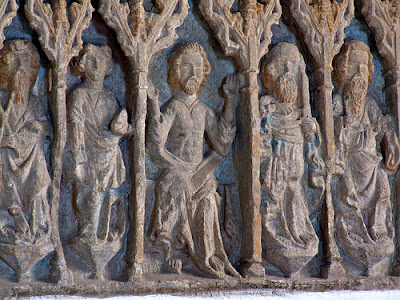
But back to Matthew:
And everyone who has left houses or brother or sisters or father or mother or children or fields for my sake will receive a hundred times as much and will inherit eternal life. Mt 19:29
Everyone who has left . . . children? (By the way, wives are curiously missing from this list. Why? Not important?)
What are we to do with such apocalyptic nonsense? It sends Jehovah's Witnesses door to door, and makes the lunatic fringe keep hoping for Rapture, no matter if constantly delayed for almost two thousand years. Sells books!
The apocalyptic perception of Jesus, which I have to admit has a high explanatory power, distresses me. Call me sentimental, but I was trying to cling to an admiration for Jesus. But the view of him as an apocalyptic preacher -- "let the dead bury the dead" finally makes sense, and a lot else besides -- and the view of the first Christians as end-of-the-world loonies -- one just can't argue with that.

Michelangelo: Last Judgment, St. Peter holding the key to heaven
SAVING JESUS FROM BECOMING A STONE BABY
BUT WAIT! There is a way that non-believers can translate “end of the world” so as to make it meaningful. It’s the “end of my life” perspective, a gift that those who believe in the afterlife are bereft of. Given that my personal world will indeed come to an end, there is absolutely no point carrying any “stone baby” of regret and resentment. When I decided that it was too late in life to be depressed, it also became too late to waste time complaining or accumulating useless things or delaying something for a “special occasion.”
There’s a man who stole a hefty sum from me by not delivering the goods. People advised me to sue him in small-claims court, but why should I go through that stress? I’d win, but collecting is another matter. It’s not worth it for me. Life is too precious for that, so I just let it go -- as close to “loving my enemy” as I can come. I know his life is a serious mess, and hope some resolution comes, some clarity so he can be an honest person again. It’s the same when I think of others who’ve hurt me -- what does it matter now? I feel mainly compassion for them. It’s too late in life for resentment.
So even if the wildly radical teachings of Jesus make sense only in the context of his expectation that the current world would soon be destroyed (“Take no thought for the morrow”) and New Jerusalem would follow, at least some of those teachings can still be applied in the context of our mortality.
*
FORMER GREAT LOVE AS A STONE BABY
Since this is officially a poetry blog, let me offer a poem related to the theme of a stone baby.
YEARS LATER
At first glance, there on the bench
where he’d agreed to meet, it didn’t seem to be
him -- but then the face of grim
friendliness was my former husband’s,
like the face of a creature looking out
from inside its Knox. No fault, no knock,
clever nut of the hearing aid
hidden in the ear I do not feel I
love anymore, small bandage on the cheek
peopled with tiny lichen from a land I don’t
know. We walk. I had not remembered
how deep he held himself inside
himself -- for fun, for thirty-two years,
to lure him out. I still kind of want to,
as if I see him as a being with a baby-paw
caught. His voice is the same -- low,
still pushed around the level-bubble
in his throat. We talk of the kids, and it’s
as if that will never be taken from us.
But it feels as if he’s not here --
though he’s here, it feels as if, for me
there’s no one there -- as when he was with me
it seemed there was no one there for any other
woman. For the first thirty years. Now I see
I’ve been hoping, each time we meet, that he would praise me
for how well I took it, but it’s not to be.
Are you as happy as you thought you’d be,
I ask. Yes. And his smile is touchingly
pleased. I thought you’d look happier,
I say, but after all, when I am
looking at you, you’re with me! We smile.
His eyes warm, a moment, with the accustomed
shift, as if he’s turning into
the species he was for those thirty years.
And turning back. I glance toward his torso
once, his legs -- he’s like a stick figure ,
now, the way, when I was with him, other
men seemed like Ken dolls, all clothes. Even
the gleam of his fresh wedding ring is no
blade to my rib -- this is Married Ken. As I
walk him toward the street I joke, and for an instant
he’s alive toward me, a gem of sea of
pond in his eye. Then the retreat into himself,
which always moved me, as if there were
a sideways gravity, in him, toward some
vanishing point. And no, he does not
want to meet me again, in a year -- when we
part, it’s with a dry bow
and Good-bye. And then there is the spring park,
damp as if freshly peeled, sweet
greenhouse, green cemetery with no
dead in it -- except in some shaded
woods, under some years of leaves and
rotted cones, the body of a warbler
like a whole note fallen from the sky -- my old
love for him, like a songbird’s rib cage picked clean.
~ Sharon Olds, Stag’s Leap, 2012
How many times have we seen this: a woman degrading herself, pursuing a man who no longer cares about her. Begging -- I can imagine her asking the husband who left her for another woman to meet again only as begging -- and no, he’s not interested, though courteous enough to go through it with a “grim friendliness.” We sense he didn’t really want to see her -- that he doesn’t want to see her ever again, and why should he? He’s married to someone else, and that’s his real life, not memories of how it was with the ex-wife. He feels awkward sitting on the bench next to the woman with whom he no longer feels any live connection.
I think here we also get a bit of a glimpse of the speaker as someone who’s been through a lot of therapy (this is revealed in other poems) and assumes that it’s good for everyone to psychobabble about every detail of their inner and outer lives, and that which you manage to verbalize is the true story rather than one of the many fictions and perspectives. In my observation, most men are utterly uninterested in that kind of analysis. Strange to say, I find myself joining the minority of women who likewise simply have other interests. Music! Literature! New developments in science! There is an exciting world out there, and a larger family. Waiting for the ex-husband to change his mind (or open up) is like waiting for Prince Charming, or -- for the Rapture.

YOU HAVE TO LET A CAT BE A CAT
When I can a cat, Georgia Dziordziusińska-Dziordziuśkiewicz, I learned that you need to let a cat be a cat. This widened to the view that you need to let each person be themselves, and you actually grow to enjoy them when they are relaxed and natural (who knew so many people were naturally charming when they don’t feel judged?), without feeling any demands put on them. Most people are good human beings, and like to be treated as such. They don’t care to be “lured out” to talk about the relationship with their father or whatever is assumed to be their “core issue.” Is that really so important? Can’t we respect the fact that perhaps they’d rather read the newspaper or go to the movies? Personally I enjoy the “strong silent” type. I have enough heavy stuff of my own and don’t want the burden of someone else’s complicated psyche piled on me. Not for free, in any case.
(By the way, I’m still not sure about cats versus dogs, now that pets have become an option. I love watching a cat be a cat and a dog a dog, sniffing around in ecstasy of exploration. I identify with that. And I know that neither species will ask me about some childhood trauma or some other “stone baby” I might be carrying, but without feeling burdened; no need to reactivate those old neural circuits; the most important and beautiful part of memory is forgetting.)
*
The clouds were so beautiful on the way to Coronado Library, again I thought that if I could no longer read or write, or contribute in any way, just looking at the clouds would make life worthwhile. But that’s assuming a brain functional enough to experience beauty, in which case it would probably be functional enough to read and write. Best not to fly in the no-think zones of potential dementia. But if someone asked me, when I'm past 80, what I loved most in life, it’s possible that I’d reply “clouds.”

photo: Jeffrey Levine
I can’t image Sharon Olds replying in this manner, and I don’t blame her: she’s herself, fixated on the body and family relationships, and I am myself, a lover of clouds (and more, but the list would be too long). She had to meditate on and on about the end of her marriage, even if to some of us that implies a sad waste of time. Her ex-husband certainly seems to want to move on without revisiting the old marriage, and who sees no more reason to see the ex-wife a year from now, or (I think this is implied) ever again.
At this moment I remembered one of my favorite scenes in the movie “A Serious Man.” The protagonist tells his “temptress” type of neighbor that he’s separated from his wife. She asks, “And have you been taking advantage of your new freedom?”
This is a wonderful point of view. Are you taking advantage of the opportunities of the moment, or are you incubating your stone baby? I speak as one who was guilty of that in my younger years, when I had spent way too much time talking in my head to my great love who married another woman. Luckily, I also developed as a writer, and creative work took over, along with teaching and journalism. And in my mental cemetery I found not the picked-clean skeleton of my once-great love, but the lilacs of gratitude: how wonderful that the cruel narcissist didn’t marry me! How magnificent that there were limits to his desire to destroy me . . .
Even so, I found the poem an interesting study of this unequal meeting of ex-spouses in which the ex-wife is still showing signs of clinging, even though she ends by implying through an image that it’s over, it really is over. But first she had to torture both of them by going through this unnecessary meeting, in the course of which she realizes that if he doesn’t look radiantly happy, that’s likely because of her presence. Her very presence is oppressive to him, is a form of silent nagging, some implied criticism of him as not open enough, or no longer husbandly.
Well, it happens: sometimes our very presence is oppressive to someone. If we recognize it, the only decent thing is to move on.
THE SHOOTING STAR
Mind you, sometimes the angels smoke, hiding it with their sleeves, and when the archangel comes, they throw the cigarettes away: that’s when you get shooting stars.
~ Vladimir Nabokov
This is clever as everything that Nabokov ever wrote, but I saw a shooting star last night, after a long period of not seeing any, and it was a lovely recognition. As usual, by the time I thought of making a wish, it was too late.
But what’s wish-making next to the great spectacle we are offered every night . . . One-tenth would have been enough to make me rejoice (typed “rejoyce”) in being here to see. Did I really, REALLY, go through three years of thinking about suicide every single day? I who say that one sunset can hold me, that I’ll never get tired of clouds . . . We change; life changes; and I am infinitely grateful to have experienced the moment -- later many moments -- when I understood that just to be alive is sublime.
But back then I was carrying a stone baby -- my rejected great love for a man whose greatest gift to me was marrying someone else.
Then I discovered that dropping idealization -- this took years -- dissolved the stone baby. I was finally free of that false pregnancy.
And I can still enjoy Michelangelo’s muscular (look at that biceps!) Jesus in the Last Judgment scene. For me this is actually a Mr. Universe contest, and Jesus wins the trophy.


While I do, on some level of ethical considerations, resent being used as a mere humanizing prop in the hands of a mass-murdering messianic maniac," thinks the cat . . . , "ultimately, I don't care. As long as he keeps scratching my back, it's all good. He's just a man, and I'm just a cat, and life is short. ~ Mikhail Iossel, Facebook
A strange thing happened to me as I was reading a biography of Lenin. The biographer’s hostility toward his subject proved of no avail: despite my “better judgment,” I found myself growing fond of Lenin, even though I wasn’t willing to forgive him his dismissal of freedom and democracy in favor of dictatorship. I hate the very idea of dictatorship, so why wasn’t I able to hate Lenin the man? Not when I was a schoolgirl, and not now?
Lenin’s charisma continues to puzzle me. Before the revolution, Trotsky told Lenin that the “dictatorship of the proletariat” can only mean “dictatorship OVER the proletariat.” Yet Lenin managed to persuade Trotsky to join his side. This stunned me. Lenin’s power of persuasion was legendary. Why? Was it his unwavering dedication? His astonishing courage?
One of my favorite poets, Wallace Stevens, saw Lenin as a “logical lunatic.” Lenin self-discipline was also legendary, whether it came to his writing routine or physical exercise. He was a supreme workaholic. In Zurich, where he was at his poorest, living in one room, he wrote Imperialism, the Highest Stage of Capitalism, emphasizing the emergence of global finance. He thought that in order to eradicate capitalism one needs to destroy the value of money in the world and abolish the ruling class. Today we can laugh at this “logical lunacy,” but it’s amazing that anyone would even try to go against the immense power of money.
“Among the communists I knew were some of the most attractive people I have ever met,” states Aleksander Wat, a Polish pre-war communist and dadaist poet who became a staunch anti-communist and a lyrical poet after his stay in Soviet prisons, described in hair-raising detail in Wat’s memoir, My Century. I think I understand that attractiveness, that spell of the heroic and exceptional. Living for an ideal can make a person charismatic. My spell was broken only when, in Robert Payne’s biography, I got to the Soviet invasion of Poland in 1920, and learned that Lenin expected the Polish workers to greet the Red Army as liberators, and together move on to “liberate” Germany and England. The fact that Poles saw the Red Army as invaders to be fought against took Lenin by surprise. It was then that I saw Lenin as out of touch with reality and going into the imperial over-reach that precedes downfall -- one in a long line of “logical lunatics.”
Lenin could be described as a prisoner of one idea, a utopian vision of the class-free future. In his long poem, “Esthétique du Mal,” Wallace Stevens uses “Konstantinov” (note the “constant” in the name) as a stand-in for Lenin. Victor Serge was an anarchist who later joined the Bolshevik cause, and later yet denounced Stalin. He died in Mexico City. The rumors that he was poisoned on Stalin’s orders have not been substantiated.
Victor Serge said, “I followed his argument
With the blank uneasiness which one might feel
In the presence of a logical lunatic.
He said it of Konstantinov. Revolution
Is the affair of logical lunatics.
The politics of emotion must appear
To be an intellectual structure. The cause
Creates a logic not to be distinguished
From lunacy . . . One wants to be able to walk
By the lake at Geneva and consider logic:
To think of logicians in their graves
And of the worlds of logic in their tombs.
Lakes are more reasonable than oceans. Hence,
A promenade amid the grandeurs of the mind,
By a lake, with clouds like lights amid great tombs,
Gives one a blank uneasiness, as if
One might meet Konstantinov, who would interrupt
With his lunacy. He would not be aware of the lake.
He would be the lunatic of one idea
In a world of ideas, who would have all people
Live, work, suffer and die in that idea
In a world of ideas. He would not be aware of the clouds
Lighting the martyrs of logic with white fire.
His extreme logic would be illogical.
~ Wallace Stevens, “Esthétique du Mal,” XIV
Yes, Lenin was a “lunatic of one idea.” I can’t argue with that:
He would be the lunatic of one idea
In a world of ideas, who would have all people
Live, work, suffer and die in that idea
In a world of ideas.
Where Stevens gets it wrong is in imagining Lenin as so obsessed with his one idea that he doesn’t even notice the lake and the clouds. On the contrary, Lenin was more than just “aware” of the lake. He took great delight in the beauty of Switzerland. He loved the Alps, the lakes and the clouds, just as he loved the beauty of southern Siberia where he was sent into exile. (Yes, Siberia is supposed to be beautiful. Lenin’s wife, Nadezhda Krupskaya, called Siberia an “enchanted kingdom.”)
And he loved Paris and London too, and Italy as well. And music and literature -- Pushkin, Tolstoy, Turgenev. He would not be the exceptional and charismatic man he was if he didn’t come across as brilliant and well-read, human and passionate, a soul on fire. He lived for his great cause and was fierce in debate, but would mellow listening to music.
(A shameless digression: “Esthétique du Mal” contains many lines I love. Here are the ones I simply can’t resist sharing:
His firm stanzas hang like hives in hell
Or what hell was, since now both heaven and hell
Are one, and here, O terra infidel.
and
The death of Satan was a tragedy
For the imagination.
and
The greatest poverty is not to live
In a physical world, to feel that one’s desire
Is too difficult to tell from despair.)
Lenin definitely lived in a physical world, and, despite moments of despair, was confident that his desire for a new social order would be fulfilled.

Alas, distractible reader, now that I have distracted you with metaphysics, let me note one more eruption of Lenin in another poem by Stevens, “Description Without a Place”:
Lenin on a bench beside a lake disturbed
The swans. He was not the man for swans.
The slouch of his body and his look were not
In suavest keeping. The shoes, the clothes, the hat
Suited the decadence of those silences,
In which he sat. All chariots were drowned.
*
The last line of this section ends with the phrase “apocalyptic legions.”
Again, though I agree about the apocalypse, I question the notion that Lenin “was not the man for swans.” He loved nature, having spent his childhood summers on his grandparents’ estate near Kazan. Much as we may condemn Lenin’s politics, he was not indifferent to swans or the opera.
 A drawing of Lenin in his famous worker’s cap. Note the tie.
Was he sensitive, or was he ruthless to the point of cruelty? He was both. And that’s why he remains fascinating: he was a cultivated, well-read man with whom a typical cultivated person of his times would have much in common. If his older brother, Sasha, whom he adored, had not been executed for taking part in a foolish, juvenile anti-Tzarist plot, who knows if Lenin would have become a revolutionary at all. One can easily imagine him as a jovial lawyer in a pleasant little town on the Volga, playing piano duets and hunting in the woods. He’d be known for his mastery of chess. As for the revolution, well, it would never have happened without him.
 Four-year-old Lenin and his sister Olga.
The “logical lunatic” type of person certainly exists. I’ve met a couple of men who erected whole complex philosophical systems to justify their self-destructive behaviors. On a larger and more deadly scale, Sergey Nechayev, an anarchist leader in mid-nineteenth century, was an example of a logical lunatic. His “Revolutionary Catechism” opens with these words:
The revolutionary is a doomed man. He has no personal interests, no business affairs, no emotions, no property and no name. Everything in him is absorbed in the single thought and the single passion for revolution.
It may seem perverse of me, but this reminds me of what Aleksandr Solzhenitsyn says about how to survive as a prisoner. I quote from memory: You must think of yourself as already dead. Stop trying to save your life. If you see yourself as a dead man, they will have no power over your spirit. Only then you won’t lose your human dignity.
*
Dostoyevski presented the anarchists in a very unflattering way in The Devils. Lenin thought the novel was a work of genius, but was unhappy that it presented a Nechayev-like figure in such negative light. According to Lenin, Nechayev discovered the need for a small number of utterly dedicated revolutionaries, the elite who will insure the success of the revolution -- at least in its destructive phase.
But for Lenin, being utterly dedicated to the destruction of the old regime didn’t mean that he should sacrifice his beloved late afternoon walk.
*
Yes, I hear the predictable comment: if only the Vienna Fine Arts Academy had accepted Hitler, he might have become a harmless landscape painter. We don’t know and we’ll never know. What if the two had not had such devoted mothers who infused them with great self-confidence. What if each had a charismatic teacher who’d point him in a different direction. What if . . . It’s startling to think that history would have been different if just one variable happened to be the opposite of what it was.
Speaking of the role of seemingly minor factors, Hitler’s father’s original name was Schicklgrubber. Alois Schicklgrubber disliked the name and had it legally changed to Hitler -- according to one source, a name he picked off a tombstone. The joke that “Heil Schicklgrubber” would never have worked rings true.
** The windows of the Zurich apartment rented by Lenin and his wife
Adolph Kammerer, Lenin’s Zurich landlord and a shoemaker, had fond memories of the Russian revolutionary. Robert Payne quotes Kammerer: “[Lenin] was always buying bottles of hair oil to cure his baldness, and he forgot to turn off the gas jets, but he was a good fellow.” Human, all too human.
Payne writes that Lenin was delighted with the beauty of Lake Zurich and often walked on the strand. The drawback of living on Spiegelgasse (Mirror Street) was the stench of the sausage factory, so the windows had to be kept shut. And the borders and the eyes.
WE LOVE WHAT IS FAMILIAR
My mind condemns him. My mind understands that even a serial killer is a mere petty criminal next to an idealist who lives for a Great Cause, willing to die and kill for it. Willing to kill hundreds of thousands, and what’s a million or two? As a Chinese physician from Taiwan -- and thus no fan of Mao, I foolishly assumed -- told me, “Perhaps those people needed to be killed.”
The mind condemns, but the heart is naive and sentimental. You might as well expect an American to turn against George Washington and his wooden teeth. Not as much as the Russian children, the little boys saluting, but we too were taught to love Lenin.
Odd that the church didn’t succeed with Jesus half as well. I suspect it was the crucifixion. You couldn’t love the kind of god who wanted to have his crucifixion and eat it too.
There were two Lenins, if you drew a line down the middle of his face. The right side was Mongolian, the left European -- or maybe the left eye was rounded with astonishment and sadness at the collision of the ideal and the real? That sadness at the dawn of my life, that death cry.
From a poem of mine:
I know I’ll never meet anyone
who’s had my childhood,
surrounded by portraits of Karl Marx,
Lenin, Friedrich Engels. Engels tossed in
only for the sake of Trinity.
We all knew who God the Father was,
who the Son with a slant Siberian eye,
and Engels the long-suffering Holy Ghost.
I’ll never meet anyone
who’s heard about the Tzar’s
Winter Palace, the salvo from the battleship
Aurora, the Finland Station, Smolny Institute.
Those were family names;
it didn’t matter that they stood for
humanity’s shattered dreams.
You love things because they are yours.
You love what you grew up with:
not the moronic regime
but the blossoming banners of springtime,
the lilacs of ideals, the enormous width
of The International. When you sang it,
you sang with a million mouths.
Aren’t all poems about forbidden love?
The swooning lilacs instead of suicide
after seeing the Ikea sign
from my old window in Warsaw?
**
When I returned for a visit, soon after the fall of communism, the portraits of Lenin were gone. Nowhere, that face more familiar than the faces of my relatives. The country was no longer his, and no longer mine.
Why didn’t I grow to dislike Lenin? Maybe there is something indelible about a childhood affection, the stories of how he worked into the night, the only one awake, the light of his solitary lamp seeping out through through the door. Or how he loved the mountains, including the High Tatras in what was then Austrian Galicia. I saw the little bronze stars marking the trails he’d hiked.
Or maybe it was the feeling that he wasn’t evil so much as naive about human nature. How could anyone imagine that he could abolish the power of money and create a class-free society? A society with no need for a standing army, police, or bureaucracy? Any idealist can understand and weep.
But that’s rationalizing. For me it was enough that he loved to read and write and take long walks. He was ascetic and compulsive. Any writer can understand that.He thought he lived for a great cause, but I suspect it was his love of reading and writing that kept him alive. His excessive love of ideas. He loved ideas more than people. Any intellectual can understand that.
I was also astonished and impressed by the victory of the revolution, which had the air of the miraculous about it. The White Army with its professional Tzarist officers and the troops and supplies sent by the Western powers could not stop the Red Army, which had an ideal and charismatic leadership.
(Of course not everyone was persuaded. A factory worker in Paris said to Lenin’s wife [mercilessly described by Lenin’s sister Anna as looking like a herring], “God created the rich and the poor, and all is right in the world.”)
But perhaps it wasn’t so much a matter of personal charisma. Here is one historian’s view:
Charisma is typically associated with a saint or with a knight, some personal attribution, and what Lenin did was remarkable. He did exactly what he claimed to do: he created a party of a new type. He made the party charismatic. People died for the party. It’s as if people would die for the DMV. Most people don’t get too excited about the Department of Motor Vehicles because it's a bureaucracy. What Lenin did was combine the attributes of personal heroism and the efficiency of impersonal organization, and created a charismatic organization. That's been done before. It's been done by Benedictines, it’s been done by Jesuits, but it’s never been done by a political party before. ~ Ken Jowitt
The ideal, the great cause -- and the wild daring to try to put a utopian vision into reality. It had to end badly, but that someone had the daring! It seems that the experiment simply had to be performed so that humanity could learn about idealism pushed to the extreme. The greater the cause, the greater the ultimate evil that results. The steady repetition of that irony is like the fall of empires: they never learn.
But all this is pale, rational excuses next to the primordial fact that found its voice in the poem: the love of the familiar. The trinity of Marx, Lenin, and Engels above the blackboard in every classroom. The power of the familiar.
A WORKAHOLIC’S PARADISE
But here is the likely core reason of my “Lenin envy”: his life in Switzerland, except for the sausage factory in Zurich, is my idea of heaven: every day, quiet work and long walks with marvelous vistas.
Nigel Barber observes:
For people who are really involved in their job, working hard and meeting objectives comes naturally. It requires effort, of course, but they are not fighting themselves every step of the way. Instead, they feel calm and focused and their day passes in a blur of pleasantly stimulating activity.
Such people tend to be workaholics and many feel far happier, calmer, more stimulated, and in control of their lives when they are working than on their days off. Working can be an avenue to peak experiences and such experiences are potentially addictive which is why some people work compulsively and go far beyond the call of duty.
http://www.psychologytoday.com/collections/201306/practice-practice-practice/work-habits-versus-creative-flow
*
I don’t think it takes peak experiences. Just maintaining calm focus is so pleasant to an introvert that leaving one’s study in order to, ahem, engage with the world, seems like leaving paradise for bedlam.
*
Growing up I knew that Lenin’s wife was devoted to him, and never imagined that a different woman was the great love of his life. Once I learned about Inessa Armand, I wondered what it was about Lenin that attracted her most. She was a beauty with striking large eyes and full lips, an Olympian goddess next to the small, bald, corpulent man.
(He was completely bald by the age of twenty-three, when he became a sought-after speaker in the Marxist circles. The joke about him was that his brains were so big, they pushed out his hair.)
Inessa was allegedly the one who initiated the relationship after hearing Lenin speak in a meeting. She loved the way his face lit up when he spoke. Above all, she loved him for his intellect. Intellectual men don’t always realize how irresistible they are to women.
Lenin’s wife was actually fond of Inessa and the two children that Inessa brought with her to Paris (she left the other three with their father in Russia). Nadezhda wrote, “The house grew brighter when Inessa entered it.”
Bertram Wolfe writes, “She had a wider culture than any other woman in Lenin's circle, . . . a deep love of music, above all of Beethoven, who became Lenin's favorite too. She played the piano like a virtuoso, was fluent in five languages, was enormously serious about Bolshevism and work among women, and possessed personal charm and an intense love of life to which almost all who wrote of her testify.”
Yet she too became a “logical lunatic.” The love of beauty does not protect one against the lure of a heroic life, be it ultimately for the wrong cause (and every cause becomes wrong if pushed to the extreme). Perhaps the emotional intensity that often goes with mental giftedness and the love of beauty makes one even more susceptible.  Inessa Armand, 1890
In 1920, Inessa died of cholera (and malnutrition and overwork. She was only forty-six. One witness described Lenin at her funeral: “Lenin was utterly broken by her death... He was plunged in despair, his cap down over his eyes; small as he was, he seemed to shrink and grow smaller. He looked pitiful and broken in spirit. I never saw him look like that before.” Olga Kollontai wrote: “He was not able to go on living after Inessa Armand. The death of Inessa hastened the development of the sickness which was to destroy him.”
*
LENIN TO HIS MISTRESS, INESSA ARMAND
(the village of Poronin, Tatra Mountains)
Dear Friend, My Red Angel: I long
to give you the voluptuous green
of the deep Tatra valleys, blueberries,
Five Black Ponds pure and dark
as your eyes. To think you have a husband
yet never speak of him, nor of
anything as bourgeois as divorce.
The night I escaped, a corpse-like full moon
glazed the frozen Finnish Channel.
Halfway to the ship bound for Sweden,
the ice began to crack.
I was ready to die – life hadn’t denied
me anything except great love. Then
you, Inessa, in the darkest time –
the Lafargues slumped in their chairs,
self-injected with cyanide
(Marx’s daughter! she could still be of use);
Russian exiles babbling about balalaikas,
carted off to insane asylums;
my wife dozing with her glasses on –
“So I can see where I’m sleeping.”
Remember when you played
the Appassionata for me?
I could listen to it all day, but I
mustn’t: music makes me want
to stroke people on the head.
Imagine, Emma Goldman writes,
“If I can’t dance to it,
it’s not my revolution.”
Anarchists are such children.
Yet they too can be used:
what the Italians call utili idioti.
Then that madwoman Rosa Luxemburg
with her “freedom for the one
who thinks differently.”
I’m tired of repeating and repeating,
Liberty is a form
of bourgeois dictatorship.
The masses have no need of liberty.
Democracy -- what’s the point?
The ruling class remains the same.
I’m sorry, dearest – I should rather say
I remember our first New Year’s Eve
when you stood by the fireplace,
your red hair a shroud of flame –
I thought of the fox I saw
in the snow in Siberian woods:
so beautiful that I couldn’t kill it.
I know you will forgive me.
Yours, Vladimir Ilich.
~ Oriana © 2013
.jpg)
Lenin's house in Poronin. The statue was taken down in 1990.
Hyacinth:
I like the story of Lenin and the fox. He had a tender side.
Oriana:
Or at least a “human” and beauty-loving side. I wrote this blog to grapple with my own confusion about this man whose face was in every classroom as I was growing up. That face in the bookstores, in public offices. I wanted to say “everywhere,” but that would be a hyperbole. Still, I did see it every day for many years, always the same portrait, his slanted eyes looking to the side, not at the viewer.
The story of the fox was told by his wife in her memoirs. She says (and others have confirmed this) that Lenin often walked with his hunting rifle, but would come home with nothing. He wasn’t really interested in hunting. The fox suddenly appeared just a few yards in front of him. Asked why he didn’t shoot the fox, Lenin replied, “Because it was so beautiful.”
One more story that shows his human side: he’d play cards with his mother-in-law and usually let her win. She’d shake her head and say, “How could an intelligent man like you play so badly against a weak old woman like me?”
But I don’t mean to say that would should forget about the evil he helped to bring about, ruthlessly pursuing his vision of the ultimate good. Perhaps his greatest fault was having absolute certainty -- yes, the very trait that was essential to his success as a leader. With so much history behind us, with its sadly repetitious lessons, we need to develop a deep respect for the humility of uncertainty.
Charles:
Love how you humanized Lenin with interesting anecdotes and photographs. So interesting to think that if there was one variable in Lenin's or Hitler's life the world would be different.
My favorite line in blog is: "You couldn’t love the kind of god who wanted to have his crucifixion and eat it too."
I also love this: "The greater the cause, the greater the evil. The steady repetition of that irony is like the fall of empires: they never learn."
And this: "He thought that in order to eradicate capitalism one needs to destroy the value of money in the world and abolish the ruling class."
Love the way you segued to LENIN TO HIS MISTRESS, INESSA ARMAND.
Oriana:
Anecdotes are antidotes to abstraction. This is especially important if a person has been either idealized or demonized.
Lenin needs to be "humanized." As his shoe-maker landlord in Zurich said, he was a "good fellow." Intellectuals can easily recognize at least parts of themselves in him. In me he arouses the longing to give myself to a cause utterly, and the envy that he was able to. Talk about a “purpose-driven life”! And then, the instant warning that this can lead to evil. I’m relieved that there is no blood on my hands, even through association. The love of ideas is a dangerous thing.
(Atheism -- no. Nobody would die -- or kill -- for atheism. I like being an example of “good without god,” but a more comprehensive and life-affirming vision needs to be worked out, with ideals that don’t kill.)
Yes, it's amazing to think that a single variable would have changed history. Maternal rejection, for example, would have made self-confidence difficult or impossible. A leader needs to radiate self-confidence, and that doesn’t come from having been put down and ridiculed and shamed. Extraordinary people often have extraordinary mothers, both loving and ambitious for their children. Or if it's not the mother, then another exceptional and inspiring person has "manifested" early in life. One way or another, there was a feeling of security and being greatly valued.
Lenin seems to have had a pretty wonderful childhood until the trauma of his older brother's execution by hanging for taking part in a failed (and ridiculously incompetent) anarchist plot. Imagine how the mother must have suffered. Of course all the children suffered too. But Lenin was already 17, so that didn't wreck his childhood. It did, however, ruin his chances for a professional career in Russia.
Yet another factor was Lenin's power of persuasion: he managed to recruit Trotsky, formerly a moderate who favored democracy. Without Trotsky, the revolution would not have succeeded. So yes: change one or two factors, and world history would have been different.
And yes, idealism pushed to the extreme leads to evil. The promise of workers’ paradise crumbles into communal apartments and food shortages. True, a devout liberal might say, but the extreme poverty at the social bottom was rapidly eliminated.The large land owners, the parasitic aristocracy, were gone (most of them left Russia). Literacy spread quickly. We need to acknowledge this too. History is very complex. Let's be less judgmental, but more complex in our thinking. Let’s be willing to say, “I don’t know.”


.jpg)