skip to main |
skip to sidebar
 Noah’s Ark, Edward Hicks, 1846
DARWIN, ONCE MEANT FOR THE CLERGY,
IMAGINES HIS SERMON ON NOAH
Too late, dear brethren, too late to believe
there never was a rainbow before the Flood –
or that the ark, three hundred cubits long,
could contain millions of species.
I won’t belabor the ark’s humble door
vis-à-vis a giraffe,
the whine of the two thousand
species of mosquito.
And the animals of the then-unknown
Australia and the New World?
Did they plunge into distant oceans,
two and two of all flesh,
and every thing that creepeth on the earth –
snails and slugs slithering for centuries.
As iron-dark clouds barred heaven,
did gorillas and polar bears parade
through a mud-brick Mesopotamian village?
And our fabled forefather, when the Lord
shut the door of the ark,
was six hundred years old.
The less believable it is,
the more enchanting it is.
Listen how tenderly it is said, But the dove
found no rest for the sole of her foot . . .
then he put forth his hand, and took her,
and pulled her in unto him into the ark –
The new theologians tell us the myth
is not even Hebrew, but primeval:
purification of the world by water.
Purification by science
is another Deluge.
Evolution is not crowned with a rainbow.
Brethren, I do not speak of Truth –
I offer evidence. I too carry
a heavy church in my heart.
The ship I sailed on for five years
was a kind of ark – I and Noah
on a long, crowded journey,
he with his salvaged animals,
I with my specimens in jars.
Brethren, behold the rainbow and rejoice
in the frail moment when the dove
alighted with a glistening olive leaf –
but how can we forget
the faces of the drowned –
Now the windows of heaven are shut;
all we have is stories.
Perhaps a future humanity will evolve
a kinder God, without wrath.
Today let us honor our father Noah,
drifting with the saved
seed of life toward Ararat.
~ Oriana © 2014
**
The problems with the traditional Judeo-Christian worldview did not begin with Darwin. As the Episcopalian Bishop Shelby Spong points out in his Why Christianity Must Change or Die, and as most educated people realize, the Copernican idea that the earth orbited the sun, combined with Galileo’s astronomical observations using the telescope (which showed, among many other wonders, that the moon had a crater-scarred landscape rather than being a perfectly smooth sphere -- oh no, an imperfection in a celestial body!), displaced the earth from the center of the universe.
If the whole universe was created with us in mind, as the bible implied, so that we could worship the creator, then obviously the earth should not be just another planet orbiting the sun. Later astronomers created even more trouble, discovering that the sun was a rather average star in a provincial corner of our galaxy. And the cosmic distances were quite troubling. In modern times someone calculated that if Jesus moved with the speed of light (which is not possible, but let’s imagine), given the 2000 years since the Ascension, he still hasn’t left the galaxy.
(Sophisticated Reader, I realize that an answer to this is: let’s not be literal, only metaphorical. But the argument that in the past people used to read the bible in a metaphorical way and only in modern times we slid into weak-minded literalism doesn’t convince me. I just don’t see a medieval peasant grasping the Ascension as a metaphor for spiritual development, while we moderns devolved to the mentality of kindergarten.)
 Galileo’s drawing of the moon
Darwin created a worse problem by far, and not only by making man a highly evolved animal with a more developed brain. Far more damaging was the very concept of evolution, soon adopted by other fields of knowledge. Thus, the earth evolved; the whole universe evolved and was still evolving. At the human level, cultures evolved and continues to evolve at an amazingly accelerated pace. Technology and knowledge have evolved. Art has evolved (some would say that starting with Impressionism, it devolved).
CHRIST TZAR
Religions too evolved and may now be dying -- or, if not, it will eventually be greatly transformed (into something more benign, we hope). The very concept of god evolved -- from a tribal warrior deity, the “Lord of Hosts” who fought against the enemies of his tiny chosen nation, to the sole and absolute ruler of the whole universe, the “king of kings” (absolute monarchy being dominant at the time; the sacred scriptures of humanity were written in the era of kings and emperors and warlords).
As Nietzsche observed, it’s not necessary to argue about the existence of god; it’s enough just to trace the evolution of the concept.
 Christ Tzar, a Russian icon, 1690
THE UNEMPLOYED GOD
Bishop Spong notes that the Christian churches resisted Darwin with vigor, but the pre-Reformation ecclesiastical power had already been broken, and the Church’s ability to threaten Darwin with execution as a heretic no longer existed. Besides, truth can never be deterred for long just because it is inconvenient. Spong observes that if man was an animal, then the concept of the soul and the afterlife, traditionally denied to animals, became questionable. Some have tried to cope with this by bestowing soul and afterlife on animals, especially dogs and cats, and maybe horses. Given their intelligence, maybe also elephants and dolphins. But where do we stop? Are frogs and fishes to be denied? (Milosz wanted even the insects to enjoy resurrection.)
Spong quotes Michael Goulder, an Episcopalian priest who renounced priesthood when he decided that the god of the past “no longer had any real work to do”:
The tasks assigned to this God by traditional wisdom, he suggested, have been slowly but surely stripped from the divine side. This God no longer fights wars and defeats enemies. This God no longer chooses a special people and works through them. This God no longer sends the storms, heals the sick, spares the dying, or even judges the sinner. This God no longer rewards goodness and punishes evil. Yet this virtually unemployed deity is still the primary object and substance of the Christian Church’s faith.
The theistic God has no work to do. The power once assigned to this God is now explained in countless other ways. The theistic God is all but unemployed. . . . If there is no other possible understanding of God, then surely God has died.
Religion and personal and autobiographical. The theist deity always reflected the particular theologian, Spong maintains: “The fact is that the God of Thomas Aquinas looked and acted very much like Thomas Aquinas.”

Aquinas by Carlo Crivelli, 1467
**
But what about the emotional need for a protective deity, a parent in the sky? Even if science shows that god is not necessary for the function of the universe, it can’t do away with people’s longing for “invisible support.” This is where Spong is at his most interesting. He quotes an ancient Hebrew prophet:
With what shall I come before the Lord and bow myself before God on high? Shall I come before him with burnt offerings, with calves a year old? Will be Lord be pleased with thousands of rams; with ten thousands of rivers of oil? Shall I give my first-born for my transgression, the fruit of my body for the sin of my soul? Mica 6:6-7
From the historical point of view, this is an interesting window on what used to constitute worship. But from where we stand, isn’t this simply disgusting?
Could it be that some people still don’t realize how archaic the bible is -- like all “holy scriptures,” a product of its times? Maybe they realize, but still cling to religion in the hope of emotional security.
Dead ideas continue to slow down our development. Many are afraid that the light of reason would force them to drop their security blanket. In Act 2 of Ghosts, Ibsen wrote:
I almost think we’re all of us Ghosts. ... It's not only what we have invited from our father and mother that walks in us. It's all sorts of dead ideas, and lifeless old beliefs, and so forth. They have no vitality, but they cling to us all the same, and we can’t get rid of them. Whenever I take up a newspaper, I seem to see Ghosts gliding between the lines. There must be Ghosts all the country over, as thick as the sand of the sea. And then we are, one and all, so pitifully afraid of the light.

FREUD’S “THE FUTURE OF AN ILLUSION”
In Judaism, god is “the Lord.” In Christianity he becomes “our father.” This family analogy attracted the attention of Sigmund Freud, who duly noted the infantile character of much of the language of Christianity.
In his 1927 volume, The Future of an Illusion, Freud argued that humans were traumatized by the knowledge of their mortality. A psychological coping mechanism was needed. Spong writes:
Religion, Freud contended, was the coping mechanism, the human response to the trauma of self-consciousness, and it was designed above all to keep hysteria under control and to manage for these self-conscious creatures the shock of existence.
For Freud, the essence of an illusion is that it springs from a wish. We wish to be immortal the way a poor girl wishes to marry a prince. Man feels helpless, and thus wishes for an all-powerful protector(s). In Freud’s words: “The gods retain the threefold task: they must exorcise the terrors of nature, they must reconcile men to the cruelty of Fate, particularly as it is shown in death, and they must compensate them for the sufferings and privations which a civilized life in common has imposed on them.”
Nietzsche said that religion is “not wanting to know the truth.” And because religion is not a search for truth, but rather a part of a complex emotional defense system, it does not tolerate open debate and dissent. Its truths are “revealed” and thus can’t be questioned. And the hysteria that religion was meant to contain reveals itself in irrational hostility when dissent is encountered. I remember, a few months after I stopped going to church the priest who was shouting at me, sweating and red in the face, his black robe billowing in the spring wind; right in the middle of the sidewalk of one of the busiest streets in Warsaw, he was shouting at a fourteen-year-old schoolgirl. I now feel sorry for the man, so threatened by a young girl’s disbelief.
Nevertheless, there are those who see the irrationality of religion as its greatest strength. Otherwise, the collective power of the human intellect would have disposed of it long ago. At his most optimistic, Freud maintained that the voice of the intellect is soft, but it will not rest until it’s been heard.
 RILKE: WE ARE BUILDING GOD
In 1900, when Rilke was twenty-five, he wrote in his diary:
There were times, earlier, when I believed: he [god] is in the wind, but for the most part I didn’t experience him as a unified personality at all. I knew only aspects of god. And many of those aspects were horrifying. For even death was only a component of his being. And he seemed to me unjust in the extreme. He tolerated unspeakable things, permitted cruelty and grief, and was massively indifferent . . .
I argued on his behalf. That his shortcomings, his injustice, and the deficiencies of his power were all matters of development. That he is not finished yet. When was there time for him to have become?
GOD IS NOT FINISHED YET. I can almost go along with it.
God in the wind? It’s possible that Rilke refers to the Hebrew ruach, which literally means wind, but came to be interpreted as the breath (or spirit) of god. Originally, the same word meant wind and spirit, hinting at archaic animism: wind as a supernatural element, the breath of god. In Slavic languages the word for spirit is related to the word for breath, and inspire used to mean both “inhale” and “blow into” or “breathe into.”
The more interesting part is the positing of god’s incomplete consciousness, also pointed out by Jung in Answer to Job. By developing our consciousness, we are helping god become more conscious, more ethical. God is a projection of human ideals, but in some mysterious way a real being as well. Thanks to human progress, god is in a constant process of becoming. We are building god.
This is called Process Theology. (Are there any Process Theologians in the trenches?)
 An abandoned locomotive in a former Siberian gulag
WE ARE NOT BUILDING GOD; WE ARE BUILDING HUMANITY
It’s not god’s consciousness that needs fuller development; it’s the collective human psyche. We are coming closer and closer to realizing how amazing it is to be human. And we are beginning to acknowledge that we are interconnected with other humans, and with all of life.
In The Sirens of Titan, one of my favorite science-fiction novels, Kurt Vonnegut described the Church of God the Utterly Indifferent. But obviously we don’t want an indifferent god, even though logically that seems to be the only possible deity. Fortunately concern for us exists: we receive it from other human beings. It makes sense to be kind and cultivate friendships.
(Disappointed Reader: I hear you saying: “other human beings” -- is that all? Isn’t it time we came to hold human beings in higher esteem? Because, aside from dogs, that’s our only source of love and help.)
CAN WE REALLY IMAGINE A NON-THEIST GOD?
Spong and many others who want to salvage the divine have suggested that god is not a being; it (this seems the appropriate pronoun) is some transcendent force field, intelligent cosmic energy, or even the “Ground of Being.” Spong prefers the “Ground of Being.” We exist in god as fish live in water, but in a more mysterious way than can be expressed.
Alas, this is so abstract that it makes no sense to me. It seems like desperate clinging to the concept of god when we don’t need this hypothesis. The universe simply IS. We ARE. We are a part of the universe, or, to make it sound more affectionate, we are the children of the universe. The universe itself is our “ground of being.” Isn’t that enough?
But what about the non-theistic religions of Buddhism and Taoism? They have become tremendously popular -- finally an alternative to a personal god, obviously created by man. Yet those who’ve traveled to East Asia claim that in practice Buddhism and Taoism are theistic and based in ritual and magic; only in pure doctrine can they be said not to be “pure” non-theism.
(I won’t get here into allegation of sex abuse in the Buddhist monasteries. But we do know that as soon as religion becomes institutionalized, it becomes corrupt.)
I am selectively attracted to the Eastern wisdom. I see “being posthumous” as a state of bliss. To me, being posthumous means that my life has already happened -- or at least the essence of that life: writing and teaching -- poems, publications, jobs, anything else that typically goes on a resumé -- as well as great love, dancing with the Prince etc. Now I can enjoy simply being. I don't need to prove anything, achieve anything. Nor am I waiting for the Prince. All that anguish is over.
It’s pretty much the Eastern wisdom, but with my own personal angle. Now I finally write for pleasure. Imagine! Writing for pleasure, without the torture of trying to publish. Until this stage, writing was a joy only when I was a beginner -- how amazing to have come full circle, though of course at a different level and even different kind of writing.
Actually someone upbraided me once: “You have a duty to publish! You have so much to say. The world needs to hear this. You can’t just write for your own pleasure!” -- not realizing that at the time I wasn’t writing for pleasure; I was writing to prove that I was not a failure, or at least not a TOTAL failure, even if I had little luck publishing.
Such ironies often happen in life: I gained an international audience (India! Saudi Arabia!) only when I started writing for pleasure (here I remember another person chiming in, when I emailed her I was starting my blog e-dress, “As long as you enjoy doing it; pleasure is the only thing you’ll ever get out of it.”) And it has indeed been an avalanche of pleasure! Not just the pleasure of writing, but also the pleasure of having an audience and getting feedback, and the pleasure of publishing on my own terms.
 Arabian sand cat
CLIMBING A VERTICAL MOUNTAIN
Arabian sand cat
CLIMBING A VERTICAL MOUNTAIN
Once -- many years before my “posthumous” insight -- I had a dream in which I was climbing an almost vertical mountain. I had the right technique: I knew that if I never rested and if I kept climbing quickly enough, I would not fall off the sheer wall with practically no foothold. To my left was my grandmother Veronika. I didn’t see her face, but I recognized her leather slippers. She was climbing the impossible steepness in parallel with me.
At the same time I could see a beautiful wide road with a pine forest on one side and the sea on the other (my memories of the Baltic). People were walking down that road. I strongly suspected -- in fact I knew! -- that the road led to the same place as the virtually impossible climb up the mountain, but I did not dare stop my struggle. When I was at the top, on the large plateau, I saw that the easy and beautiful road did indeed lead to the same place, and that’s how other people arrived there. Some in fact drove in in large cars! I assumed they had to be Americans.
When I told the dream to a friend, she asked what my grandmother and I had in common. I answered, “A lot of hardship in life.” The dream was transparent in its message. Still, it took me more than a decade to accept the idea that taking the beautiful and easy road was the right choice, rather than persisting in an agonizing effort, akin perhaps to “dying with honor.”
Compounding the problem was having grown up with the Catholic cult of suffering. Suffering was good for you. It was the way to heaven. I am not sure if anyone stated this to me in so many words, or if it was just a conclusion I drew based on reading the lives of the saints. Fortunately I never tried self-flagellating (one of my cousins did). But enough digression!
The point seems to have been by Eastern sages many centuries ago: stop striving and just be. Let happiness happen. The root of “happiness” is “hap” -- luck, or chance, or whatever happens.
In The Idiot, Dostoyevski asks, through the mouth of Prince Myshkin, “Can anyone be unhappy, really?” To the Prince, as to Dostoyevski, just to be alive was miraculous.
 Cezanne Mt. Victoire
BORGES AND IMMORTALITY
Still, I’m quick to concede that Dostoyevski regarded the belief in immortality as a vital part of human culture. True, he was torn with doubt; on Tuesday morning he believed in god and the afterlife; by Wednesday he didn’t. But probably all would agree that the chief attraction of theistic religion is the promise of life everlasting.
Borges has an answer to this in what is perhaps his most extraordinary poem:
INSCRIPTION ON ANY TOMB
Let not the rash marble risk
garrulous breach of omnipotent oblivion,
in many words recalling
name, renown, events, birthplace.
All those glass beads are best left in the dark.
Let not the marble say what men may not.
The essentials of the dead man’s life --
the trembling hope,
the implacable miracle of pain,
the wonder of sensual delight --
will abide forever.
Blindly the willful soul asks for length of days
when its survival is assured by the lives of others.
You yourself are the embodied continuance
of those who did not live into your time
and others who will be (and are) your immortality on earth.
~ Jorge Luis Borges, tr. W.S. Merwin

Borges was such a “singular” man (I mean it in the sense of unusual, exceptional -- but the word insists on its most common meaning) that it’s striking how he doesn’t buy “individualism.” He does not insist on his “exceptionalism.” Simply because we are human, we are not isolated individuals; we are humanity. We pass as the water in the river passes, but the river remains.
This realization may have come to Borges in part from his life among books. He realized that his mind is a tapestry of the endless volumes he’s read, influences he’d absorbed. From there it’s only a step to seeing oneself as part of the larger human community across time, and of the human continuum.
His acceptance of the collective mind set Borges apart from those writers in his generation who insisted on the cult of the artist as completely separate and alienated. But Borges communed with great writers across time, and knew he was part of a continuum.
This is not to deny the uniqueness of each of us, something we bring to the universe only once. “There will never be another you.” In the Western culture in particular, everyone has had at least moments of feeling so different from others that loneliness threatens to overwhelm: no one really knows me, so how can they love the “real me.” Never mind that the “real me” is so elusive, so . . . unreal. Even our memories are not fully ours, but a collage of we absorbed in all kinds of ways, including books and movies.
If we were words, each person would be an oxymoron: a collective individual. A single individual has no meaning apart from his social context. As Christian Wiman said, “Experience means nothing if it does not mean beyond itself: we mean nothing unless and until our hard-won meanings are internalized and catalyzed within the lives of others.”
As Borges reminds us: others are and will be our immortality, here on earth.


Who, if I cried, would hear me among the angels’
hierarchies? and even if one of them pressed me
suddenly against his heart: I would be consumed
by that greater existence. For beauty is
but the beginning of terror we are still able to endure,
and we admire it so because it serenely
disdains to destroy us. Every angel is terrifying.
~ Rilke, First Duino Elegy
If angels and other super-human beings -- providing they even exist -- do not hear us, then, Rilke asks, who can we turn to in our need? That unspecified need ultimately always comes to this: our terror of death, of non-being. Rilke is on that cusp of modernity that’s still willing to let immortals exist, but, as the enlightenment-era deists claimed earlier, the gods can’t hear us.
Then who can we turn to?
Not angels, not men;
and already the knowing animals
guess we don’t feel truly at home
in the interpreted world.
Can we turn to a lover? Are lovers not a great example of giving strength to each other? Rilke doesn’t trust romantic love that way:
. . . Is it easier for lovers? Alas,
with each other they only conceal their fate.
Even the consolations of nature don’t entirely suffice -- not the night, nor the wind that “gnaws at our faces.” Ultimately Rilke settles for music, though some doubt remains:
Is the old tale in vain
that tells how music began
in the mourning for Linos
piercing the arid numbness,
and, in that stunned space
where an almost godlike youth
suddenly ceased to exist,
made the emptiness vibrate in ways
that charm us, comfort and help?
The Greek poets would have said, “a godlike youth,” without the qualifier. But modernity doesn’t dare reach for such certainty. And that’s perhaps why only music, not needing words, can still soar.

Why do so many poems dance the dance of death? And why are dark poems [usually] more interesting and powerful? How do we account for the pervasive darkness of poetry -- not just in great poetry, and certainly not just the famous elegies, but 90% or more of poetry in general. When Billy Collins said, “poetry is an unending funeral,” we all nodded in agreement. That poetry deals with death and loss is a truism; even love poetry tends to have mortality as a hidden theme. Why? I once wrote an essay about it, but I don’t remember if I posted it.
How come I don’t remember? Well, adrenaline greatly helps us remember things, and there must not have been enough adrenaline in me at the time . . . I’m no longer the high-adrenaline babe I used to be (a long sigh here, both of relief and sadness). And look, I inserted “usually” into the second sentence of the preceding paragraph -- a sign of intellectual caution, of the age of mind rather than the age of vitality, as Milosz aptly labeled the two phases in almost (“almost”!) every writer’s creativity.
*

I’m reading Rick Hanson’s Buddha’s Brain. This morning I was reading about how the brain is wired for "bad news" – the so-called "negativity bias." Every paragraph held my interest. The evidence was compelling: yes, of course it’s a hard-wired neural bias. Then, after making us see how we are compelled to remember the bad, the dark, and above all the scary, Hanson turns to the need for positive experiences and emotions. It's a rather boring chapter, and I made this discovery: positive experiences are soon forgotten because they tend to be boring, e.g. a trip to the zoo when everything went smoothly, no one fell into the moat separating the visitors from the lions, and the only controversy was whether to have lunch now or later.
If Adam Zagajewski had turned out to be genial and pleasant, chit-chatting with me about the weather or reminiscing about the problem Milosz had with deer grazing in his garden in Berkeley, how much would I remember about the Vermont experience? The badness was unpleasant while I was there and before it all fell together when I read about Asperger’s Syndrome. Now, with more understanding and the emotional discomfort long over, I find those memories interesting and also quite funny: a funny funeral, if you will. His bursts of narcissistic rage were priceless, as was his low tolerance for upstarts like the the ones gathered at the Vermont Studio Center who dared call themselves poets. And the impressive amount of talent, skill, and serious dedication displayed by at least half of those poets -- would I have noticed it as acutely if not for the counterpoint of Zagajewski’s attitude: “I and I alone am a real poet in this place”?
Also, in a different realm, would I have noticed how friendly Americans are in general if not for the contrast? Would I have found my fellow poets, writers, and visual artists so downright adorable? Perfect strangers smiling at me -- would I have even noticed in a low-adrenaline state?
*
To return to the book and the issue of how interesting and memorable dark experiences are. True, some mainly positive experiences can be interesting, but that’s because there is some tension mixed in: paradise, yes, but with the threat of loss. Falling in love is interesting. I find the very expression: to FALL in love -- unique, I think, to the English language -- to be psychologically brilliant. Likewise, novelty alone produces some tension as the brain is roused up and wildly scanning this new environment to make sure there is no danger to survival. Adrenaline, a flight or fight hormone, makes us remember things. Let me repeat this with more emphasis because it’s so important: ADRENALINE MAKES US REMEMBER THINGS. It's a great aid to memory formation. If you block adrenaline receptors, you block the memory. That’s how we (and other animals) evolved: adrenaline made us remember what leads to danger and what favors survival.
I found Terrence Malick’s 2011 movie, The Tree of Life, boring beyond belief because it has long “happy” sequences of a toddler doing toddler-type things, and then young boys doing young-boy things such as kicking a can etc -- hence the idea that it should be retitled “A Boy’s Life.” The father is authoritarian, needing to be the boss at any price, and that creates some tension, but the tension is not dramatic enough. The mother is just being a loving mother, without a single negative moment. The mother is a saint. There are some arguments with her husband, but we can't hear the words – we just assume she's defending the boys, so you can't blame her. And all ends well -- we are in heaven, which looks just like a California beach at sunset.
As movies go, The Tree of Life is an exception. I think movies in particular cater to our inborn negativity bias by presenting conflict and the drama around it. Any good story has the protagonist dealing with something bad. Even a Christmas movie such as “It’s a Wonderful Life” has plenty of darkness, including an attempted suicide! That’s the standard Hollywood technique: don’t make it all good or all bad, but create interest by mixing the two. Of course novels work the same way -- even pulp romances have the heroine nearly lose her purity.
The need for good-bad interweave also explains why happy-happy poems don’t really work, since even a poem needs some dramatic tension -- or call it A SHOT OF ADRENALINE. That’s why we can re-read Ancient Mariner, but who ever wants to re-read Wordsworth’s Prelude? Yes, even a poem has to have dramatic tension to hold our attention. As Zagajewski (a brilliant man who simply happens to have Asperger’s) said, “Poems are short tragedies.”
I’m thinking of a friend’s statement, “When you’re traveling, even the bad is good.” For a writer, the bad is especially good, a goldmine of material. If someone says, “My mother was a typical housewife,” who wants to hear about it? (This never stopped a certain woman whose name I blessedly forget from writing a four-section poem on the theme: Father liked mother’s apple pie best”?) But if someone says, “My mother was a schizophrenic,” or “On the way to a posh business party, I saw my mother searching for food in a dumpster,” you bet everyone's interested. The memoir becomes a best-seller. It doesn't have to be this extreme, but you get my drift.
Give me a good dark poem anytime. Anne Carson’s The Beauty of the Husband is a work of genius from that perspective: funny in a very dark, brilliant way. Tears turned to diamonds. I loved it on my first reading. Now that I’m re-reading it, I love it even more. I’m awed by Carson’s genius, and I don’t use the word “genius” lightly. I reserve it for poets like Emily Dickinson.
I don’t mean to overstate the case for darkness. Some of my favorite music is an example of a positive experience that never bores me, and there are times I’d rather have the harmonies or Mozart than Beethoven’s drama. The beauty of nature doesn’t bore me, e.g. the Eastern Sierra or the Pacific Ocean. True, those are experiences of the sublime, and there is a threatening aspect to the sublime. In Rilke’s words, “beauty is but the beginning of terror, and we adore it so because it serenely disdains to destroy us.” But I don’t have to fall into the cascades at Whitney Portal in order to appreciate their beauty. The energy, the rush? Yes, but I also love looking at a calm lake.
It maybe true that it’s the outbreaks of the unpredictable and the threatening that stay in memory, the bear at the campground more so than another grand panorama, but I never saw a panorama I didn’t like. Animals don’t bore me. The only thing that makes me more happy than a kitten is two kittens. But some other experiences that are supposed to be positive – after a while I just go numb.
True, poetry readings that carry on and on, one poem darker than another, also make me numb. Ideally, we need an interweave: let the darkness deliver a jolt, a shot of adrenaline, rather than be a constant drizzle. Still, life can have long periods of constant drizzle, not to mention a vehement storm now and then. You have to admire poets for their honesty. They know better than to deliver sunshine, sunshine, sunshine.
What’s the point of poetry? It’s been said that we tell ourselves stories in order to live. I hold to the unpopular view that poetry too needs a thread of narrative on which to string its images; it needs both light and shadow to create dramatic tension. A poem is often a micro-narrative, a “short tragedy.” We are so strangely wired that we seem to need to deal with the bad news along with the good news. Our survival depends on it. And poetry is one way of grappling with the bad news. It is a safe container for it since the beauty of language is a victory, however slight, over the darkness. Those who love poetry do not mind the darkness.

*
In any case, the darkness can’t be avoided if we want to live to the fullest:
You see that I want much.
Perhaps I want it all:
the darkness of every infinite instant,
the trembling light of every ascent.
~ Rilke, The Book of Hours
Rilke was familiar with Nietzsche (Lou Andreas-Salomé probably made sure of that), and Nietzsche’s command to “live dangerously.” Nietzsche, who also named alcohol and Christianity as “the two great European narcotics,” deemed it cowardice to try to avoid the distress that goes with any serious work toward an accomplishment. The hardship and darkness had to accepted and endured.
Nietzsche: The secret of harvesting from experience the greatest fruitfulness and the greatest enjoyment of it is -- to live dangerously! Build your cities on the slopes of Vesuvius!
True, some people take more risks while others timidly keep to the well-trodden path. But it seems to me that living is inherently “dangerous”: if you live long enough, the odds are that you will experience a personal tragedy and/or go through one or more periods of great suffering. I don’t know a single person who is an exception.
Creative people are in fact often given as an example of having been molded by a great deal of suffering. They often have to overcome an early trauma. “Overcome” is perhaps an overly optimistic term; in some ways, that trauma is always with them. When asked what a writer needs most, Hemingway famously replied, “An unhappy childhood.” And creative work itself, though a source of joy, also creates tension and frustration, and often the feeling of being a total failure. The light of a dream that an artist carries in her ascent is indeed like a trembling candle flame.
*
At the same time, we need to take care not to embrace the cult of suffering. There is much to be said for the Daoist principle of wu-wei: “not straining.” For all that has been said about the ratio of inspiration to perspiration, too much deliberate effort can interfere with inspiration. One of the most important principles of creative work is not to sweat too much. When an impasse develops, it’s best to walk away from the work. The unconscious will keep working on the problem, producing a solution unexpectedly and often at a notoriously inconvenient time, as when you are in the shower. That’s tough: you end the shower quickly and start scribbling. When the muse knocks, you open. Otherwise the muse will cease to visit.
*
But it won’t do to say that poetry is dark, the darkest of all literary genres. Great poetry tends to affirm life in spite the inevitable fate, in spite of mortality. Though we know that love brings pain and not just joy -- “that which is your greatest joy will also be your greatest grief” -- and even though we know what awaits us -- we’ve seen the cemeteries -- just to live is transcendent. As Rilke says in the Seventh Elegy: “to have been here even once is beyond words.”
Again and again, though we know the landscape of love
and the little churchyard there, with its sorrowing names,
and the frightening silent abyss into which the others
fall: again and again the two of us walk out together
under the ancient trees, lie down again and again
among the flowers, face to face with the sky.
~ Rilke, tr. Stephen Mitchell
Michelangelo: Last Judgment: angels waking up the dead
What is that unforgettable line?
~ Samuel Beckett
This brought to my mind a different sense of “line” -- one that continues, but is now never as long as it used to be. Here is an evocative photo of the line to see Lenin’s mummy, 1959. People were willing to wait for hours. (Also, talk about a “stone baby” that any ideology or religion is doomed to become.)
photo: Dmitry Balternants
A STONE BABY (LITHOPEDION)
“Lithopedions [calcified fetuses] are extremely rare; less than 300 cases have been recorded. The most recent case was that of a 92-year-old Chinese woman who was found to be carrying a 60-year-old stone baby in 2009.”
This may serve as a poem prompt: are you carrying a stone baby? An earlier self that’s still harboring a horrific grudge, or any other way you might want to imagine it?
http://www.buzzfeed.com/tasneemnashrulla/an-82-year-old-woman-is-carrying-a-40-year-old-fetus-inside

THE CRUCIFIX AS A STONE BABY
I remember a Jungian lecture on the meaning of the Catholic mass, which is based on the rite of animal sacrifice in the Jerusalem temple. Placating god with mere animal sacrifice was over; now the priest offered god “the perfect sacrifice,” his son, in the form of the host -- from Latin “hostia,” meaning VICTIM, and wine = the blood of that victim, blood being the synonym of life.
My revulsion as I heard let me know that my remnant nostalgia for childhood liturgy was over. I always hated the heavy smell of incense; now I realized it was originally used to cover up the stench of blood. “Without shed blood there is no freeing from sin” (Hebrews 9:22). This was the “bloody ransom” that we needed to enter paradise.
(In New International Version: “In fact the law requires that nearly everything be cleansed with blood, and without the shedding of blood there is no forgiveness.” KJV uses the term “remission” -- “without shedding of blood there is no remission” -- the term for canceling a debt, bringing to mind a sort of economic exchange.)
I was also extremely disappointed to read the translation of the four eucharistic prayers the priest can choose from to perform the the miracle of transubstantiation. I’d expected something sublime, not these pedestrian words around the archaic concept of a sacrificial “victim.”
WHAT HAPPENED TO THE GOAT THAT TAKES AWAY SINS?
It’s interesting that the rite of the “scape goat” was omitted. No more transfer of the sins of the community onto a goat, the animal then driven out of the city. So convenient, and yet so entirely abandoned, that custom of simply loading the collective transgression onto an innocent animal, like cargo on a ship, and away! Imagine if Christians still sang hymns about “the goat that takes aways the sins of the world.”
But the Yom Kippur ritual of offering a perfect lamb remained, now elevated to a symbolic human sacrifice.
As for the objection that to kill an innocent man is a crime greater than the Original Sin, and that one crime doesn’t wipe out another, all we can say is that once we are trapped in a circular argument of unreality, we can’t possibly expect a rational solution. Why did Jesus die on the cross? To pay for our entrance ticket to paradise? Pay it to whom? This was a subject of many medieval theological debates. A popular answer was that the devil had to be paid; later this majority opinion was labeled a heresy. Imagining any kind of economic exchange only plunges are deeper into absurdity, so we must cease trying to understand. Who are we to question god’s master plan?
The whole thing has become a stone baby, and must go. No one can “save” us by being executed in our place. But -- and this is where the liberation by truth comes in -- we don’t need to be saved. We are not born in sin and wicked by nature. On the contrary, it’s high time to acknowledge that most people are good, and we are wired for empathy and even altruism.
Or, as George Eliot remarked about one of her characters in Middlemarch, “Celia didn’t need salvation anymore than a squirrel.”
No religious symbol is as revolting as the crucifix. This would be obvious if we “modernized” it to be an electric chair. Imagine an electric chair at the center of every altar.
Crucifixion was more cruel than electrocution, causing a drawn-out agony, but that makes the crucifix all the more revolting. Interestingly, the crucifix does not appear until the Middle Ages. In early Christian iconography, the preferred image was that of a triumphant risen Christ. How did that radiant image of hope come to be eclipsed by the image of death by torture? Scholars have their answers: yes, history dictated a cult of suffering. How different the emotional tone of Christianity might have become without the compulsory crucifixes . . .
SAVING JESUS FROM BEING A HUMAN SACRIFICE
I have come across an eye-opening book by Gary Wills, Why Priests? Wills quotes another author, René Girard, who argues against St. Anselm’s interpretation of the Passion as a substitute for animal sacrifice.
St. Anselm based based his argument on the dubious Letter to the Hebrews, which scholars established to be the work of an anonymous author passing himself off as St. Paul. “There is nothing in the Gospels to suggest the death of Jesus is a sacrifice, whatever definition (expiation, substitution) we may give for that sacrifice.”
The Letter to the Hebrews, Wills and Gerard argue, gives undue centrality to animal sacrifice as the way of worship. But if Jesus is trying to present a new concept of god as a god of non-violence, then the Roman soldiers who carried out the execution, or the high priest, or anyone else, could not be interpreted as offering a blood sacrifice to a god who rejects blood sacrifice.
Wills comments:
Girard’s claim was all the more striking since he thought most other societies and religions were based on violence, on coalescence around a “founding murder,” and that “Christianity . . . is the only body of belief to escape the need for violence.”
As a lesser point, animal sacrifice had to be carried out in the Temple of Jerusalem, while the execution of Jesus was carried out outside the walls of Jerusalem, and obviously not in the Temple. (Once we get involved in arguing about archaic rituals like animal sacrifice at the Jerusalem Temple, that’s the unfortunate literal and legalistic path we follow.)
As for medieval theologians like Anselm, “they read the Old Testament in the light of the New, in a regression to sacrificial concepts debunked by Jesus.”
THE TWELVE THRONES
So it’s possible to view the death of Jesus as simply the execution of a religious leader thought to be a danger to the Roman Empire, and not a “bloody ransom” for the Original Sin, or all sins. But is it possible to escape the view of Jesus as an apocalyptic preacher who thought the end of the world was imminent?
My heart sank when I saw the medieval image of the Twelve Thrones and the apocalyptic explanation of it:
I tell you solemnly in the New World, when the Son of Man is seated on his throne of splendor, you who have been with me will be seated on twelve thrones, to judge the Twelve Tribes of Israel. Mt (19:28)
(In KJV:
And Jesus said unto them, Verily I say unto you, That ye which have followed me, in the regeneration when the Son of man shall sit in the throne of his glory, ye also shall sit upon twelve thrones, judging the twelve tribes of Israel.)
In Luke 22:30, modern version:
so that you may eat and drink at my table in my kingdom and sit on thrones, judging the twelve tribes of Israel.
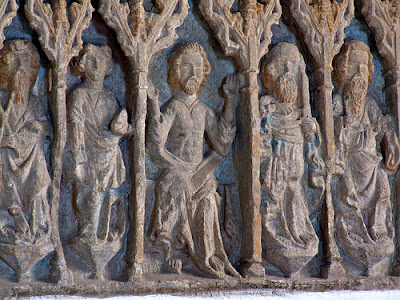
But back to Matthew:
And everyone who has left houses or brother or sisters or father or mother or children or fields for my sake will receive a hundred times as much and will inherit eternal life. Mt 19:29
Everyone who has left . . . children? (By the way, wives are curiously missing from this list. Why? Not important?)
What are we to do with such apocalyptic nonsense? It sends Jehovah's Witnesses door to door, and makes the lunatic fringe keep hoping for Rapture, no matter if constantly delayed for almost two thousand years. Sells books!
The apocalyptic perception of Jesus, which I have to admit has a high explanatory power, distresses me. Call me sentimental, but I was trying to cling to an admiration for Jesus. But the view of him as an apocalyptic preacher -- "let the dead bury the dead" finally makes sense, and a lot else besides -- and the view of the first Christians as end-of-the-world loonies -- one just can't argue with that.

Michelangelo: Last Judgment, St. Peter holding the key to heaven
SAVING JESUS FROM BECOMING A STONE BABY
BUT WAIT! There is a way that non-believers can translate “end of the world” so as to make it meaningful. It’s the “end of my life” perspective, a gift that those who believe in the afterlife are bereft of. Given that my personal world will indeed come to an end, there is absolutely no point carrying any “stone baby” of regret and resentment. When I decided that it was too late in life to be depressed, it also became too late to waste time complaining or accumulating useless things or delaying something for a “special occasion.”
There’s a man who stole a hefty sum from me by not delivering the goods. People advised me to sue him in small-claims court, but why should I go through that stress? I’d win, but collecting is another matter. It’s not worth it for me. Life is too precious for that, so I just let it go -- as close to “loving my enemy” as I can come. I know his life is a serious mess, and hope some resolution comes, some clarity so he can be an honest person again. It’s the same when I think of others who’ve hurt me -- what does it matter now? I feel mainly compassion for them. It’s too late in life for resentment.
So even if the wildly radical teachings of Jesus make sense only in the context of his expectation that the current world would soon be destroyed (“Take no thought for the morrow”) and New Jerusalem would follow, at least some of those teachings can still be applied in the context of our mortality.
*
FORMER GREAT LOVE AS A STONE BABY
Since this is officially a poetry blog, let me offer a poem related to the theme of a stone baby.
YEARS LATER
At first glance, there on the bench
where he’d agreed to meet, it didn’t seem to be
him -- but then the face of grim
friendliness was my former husband’s,
like the face of a creature looking out
from inside its Knox. No fault, no knock,
clever nut of the hearing aid
hidden in the ear I do not feel I
love anymore, small bandage on the cheek
peopled with tiny lichen from a land I don’t
know. We walk. I had not remembered
how deep he held himself inside
himself -- for fun, for thirty-two years,
to lure him out. I still kind of want to,
as if I see him as a being with a baby-paw
caught. His voice is the same -- low,
still pushed around the level-bubble
in his throat. We talk of the kids, and it’s
as if that will never be taken from us.
But it feels as if he’s not here --
though he’s here, it feels as if, for me
there’s no one there -- as when he was with me
it seemed there was no one there for any other
woman. For the first thirty years. Now I see
I’ve been hoping, each time we meet, that he would praise me
for how well I took it, but it’s not to be.
Are you as happy as you thought you’d be,
I ask. Yes. And his smile is touchingly
pleased. I thought you’d look happier,
I say, but after all, when I am
looking at you, you’re with me! We smile.
His eyes warm, a moment, with the accustomed
shift, as if he’s turning into
the species he was for those thirty years.
And turning back. I glance toward his torso
once, his legs -- he’s like a stick figure ,
now, the way, when I was with him, other
men seemed like Ken dolls, all clothes. Even
the gleam of his fresh wedding ring is no
blade to my rib -- this is Married Ken. As I
walk him toward the street I joke, and for an instant
he’s alive toward me, a gem of sea of
pond in his eye. Then the retreat into himself,
which always moved me, as if there were
a sideways gravity, in him, toward some
vanishing point. And no, he does not
want to meet me again, in a year -- when we
part, it’s with a dry bow
and Good-bye. And then there is the spring park,
damp as if freshly peeled, sweet
greenhouse, green cemetery with no
dead in it -- except in some shaded
woods, under some years of leaves and
rotted cones, the body of a warbler
like a whole note fallen from the sky -- my old
love for him, like a songbird’s rib cage picked clean.
~ Sharon Olds, Stag’s Leap, 2012
How many times have we seen this: a woman degrading herself, pursuing a man who no longer cares about her. Begging -- I can imagine her asking the husband who left her for another woman to meet again only as begging -- and no, he’s not interested, though courteous enough to go through it with a “grim friendliness.” We sense he didn’t really want to see her -- that he doesn’t want to see her ever again, and why should he? He’s married to someone else, and that’s his real life, not memories of how it was with the ex-wife. He feels awkward sitting on the bench next to the woman with whom he no longer feels any live connection.
I think here we also get a bit of a glimpse of the speaker as someone who’s been through a lot of therapy (this is revealed in other poems) and assumes that it’s good for everyone to psychobabble about every detail of their inner and outer lives, and that which you manage to verbalize is the true story rather than one of the many fictions and perspectives. In my observation, most men are utterly uninterested in that kind of analysis. Strange to say, I find myself joining the minority of women who likewise simply have other interests. Music! Literature! New developments in science! There is an exciting world out there, and a larger family. Waiting for the ex-husband to change his mind (or open up) is like waiting for Prince Charming, or -- for the Rapture.

YOU HAVE TO LET A CAT BE A CAT
When I can a cat, Georgia Dziordziusińska-Dziordziuśkiewicz, I learned that you need to let a cat be a cat. This widened to the view that you need to let each person be themselves, and you actually grow to enjoy them when they are relaxed and natural (who knew so many people were naturally charming when they don’t feel judged?), without feeling any demands put on them. Most people are good human beings, and like to be treated as such. They don’t care to be “lured out” to talk about the relationship with their father or whatever is assumed to be their “core issue.” Is that really so important? Can’t we respect the fact that perhaps they’d rather read the newspaper or go to the movies? Personally I enjoy the “strong silent” type. I have enough heavy stuff of my own and don’t want the burden of someone else’s complicated psyche piled on me. Not for free, in any case.
(By the way, I’m still not sure about cats versus dogs, now that pets have become an option. I love watching a cat be a cat and a dog a dog, sniffing around in ecstasy of exploration. I identify with that. And I know that neither species will ask me about some childhood trauma or some other “stone baby” I might be carrying, but without feeling burdened; no need to reactivate those old neural circuits; the most important and beautiful part of memory is forgetting.)
*
The clouds were so beautiful on the way to Coronado Library, again I thought that if I could no longer read or write, or contribute in any way, just looking at the clouds would make life worthwhile. But that’s assuming a brain functional enough to experience beauty, in which case it would probably be functional enough to read and write. Best not to fly in the no-think zones of potential dementia. But if someone asked me, when I'm past 80, what I loved most in life, it’s possible that I’d reply “clouds.”

photo: Jeffrey Levine
I can’t image Sharon Olds replying in this manner, and I don’t blame her: she’s herself, fixated on the body and family relationships, and I am myself, a lover of clouds (and more, but the list would be too long). She had to meditate on and on about the end of her marriage, even if to some of us that implies a sad waste of time. Her ex-husband certainly seems to want to move on without revisiting the old marriage, and who sees no more reason to see the ex-wife a year from now, or (I think this is implied) ever again.
At this moment I remembered one of my favorite scenes in the movie “A Serious Man.” The protagonist tells his “temptress” type of neighbor that he’s separated from his wife. She asks, “And have you been taking advantage of your new freedom?”
This is a wonderful point of view. Are you taking advantage of the opportunities of the moment, or are you incubating your stone baby? I speak as one who was guilty of that in my younger years, when I had spent way too much time talking in my head to my great love who married another woman. Luckily, I also developed as a writer, and creative work took over, along with teaching and journalism. And in my mental cemetery I found not the picked-clean skeleton of my once-great love, but the lilacs of gratitude: how wonderful that the cruel narcissist didn’t marry me! How magnificent that there were limits to his desire to destroy me . . .
Even so, I found the poem an interesting study of this unequal meeting of ex-spouses in which the ex-wife is still showing signs of clinging, even though she ends by implying through an image that it’s over, it really is over. But first she had to torture both of them by going through this unnecessary meeting, in the course of which she realizes that if he doesn’t look radiantly happy, that’s likely because of her presence. Her very presence is oppressive to him, is a form of silent nagging, some implied criticism of him as not open enough, or no longer husbandly.
Well, it happens: sometimes our very presence is oppressive to someone. If we recognize it, the only decent thing is to move on.
THE SHOOTING STAR
Mind you, sometimes the angels smoke, hiding it with their sleeves, and when the archangel comes, they throw the cigarettes away: that’s when you get shooting stars.
~ Vladimir Nabokov
This is clever as everything that Nabokov ever wrote, but I saw a shooting star last night, after a long period of not seeing any, and it was a lovely recognition. As usual, by the time I thought of making a wish, it was too late.
But what’s wish-making next to the great spectacle we are offered every night . . . One-tenth would have been enough to make me rejoice (typed “rejoyce”) in being here to see. Did I really, REALLY, go through three years of thinking about suicide every single day? I who say that one sunset can hold me, that I’ll never get tired of clouds . . . We change; life changes; and I am infinitely grateful to have experienced the moment -- later many moments -- when I understood that just to be alive is sublime.
But back then I was carrying a stone baby -- my rejected great love for a man whose greatest gift to me was marrying someone else.
Then I discovered that dropping idealization -- this took years -- dissolved the stone baby. I was finally free of that false pregnancy.
And I can still enjoy Michelangelo’s muscular (look at that biceps!) Jesus in the Last Judgment scene. For me this is actually a Mr. Universe contest, and Jesus wins the trophy.

The Feather Against Which My Heart Will Be Weighed
The crow feather I found was not an idea.
The crow feather was a black slash on the green lawn.
It was a way of counting. One. One.
The crow feather seemed to be waiting for me.
It rested, abided, as though placed just so
for the one time I would walk to its threshold.
I believe the crow feather when it is in my hand.
I know that it is a feather in my hand,
black quill, inkless, for writing out the gospel.
~ Michael Chitwood, from Poor Mouth Jubilee
**
JUDGMENT DAY
I saved a drowning dragonfly,
with a canopy pole I hoisted him up
from the pool. Without pausing to dry
the stained glass of bronze-veined wings,
he took to the air, a weightless shimmer
zigzagging across the dazzled backyard.
Perhaps this buoyant brilliance
will save me on Judgment Day –
on one scale, my heart
filled with darkness;
on the other, like the Egyptian
Feather of Truth,
a translucent dragonfly wing.
~ Oriana Ivy © 2013
In both poems, I’m astonished by the human ability to see far-reaching pattern and meaning in almost anything. Of course we have thousands of years of culture to draw on, including various mythologies. There are patterns and symbols that those mythologies have in common. Black birds like crows are typically messengers of death. The souls are weighed against something that is practically weightless: a feather or one tear from the eye of the goddess of mercy (if we are dealing with a benevolent mythology).
After a friend read my “Judgment Day,” she asked with dismay, “But what if there is no Judgment Day?” “It doesn’t matter,” I replied. Of course there won’t be any literal Judgment Day or the Second Coming any more than my heart will ever be weighed against any feather or an insect wing. “Judgment Day” is every day, if we stop to think about our actions and whether or not we are helping or hurting living things. Then why this persistent use of worn-out mythologies in literature and in the arts in general?

The earliest manuscript of the Gospel of Mark (“Mark” was a name made-up later; the early texts of the gospels were anonymous)
Generation after generation of writers, why this constant revisionist return to the old mythologies? My answer is that we can’t help it: we are wired to seek meaning and modulate that meaning to serve us now. Finding a meaning is uplifting. It brings us comfort to think (without literally believing) that a crow feather we found is a quill for writing the gospel, or that a weightless dragonfly wing can tip the scales in favor of paradise. Now, you may object, Michael Chitwood’s crow feather is “inkless,” so perhaps the only gospel he could write would be blank -- a fit image of modernity, it could be argued. But this is outweighed by the very fact that the speaker sees a purpose in finding the crow feather, and feels himself chosen for a special task precisely because he found that feather. It was “waiting” for him.
Does he literally believe that the feather was waiting for him? Do I literally believe that the wing of a dragonfly I rescued will open for the me the gates of paradise? Of course not. If we did, we’d probably be on a mental ward, zombified with drugs that are supposed to suppress delusions. Only a schizophrenic would believe that everything is a secret message, an omen, a crow feather a sign that one is chosen to write a new gospel.
But a writer can get away with saying the wildest things because some more general meaning is intended, along with the universal human yearning to be needed, to have a purpose.
And there is beauty in the fact that feathers were once used as quills for writing.
We know that myths often stem from cognitive illusions, e.g. the illusion that everything must have a purpose, or that good actions will be rewarded . . . . And yet, and yet . . . There is a beauty to mythic stories, and it’s a joy to play with possible symbolism. As long as we are not willing to kill or die for the “truth”and as long as we are thinking symbolically for private joy but don’t try for force others to see what we see (though of course, like Whitman, we invite the reader to believe what we believe), there is no harm. If the poem of this sort is well-written, it gives intellectual and esthetic pleasure of the sort that makes life worth living.
And ultimately, perhaps, it’s the memory value of stories and images. Myths give us both. Daphne changing into laurel is so transformed by beauty that we don’t think of in terms of “sexual harassment” -- though this rescue from unwanted closeness also teaches a subtle lesson that any choice comes with a price. Aphrodite arising from sea-foam is likewise a transfiguration by beauty of the gruesome violence that precedes it. Thanks to this beauty we can rest a bit from the incessant crucifixions and last judgments of religious art, the naked bodies of the damned falling headlong into the flames.
Mythologies can also be non-supportive and anti-life -- at least in some interpretations. Here are five indelible lines from “Blue Stones” by Larry Levis:
My father thought dying
Was like standing trial for crimes
You could not remember.
Then somebody really does throw
The first stone.
This is the result of toxic theology that derives its power from threats of punishment. The message of compassion is lost, and punishment is coming -- even though we can’t even remember our sins. Imagine a mother of six on trial for losing her temper. This is the absurdity we get with anti-human, anti-life religion.
For historical reasons, on the Hebraic side, ours is a mythology of exile and punishment -- the alternative was to admit that Yahweh was powerless to protect his people, or simply did not care. Better to see each disaster as divine punishment rather than accept impotence or indifference. Better a cruel god than empty air.
Fortunately that’s not the only mythology out there. I like what Joseph Campbell says: “A myth is the dynamic of life. You may or may not know it, and the myth you may be respectfully worshiping on Sunday may not be the one that’s really working in your heart.” Campbell goes on to say that we need to “filter out of the inheritance of traditions those aspects that support you in your own inward life.”

Some say no, we have to accept the whole package, the cruel and the nasty together with the compassionate and supportive. Those people tend to believe that the whole package somehow dropped from heaven rather than got created by culturally evolving humans over many centuries. Once we know the human origin of this amazing compilation, once we already ARE being selective -- the bible tends to be quoted VERY selectively -- I say let’s be even more selective. Let’s take only the best and most supportive from each tradition -- that which helps us live. Life should be a joy: not a ledger of sins and failures to live up to impossible standards, but an iridescent beauty like a dragonfly.
*
By the way, biblical scholars -- who study the manuscripts of the gospels in the original Greek -- have discovered that the story of the woman taken in adultery, the origin of the expression “to cast the first stone” -- does not exists in the earliest versions. It was added in the margin by a scribe copying a manuscript, and incorporated into the body of text by a later scribe.
This indicates that there were stories floating around in the oral tradition, and this one in particular found itself added to the text held to be inerrant and unchangeable. Some would call it a forgery. One of the most revered gospel stories, foundational, of utmost importance to the ethical teachings of Christianity -- a forgery?
Everyone loves this story. Removing it would cause an uproar. Considering the lesson it teaches, does it matter if it’s invented -- a myth, a legend that just happens to fit the teachings better than anything else?
*
DARK AND DARKER
There are many dark passages in Larry Levis. This one speaks to me in a very personal way:
Each day at noon
I used to close my eyes,
And lie alone in the dark, listening.
And you never spoke,
Never uttered the thin prayer that was me.
In the poem Levis is addressing his own “spirit.” There is a poetic tradition of addressing one’s own soul. Now that many don’t believe in having a soul (unless as a synonym for the ever-shifting mental life), such addressing of the soul is almost bound to come up empty. The soul will not speak to us. It doesn’t care about us at all. No surprise.
But I react to this passage for a different reason. Once a year or so, I decide to “give god yet another chance.” I lie down and send a humble supplication into the air: please give me a sign that you exist. I don’t expect a voice from the whirlwind. I don’t expect the clouds to open to reveal the “eye in the sky.” Any subtle sign will do. The shadow of a twig moving across a corner of the wall. Some faint music. A rustle or a barely audible whisper.
I turn into total attention. And the result is, at best, only the steady hum of the refrigerator. Nothing, nothing, nothing.
I realize that a theist would object to this exercise. Never mind my attentiveness: the divine reveals itself only at its own choosing. So far it has not chosen to. I may not be a worthy vessel: an intellectual and not a simple housewife, the kind who tends to get abducted by aliens.
There is a sadness about this silence of the missing god, but also a challenge to name something else that helps me live. What’s interesting is that this “something” also responds only when it’s ready. I mean that which is sometimes called the “cognitive and creative unconscious.” I have a private name for it, but it shall not be revealed. In public, I also call it “the other self.” This too is a bit awkward, since it’s a process, not a static entity: the mysterious processing of information that the brain does “on the back burner.” I pose a question; the answer will come when it’s ready.
You could say I trust my brain. I trust that in time it will find that one-in-a-million missing pieces of information -- as long as at some forgotten time I put it there. I trust my brain not because it’s infallible, but because on the whole it’s reliable and performs amazing (to me at least) feats.
I’ve come to trust my brain, meaning I trust myself. I am not a fallen creature bent on evil except if I go to confession and cleanse my dirty soul (car wash images intrude here). I trust myself to be kind to others, relying on the empathy I was born with and developed later without any conscious effort. I trust that my intricate brain can grasp complex ideas and enjoy metaphors. I trust myself, and not the “prophet” who stands in the busiest corner of downtown with a sign that the world will end before the year is over. I very much enjoy the description of the Whore of Babylon and the Catholic Encyclopedia’s attempt to refute the argument that the Vatican is the Whore of Babylon. I enjoy it all, but for the perception of reality, I trust myself. What a concept.

(A shameless digression: Even when I believed in god, I didn’t trust him. He was not to be trusted. “Where were you when I needed you?” is for me a religious anthem. God does not protect children from abuse and misfortune, as Ivan Karamazov brilliantly points out before stating, If my entry to paradise is bought with one tear of a tortured child, I return the ticket.
One of the first things a child learns about god from experience rather than from catechism is that god doesn’t answer prayers in any reliable fashion, and he permits dreadful things to go on. So what use is he? He keeps you scared. He is the ultimate judge and executioner. It was said that if not for the fear of god, people would lead a life of sin, and even crime. What I saw was that criminals went to prison, so apparently that fear of divine justice didn’t work too well: we needed human justice after all. Later I learned that people were good or bad apparently in proportion to the amount of empathy they felt for others; social and economic factors also played a role. Empathy, universal in all social species of mammals, is another reason I am so impressed by the brain.)
(Another shameless digression. A reader asked me, in what I imagined a shocked tone of voice: “But Oriana, what if after you die you wake up and discover you are fully conscious and accountable for your life?” I replied that I hold myself accountable for my life right here, on earth. But if I found myself fully conscious after dying, what a wonderful surprise! And knowing that I haven’t done anything that would merit eternal damnation, what is there to fear? But if god tosses into eternal fire all those who because of an accident of birth did not hold the correct belief -- millions of Hindus, for example -- then he is worse by far than Hitler.)
But I know I will not “wake up” after death. Only a living brain produces consciousness. I’m amazed by both the conscious and the unconscious processes. I love the way the brain can make some use of whatever comes its way: accidental discovery of some old notes, for instance, or passages in books opened at random. Sometimes this could be called inspiration, and it can be fairly complex. Sometimes it’s simply recall of something long-forgotten: what is the name of that California tree that’s like a poplar, but with a thicker trunk, and grows near streams, in the ravines? Paper tree, my consciousness instantly suggests, but I know that’s wrong. I think my answer may be in a poem by Larry Levis. I get out of bed (it’s past my bedtime), find the book, and start reading Larry Levis. The word is stubbornly missing. I drop the book and turn off the light. And instantly I know: cottonwood. I get out of bed to scribble “cottonwood” on a slip of paper, but know it’s not really necessary: I’ll remember it when I wake up.
And I do. I also decide to use some of Larry Levis for the blog post you are now reading.
And here is his Daphne -- the ending of the poem “The Two Trees,” in which he is so starved for connection that his only friends are two trees on campus. In springtime, one of the trees, not the sturdy oak but the one that seemed more feminine, “sleepier, more slender”
that seemed frail, but was really
Oblivious to everything. Simply oblivious to it,
With the pale leaves climbing one side of it,
An obscure sheen in them,
And the other side, for some reason, black bare,
The same, almost irresistible, carved indifference
In the shape of its limbs
As if someone's cries for help
Had been muffled by them once, concealed there,
Her white flesh just underneath the slowly peeling bark
—while the joggers swerved around me and I stared—
Still tempting me to step in, find her,
And possess her completely.
DRAGONFLIES VERSUS JUSTICE
Now, just for the joy of it, some interesting facts about dragonflies:
The dragonfly can move at an amazing 45 miles an hour, hover like a helicopter fly backwards like a hummingbird, fly straight up, down and on either side. What is mind blowing is the fact that it can do this while flapping its wings a mere 30 times a minute while mosquitoes and houseflies need to flap their wings 600 and 1000 times a minute respectively. The dragonfly accomplishes its objectives with utmost simplicity, effectiveness and well, if you look at proportions, with 20 times as much power in each of its wing strokes when compared to the other insects. The best part is that the dragonfly does it with elegance and grace that can be compared to a ballet dancer.
The dragonfly has a 360-degree vision.
The dragonfly exhibits iridescence both on its wings as well as on its body. Iridescence is the property of an object to show itself in different colors depending on the angle and polarization of light falling on it.
Dragonflies have inhabited our planet for almost 300 million years.
The dragonfly is such an intricate and gorgeous little being that it’s easy to understand our bedazzlement when one appears while we are thinking about justice, perhaps, and how there are two kinds: justice meant as punishment, vengeance; and justice as fairness, as in equal pay for equal work. Anne Carson’s suggests that a dragonfly is much more interesting than ideas.
God’s Justice
In the beginning there were days set aside for various tasks.
On the day He was to create justice
God got involved in making a dragonfly
and lost track of time.
It was about two inches long
with turquoise dots all down its back like Lauren Bacall.
God watched it bend its tiny wire elbows
as it set about cleaning the transparent case of its head.
The eye globes mounted on the case
rotated this way and that
as it polished every angle.
Inside the case
which was glassy black like the windows of a downtown bank
God could see the machinery humming
and He watched the hum
travel all the way down turquoise dots to the end of the tail
and breathe off as light.
Its black wings vibrated in and out.
~ Anne Carson, Glass, Irony and God
Charles:
Your dragonfly poem reminds me of the haiku about the dragonfly (“a dry stick: put on wings: a dragonfly”). They are both uplifting at the end.
So much wisdom in Judgment Day being every day. I love that.
You blog and your poems "give intellectual and esthetic pleasure of the sort that makes life worth living."
..."people were good or bad apparently in proportion to the amount of empathy they felt for others": Yes!
Love the information on dragonflies and the final poem by Anne Carson.
Oriana:
I know others too have said that every day is Judgment Day. We have to be accountable at a moment’s notice: here is the good I’ve done; here’s what I regret having done -- without dwelling too much on either.


