Showing posts with label alcoholism. Show all posts

Sunday, August 7, 2016

DANTE’S 3 BEASTS; LOVE: YOUTH AND AGE; JAMES WAS RIGHT: WE FEEL SAD BECAUSE WE ARE CRYING; DID ZEUS EXIST?; WHO STILL SMOKES

I faced a spotted Leopard, all tremor and flow

and gaudy pelt. And it would not pass, but stood
so blocking my every turn that time and again
I was on the verge of turning back to the wood.

This fell at the first widening of the dawn
as the sun was climbing Aries with those stars
that rode with him to light the new creation.

Thus the holy hour and the sweet season
of commemoration did much to arm my fear
of that bright murderous beast with their good omen.

Yet not so much but what I shook with dread
at sight of a great Lion that broke upon me
raging with hunger, its enormous head

held high as if to strike a mortal terror
into the very air. And down his track,
a She-Wolf drove upon me, a starved horror

ravening and wasted beyond all belief.
She seemed a rack for avarice, gaunt and craving.
Oh many the souls she brought to endless grief!

~ Dante, Canto I, tr John Ciardi

The three beasts are mentioned in Jeremiah, and probably refer to three different countries hostile  to ancient Israel.

Mark Musa (regarded as Dante’s best annotator):

“The early critics thought of the three beasts that block the Pilgrim’s path as symbolizing three specific sins: lust, pride, and avarice, but I prefer to see in them the three major divisions Hell. The spotted leopard represents Fraud. The lion symbolizes all forms of Violence. The she-wolf represents the different types of Concupiscence or Incontinence.”
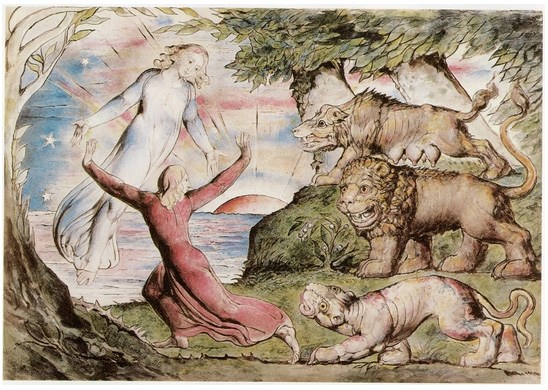

This is Blake, of course. Who else could create such distinctive and endearing, anatomically incorrect human and animal forms? 


Oriana: The she-wolf made me think of the Hungry Ghosts, for whom nothing is ever enough. Maybe “greed” would be the best simple word for this.

However, the she-wolf (lupa) is also a word for prostitute, so lust has been suggested. And wolves have been unjustly accused of meanness in general — and yet a she-wolf can also be a symbol of nurturing, or else we wouldn’t have the myth of infants being adopted and raised by wolves. Animal symbolism can be tricky. There is nothing intrinsic about the wolf to suggest a specific category of sin.

Lions are widely represented in art. They look impressive — but are they any more violent than any other predator? They hunt only when hungry — it’s about the need for food, not any kind of joy in killing, or tendency to violent rage. In the wild, an enraged lion is probably extremely rare. These are cats. They sleep a lot.

They are the only social felines, and they form emotional bonds within the group.


But, in the human mind, here is a possible link between lions and violence. What humans project on lions is PRIDE. And there is indeed a relationship between pride (think of an inflated ego) and the kind of violence that proceeds from wounded pride.

I’ll never forget the lecture on pride at the Los Angeles Jung Institute. It was the first one in the series on the Seven Deadly Sins. Pride is always listed as the first and greatest deadly sins — all other sins are said to follow from pride in some way. While the connection between pride and lust or gluttony could be questioned, there is indeed a connection — in humans, not among lions — between pride and violence, the lecturer, a former prison psychologist, pointed out. “If you want to see pride, visit a prison,” he said.

I have done some work in prisons, and I can confirm that. That’s where you find huge egos, and the demand for “respect.” Now, outsiders would say that criminals ought to feel shame, not pride — but the fact is that the inmates, having been nearly universally abused in childhood, disvalued and made to feel powerless, have a tremendous need to pretend that they are powerful and important. They’d rather be feared than liked — to be feared is a sign of “respect.” And to enforce that kind of fear-based respect, they are ready to use violence. Scarred from trauma, they are always defending their “honor.”

As for the leopard and fraud, the beauty of that animal’s coat also implies the negative associations of beauty that can be attached to a beautiful person. Their attractiveness implies the power to deceive. I'm reaching here, I know. Let’s face it: there is nothing obvious about seeing a leopard as a symbol of fraud. No wonder even critics are confused, not to mention the average reader.


Using animals to represent “sin” is ridiculous on the face of it. But the Middle Ages saw all living being as “fallen” and ruled by Satan. In the modern times, we are finally beginning to see that even humans are not inherently “sinful” or evil by nature. With rare exceptions (we don’t really understand true psychopathy; it may stem from brain abnormalities), a bad human being, like a “bad” dog, has been abused. They act out of their wounds.

Extreme stress can be another cause of violence. When starved men fight over food, there is no mystery about that.

Yet another cause is indoctrination with hate speech. Again, it’s the most emotionally damaged individuals who will be most susceptible. 


**

The sun shone, having no alternative, on the nothing new. ~ Samuel Beckett, Murphy, 1938


This Black Iris by O'Keefe is less well known


Speaking of nothing new, there is also the sorrow of re-reading something you wrote in youth, thinking it was wisdom, while it was merely youth:

LOVE: IT DEPENDS ON YOUR STAGE OF LIFE

Youth:

“We don’t know what love is.

Why in our heads we love
someone quite different
from the one we say we love.

If we love the same person
in different guises
every time.

If that person is really
ourselves.

Is it all an illusion.

Is it only dressed-up sex,
as Tolstoy said —
how come we don’t fall in love
with a brilliant 80-year-old
who happens to share our spiritual interests?

Is it worth it.

Why is it so easy to love
a dog or a cat.

Maturity:

Because a dog or a cat will never criticize you.

One day you realize that Prince Charming would be a nightmare.

You come to agree with Kurt Vonnegut’s: “You learn to love whoever is there to be loved.”

And you feel blessed. 


Chagall The Song of Songs

**

When marrying, ask yourself this question: Do you believe that you will be able to converse well with this person into your old age? Everything else in marriage is transitory. ~ Friedrich Nietzsche

My parents had that kind of marriage. got married at 35, after they have already “found themselves” and knew they wanted a companion with the same or very similar interests. They were lifelong best friends. They liked to take long walks, during which they talked, talked, talked.

My mother's birthday was August 4, and my father's, November 4 -- so she was 3 months older. He liked to joke that he liked older women.


 Diane Arbus, 1962

WILLIAM JAMES WAS RIGHT: WE FEEL SAD BECAUSE WE ARE CRYING


~ “LeDoux began his career in science working under the neuroscientist Michael Gazzaniga, well-known for his research on “split brain” patients, that is, patients whose left and right hemisphere are disconnected from one another in a surgical procedure designed to help control severe epilepsy. These individuals’ brains are unable to integrate information from both sides in the usual way — in experiments with split brain patients, it was possible to present information to only one half of the brain (by flashing it to only eye, and not the other) and watch as the other half struggled to create an elaborate story to explain away the behaviors it had no conscious awareness of having performed. For instance, if a humorous prompt were shown to the right hemisphere of the brain, the patient would burst out laughing, yet not know why. Instead of confessing their confusion, they would rush to say something like, “You guys are so funny.” LeDoux saw firsthand in these studies the brain’s tenacious need to cook up narratives to explain itself to itself. “The idea is that what’s consciousness does,” LeDoux says. “It creates these explanations or ideas about behavior.”

That early observation is foundational to what LeDoux now believes about why we experience emotions like fear and anxiety. In the face of danger, the brain kicks into defense mode, detecting the threat faster than our conscious awareness can ever operate, and sending a host of marching orders throughout the brain and the body, readying all systems to take action. It’s only after this process has begun that the emotions of fear and anxiety rise into consciousness — and only if, LeDoux says, “you have a brain that can be conscious of its own activity,” a brain with the “ability to conceptualize all of that, to label it linguistically, and to integrate it with thoughts and memories.” In other words, fear and anxiety are not wired into the brain as basic responses to the world around us — rather, the responses that lead to them are, and they only coalesce into fear when the brain interprets them as such.

To feel afraid is to be conscious of fear — so the question of where exactly feelings like fear and anxiety arise in the brain is intimately tied to nothing less than the ongoing mystery of how our brains pull off the great feat of consciousness itself.

LeDoux argues that the activities of this basic neural defense system do not account for the actual experience of fear, even though it has become commonplace in neuroscientific research to act as if they do, using, for instance, the instinctive, defensive behaviors of animals like fleeing or freezing to stand in for the larger, more complex phenomenon of being afraid. Rather, anxiety and fear arise only after the brain’s threat system has unconsciously picked up and responded to the first scent of danger — and not from any one single part of the brain, but from many.

Because there are both conscious and unconscious processes at work when anxiety spirals out of control, LeDoux believes that effective treatments would have to engage differently on each level — the whirling subliminal, automatic circuitry that patients aren’t even aware of needs to be subdued before the second-step project of addressing the higher level of conscious thoughts and feelings can begin.

LeDoux is well aware that in his struggle for precision and clarity, he’s taking on a serious challenge. It’s no easy task to undo decades of common usage. “Not everyone is happy with this,” he says, but “as a scientist you have some obligation to get as close to the truth as you can, and nothing gets in the way of truth as much as language does.” ~

http://nymag.com/scienceofus/2015/07/everybody-misunderstanding-fear-and-anxiety.html

Oriana:

William James was the first to promote an interpretation theory of emotions. According to James, body responses come first, e.g. a lump in the throat. Then we call it sadness. Consciousness lags behind the body. “You feel sad because there are tears in your eyes,” my first psychology instructor explained — and we found it a very strange, “backwards” explanation. Now neuroscience seems to be bearing it out: the automatic physiological response precedes the conscious interpretation. Block the adrenaline, and calm will persist.

The survival responses are faster than consciousness because they are ruled mainly by the brain stem, the oldest neural structure in terms of evolution. Consciousness comes after, with its “stories” and justifications. Suppose there is a sudden noise. We “jump” first — the startle response — then, primed with adrenaline for “fight or flight,” we look around to see if the danger is real.

Not that the stories we make up, the post-hoc explanations, are not important. We need to make sense of what is happening. We also need a “story of me.” Alzheimer’s victims lose that partly fictitious but nevertheless crucial “story of me” along with the ability to interpret their life and their environment. It’s striking how anyone with dementia starts making up stories — because stories are so essential to us.

But the story comes second. William James was brilliant — and totally ahead of his times.


DID ZEUS EXIST? WHY THE GREEKS BELIEVED IN THEIR GODS (the argument from personal experience, e.g. miracles)

~ “Why did belief in the gods persist in spite of critical challenges? What evidence seemed decisive to the ancient Greeks? Robert Parker, in his “On Greek Religion,” emphasizes the role of what the Greeks saw as experiences of divine actions in their lives. ”The greatest evidence for the existence of gods is that piety works . . . the converse is that impiety leads to disaster,” with by far the most emphasis given to the perils of ignoring the gods.

There were also rituals, associated with the many cults of specific gods, that for some worshipers “created a sense of contact with the divine. One knows that the gods exist because one feels their presence during the drama of the mysteries or the elation of the choral dance.” More broadly, there were “epiphanies” that could “indicate not merely a visible or audible epiphany (whether in the light of day or through a dream . . .) but also any clear expression of a god’s favor such as weather conditions hampering an enemy, a miraculous escape, or a cure; it may also be used of the continuing disposition of a god or goddess to offer manifest assistance.

Most of us do not find our world so filled with the divine, and we may be inclined to dismiss the Greeks’ “experiences” as over-interpretations. But the people who worshiped Zeus claimed to experience his presence in their everyday lives and, especially, in their religious ceremonies.”

From a comment: (this article elicited 744 comments)

Dionysos — the Zeus of Turkey's Mount Nysa — died each fall, was buried in the sanctuary of Apollo at Delphi, which he would abandon until Dionysos’ rebirth in the spring. “He is risen,” his believers cried out on the appropriate Sunday sunrise, and Apollo had returned.

The great advances of Greek civilization in the fifth and fourth centuries began quite suddenly when the sophists, whom Plato and Socrates despised, stripped the gods out of the myths. That left them with only the natural phenomena the gods were thought to personify and control. So much for the supernatural. The pagan Greeks made no sharp distinction between nature and any hyper-nature, though it is easy for us to see them edging towards it. Christianity defined the boundary.

And another comment:

If you believe in god, does it bother you that all gods that have even been created/worshiped have all acted in the same way as yours does? As though they don’t exist at all. And the reasons that you believe in your god, personal experience, believing that prayer or sacrifice actually work, filling your unanswered questions about the world with a god etc are the same reasons that people gave for believing in past gods. And are the same reasons given for believing in other current gods. The supernatural doesn’t exist, only questions do. And those questions won’t be answered until evidence leads us there. If you jump to supernatural conclusions every time you don't understand something you have a primitive mind and are thinking like people who lived thousands of years ago.

And another:

Does God cease to exist when there are no humans that believe in him? if so, how many does it take to sustain his reality? A million? A thousand? One?

And the inevitable one:

Amazing intellectual acrobatics to avoid the obvious conclusion that there is no more reason to believe in a Judeo-Christian god than there is to believe in Zeus.

http://opinionator.blogs.nytimes.com/2013/07/31/did-zeus-exist/?src=rechp&_r=2


Oriana:

It’s interesting that the arguments the ancient Greeks used to “prove” the existence of the gods are the same are those used today: prayer (and animal sacrifice) works, while lack of prayer brings on disaster; believers experience the god’s presence and receive signs and miracles . . . same stuff, pointing to human psychology rather than external reality. It’s known as the “argument from personal experience.”

“I sacrificed a bullock to Zeus, and my son came back from the war alive” — who could fail to be persuaded by that?

Here is an interesting exercise: replace the word “god” with “Zeus”:

Zeus works in mysterious ways.

Zeus sends suffering to those he loves.

Zeus never sends you more suffering than you can bear.

Man was created to serve Zeus.


**

Whether it’s Yahweh or Zeus, as long as an imaginary invisible Superman is put ahead of human beings and the principle of kindness, evil is inevitable. And the same goes for ideologies and institutions, whether it’s the Catholic church or the communist party.

THE “MALE WARRIOR” IN SPORTS
 
~ “The researchers concluded that men are much more likely than women to engage in friendly physical contact—such as pats on the back, hugs, and interlocking handshakes—following athletic competition. The duration and frequency of affectionate physical contact after competing against a rival served as a benchmark for rating the strength of someone's pro-social intentions.

Benenson believes these findings give credence to what evolutionary psychologists refer to as the "male warrior hypothesis." This is the notion that males purposely nurture warm feelings after conflict to increase their odds of having allies to help defend their group in the future. In a statement, Benenson said,

    “Our results indicate that unrelated human males are more predisposed than females to invest in a behavior, post-conflict affiliation, that is expected to facilitate future intragroup cooperation. This finding feels very counterintuitive because we have social science and evolutionary biology models that tell us males are much more competitive and aggressive."

Throughout our evolution, prevailing in competitions has been a keystone of the survival of the fittest. The importance of post-conflict reconciliation between fierce opponents is often underestimated. This research suggest that making conciliatory physical gestures immediately after the dust has settled, might prevent someone from holding a grudge or being a sore loser. 

Conclusion: Why Would Women Be Less Willing to Reconcile After a Conflict?

In today's world, sportsmanlike displays of affection after an athletic competition have the power to facilitate future cooperation and friendship when athletes become comrades off the court. This phenomenon has been demonstrated in both chimpanzees and humans. Typically, whomever invests more in post-conflict resolution by being physically affectionate fosters future cooperation more effectively.

The male warrior hypothesis proposes that the overall success of our ancestors’ in-groups relied on the ability of men to triumph in one-on-one conflicts—while maintaining cooperation within the group and solidarity with outside groups.

The whole community benefits when unrelated men triumph over threatening external groups. On the flip side, women gain more by sticking close to family members and having one or two close friends who can share the burden of raising children.

From an evolutionary perspective, the researchers believe these factors drive women to reconcile with fewer individuals, while men strive to keep the peace with a larger number of unrelated same-sex peers. Could this explain why the "old boys' club" is such a formidable and widespread fraternity?” ~

https://www.psychologytoday.com/blog/the-athletes-way/201608/harvard-study-gives-credence-the-male-warrior-hypothesis

WHO STILL SMOKES? THE POOR, THE UNEDUCATED, ALCOHOLICS AND THE MENTALLY ILL

In the 1960s, more than 40 percent of Americans smoked. Now, that's down to 18% . Not only are fewer people smoking, heavy smokers are consuming fewer cigarettes.

Smoking is far more common among those living below the poverty level, those with GED-level education, and among American Indian or Alaskan Natives. Rates are also much higher in the lesbian, gay and transgender community.

The Midwest has a higher smoking rate than other areas and nearly double the rate in the West.

West Virginia has the highest rate in the country.

Only 6% of those with post-graduate education smoke.

http://www.npr.org/sections/health-shots/2014/07/31/336386346/amid-smoking-decline-look-whos-still-lighting-up

(From a different source:) Surprisingly, few studies have addressed the association between smoking and drinking despite the fact that 80 to 95% of alcoholics smoke cigarettes. NIAAA estimates that alcoholism is 10 to 14 times more prevalent among smokers than non-smokers. Other studies estimate that roughly 70% of alcoholics are classified as "heavy smokers", smoking more than one pack a day.

Approximately 85% of people who have schizophrenia are also heavy cigarette smokers, and 60% to 70% of people with bipolar disorder. It’s been suggested that it’s self-medication, and it makes some sense: the long exhale is soothing.

ending on beauty:

“If God had been here this summer, and seen the things that I have seen—I guess that He would think His Paradise superfluous” ~ Emily Dickinson Letters, 1856.

This reminds me of Jack Gilbert's title, "We have already lived in the real paradise." An imperfect paradise, to be sure, but still a paradise.


Tuesday, May 31, 2011

MILOSZ AT THE GATES OF HEAVEN


     Czeslaw Milosz, Krakow 2002. Photo: Judyta Papp


AN ALCOHOLIC ENTERS THE GATES OF HEAVEN


What kind of man I was to be you’ve known since the beginning,
since the beginning of every creature.

It must be horrible to be aware, simultaneously,
of what is, what was,
and what will be.

I began my life confident and happy,
certain that the Sun rose every day for me
and that flowers opened for me every morning.
I ran all day in an enchanted garden.

Not suspecting that you had picked me from the Book of Genes
for another experiment altogether.
As if there were not proof enough
that free will is useless against destiny.

Under your amused glance I suffered
like a caterpillar impaled on the spike of a blackthorn.
The terror of the world opened itself to me.

Could I have avoided escape into illusion?
Into a liquor which stopped the chattering of teeth
and melted the burning ball in my breast
and made me think I could live like others?

I realized I was wandering from hope to hope
and I asked you, All Knowing, why you torture me.
Is it a trial like Job’s, so that I call faith a phantom
and say: You are not, nor do your verdicts exist,
and the earth is ruled by accident?

Who can contemplate
simultaneous, a-billion-times-multiplied pain?

It seems to me that people who cannot believe in you
deserve our praise.

But perhaps because you were overwhelmed by pity,
you descended to the earth
to experience the condition of mortal creatures.

Bore the pain of crucifixion for a sin, but committed by whom?

I pray to you, for I do not know how not to pray.

Because my heart desires you,
though I do not believe you would cure me.

And so it must be, that those who suffer will continue to suffer,
praising your name.

~ Czeslaw Milosz, This, 2000

**

Sober Reader, you yawn: yet another famous poet turns out to have been an alcoholic. “Heaven is the third vodka” – should we even bother discussing what for non-alcoholics is sheer nonsense? And is it really true that great writers need a “charismatic flaw,” as the literary critic Leslie Fiedler claimed, that flaw generally being dependence on alcohol?

Milosz writes: “My real drinking began in earnest in occupied Warsaw with my future wife Janka and Jerzy Andrzejewski (author of Ashes and Diamond) . . .  I drank a lot, but always took care to separate time for work from time for letting go . . .  Alas, too many generations of my ancestors drank for me to have been free from the urge for the bottle.” (Milosz’s ABC, p. 18)

The fact that Milosz had the self-discipline to separate work and drinking possibly accounts for his amazing creativity in old age. Or maybe it was the positive emotions generated by the Nobel Prize when he was almost seventy, receiving recognition and adulation at last. I prefer not to delve into this puzzle, except for acknowledging how inspiring it always is to find a writer who in his or her old age experiences a creative blossoming rather than a decline. Instead, I am interested in the acutely bitter tone of this unique poem. Is this Job speaking, subtly accusing the Old One (as Einstein liked to refer to God)? Let’s not forget that Milosz is a metaphysical poet, and can provide us with a certain metaphysical shiver when we consider the kind of cruel deterministic theology that is still very powerful, while progressive Christian theologies remain anemic.

“An Alcoholic Enters the Gates of Heaven” is especially interesting in the light of the recent prediction by a fundamentalist preacher, Harold Camping (a happy camper, since he regards himself as one of those predestined to taste paradise) that the Last Judgment would take place Saturday May 21st at 6 PM (Eastern Standard Time, I think). I have also just read an interesting summary of crucifixion-centered theologies versus progressive theologies. The preacher who was predicting the end of the world belongs to the first tradition, of Christ seen both as a sacrificial victim, a "sin sacrifice," and – this seems an egregiously un-Christian concept – as the ultimate judge who will accept the chosen few and hurl billions of souls into eternal torment.

Progressive theologies, on the other hand, are fascinated by early Christianity that emphasized agape (loving kindness; a community of affection) and paradise rather than hell. The basic tenet of progressive theologies is that the Second Coming is the birth of Christ Consciousness within us and among us, in the global community. We are here to build the kingdom of God on earth. God intends all souls to be saved. Paradise is here and now.

Alas, progressive theologians do not seem to have the PR resources commanded by the “blood of the Lamb/Armageddon” theologies. The only time there seemed to be true hope for progressive theologies was when Rabbi Kushner’s famous book, When Bad Things Happen to Good People, became a best-seller. Kushner posited a deity with limited powers, one who neither causes nor prevents cancer, heart attacks, tsunamis, and other disasters. God does not decide which child will get leukemia, or who will grow up to be an alcoholic. Some evil is the work of natural laws (these days, an earthquake is rarely called an “act of God”); other kinds of evil are the work of man. Afterwards, everything depends on our response: do we curse and despair and can’t move on, or do we summon the strength to transcend the tragedy? Faith is one of the resources that can increase people’s strength to endure and recover. (Twelve-step programs also come to mind.)

Alas, Milosz was brought up in old-time Catholicism. Even though he forayed into such unorthodox theologians as Swedenborg and Simone Weil, he could not accept the notion that God’s power is limited and it wasn’t God who planted alcoholic genes in a particular individual: it just happened. The first lines of the poem tell us that God knew who’d be an alcoholic “since the beginning of every creature,” i.e. since the moment of creation. Predestination? Yes. A Calvinist doctrine, is has wormed its way into any theology which agrees with the statement, “Everything that happens is the will of God.” And if the belief in omniscience, including the knowledge of everything that will happen, is the required trait of divine perfection, then logic grimly leads to the conclusion that only predestination can account for omniscience. Everything was decided for eternity at the moment of creation. And countless millions were predestined to become alcoholics.

What kind of man I was to be you’ve known since the beginning,
since the beginning of every creature.

I remember my father’s saying that the only way out of these theological conundrums is those religions where the gods have limited knowledge and limited power. This idea has been around for a long time, certainly long enough for Milosz to have heard of it. But when the doctrines of omnipotence and omniscience are drummed into a child’s mind, reinforced with the fear of eternal damnation is you dare question dogma, it is difficult to shake off toxic beliefs. It seems to me that Milosz caused himself untold anguish by not being able to liberate himself from the toxic theology of “old-time religion.”

True, the Catholic Church emphasizes free will. I don’t remember the word “predestination” being ever used in my catechism classes. In fact the existence of evil was explained in a simple and powerful way: “Because God has granted man free will.” Thus God will allow genocide rather than interfere with man’s free will. Case closed. It’s only the more intellectual Catholics who ponder omniscience, connect the dots, and arrive at the moral monstrosity of predestination.

It is interesting that in this poem Milosz does not use the capital “You.” Maybe the god who predestines so much suffering doesn’t deserve to be capitalized. In fact, already in the second stanza, the poet winces at the idea of what it must be like to be an omniscient god who knows what will happen since he planned it down to the smallest detail. Milosz startles the reader by announcing that it must be horrible to be God:

It must be horrible to be aware, simultaneously,
of what is, what was,
and what will be.

~ and later

Who can contemplate
simultaneous, a billion-times-multiplied pain?

and then the stanza that is bound to shock the pious:

It seems to me that people who cannot believe in you
deserve your praise.

But the pathos of the poem lies in the personal part:

I began my life confident and happy . . .
I ran all day in an enchanted garden.

Not suspecting that you had picked me from the Book of Genes
for another experiment altogether.
As if there were not proof enough
that free will is useless against destiny.

Note also:

Under your amused glance I suffered
like a caterpillar impaled on the spike of a blackthorn. [emphasis mine]

The experiment of making someone an alcoholic somehow amuses this kind of God, even though the results are known in advance. Maybe God would be bored if the world were filled with goodness. He wants to be entertained with some people’s drunken antics, their remorse, their broken promises. If the alcoholic’s wife and children suffer, that’s “collateral damage.”

The speaker wonders if perhaps he is like Job, being tested to see not so much if he’ll curse God (cursing God would imply that God exists), but, in the modern context, if he’ll become an atheist and decide that the world is ruled by accident.

I asked you, All Knowing, why you torture me.
It is a trial like Job’s, so that I call faith a phantom
and say: You are not, nor do your verdicts exist,
and the earth is ruled by accident?

The God who performs such experiments, having already predestined their outcome, the God who can contemplate pain multiplied billions of times, does not appear to be synonymous with love. Let me quote the startling lines again:

It seems to me that people who cannot believe in you
deserve your praise.

The poet then ponders the possibility that God is not an amused sadist, but is overwhelmed by pity instead. The proof of it is crucifixion

for a sin, but committed by whom?

By Adam and Eve? Is it the old “ransom” theology here, demanding that someone must pay with blood for the first humans’ having dared to reach for knowledge? Or is it the sum of the collective sin, all the sins committed in the past and present, and the sins about to be committed in the future? The whole obsession with sin seems a monstrosity.

Nevertheless, Milosz decides that atheism would be impossible for him

Because my heart desires you,
though I do not believe you would cure me.

Here Milosz falls into his own trap, since if God happened to predestine his cure, then the cure would certainly happen. So “I do not believe you would cure me” stems from some bitter intuition that cannot be rationally explained.

Milosz knows that faith rests on emotional need, not on reason. And thus, like Job, he decides that the solution is to praise the author of the suffering. Thus he joins the community of those who “continue to suffer, / praising your name.”

Czeslaw, I want to scream, even the gospels provide a less deterministic and sin-obsessed scenario. For instance, in Matthew 25: 31 and onward, we see that the Last Judgment separates not the sinless from the sinful, but those who did good works such as feeding and clothing the poor and visiting the sick from those who did not perform such kind deeds. Thus, at least according to St. Matthew, doing good is the criterion for admission to heaven. Long live orthopraxy (right conduct) as opposed to the Protestant doctrine of “by faith alone” (sola fide). I have always praised the Catholic church for maintaining that faith without works is dead: “For as the body without the spirit is dead, so faith without works is dead also” (James 2:26).

Nevertheless, we are still stuck with the existence of eternal punishment, even if the non-doers of good somehow deserve it. The hellfire that is the foundation of traditional Christianity remains a problem. The current Pope, a former Grand Inquisitor in charge of maintaining the purity of the doctrine, has changed the definition of hell to a state of mind in which a human being is separated from God. Thus, hell can be experienced here on earth (no one would argue with that), and it need not be eternal. It seems that almost everyone experiences both hell and heaven right here on earth, and several times at that. Swedenborg’s idea that a soul can decide to leave hell for heaven makes intuitive sense.

And simply dropping the idea of predestination, even if it implies no omniscience, would cleanse God of the charge of cruelty. No need to posit an “amused glance.” Karl Barth, regarded as one of the greatest theologians who ever lived, rejected immutable predestination at the moment of creation because it would negate grace and Christ’s power of redemption. (It puzzles me that Milosz would not be of the same persuasion. Is not believing that God would cure him equivalent to the sin of despair?)


Likewise, if we assume the atheist position, the universe may be indifferent, but at least it does not watch our suffering with an amused glance.


Besides, both chaos theory and quantum theory cast doubt on the deterministic universe. It can seriously be doubted if Milosz’s genes were determined in the first nanosecond of the Big Bang. As for the so-called genetic lottery, neither malice nor kindness was involved, no Job-like experiment and no amusement – and we are learning that DNA is not destiny.


Furthermore, Milosz did admire and accept Sartre’s “philosophy of freedom.” One of its main tenets is that the present changes the past. We know that human memory is meaning-based, and that meaning is subject to evolution and insight. This is what allowed Milosz his escape from depression by “escaping forward.” There may be no consolation, but there is work to be done. It’s pointless to be stuck in the Middle Ages, wasting time on theological conundrums. And besides, as the title indicates, even an alcoholic can enter heaven. For me, this means heaven right here, right now – right this moment as I am typing these words, knowing they might be helpful to someone – or at least interesting. And even apart from that, and in spite of aches and pains and dissatisfactions, there is an elementary pleasure in existing.


Actually, this poem interests me not because of its presentation of old-time theology, but because I see a wider meaning that has nothing to do with religion. I see it as somewhat related to Jack Gilbert’s “A Brief for the Defense,” which also deals with the existence of enormous suffering in the world. Great poets and writers frequently grapple with the problem of evil, of innocent suffering, and that is one reason we regard them as great.

The question need not be whether to praise God, but whether to continue to affirm life in spite of suffering. One thing that a writer can do is fully acknowledge and lament suffering, but also juxtapose it with something good. Even if the world ends on some fine Saturday, we can still take delight in the blossoming jacarandas and whatever other fragments of paradise are within our sight. “We must risk delight,” as Gilbert puts it. That, perhaps, is the greatest piety.


Milosz did know how to risk delight. Poems of his that people tend to love most are not Augustinian torments, but an acknowledgment that we do the best we can and that life is a gift, and our cup runneth over:


GIFT

A day so happy.
Fog lifted early. I worked in the garden.
Hummingbirds were stopping over the honeysuckle flowers.
There was no thing on earth I wanted to possess.
I knew no one worth my envying him.
Whatever evil I had suffered, I forgot.
To think that once I was the same man did not embarrass me.
In my body I felt no pain.
When straightening up, I saw blue sea and sails.

Berkeley, 1971


“Gift” is one of Milosz’s Blakean songs of innocence, at least borderline transcendent: a day in which the ordinary earthly life is a paradise – if only we forget the evil we have suffered, do not feel guilty or embarrassed by our past, and envy no one. To see the birds, the flowers, the ocean with no thought of the self – “if the doors of perceptions were cleansed, everything would appear to man as it is, infinite” – that, sages agree, is paradise. And if we experience enough paradise here on earth, perhaps the longing for some vague heaven will lose at least some of its appeal. If not, then we have to seriously reconsider the concepts of God and the kind of afterlife that would be something else than floating in the clouds, “doing nothing and nothing forever.” That can never be a poet’s dream. A poet takes the gift of his/her life and transforms it into a gift for others. That would be heaven enough for me. 


                                        Milosz, Krakow 2001. Photo: Judyta Papp
**

You may be wondering how Milosz managed to live to be ninety-three, sharp and productive to the end. It’s possible that alcohol actually helped him. Recent studies on drinking have come up with politically incorrect results. It turns out that even heavy drinkers outlive tee-totalers. The effect of alcohol in preventing heart disease and stroke is greater than the effect of measures such as exercise, diet, and statins.

Benefits of moderate drinking (1-2 glasses a day; daily alcohol consumption is more beneficial than less frequent drinking) includes decreased incidence of heart attack and stroke, diabetes, arthritis, rheumatoid arthritis, dementia, several major cancers, osteoporosis, gallstones, kidney stones, thrombosis, and enlarged prostate.

Large recent studies have established that people who drink 1-2 glasses a day have the lowest death rate from all causes.

It doesn't have to be red wine since the benefits are due to alcohol per se. Alcohol is anti-oxidant and anti-inflammatory, and dilates blood vessels better than anything else. It also raises the levels of serotonin.

Why even heavy drinkers tend to live longer than tee-totalers is unclear. Stress reduction may be the main factor.


                                                 Photo: Judyta Papp

But there is heavy habitual drinking, and then there is the tragedy of progressive, out-of-control alcoholism. Binge drinking, and/or drinking the first thing is the morning, are signs of advanced alcoholism, with its shortened life expectancy. Given that Milosz lived to be ninety-three, and continued to be productive, my guess is that his alcoholism, while undeniable (“Heaven is the third vodka” – take that, all you theologians who would define heaven!), was not of the worst kind. The pious may take it as a sign of grace. I am simply grateful that Milosz had a wonderfully productive old age, creating fascinating poems.


(My thanks to Jon Wesick for enlightening me on chaos theory and quantum mechanics in regard to the concept of the deterministic universe) 


Michael (from Walker Pass, waiting for the snow to melt so he can resume hiking on Pacific Crest Trail):


If one must order life by shuffling pieces around on the game board called god, predestination is a worthy fiction, as are a 7-day creation, sin, heaven, and hell. If. Feats of creativity at playing this game are written on every dusty page of Christianity. If. But my impatience is large. I cannot sit quietly by watching men and women earnestly working out the next move when the game board itself should be scrapped. We need to begin again. 

Oriana:

I completely agree with you. In Wisdom of the Psyche, (thanks for recommending the book), Ginette Paris says more than once that it’s still very soon after the death of God, and it will take a few more generations before we (at least the Western civilization) are done mourning and fully concentrate on living this life well, doing our best to create at last an approximate paradise of beauty and affection and meaningful work right here on earth. 


Doing away with both predestination and divine punishment was announced also by Rabbi Kushner in his When Bad Things Happen to Good People. It is possible to develop a spirituality without a cruel, monstrous being who in the moment of creation decided which child to make leukemic, which deformed, which doomed to struggle with alcoholic genes, and so on. Nor is everything that happens to be seen as either punishment or reward. The same goes for the equally monstrous law of karma that exacts retribution for something done during a lifetime four hundred years ago. I love the way both Kushner’s and Paris’s books praise the healing power of human affection.


I think we also have to deal with the human, all too human yearning for the absolute. It took me a while to realize that aside from facts such as “the earth is round,” we simply can’t speak of absolute truth. We speak of points of view, perspectives, interpretations. I used to yearn for a divine voice (or any voice of superior wisdom) to explain the meaning of my life to me. Then with the suddenness that tends to accompany insight, I realized that there is no such thing as THE meaning of my life. We have a meaning-seeking brain, however, and mine set to work in no time to provide possible meanings, depending on the point of view.


Oddly enough, that turned out to be more satisfying than hearing some variation of that “divine voice” I used to yearn for. If I were to hear that voice now, I’d immediately reply, “From whose point of view?” Anything absolute now strikes me as constricting and authoritarian. But it takes a lot of life experience to stop waiting for THE answer, THE book, THE man, THE job. The list varies somewhat from person to person, but the notion of the absolute and of magical, all-satisfying person or condition underlies it all. Not all people manage to outgrow the yearning for the absolute; there are octogenarians still waiting for their Prince or Princess instead of loving the imperfect partner they are lucky to have. But as ideas such as multiple perspectives, more than one vocation per lifetime, partial truth and partial satisfaction make their way into the collective psyche, there is at least hope for more maturity and tolerance. 


Hyacinth:

My favorite poem by Milosz is “The Gift”. Milosz touches me in some of his lines and these are the most lyrical and touching. I read a quote from Thoreau this morning: "My truest, serenest moments are too still for emotion; they have woolen feet." That I understand: these moments of silence of the "soul." There are certain meadows and moments that have "woolen feet" for me too.

Oriana:

Let me shamelessly digress with this precious quotation about Thoreau:

Alcott and George William Curtis were both visiting Mr. Ricketson, and interesting discourse had gone on at the dinner, Thoreau talking very well. After dinner, Alcott and Curtis went with Mr. Ricketson to his “Shanty” for serious talk, but the others went into the parlor to consult some bird book. Mrs. Ricketson, playing at her piano, struck into “The Campbells are Coming.” Thoreau put down his book and began to dance—a sylvan dance, as of a faun among rocks and bushes in a sort of labyrinthine fashion, now leaping over obstacles, then advancing with stately strides, returning in curves, then coming back in leaps. Alcott, coming in, stood thunderstruck to see “Thoreau acting his feelings in motion” as he called it. Alcott did not have that kind of feelings. 

Edward Waldo Emerson, Henry Thoreau as Remembered by a Young Friend, 1917 (the youngest son of the famous Emerson)

“The Gift” is a timeless, wonderful poem. I hope Milosz had many more of those moments, and didn’t really lose sleep over predestination – though we can’t be sure. A nasty theology can do so much damage. I mean chiefly the classic Calvinism with its “total depravity” and “limited election.” It horrifies me that people went for it.


Mary:

It's not surprising that Milosz lived with alcoholism. So many poets have mood disorders and self-medicate. I recognized something bipolar in Milosz when I discovered his work in my teens, though I didn't yet know that word or description. There is something about alcoholic thinking that meshes with the theology of this poem – the fear, guilt, shame. At the same time, I wonder, why did humans evolve to have genes for alcoholism?

Biologists have found adaptive purposes for other disease genes. Two copies of the sickle cell gene create sickle cell anemia, but one copy, like my half African American grandson has, confers resistance to malaria. And even when people end up with genetic diseases – not all but a part of the suffering is due to disability not as some predetermined biological damnation to an irredeemably horrible life, but as the construction of an excluding, unaccommodating culture. I have a number of genetically based disorders – a big reason for my fatigue – and have thought about this issue a lot. Maybe there are dimensions to it that go beyond the individual's suffering, intense as that can be.

Oriana:

Alcoholism among creative people is certainly no surprise. Neither is the bipolar disorder. I can understand the temptation, even among some professionals, to associate mood disorders and alcoholism with creativity. But I’ve come across too many alcoholics who were NOT creative (reminding me of “Artists are such fools.” – “There are so many fools who are not artists) to make me swallow the supposed connection between alcohol and the “inner fire” of creativity.

True, creative and high-achieving people very often have something at least partly abnormal about them, something that makes them outsiders who deeply understand the tragic dimension of human existence. But alcoholism is a particularly destructive way of being abnormal, most often leading to premature creative decline.  Milosz’s alcoholism was of the fascinating “disciplined” sort. The capacity for self-restraint and persistent, disciplined effort are also supposed to be genetic. Perhaps Milosz should have been mainly thankful for his genes. I feel the poem presents an unfortunate, mistaken perspective. Imagine if we had here a poem of thanksgiving instead! Milosz’s poems of gratitude also happen to be more lyrical.

I’ve come across the theory that there is less alcoholism among Mediterranean peoples because they have lived with alcohol for thousands of years, and the worst alcoholics – those who start drinking heavily already in their teens – just didn’t get to live long enough to reproduce in a significant way, so those genes got “weeded out” over many centuries (hence the myth that there are no Jewish alcoholics). In Northern Europe – so the theory goes – not enough time has elapsed, and now alcoholics get to live longer, etc. These theorists also point out to the Native American population: look what happened when whisky was introduced. 

I don’t know if I buy that, but the persistence of alcoholism has certainly been one of the genetic puzzles. My guess is that it is not purely genetic. As you say, culture has something to do with it. A repressive, stress-causing culture, one that uses “fear, guilt, shame” to manipulate people, creates the conditions when “release” is of tremendous value. There are certainly alcoholics in every social class, but it seems to me that the association with poverty and the “social bottom” is real. I’ve been to places in rural America where it’s just scary to see those hollow faces and burned-out eyes, especially in women.

In terms of “side benefits,” it’s been pointed out that early on in the disease, thanks to having reliable stress release, an alcoholic has an advantage over the “normie,” and can do better in a stressful job. Drinking is easier than meditation or physical exercise. I am terrifically grateful for having been spared the alcoholic genes, so I was forced to find other means of escape – or I’d probably be dead by now. Fortunately, my love of books and ideas created a sufficiently rewarding alternate reality for me. Once I had a marvelous dream about having decided to commit suicide and walking around a (generic) college campus and saying goodbye to strangers. Then, in the dream, I stood in front of the library, glassy, all lit up. And I woke up in awe, repeating, “So many books! So many books!” And of course I have writing too. I am so blessed.

Stress reduction, art education, enjoyable physical exercise, affordable mental health services – wouldn’t it be wonderful if we had more of these? There’d still be alcoholism and other substance abuse, but to a lesser degree, I think, since the amount of stress is a well-established factor. I think lives might be saved. And no toxic theology please.