Showing posts with label Poland poems. Show all posts

Saturday, July 3, 2010

ENTER YOUR OWN CARMEL


[monastery in Rytwiany, a  small town in the Mountains of the Holy Cross region in central Poland; Hermitage of the Gold Forest]


This is not a Carmelite convent, but it's Carmel that has always fascinated me, its contemplative concentration. I have read three biographies of St. Teresa of Avila. One time I had a trance-like vision of her and heard the one-sentence message she spoke to me. It was a time when my interest in poetry was waning, and I wondered if I should give any more of my time and life to it.  But it wasn't really a matter of poetry, I later came to understand; it was about being a writer in the larger sense. I was not to be silent, bashful, withdrawing my voice from the concordance. 


No Te Calles
                           
Do not be bashful with God.
                                   ~ Teresa of Avila

She scribbles with a quill, bent over her desk –
her slim escritorio in heaven,
if that’s what these drifts

of white around us mean – clouds, winds.
Glances at me, says, No te calles.
Resumes her writing. Is erased.

It means, “Don’t fall silent.” Yes.
Her whisper like a hawk cry across the city:
Enter your own Carmel.

With my sensuality? Yes. I know Teresa’s
secret: she’s in love. He stands among 
the lilies. In the doorway. By the side 

of her narrow bed. I know the nun’s 
secret, the soul of any saint,
because I have two voices, two selves:

one higher-pitched, Hispanic, sailing west.
My other self is an atheist. Yet I shiver
every time I hear the word “Carmel.”

My low-pitched self, my bashful dove,
you’re safe – all houses full. She writes,
“If, after the second time, you still

look forward to the visit from your family,
then the life of the soul is not for you.”
I would not be looking forward.

Family – lost keys to forgotten doors.
But friends, my living rosary of friends –
and morning glories’ crumpled

trumpets at my window,
and the Castilian lisping in the sway
of a eucalyptus grove – why forsake

the only paradise I have? She says,
“If only we took care to remember
what a Guest we have within,

we would not abandon ourselves
to the things of the world.”
But the lilies, are they not the smile of God?

I say “Madre mia, I don’t even know
how to pray.” She says, No te calles.
And again the shiver, though I know it

can’t be true, when she died,
the room filled with the scent of flowers.

**

On a personal note: I got interested again in my maternal grandmother's maiden name, Rytwinska. For years I kept wondering if that's perhaps a polonized form of Ryvin, the "t" being a spelling error of some provincial clerk. But going by my mother's statement that it comes from a place named Rytwiny, I finally (!!!) googled Rytwiny. It's a village not far from Zielona Gora -- the "Green Mountain" in my dream, the dream where I saw Cecilia on the tower, calling to me across the ocean and two continents that she found the one place in Poland that was not stained by the shadow of the war.


True, Jews were often called after a place  -- many had "habitational names" -- so there is still some possibility of a Jewish connection, but it's tenuous. "Rytwiner" wd be definitely Jewish, but Rytwinski sounds simply Polish. One might as well posit minor nobility, also typically named after a place, esp a rural place that could indicate an estate. The name isn't common, but it's not exactly rare either. Assuming a spelling error, it's possible that the name was once Rytwianski, derived from a little town in the Holy Cross Mountains in Central Poland (this small range includes the Bald Mountain, the site of witches' sabbath). This leaves my plausible but non-traceable Jewish ancestry a mystery as always, but it matters to me less and less. Culture trumps genes, and Catholicism left an indelible imprint. 

Saint Teresa of Avila had Jewish ancestry (Saint John of the Cross had both Jewish and Arab ancestry) -- does it matter? Did it matter to them? If so, it probably made them feel all the more close to the whole Judeo-Christian tradition. In the case of San Juan de la Cruz, we know of his great love for the Song of Songs, which inspired his own famous canticle from The Dark Night of the Soul.  I especially love the ending, the last three lines of the last stanza


all things ceased; I went out from myself,
leaving my cares
forgotten among the lilies.


Stanzas of the Soul


1. One dark night,
fired with love’s urgent longings
-- ah, the sheer grace! --
I went out unseen,
my house being now all stilled.


2. In darkness, and secure,
by the secret ladder, disguised,
-- ah, the sheer grace! --
in darkness and concealment,
my house being now all stilled.


3. On that glad night,
in secret, for no one saw me,
nor did I look at anything,
with no other light or guide
than the one that burned in my heart.


4. This guided me
more surely than the light of noon
to where he was awaiting me
-- him I knew so well --
there in a place where no one appeared.


5. O guiding night!
O night more lovely than the dawn!
O night that has united
the Lover with his beloved,
transforming the beloved in her Lover.


6. Upon my flowering breast
which I kept wholly for him alone,
there he lay sleeping,
and I caressing him
there in a breeze from the fanning cedars.


7. When the breeze blew from the turret,
as I parted his hair,
it wounded my neck
with its gentle hand,
suspending all my senses.


8. I abandoned and forgot myself,
laying my face on my Beloved;
all things ceased; I went out from myself,
leaving my cares
forgotten among the lilies.


    ~ San Juan de la Cruz
**
Translated by Kieran Kavanaugh, OCD, and Otilio Rodriguez, OCD, revised edition (1991) [ Copyright ICS Publications. Permission is hereby granted for any non-commercial use, if this copyright notice is included. Maintained by the Austrian Province of the Teresian Carmel ]


Una:
Beautiful church and I enjoyed the history that follows the name of your grandmother. Makes me wish I knew more of my ancestors, especially those that migrated from Scotland. But genealogy is such a task and my time is devoted to poetry.

There is a family disagreement about the  family name. some say it was MacNichols, shortened to Nichols. How much we are influenced by those who were before us.

If only we had listened more diligently to the stories of our elders but when I was a child visits were rare because of travel. It took much longer to get from place to place than it does now. My father had a Model T and later a Pierce Arrow and even later a Willy's with a rumble seat.

Oriana:
I was very struck by your statement, 


How much we are influenced by those who were before us. The material and spiritual foundation they laid, the way their molded their children's character. And we don't even know. Before my grandmother, I have only a hint of the family's tragedies and triumphs. I can sense the flames in that sepia light. 


I certainly wish I'd asked more questions while my parents were still alive. And I wish I didn't carelessly lose the little piece of paper where I wrote down the family names that went back as far as my mother could remember. It just wasn't precious to me at the time. All I wanted to think of was the future.

My paternal grandmother had an odd name, "Miazek" -- possibly a misspelling of a French-Belgian name (she did not look Slavic, either, but she didn't look Jewish either -- it was something different). My father, in a jocular way, talked about his Napoleonic ancestor, just as my mother, half-believing, I think, talked about her medieval Spanish ancestor, who allegedly rendered some services to the Polish king. She herself was puzzled over her possible/probable Jewish roots. It wasn't denial, but plain ignorance. Every relative she knew was a Catholic.

Still, my mother did get stopped and interrogated by the Nazis at various times, and had to prove that she was Catholic. One time she was asked, "How many gods are there?" – as if Judaism weren’t monotheistic. This was the time she liked to recall, because she could laugh about it. In fact her appearance made it particularly dangerous for her to be a member of the Resistance.

To come back to that “legendary” medieval Spanish ancestor, my almost equally legendary great-uncle Klemens, an old bachelor, a self-taught intellectual and amateur scholar whose most treasured possession was an etymological dictionary, claimed that “rytwiny” was a name for a piece land given by a king in payment for special services. I never had the motivation, time or resources to try to verify this. Besides, the alleged Spanish ancestor seemed less real than Don Quixote to me. Then one of my cousins married an erudite former Jesuit priest who specialized in old Latin documents and manuscripts. And behold, he said he’d traced the family back to the Middle Ages.

You’d think I’d be excited. But I felt, “What else is new?” And even then, I failed to ask questions, and only now I regret it. I guess it’s a sign of having become more American than I’d like to admit, this curiosity that so many Americans have about their ancestors, having been cut off from those countless European cemeteries, ancestry being everywhere and commonplace. It seemed strange to me at first, this American fascination with genealogy – almost like adoptive children searching for years, sometimes their whole life, for their biological parents.

How do I pull together this post that tries to weave together Carmel, my Spanish ancestor, and even Great Uncle Klemens? Well, my grandmother’s mother was a lay nun. Being married, she could not be enclosed in a convent as a bride of Christ, but in her way she tried to be a saint (ambition runs in my family). Each evening she walked from neighbor to neighbor, asking if she perhaps offended them, and if so, asking forgiveness. She would not go to bad until she felt forgiven and forgiving, blessed and blessing others.

As for Antonina's rather wild hat, the tendency to wear strange headgear also seems to run in the family. But look at the passion in those eyes. I think she has entered her own Carmel


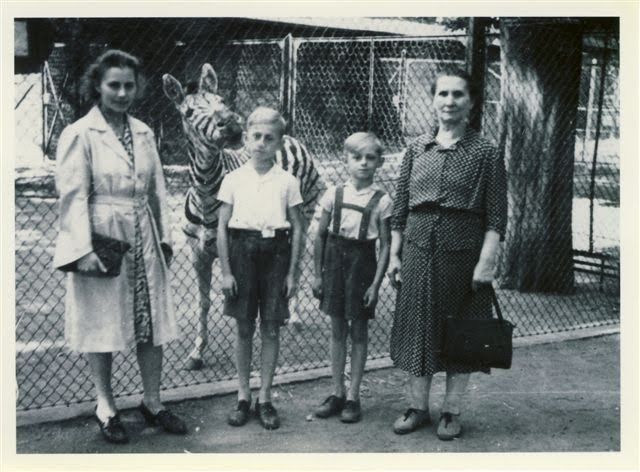

** 

Monday, May 31, 2010

LIVING IN THE ZOO


Living in the Zoo
Poznan, 1945-46


the first year after the war,
one third of the city destroyed,
my mother was lucky to get a room
in the Pavilion of Small Mammals.

Her best friend was a mongoose.
Now and then she’d bring him a rare
delicacy, an egg.  He’d cup it in his paws,
cut two dainty holes with his teeth
and suck out the contents.

She woke to the roaring of lions.
The hippopotamus mooed
for his cartload of wilted leaves;
the rhinoceros grated his horn
against the metal gate.

Three owls like Fates turned parallel
heads as she passed. Llamas spat at her.
The toucans were indifferent,
side-stepping on the branches
of their one pruned elm.

Early autumn Russian soldiers arrived.
They broke twigs from the trees
to poke at the animals.
The hippopotamus hid in his pond.
My mother saw the tiny bumps
of his nostrils wrinkling the dark water.

The biggest drama starred the elephant,
bought ten years earlier from a circus keeper:
“A bad animal, difficult to train.”
Now the circus again came to town.

the circus keeper entered the enclosure:
“That’s my old buddy –
I know how to handle him.” 
Moments later the enraged elephant
hurled his former master
over the fence onto the cement.

The zoo director’s breath steamed with vodka,
but he knew every single animal.
He sported long whiskers;
colleagues joked that the director spent
so much time with the animals,
he had grown to resemble a seal.
His show-off act was to walk
into the lion cage and pat
the male lion on the behind.

His favorite was the giraffe he’d brought
after the war from another zoo.
a low trolley was built,
a rope fastened around the giraffe’s neck;
two people pulled it down when the truck
approached an overpass or a tunnel.

In her new home, every day
the director went to see the giraffe.
she thrived. then her legs got swollen,
she could only kneel. One day she lay down.
The director embraced her neck, and wept.
The giraffe died in his arms.

my father visited my mother
when she lived in the zoo.
She left the town to marry him.
The three owls lit her way
with lanterns of their eyes.
The toucans stood like an orange dawn
in their inappropriate tree.

~ Oriana


Wednesday, May 26, 2010

HOW HORIZONS WORK


Though I grew up in central Poland, in Łódź and Warsaw (primarily Warsaw), and central Poland is totally flat, I always loved mountains. My first experience of beauty happened as I was standing at the edge of a Carpathian meadow, looking at the radiant crescents of the hills.

Nevertheless, there was one aspects of living in a flat place that I did appreciate: away from the buildings, it was possible to see the horizon, that blurred, unreal gray line where the sky and the earth meet.

How Horizons Work


From red desert cliffs I tried
to touch the rim of the sky –
I wanted to see the earth
curve – but a far-off ridge
prevented the horizon.

The scenery is too rich.
Horizons require
a routine of plains,
the discipline of sameness.
My students can’t comprehend.
Their lives are vertical. 
One wrote: “As I stand
at the tip of the horizon. . .”

The poetry of ignorance . . .
Even standing on tips of things,
one sees much, but not far. 
Hills and houses insist
on separate angles.
Most days not even clouds
to tuck in the corners.

An American tourist
remarked about Warsaw:
“Beautiful, but completely flat.”
In school we took a field trip
to study the horizon.
we walked to the railroad tracks,
saw parallel lines that met
in a blur of gray,
which the teacher said wasn’t
infinity, but would do.

That’s where everything
waited, in the blue-gray
infinity that wasn’t there,
but would do – always the same
distance apart, like the future.
Now only from far away, at night,
the cities still continue,
with their maps of lights.

~ Oriana (c) 2010

**

Marjorie Rosenfeld, who grew up in the Midwest, writes this:

I think people are most comfortable with the topography they grew up with.  My paternal grandfather came from Brody, Galicia (now Brody, Ukraine).  When I was doing research for my Brody Web site and read the Brody portion of Narrative of a Mission of Inquiry to the Jews from the Church of Scotland in 1839 (which I now have at the Web site), I was struck by this:

Brody is situated in the midst of a sandy plain and is five miles distant from the Russian frontier.  So completely level is the country all around that the distant village of Potamkin is the only object beyond the town which arrests the eye.

I suddenly understood then why my grandfather had settled in Galesburg, Illinois, where I also spent the first 6 years of my life, spending the next 6 in Bloomington, Illinois, which is also flat, and then Chicago until I was 16.  Old Town, Alexandria, VA, where I was living before I moved here, is also very flat.  What was hardest for me to get used to about this area [San Diego County] was the topography.

When my family lived in Bloomington, we used to drive from Bloomington to Galesburg every Sunday to have dinner with my grandparents.  I was very susceptible to car sickness, and my father usually had to stop the car by the side of the road at least once between Bloomington and Peoria, where we broke our trip to have a cream soda with my Great Uncle Will (my grandmother's brother) and Aunt Carrie.  We finally discovered that there was a particular hard candy with a strong citrusy flavor I could suck to help the car sickness, especially if I sat in the front seat with the small side window that cars used to have turned in so that the air was blowing directly on me.  On the way back from Galesburg at night, though, my father let me lie down in the front seat and put my head on his lap while he drove.  I never got sick then.

Your poem [“How Horizons Work”] reminds me of one I wrote while living in the Washington, D.C. area for a friend who kept leaving her husband and going back.  She could never decide what to do, so it was an endless round of drama:
  
Getting Through


Because the train is crowded tonight, we sit backward. 
Someone said riding this way makes you sick. In fact,
I like it, facing where I was as destinations rush at me
behind my back.  You, Friend, would not love this ride,
who never will leave home and are afraid of walls,
welcome the way we break into sudden dazzling light
at Arlington Cemetery, or dip to the darkness of tunnels after.

You say your husband keeps you in but keeps you. 
Contemplating where I’ve been, the landscape whole
and opening up—wider all the time we go—I know tracks,
like lives, run parallel.  Still, at the end of the line, on any day
is a point whichever way you look where tracks meet. 

Supper tonight, alone or in company, means civil claret
and nourishment enough for one.  True, to be held back
and held is touching.  If you could choose some other trip,
what is the worst they could say of you: that you left, taking
no baggage with you, running free, new wine in an old cup?

~ Marjorie Rosenfeld

**
Oriana:

My favorite passage in this poem is

                                                            I know tracks,
like lives, run parallel.  Still, at the end of the line, on any day
is a point whichever way you look where tracks meet. 

-- I love the way poetry manages to convey the paradoxes of life, often simply by using an image. Is every image metaphoric? Yes and no. 


Marjorie has another fine poem about flatlands.  Below is an excerpt:


Nocturne in Texas Fields

We have lost our bearings
here, where no trees
define the limits of the land.
Only dim hills
hover along the edge
of ground and sky,
making their far shadows
on the sands of the fields,
blurring the borders of the mind.

And the mind,
unconfined,
leaps out. 
Let loose,
with too much space,
fancy riots. Reason,
stretched too wide,
runs thin. 
Divorced from the familiar,
out of place
in the immensity of landscape,
we are orphans on the earth's face.

    ~ Marjorie Rosenfeld 

**

Sunday, May 16, 2010

MY GRANDMOTHER'S LAUGHTER

My grandmother Veronika, 1945, 
first ID photo after Auschwitz

MY GRANDMOTHER'S LAUGHTER


1. Black Soup

My grandmother, a goose in her lap,
strokes the white bird,
strokes the long neck,
and when the goose is calm,
she calmly cuts its throat,

draining the blood
into a blue washbasin.
She makes the sweet, heavy
black soup. Apple slices
float, half-moons.

Her wide sleeves winnow
the feathered air.
Woopoo-tzoopoo,
woopoo-tzoopoo, she sings.
She pokes my arm

as if testing a cake:
This child is too skinny, she sighs.
I sit on top of her feet,
telling her to walk,
to take me somewhere.

skins of baked apples crack,
ooze tears of sugary sap.
Rosaries of mushrooms
dry over the stove,
shrink into pieces of dark wing.


2. Only the Horse


The Raba River spits up white,
drowning the cool green of spruce,
slow crescents of the Carpathians.
Poplars taper to silver. Wind,

then a stillness. The first drops.
The driver unrolls the roof.
The rain grows heavy, knocking,
trying to enter from all sides.

The driver heaves himself inside: 
The horse knows the way.
The river boulders knock,
the carriage rocks like an ark.

And all is found: the rain, the road,
the Raba hissing in stone bed;
the driver silent, the hooves a clock,
the horse a steady brown rhythm.

A village past the river willows;
the sunken bell of vespers.
The horse stops. Ribbons of steam
curl off his flanks.

Rain hushes to a prayer
along the dripping leaves.
The dorozhka disappears
into the wet-shining green.

Only the horse knows the way,
the horse in a halo of steam,
hooves ticking on the wooden bridge
for a hundred years.


3. Ghost Forest

Woolly threads of conifer breath
rise, tiny bent souls.
on the slopes, a ghost forest –

strangled spruce, green only at the top.
Underneath, gray sticks,
upturned bony hands.

No one enters –
you’ll get scratched,
slip on the needles and fall. No

blueberries or wild strawberries
here – a forest of nothing.
Still I press into that thicket,

squeeze between spindly trunks,
until like a starving tree
I stand in the inner dusk.

Beyond, bird calls of meadows.
Sunlight beads the bowed
tips of grass;

grandmother weaves for me
crowns of white clover.
What gray hunger draws me

past the smiling green
into the ghost forest –
As if there weren’t already

too many dead –
As if those with no faces said,
If you cannot win, endure.


4. My Grandmother's Laughter

One day in the street my grandmother
stops before another grandmother.
Both stammer: “It’s you – you – in Auschwitz – ”

Turning to me: “She and I shared
the same blanket. Every night she said,
‘You’ve got more than I’

and pulled, and I pulled back,
and so we’d tug across the bunk – ”
and the two grandmothers laugh.

In the middle of a crowded
sidewalk, in old women’s dusk,
widows’ browns and grays,

they are laughing like two schoolgirls –
tears rain down the cracked
winter of their cheeks.

On Piotrkovska Avenue,
on the busiest street,
they are tugging that thin blanket –

They are pulling back.


5. Praying to Saint Anthony

Pincushions and hairnets,
a mischievous spool of thread;
thimbles wobble in uneven hoops,
needles enter the secret veins of things. 

We rummage through drawers
reeking of decayed Soir de Paris
cologne and valerian drops;
the slipper-hedged dusk under the bed.

There remains the invisible world.
We kneel on the creaking floor
before the painting of a smiling monk,
a lily like a magic wand

tilting from his hand.
With a practiced zigzag,
we cross ourselves: Saint Anthony,
guide us to Grandmother’s thimble.

Again we scan
the summits of wardrobes,
horizons of floors;
the precipice behind the couch,

gritty crevasses of chairs.
Again she hides in laughter:
The devil must have covered it
with his tail.


6. Grandmother’s Theft

You’d think the pages would bleach,
she’d read them so many times –
lions run out of Christians

and Nero sicken from pearls
dissolved in purple wine.
She attends Caesar’s banquets.

descends with an oil lamp
into the catacombs’
damp dark. Quo vadis?

“Where are you going?”
she repeats like a password.
And will not return the book.

*

For years her eldest brother, Józef,
puzzles over the gap
in his gilded-edged volume set.

He had received private teaching,
while she, to pay for his lessons,
was taken out of school in fourth grade,

put to work in a textile factory.
About the novel, she explains:
Because he never gave me anything.


7. Wolves

We set out late, ruddy pelt of the sun
tangled in the branches.
Then the dark begins to tick,

rustle and creak, the crowns of pines 
riddled with imagined owl flight. 
A stir in the ferns, a snap.

I’m waiting for one
high note, clean blade of a knife.
And the dark is pierced –

panting, barking, an animal tumult.
Hungry bodies of the night,
they are closing in.

Yezus Marya! grandmother shouts.
Then, calmly: Stand still.
There are lights and cries,

the villagers banging gates,
calling back the dogs
they loosed from the chain.

We borrow lanterns and walk on,
wolf shadows swaying
among the shadows of pines.


8. All Souls

On All Souls’, grandmother and I
buy chrysanthemums at a bazaar.
Petals smell of the earth.
The sun grows small, a white pebble.

Hundreds of candles gentle with their glow
the sites of executions. 
On white-pebbled paths,
we walk among the graves.

She thrusts a coin into the hand
of a beggar woman wrapped
in seven black shawls:
Pray for the soul of Yakub.

Adds his last name, so God
won’t confuse him with anyone else.


9. Winter comes from the East


Winter comes from the East,
winter comes at Christmas
crows from the frozen

heart of Russia,
a black wind off the Urals.
A ruddy ring around the moon

means frost.
Moon in a fox-fur hat
brings cold, great cold.

I paint ghost roses
with my breath, lick icicles,
wade wind-tilted snowdrifts.

One night across the bright darkness,
I see a falling star.
I am young, and do not make a wish.


10. Bread and Salt

In late amber
afternoons, the streets ascended
on the scent of warm bread.

She brings home a sun-round loaf.
Under the saw-toothed knife
the crust crackles, resists;

I beg for the “heel,” I eat
the steaming, almost breathing
bread, like the flesh of the earth.

*

At the spa with the salt towers,
the fountain of Hansel and Gretel,
huddled under a dripping

stone umbrella. The salt towers
are five-storied pyramids, dripping brine
through a scaffolding of birch twigs.

We stroll around, breathing the salt breeze.
It’s meant to cure everything.
“Inhale!” grandmother reminds.

*

We watch a bride and groom
greeted at the door
with bread and salt.

Bread so you never go hungry.
Salt so you dance with
shadows, in the lucky light.


11. Stations of the Cross


“Why are there no women priests?”
She shrugs: Because men rule the world.
Like we have to listen to the Bolshevik.
We are doing Stations of the Cross.

She lingers before the Sixth Station:
Pale wisp of a girl, Veronica
presses through the jeering crowd,
the whips of snarling executioners.

She holds out her white veil to wipe
the condemned man’s face,
streaked with blood and sweat.
My grandmother Veronika

greets her patron saint.
She has seen the executioners.
Only the uniforms are different.
She does not bow her head.

In the kitchen, making beet soup
with botvinka, not wasting
the tiniest leaf, she laments:
As soon as I close my eyes,
you will never go to church.


12. God's Hearing

One evening in Auschwitz
the women in her barracks began to pray.

Their prayer grows and grows,
a chant, a hymn, a howl –
it carries far

into the searchlight-blinded,
electric wire-razored night.
The Kapo rushes in, shouting,

Not so loud!
God is not hard of hearing!

And my grandmother laughs.
Then she begins to sing:
Many have fallen

in the sleep of death,
but we have still awakened
to praise Thee,

she sings to the God of Auschwitz.
Her voice does not quiver.

         ~ Oriana


*****

Ursula:
These are  marvelous, so full of love and memory and life -- the horse pulling you all through the forest in the rain, and your grandmother and her bunkmate laughing over what must have been a threadbare, vermin eaten blanket, what resilience.

Are you making books of these? Have they all been published somewhere? They are so strong, and full  of good spirit. I found them deeply refreshing.

Oriana:
Thank you, Ursula. Yes, the resilience -- my grandmother's strength of spirit was magnificent.

Some of the sequence has been published, but not the entire sequence. I've seen sending out my manuscript (including this sequence) to various contests, but with no success. Maybe this is not surprising, since the trend is away from the narrative, even if it's a lyrical narrative.
And I want to share these stories, these strange and magical details. If a few people can find them through this blog, it's better than nothing.
**