Showing posts with label spirituality. Show all posts

Tuesday, February 15, 2011

LARRY LEVIS: A FINE TREMBLING


TO MY GHOST REFLECTED IN THE AUXVASSE RIVER

I’m tired of praising the dead
Tired of ghosts.
I am just sitting in my yard, watching
Thin clouds move above me,
And the grasses are bending in one direction.
This wind has no friend but me;
It is Spring,
And I am addressing you, Spirit,
Because the wheat ripens for no one,
Not for the sky,
Not even for you.
And you, who do not believe in words,
Care less for my life than for a broken comb you’ve left
In a movie theater, or in a bar.
Each day at noon
I used to close my eyes,
And lie alone in the dark, listening.
And you never spoke,
Never uttered the thin prayer that was me.
Or on the long bridges when I drove to work,
You would stare into the river
Until you made yourself think of nothing.
And when you found you could do it,
You were thrilled,
You were like a spider
Moving laboriously, and without thoughts, over a bead
Of water shining in its web.
You stayed out later, and later.
You loved knives, bars, drugs, music.
When you would turn on the radio
And dance alone, in the kitchen
Of the diner,
I kept sweeping.
You have become pure, finally.
You have become that silence just under the water
Where the river turns brown, and slows,
And a stillness rides alone
Over that place –
And I just drive past it, now.
If only I could reach in and pull you out,
Or if only you were a fish,
And then, if you did not speak to me,
As a fish did once, in a dream,
I would slice you up to the stomach and slap
Your head against stone.
And make you flesh,
Even while these flies dance on the rocks.
But I am a stranger, I will pass,
And always, when I bend to drink
From this place, I come up with nothing, with
Broken water, a fine
Trembling in my hands,
Which must be you.

~ Larry Levis, from The Dollmaker’s Ghost

**

For me, the poem starts here (pardon this workshop habit of saying: “The poem starts here”):

It is Spring,
And I am addressing you, Spirit,
Because the wheat ripens for no one . . .
And you, who do not believe in words,
Care less for my life than for a broken comb you’ve left
In a movie theater, or in a bar.
Each day at noon
I used to close my eyes,
And lie alone in the dark, listening.
And you never spoke,
Never uttered the thin prayer that was me.

~ This is a complaint. The transcendent part of the young man, maybe that “larger self” that Adam Zagajewski mentions in his poems, does not seem interested in its container, so to speak – the daily self of the poet. Eventually that part of him becomes “a silence just under the water,” and, later “a fine trembling” in the speaker’s hands. And yet this is not a negative poem, when you consider the beauty of it, especially the beauty of the last lines. The poem illustrates one of the paradoxes of poetry: the content may seem despairing, and yet the reader is left in a state of hushed awe, and nourished with beauty.

Lisa:

I can't help replying again, in reference to the self becoming bigger than one's self. Obviously not even Levis' ghost grew bigger than himself, and he ardently stays shut up (and down) in his own pity. Then, there is "Salmon Boy," who becomes caught up in his separate ego-self until his father spears him and his mother filets him- so that he is left out, exposed to the sun, to become the food for his people - to become one with them, or to become integrated, or to become larger than himself. This is the ancient act of initiation; this is the ancient act of the father, who must give the blow, in order for his son to become "bigger than himself" and his own self- infatuation or self-pity. Oh, I am a bit tired of the one who chooses to remain a stranger and not dip down into the river, not see his own "ghost spirit," not make of it a fish.

Salmon Boy, by David Wagoner

That boy was hungry. His mother gave him Dog Salmon,
Only the head. It was not enough,
And he carried it hungry to the river's mouth
And fell down hungry. Salt water came from his eyes,
And he turned over and over. He turned into it.

And that boy was swimming under the water
With his round eyes open. He could not close them.
He was breathing the river through his mouth.
The river's mouth was in his mouth. He saw stones
Shimmering under him. Now he was Salmon Boy.

He saw the Salmon People waiting. They said, "This water
Is our wind. We are tired of swimming against the wind.
Come to the deep, calm valley of the sea.
We are hungry too. We must find the Herring People."
And they turned their green tails. Salmon Boy followed.

He saw Shell-Walking-Backwards, Woman-Who-Is-Half-Stone.
He heard the long, high howling of Wolf Whale,
Seal Woman's laughter, the whistling of Sea Snake,
Saw Loon Mother flying through branches of seaweed,
Felt Changer turn over far down in his sleep.

He followed to the edge of the sky where it opens
And closes, where Moon opens and closes forever,
And the Herring People brought feasts of eggs,
As many as stars, and Salmon Boy ate the stars
As if he flew among them, saying Hungry, Hungry.

But the Post of Heaven shook, and the rain fell
Like pieces of Moon, and the Salmon People swam,
Tasting sweet, saltless wind under the water,
Opening their mouths again to the river's mouth,
And Salmon Boy followed, full-bellied, not afraid.

He swam fastest of all. He leaped in the air
And smacked his blue-green silvery side, crying, Eyo!
I jump! again and again. Oh, he was Salmon Boy!
He could breathe everything! He could see everything!
He could eat everything! And then his father speared him.

He lay on the riverbank with his eyes open,
Saying nothing while his father emptied his belly.
He said nothing when his mother opened him wide
To dry in the sun. He was full of the sun.
All day he dried on sticks, staring upriver.

**

Oriana:

Well, I am glad there is the "feeding the people" communal meaning that we can give to the Salmon Boy's final condition.

Larry Levis’s poem delights me with its marvelous lines, and frustrates me at the same time – and then delights me again when we get to the "fine trembling."

If not for the title, I could see this as an address to God – Kurt Vonnegut's God the Utterly Indifferent. It's possible that this kind of god loves humanity, but not on an individual basis. And perhaps the poem can be perceived as being addressed simultaneously to the speaker's spirit, a detached internal Witness and fearless dancer, and to God the Utterly Indifferent. It's not Teresa of Avila exclaiming, "If only we took care to remember what a Guest we have within  . . . "

But let us remember that the image knows more than the poet, and while the speaker seems dejected not to receive more ego satisfaction, to be only a temporary container, if that much, the images of water, shining, stillness, the "silence just under the water" and finally the "fine trembling" add up to beauty and mystery. Anyone who has had the experience of filling his hands with water from a stream and seeing the fine trembling knows how wonderful that looks and feels, that little bit of water dancing in your hands, shining and alive. I am in awe that Larry Levis identifies this beautiful trembling with his spirit. Even though before that he says, "I come up with nothing," that is eclipsed by the luminosity of the final image and the discovery. And the lyricism seduces me too.

Aside from the ending, the part about the spirit dancing in the diner kitchen while the young man keeps sweeping is also unforgettable. So we have this man doing a menial job, but his spirit – or the Spirit – celebrates himself. Later we get the flies dancing on the rocks – dancing, not just swarming. Come to think of it, the fine trembling could also be seen as a kind of dancing. It's an image combining fragility and a great, invincible vitality.

Alas, there is no human community here, and the greater wisdom that would come from relatedness. This could be read as a portrait of an isolated individual sulking that Something Greater does not deign to speak to him. Inside our mind is a cosmic mind, the Upanishads say. Presumably the cosmic mind is connected with everything, but we have to know how to tune in to it – maybe by losing the preoccupation of the self. Some believe there is an angel inside us, or walking near us – an immigrant who makes us long for another place. Or maybe, on the contrary, it’s an angel of this life, this world, not one of inaccessible angels in Rilke but the Stevensian Angel of Reality, one who says Look! Look now while there is a chance.

Because Levis does this looking at the world – he does not merely contemplate himself – there is a poem behind the poem here, a poem of images wiser than the poet. For me those images align along the lines of an amazing New York Times article called "Happy like God." Let me offer just one sentence of it:

To be like God is to be without time, or rather in time with no concern for time, free of the passions and troubles of the soul, experiencing something like calm in the face of things and of oneself.


And here is Levis:


You have become that silence just under the water

Where the river turns brown, and slows,
And a stillness rides alone
Over that place –

Levis says it better, because he uses the power of images, so he speaks beyond himself, in a larger fashion – even if he doesn't quite know it. He uses archetypal nature images such as water. As Jung said, "He who speaks through archetypes speaks with a thousand voices."

Lisa:

Oriana, an apology for what sounded a bit reactionary. I was very wrapped up with a student of mine – one who I adore, one who is really suffering, and this poem you sent really brought it up for me! This "being a stranger" – lost in the world even to oneself, was just too painful to face this last week. However, I am revisiting this poem, which I do love, and which is so very beautiful. 


This "you have become pure...where the river turns brown," and this ghost of oneself that is irretrievable and was, perhaps, never within grasp anyway, 
this "nothingness" which is the water of life itself –that which makes our body say to itself, 
"Yes, I am here in all of this brilliant wonder."

**

Oriana:

Your post is lovely, showing your sensitivity both on the human level – the suffering student – and on the cosmic level of union with nature. 

I was indeed somewhat confused by your initial reaction, but no problem. You did make it all the more clear for me that in many poems Larry Levis is indeed this perpetual isolated adolescent, though in his mature work he can write some magical lines, and the self-pity universalizes, transfers onto all of us.

Nevertheless, I think human life has a meaning chiefly within a social network, and very few can sustain communing with nature as a source of meaning. And Levis does have some excellent poems that center on others, be it his father or the Mexican grape pickers. He makes those people enter our psyche. I think one of the central tasks of a poet is to expand our empathy.

Going back to the poem, just the fact that Levis addresses his spirit/Spirit is already amazing. True, there is a poetic tradition of the poet speaking to his soul, but Larry's poem feels quite different.

I would like you to read Szymborska's poem on the soul because I think that it says some of the same things, though it says it very differently. Levis uses the power of the image, risking obscurity; Szymborska is plain and clear, and we admire her mainly because what she says is so unexpected. Both poets appear to say that the soul/spirit has its own agenda.

A Few Words on the Soul


We have a soul at times.
No one’s got it non-stop,
for keeps.

Day after day,
year after year
may pass without it.

Sometimes
it will settle for awhile
only in childhood’s fears and raptures.
Sometimes only in astonishment
that we are old.

It rarely lends a hand
in uphill tasks,
like moving furniture,
or lifting luggage,
or going miles in shoes that pinch.

It usually steps out
whenever meat needs chopping
or forms have to be filled.

For every thousand conversations
it participates in one,
if even that,
since it prefers silence.

Just when our body goes from ache to pain,
it slips off-duty.

It’s picky:
it doesn’t like seeing us in crowds,
our hustling for a dubious advantage
and creaky machinations make it sick.

Joy and sorrow
aren’t two different feelings for it.
It attends us
only when the two are joined.

We can count on it
when we’re sure of nothing
and curious about everything.

Among the material objects
it favors clocks with pendulums
and mirrors, which keep on working
even when no one is looking.

It won’t say where it comes from
or when it’s taking off again,
though it’s clearly expecting such questions.

We need it
but apparently
it needs us
for some reason too.


~ Wisława Szymborska, translated by Stanislaw Barańczak and Clare Cavanagh

**

After Levis's lush images, we may feel disappointed by this kind of witty, cerebral poem. Tough . . . It takes all kinds. I want to point out the similarities, though. Here too the soul is very elusive, and mostly absent from tasks that bore it. Note:

For every thousand conversations
it participates in one,
if even that,
since it prefers silence.

and note also this stanza:

Joy and sorrow
aren’t two different feelings for it.
It attends us
only when the two are joined.

*
I also love it that the soul settles

Sometimes only in astonishment
that we are old.

~ or growing older. It's definitely astonishing. Don't we always feel younger -- much younger -- than we are? In dreams, don't we even look younger by far, not to mention that the dead are both dead and alive -- though in a dream, when we look in the mirror, we may see our hair suddenly gone white. Let us sit a while with this astonishment, let's offer it food and drink.

Actually the line that haunts me is the one about the soul's preferring clocks with pendulums. You don't see those very often anymore, and what a loss! There is a meditative quality about the pendulum's going back and forth, back and forth . . .

Even just the round dial and the march of the three hands, each at a different speed, those are evocative as well. Again, the power of the image. What is happening to our world as we go digital? What about that ad for a CD that will preserve your photos for 300 years?

Lisa:

On a more spiritual note . . . or are we always playing one spiritual note 
after another, even as we brush our damn teeth one more time and head 
off to work (smile - hopefully fresh and white), here is a response
to Salmon Boy from one of my music making, Kirtan playing, dear, dear 
friends:

Somehow, I think this is all of our fate . . . like the crucifixion... or
the death of the personal self. At some point, life is going to turn
us all back into itself... into God... into love. The Sufis believe
that the true idol to be destroyed is the self; and love, passionate
love, is the Divine's method of awakening us to that which is beyond
our self. Thus the lover may dissolve into love . . .

Kahlil Gibran says about love:

Like sheaves of corn he gathers you unto himself.
He threshes you to make you naked.
He sifts you to free you from your husks.
He grinds you to whiteness.
He kneads you until you are pliant;
And then he assigns you to his sacred fire, that you may become sacred
bread for God's sacred feast.

**

Oriana:

My metaphor is giving blood rather than crucifixion. I'm still very uncomfortable with the last image in the Salmon Boy poem. But I do like Gibran's poem, and yes, life does that to us, to women in particular  . . . it teaches us that it's not about our little isolated self. Meaning lies in how we touch the lives of others.

Emily Dickinson put it well:

If I can stop one heart from breaking,
I shall not live in vain;
If I can ease one life the aching,
Or cool one pain,

Or help one fainting robin
Unto his nest again,
I shall not live in vain.

(919)

Note that kindness to animals certainly counts for Dickinson. Our connection is not limited only to human beings.

I do not remember the source, but somewhere I read the beautiful statement that if you plant a tree, that already means you have not lived in vain.

I love this fusion of mystical insight from all traditions. Anna Kamienska says

I don't believe in the other world
But I don't believe in this one either
unless it's pierced by light

My ideal is to live from greatness, from generosity. For many years, I lived – at least in private – from my wounds. People kept saying, "You have so much to give," but I felt there was no right outlet, no takers. What I had to give was not wanted, I thought. The riches of my psyche were of no interest to others, my poems too difficult, too full of ideas, and my ideas too complex. But about two years ago – better late than never – I saw that the notion that life isn't long enough to recover from one's wounds need not be true. It's not about healing or not healing one’s wounds. It's about transcending them through the daily practice of generosity. 


Saturday, August 7, 2010

THE FAITH RESTROOM


North window, Notre Dame de Paris


Rose Windows
  
Sunsets surpass us in their dying,
clouds smolder to fiery wings.
We leave in colors of forgetting,
so we can be remembered

in one phrase –
unlike the hundred-petal
rose windows of cathedrals,
their everlasting sunset.

Purple flames, viridian blossoms –
let me be unafraid
of the unknown country
we try to tame with angels.

The rose windows confess
how we yearn to be ravished –
but saints tell us God lives within, 
a small, still voice, like the ocean

whispering in a seashell –
a voice we hear, or do not hear,
when we wake
in pain, in dark, and far from day.

            ~ Oriana 

**


My friend Marjorie reminded me that God loved Job. Doesn't that make us want to run from God's love? I think Simone Weil was suggesting that indeed we are not always willing to surrender to God's attempt to ambush and capture the soul, which comes to us in the form of 1) trauma (aka “affliction”) 2) beauty.

This issue is strangely alive. I direct you to a fascinating article, “God as Trauma”:


The 12-Step program people, 99.999% of whom have never heard of Simone Weil, keep repeating this motto: "God never sends you more suffering than you can endure." It’s futile to offer examples to the contrary, to parade the walking wounded and the suicides. This is not about rationality and statistics. When the emotional need is great enough, we’ll believe anything, it seems -- “no atheists in the trenches.” 

This saying inspired me to write to an ex-evangelical minister who turned to “process theology (a liberal theology based on the idea that God is a process, becoming rather than a being, and is not omnipotent, but has the power of persuasion),” There are no process theologians in the trenches. Filled with triumph, I then walked to the restroom (this took place at the Twin Lakes campground near Mammoth Lakes).  Close to the greenish structure with the Keep Me Wild bear warnings on the doors, what was that metallic sheen near the path, in the dirt and pine needles? I picked it up: it was a silver ring with an inscription. The inscription read: FAITH.

I admit I was shaken. In the privacy of the restroom, with fear and trembling, I tried on the ring. It was much too large for me; it fit only my thumb! So, it was someone else’s faith; it didn’t fit me. It slipped off.

The ring didn’t fit me. This relaxed me: one faith does not fit all. It seems to me that each person develops an individual faith, which may or may not contain elements of traditional religion. Some might prefer to say “life philosophy,” but I insist that “faith” is a better word. Philosophy implies rational thinking and having carefully examined various options. Can you imagine ever entering a relationship on that basis? All of us would still be virgins.

By the way, once fear and trembling left me, I soon found the large-handed woman who’d lost the ring. She happily put it on the moment I handed it to her. I hope she never loses her “faith” again.

The bipolar deity of the Old Testament, now vengeful, now merciful, so obviously a human creation, in our image, with our contradictions (now kind and tolerant, now mean-spirited) – this flawed deity will not do. I am not sure that I can go along with Milosz’s idea that faith is based on will: in spite of lack of rational proof or any experiential evidence, a person can choose to believe in God. You make a “leap of faith” – you simply decide to believe or not to believe. And it’s really the unconscious that decides.

I have no trouble with the notion that it’s the not the conscious mind that decides in matters of religion, mainly on the basis of emotional need, and exposure, at just the right time, to the teachings of a religion that fulfills that need. And yet the intellect, that still small voice that strangely refuses to shut up, whispers that this will happen only when the image or concept of the divine fits with other important beliefs that we hold, rather than with the 13th century worldview. “The psychoid nature of reality” is perhaps the closest the modern intellect can come to embracing some power inherent in the universe – something like the Tao, maybe?

We are wired for mystical experiences; no one denies that. And we are meaning-seeking organisms. I hope some cosmic intimacy emerges from that. To use Milosz’s words, it’s “a hope of a hope.”

On the other hand, it could be another biological joke, the way humans are wired for jealousy, but not for fidelity.

As for near-death experiences: these are so culturally/religiously conditioned, I have little doubt that it’s the dying brain’s last soothing visions of something like heaven. By now studies have confirmed that those experiences can be induced by certain drugs. So it seems that “there is no entry, only entering” (Jorie Graham).

As for the cultural conditioning of near-death visions, it’s interesting to compare those of Carl Jung, who at the time of his heart attack was strongly influenced by the Eastern religions, and those reported by conservative Christians (e.g., I read one NDE memoir in which the author remembers hearing three Lutheran hymns sounding simultaneously. Would God not prefer Bach or Vivaldi, or, for that matter, Tibetan throat singing, over that heft of cathedral tunes that Dickinson found so oppressive?)

Jung describes his experience in Memories, Dreams, Reflections. Jung’s vision ended just about when he was going to join the “greater company” of kindred minds: I was not to be allowed to enter the temple, to join the people in whose company I belonged. This, as I understand it, is also Swedenborg’s vision: afterlife means being in the company of kindred minds.

http://www.near-death.com/jung.html

By the way, I love the account of Swedenborg’s first mystical experience. He was eating supper at an inn when a disembodied voice said, “Don’t eat so much!” He left the table immediately and went up to his room, there to receive his earliest revelations. 

Here is what Milosz writes about Swedenborg’s concept of heaven and hell:
Any man may live in a constant relationship with the Greatest, Cosmic, Man – in other words, live in Heaven – but he may also avoid it and keep company with the Cosmic Evil Man – in other words live in Hell. When he dies he finds himself in one of the innumerable heavens or hells which are nothing other than societies composed of people of the same inclination. Every heaven or hell is a precise reproduction of the states of mind a given man experienced when on earth, and it appears accordingly – as beautiful gardens, groves, or the slums of a big city.

Milosz goes on to quote from Swedenborg’s Heaven and Hell:
Some hells present an appearance like the ruins of houses and cities after conflagrations, in which infernal spirits dwell and hide themselves. In the milder hells there is an appearance of rude huts, in some cases contiguous in the form a city with lanes and streets, and within the house are infernal spirits engaged in unceasing quarrels, enmities, fightings, and brutalities; while in the streets and lanes robberies and depredations are committed.

~ Czeslaw Milosz, “Dostoyevski and Swedenborg,” in Emperor of the Earth

Swedenborg’s heaven is full of gardens (but no animals) and heavenly mansions, but also of churches. “The churches in the spiritual kingdom are apparently built of stone, and those in the celestial kingdom of wood; because stone corresponds to truth, and whose who are in the spiritual kingdom are in truth, while wood corresponds to good, and those in the celestial kingdom are in good.”
It seems to me that those innumerable heavens and hells exist right here on earth (just as “past lives” are within each person’s lifetime). To me, the most interesting thing that Swedenborg proposes is that we choose heaven or hell, and, even more important, we can choose to leave hell for heaven.

Whether or not God is an external reality, it is, for each believer, an internal, subjective reality. I love to contemplate the words, “The Kingdom is within.” As for the divine as a mix of external and internal reality, for me, only music remains – but I don’t mean Lutheran or any other church hymns. When I crave the divine, I listen to Mozart. 

**

I want to assure the reader that I do not mean to disparage process theology. In many ways (except for fulfilling the human need for a strong protective figure), it’s much more appealing than traditional theology. God as a verb, God as  a process , God as a subjective experience – anything other than the Old-Man-in-the-Sky – this fascinates me, promising something that is positive without being absurd. I am an agnostic with a mystical streak that shows itself especially in my poems, with their Catholic nostalgia. It’s very easy to be an atheist in prose, but just try it in poetry! I fall into a prayerful bliss just watching leaves move in the wind. In the mountain, watching the shimmer of aspen leaves is perhaps the closest I come to a conversion experience. Simone Weil would say that those leaves moving in the wind, and all other beauty, that’s the smile of Christ.

I also enjoy reading Rabbi Kushner, who, like Simone Weil, believes that God (whatever that word means) does not interfere with the laws of nature (is not going to change the trajectory of a bullet, or fix bad genes, for instance), and does not interfere with free will (Catholic theologians believe the second of these propositions, but are unwilling to let go of miracles). Then why pray? It will make you feel better, this most pragmatic (and I dare say wisest) of rabbis replies. 

I am also intrigued by something I read in a book on popular philosophy:
Twentieth-century philosopher Alfred North Whitehead argued that not only is God incapable of determining the future – the future will determine him. According to Whitehead’s process philosophy, God is neither omnipotent nor omniscient, but is changed by events as they unfold. (Plato and Platypus, p. 22)

Rilke said it in a more daring way: we are building God. Jung too was aware that the “God image” undergoes constant evolution has humanity evolves. 

I remember a lecture on process theology given on a college campus by a Presbyterian minister. I was fascinated by his definition of God as the “power of ideals.” A member of the audience asked him, “Is that what you say to your congregation?” The minister replied, “My congregation consists mostly of elderly women, and no, I can’t say it to them.” Someone else protested that such concept of deity would never be accepted by people, who want a powerful God, one able to help them. The lecturer replied, “And do you think that ideals are not powerful?” That was a marvelous moment, a “moment of truth.”

**

One image of the ring of faith that speaks to me is the one in Henry Vaughan’s famous lines (the bride is the soul, the Beloved, God being the lover and bridegroom; where did I learn that? From a former nun) :

I saw Eternity the other night,
Like a great ring of pure and endless light,
All calm, as it was bright;
And round beneath it, Time in hours, days, years,
Driven by the spheres
Like a vast shadow moved; in which the world
And all her train were hurled.
. . .
But as I did their madness so discuss
One whispered thus,
This ring the Bridegroom did for none provide,
But for his bride.

     ~ Henry Vaughan (1621-1695)

 **

Actually I never liked to wear rings. Their function seemed to be to please others, or to signify belonging to a certain group of people. I thank Marjorie for having sent me a batch of Jewish haiku, one of which reads:

That’s a lovely nose ring.
Excuse me
while I put my head in the oven.

**

This year, toward the end of June 2010, I was again at Twin Lakes campground, and again went to the restroom that I’d named, after the ring experience, the “faith restroom.” The restroom is a duplex, with the faith restroom on the right. As I was about to leave it, I heard someone enter the adjacent restroom. Soon I heard a woman’s voice moan softly, “Oh God.”

I instantly understood her distress – most likely she discovered that her period had just started, on top of all the ordeals of camping. “Oh God” is rarely a joyful  exclamation of faith.  More often it means, “Oh, no . . . ” 

For instance, when my mother happened to break a cup, she’d croon, “My God, my God” in a way that was such great lament, filled with such immense grief, it could not have been about the broken cup. It seemed to go back to September 1939 and what happened after . . .

**

A minor metaphysical moment

The ring incident had its own Jungian humor, but the Moses incident was a gem. Years ago the steep beginning of the Red Cones trail was the scene of my meeting an elderly man named Moses, with his joke about the Ten Commandments (God kept presenting the tablets of commandments to many nations; all other nations asked, “What are those?” and then refused them; the Jews asked, “How much?” God said, “Free,” and the Jews exclaimed, “We’ll take them!” – an insider joke from the mouth of Moses; it struck me as American or capitalist, rather than Jewish per se). This time I saw an elderly man who reminded me of Moses, so I said, “Excuse me, are you Moses?”

“Am I Moses?? No, I’m Cy,” he said.

He had a handsome husky, and the dog started socializing with other people while Cy and I were talking. He jumped on someone, and Cy scolded him, “No jumping, or I’ll have to bite you.”

Religion of the Self

At the Whitney Portal campground, a man walked out of the self-composting one-holer in a T-shirt that said, WICKED OLE ME! (exclamation point on the T-shirt). He looked around sixty. He looked at me, and his face lit up with a smile.

Later I thought that the aging “me generation” will be followed by the “even-more-me” generations. We have to admit it: the religion of the Self has become dominant. Call it the Age of Narcissism (which, as I argue in a different post, also means the Age of Depression), call it the culmination of the modern trend to less and less face-to-face contact and the culture of the isolated individual – the word “self” has become sacred.

From the start, but especially lately, I’ve felt an acute disappointment that Jung chose to label our goal as “the Self.” True, it’s not to be confused with the self spelled with a small letter, but it just doesn’t sound like an inspiring goal.

(A Woody Allen digression: he noted that Heidegger’s Being, not to be confused with being, can be achieved only on weekends.)

(One of Jung’s definition of the self [actually I found the small-letter spelling] was “the God within.” But shouldn’t it be “gods”? It’s a god-eat-god world indeed, both the outer and the inner world. As William Blake noted a long time ago, “all deities reside within the human breast.” Do they also reside outside human consciousness?

To digress even further, Jung’s Self, Heidegger’s Being, Hegel’s Spirit – these are all euphemisms for “God,” though with the good intention of not having it be the Judeo-Christian deity.

As for those who want to favor the word “Universe,” there remains Einstein’s famous, “The most important question for humanity is: Is the universe friendly?”)

The lyrical moment

The Twin Lakes campground was less noisy than in previous years, I have to admit. The host suggested that this was due to “less riff-raff.” (The host was a laid-back overage hippie, gray hair in a pony-tail.)  (By the way, the fee is up to $21/night.)

Still, there were those moments when the campground seemed the heart of cultural darkness. Well, almost. Daily, the brutal noise of multiple generators drowned the powerful rush of the double waterfall. But one time I heard someone play “Für Elise” on the harmonica. And it sounded even more lyrical than when played on the piano!  One of the sweetest moments of the whole trip – the divinity of Beethoven’s music in this place of human noise. 

And my difficulties of belief were experientially resolved – or at least eclipsed and transcended in a moment of beauty.  For me it’s those moments of beauty that make life worth living – whether or not beauty is God’s ambush for the soul, as Simone Weil would have it.

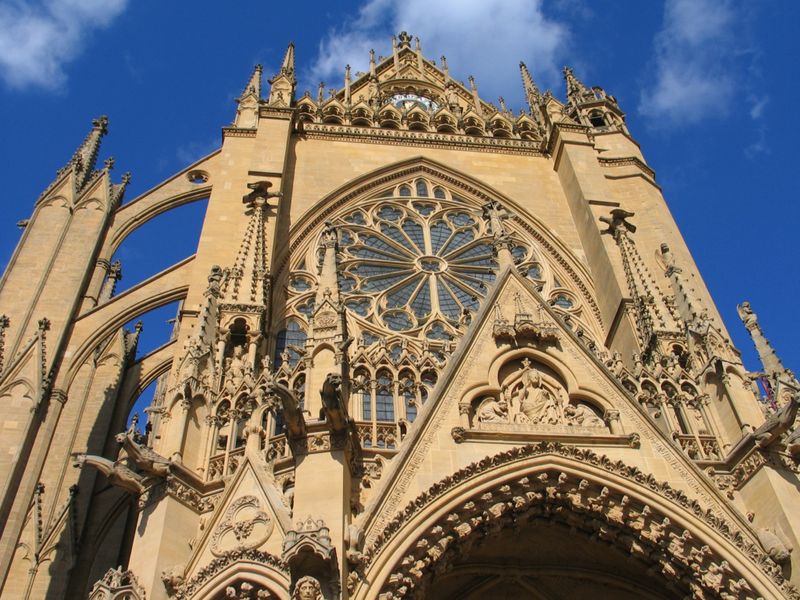
But looking at great cathedrals, I wonder if perhaps it might be the other way round – that God is mainly a pretext to make humanity create and experience a certain kind of beauty.


Metz Cathedral, nave

**

Hyacinth:

I like the phrase “ambushed by beauty.” I think also the way found objects send messages or enlighten us in ways we are so surprised by like the "Faith" ring you found at Twin Lakes.

We are ambushed often, though perhaps not often enough, by little things, by serendipitous occurrences. I wonder how many we even overlook and don't see at the time. When we do notice these occurrences, how uplifted our spirits are, how gifted we feel. I can't explain it, but I have experienced the little miracles once or twice and been  bowled over with astonishment and gratitude.

Oriana:

I am certainly open to the mystery of synchronicity. The objection to it is, Think of all the times there was no synchronicity. OK, it's not possible to think of all those times, because we simply don't remember them. So yes, these could definitely be mere chance events, but because we have a meaning-seeking brain, we receive synchronicities and other "little miracles" as a gift. And that's wonderful. Life is hard, and we need all the lifelines we can find.


In a different vein, in comments to the Dante post, I remarked that Milosz found it easier to pray in English, and wondered if it would be easier for me as well. I received a moving response from John Guzlowski.

John Guzlowski:

Praying in Polish?  I still remember my childhood Sundays, all the Poles praying out loud.  True prayer can only be prayed in Polish--there's a human raggedness and sincerity in it that I don't hear in English.  When people pray in Polish you hear their poverty, despair and hope.  Prayer in English?  It's what you see on TV--faces cleaned up and all the words stripped of their pain.

When my mother died, the funeral director found an old recording of a Little Wally, a Polka star big in Chicago in the old days, singing Serdeczna Matko.  It sounded like the first prayer spoken by the first man in a voice that didn't know what prayer was--the primal voice pleading for just a moment of understanding and doubting it would ever come.

My poem what my father believed had a stanza I cut about the way he prayed.  On his knees, even when he was an old man, who could barely raise himself to his feet.  And always out loud in Polish, out of a Polish prayer book.

Oriana:

This reminds me of how my Babcia prayed, on her knees even in old age, though usually not out loud. She had several ancient prayer books, with tissue-thin parchment in front of pictures. She also loved to sing religious hymns. In her youth, she sang in a church choir – the only outlet she had for her musical talent.

Serdeczna Mako can be translated as Loving Mother (in the vocative case – O Loving Mother).  Here is a Youtube link:


And here is a link to John Guzlowski’s superb poem, “What My Father Believed”

http://writersalmanac.publicradio.org/programs/2007/12/24/#friday

and his blog about his parents and their experiences in Nazi Germany, and related topics can be found at

http://lightning-and-ashes.blogspot.com/

Lucrezia:

Misread of the day: This tissue is strangely alive.


Oriana:

As long as our tissue is alive, let's live to the fullest.


By the way, I can't emphasize and repeat enough that I don't mean to be negative about Christianity. There is so much beauty in it, in all the old religions. Les Murray said that God is in the poetry that any religion manages to find/create. I've just ordered Honest to God, that classic of liberal Protestantism. When supernatural language is stripped away, there still remains the ideal of caritas, loving kindness toward others. Not that I want to do away with the stories of healing miracles, the Red Sea parting, and so on. These are still great stories, great literature from which we can cull insights.