Wednesday, August 11, 2010

TO HAVE AND HAVE NOT


It's Good We Only See Each Other Once a Week

It's good we only see each other once a week.
A young man about to move in with his fiancée
died of a sudden heart attack at twenty-six.
One hears these stories all the time.
The heart is trained to handle deprivation,
not unforeseen happiness. Just as when you
throw your arms around me I start to overflow,
but then I think of course, where was she before?
I deserve it and a lot more besides –
your love gets soaked up quickly
and I pull back brooding over something
I never had.
But don't stop on that account, keep going.

I was brought up to make
the most of accidental brushes with kindness.
My pleasures were collected almost unawares
from stationary models, like the girl
who sat in front of me in tenth grade,
who let me stroke and braid her golden hair
and never acknowledged it.
I wouldn't know what to do with frontal love;
would I? One snowy winter night in Montreal
I felt so great I danced a flamenco
and insisted that everyone call me Fernando.
But then I was by myself. And last night,
if there are many more nights
like last night with you –
when I think of all my nights of total happiness
I get the panicky sense that the balance
has already tipped,
and I will never again feel free
to pass myself off as a have-not.

Maybe it's good we only see each other once a week.
But don't stop on that account, keep going.

   ~ Phillip Lopate


Seretta Martin:

Here is a poem that has an unusual slant on 
a relationship and why the man feels more comfortable 
with "brushes with kindness" rather than having the 
positive attention of his lover more frequently. 
It is another example of how our early experiences 
in life may affect how we perceive relationships
years later. It speaks to comfort levels of togetherness 

and solitude and is the type of psychological poem 
that I find myself reading over several time
to understand a truth about the human psyche.

* * *

There are a few lines that are particularly poignant:

...The heart is trained to handle deprivation

...I pull back brooding over something I never had.

...the most of accidental brushes with kindness.
My pleasures were collected almost unawares

...I wouldn't know what to do with frontal love; would I?

...when I think of all my nights of total happiness
I get the panicky sense that the balance
has already tipped . . .

**


Jackleen:

I love the Lopate poem and the idea of poets romanticizing their
"have-not" status. This was certainly true of my ex-boyfriend
who milked poverty for all it was worth (short of making any
actual money doing so, of course). And of course, I have been
just as guilty, although I  am more liable to conjure up isolation
and its attendant miseries in  my poems. It seems that poverty
and loneliness bestow, or so we think,  a sort a poetic credibility.

Oriana: 


Just this morning, for the thousandth time, I doubted my poetic vocation again. I’d been reading a certain famous poet and finding him so-so (I think quite a few poets write more interesting essays). Then I turned to a popular science article and found it fascinating! And since at one stage of my life I wrote articles like that myself (and yes, got paid for it), again I felt a pull toward the kind of writing that satisfies the intellect.

Poverty and loneliness definitely made me more interested in poetry, and I too have milked loss and every kind of deprivation to the last drop. As loneliness decreases and contentment increases, my interest in poetry goes down, down, down. Maybe a less personal and less melancholy poetry would still hold me . . . Or truly great poetry, of course, where either language or content or both are simply stunning. 

It’s usually a combination of beauty, music, and mystery. I remember, in periods of misery, reading and re-reading certain poems of Wallace Stevens the way a believer might perhaps pray a lot.

I also remember a case of a young woman who started writing poems. I talked with her older half-sister who assured me that neither she nor the woman’s parents were alarmed by it; they knew their daughter was just going through a period of transient unhappiness. She’d grow out of it. And she did! Got a job, got married, had two children. As Bill Mohr said, “The question is: Are you abnormal enough?”


Una Hynum sent a comment in the form of a wonderful poem:

Paso Doble

Last night we made love on the beach,
my red gown spread underneath us
like a matador’s cape, screened
from all but the moon, hushed


as a crowd before the sword plunge
and shout. Love is like a bullfight,
a provocation of darts, a tease of red,
a sidestepping, shift, charge and thrust,


the irresistible taste of death.
And you and I are both bleeding
bull and breathless matador, the crazed
crowd and white-eyed mount.


Now, afloat on the morning after
we view the empty arena, an unraked
tangle of roses, the disturbed path
where the bull was dragged away.


         ~ Una Hynum
**


Una: 

In Lopate’s poem, the most striking lines are "she let me stroke and braid her golden hair.” They do not face each other. In confrontation there is so much risk. That’s why in “Paso Doble” I say, "Love is a bull fight" and "you and I are both bleeding / bull and breathless matador" and “the disturbed path / where the bull was dragged away.”

Love is such a double-edged sword, and we all see it from different perspectives. 


Oriana:

“Frontal love” is fabulous!  And so is the poem’s entire concern that we are so used to deprivation that like the hapless bridegroom dying of a heart attack, we may not be able to handle much happiness. Frontal love can be overwhelming, and at some point there will be pain. It’s only after long experience that I’ve come to the conclusion that the gain, the gift, is usually greater than the pain. I had to grow in strength and find reliable sources of happiness other than love before I could form of “fearless” attitude toward love.

If we have some control over the matter, should being together be rationed? Possibly. I’ve read a lot of books and articles on happiness, and the consensus seems to be that the only way to preserve romance is to keep it on a dating basis. Even then, there is no guarantee that romantic love will last – certainly not the infatuation stage.

I will never forget how, during a break in an MFA workshop, one middle-aged woman, surrounded by eight or so other women, including me, said in a confidential tone: “Let me tell you how I saved my marriage.” We hushed, prepared to receive a great secret. “Every two weeks, we go to a motel,” she said.

Marriage may be paradise for the first year or so, when there is a lot of physical and verbal affection. One of my father’s endless supply of jokes was the cynical, “A good wife dies after one year.” (I hasten to say that my parents had the happiest marriage I ever witnessed, and that my mother strenuously protested against the “good wife” joke, possibly for my benefit.) But I agree with DH Lawrence that the purpose of marriage is disillusionment. In the best scenario, we then learn to love the real person with all his flaws, not the romantic projection. In the worst scenario, the marriage becomes a state of perpetual warfare, the partners held together by mutual hatred that, unlike romantic love, can last for decades.

But even given the best scenario, what we get is a deepening affection and respect, but not passion. Louise Glück calls it “the victory of affection over passion.” That’s what mature love is, and that’s why it deserves more reverence than merely “being in love.” Even Jack Gilbert, in one of his most famous poems, “The Abnormal Is Not Courage,” says “the marriage, not the affair.”

In later years, deep affection may in fact be a greater treasure; passion is so
exhausting. But in youth, the end of the passionate phase always felt like the greatest sadness in the world, a great dream betrayed. And yet, though we may think, “I’ll never fall in love again,” we do fall in love again. The brain is wired for it; the personality enlargement that follows falling in love is extremely rewarding, even if we know that “this will end in tears.” The wiser part of us knows that those tears will matter little next to the feast and the lasting gift that a love relationship is, especially if we fall in love with someone who has a lot to give (that’s where it helps to be a little older. Jack Gilbert regards “love over fifty” as one of the supreme gifts of life; his petition to the gods is not for more fame, but for one more experience of falling in love.

Think, they say patiently, we could   
make you famous again. Let me fall   
in love one last time, I beg them.   

(~ “I Imagine the Gods” in The Great Fires)

Fortunately, romance is not the only source of happiness. And when it comes to passion, oddly enough, it’s the passion for the work you love that does not die. It does not seem subject to the merciless law that says everything passes, and passes relatively quickly. When it comes to creative work, you can go deeper and deeper in.

And guess what has more influence than any other factor in how people rate themselves on happiness: “job satisfaction.” (And that reminds me of a friend who found herself frightened when she found out she loved her job: “It’s not normal to get so much happiness out of work.”)

But let me return to the theme of “have and have not.” When it comes to po-biz, rather poetry itself and the agonies and ecstasies of the creative process, the feeling of hopelessness can be worse than that brought about by the miseries of love or lack of satisfaction with one’s work. On the national level, the poetry community is marked by the Great Divide between the Haves and the thousands and thousands of Have-Nots whose work may be excellent, but it has not received more than local recognition, and most likely never will. The division is not entirely according to merit, and that makes it more bitter. In my most bitter moments, I recall Clint Eastwood’s famous words from Unforgiven, “deserves got nothing to do it.” Or not much to do with it. Everyone I have ever talked with on the subject of recognition agrees that talent and hard work are not enough. It’s who you know – just as in romance, a lot depends on the availability of the right partners. Of course we make the best of what we have, but the dream remains and to some degree poisons everything.

On the other hand, we learn to appreciate what crumbs do come our way.  I certainly identify with Lopate’s

I was brought up to make
the most of accidental brushes with kindness.


**

On the other hand, this business of being one of the Haves or Have-nots – is it not largely a matter of perception? Are we not, all of us, a mix of Have and Have-not? Why sayings such as "lucky with money, unlucky in love"? Or, "You can't have it all"? 


I grew up as a child of privilege -- chiefly of intellectual privilege, though I saw that clearly only when I left Warsaw and my intellectual milieu, never to regain it. In adulthood, with brief periods of respite, I saw myself as a pauper, definitely a have-not. True, I had my intellect, but since I didn't have intellectual friends, my gifts went into nowhere. I read my poems to blank-faced audiences who obviously didn't understand my references. As one person exclaimed, "I don't know who Orpheus is, and I don't care to know." 


More recently, however, my perception has shifted again. True, I lost Warsaw the year I was getting to really love Warsaw, and later I lost Los Angeles, just as I was beginning to flourish in the LA poetry community. For years I wept over those losses. Now I'm finally more comfortable in SD, and life is ever so much more rewarding since I decided, less than a year and half ago, not to be depressed anymore (I always knew how to prevent depression, but I had no motivation to do it). My solution was to throw myself into work without asking why and what for.  I had to impose a strict mental discipline for myself: not to think about my losses, but about the riches I still had; not about my disappointments, but about the work ahead of me, regardless of what, if anything, might come of it.


When I consider that I have known great love, great music, and great literature, that I have been able to enjoy sublime beauty, and that, more recently, I have had the priceless gift of supportive friendship with more kindred minds, do I dare complain? That would be ungracious and immature. When I made the decision not to be depressed, I found myself in the country of gratitude – of seeing, with amazement, that I had to count myself among the lucky ones. Oddly enough, soon afterwards I received this in a fortune cookie: “Among the lucky, you are the chosen one.” I never received this particular fortune before, and I’m still puzzled over the intended meaning. But I like it – not because I think that I, in particular, am the chosen one, but because we have all been chosen, just by the fact of being alive.

Two poems come to mind:

ASPECTS OF EVE

To have been one
of many ribs
and to be chosen.
To grow into something
quite different
knocking finally
as a bone knocks
on the closed gates of the garden –
which unexpectedly
open.

  ~ Linda Pastan, from PM/AM

**

To be alive: not just the carcass
But the spark.
That's crudely put, but . . .

If we're not supposed to dance,
Why all this music?

    ~ Gregory Orr 


Saturday, August 7, 2010

THE FAITH RESTROOM


North window, Notre Dame de Paris


Rose Windows
  
Sunsets surpass us in their dying,
clouds smolder to fiery wings.
We leave in colors of forgetting,
so we can be remembered

in one phrase –
unlike the hundred-petal
rose windows of cathedrals,
their everlasting sunset.

Purple flames, viridian blossoms –
let me be unafraid
of the unknown country
we try to tame with angels.

The rose windows confess
how we yearn to be ravished –
but saints tell us God lives within, 
a small, still voice, like the ocean

whispering in a seashell –
a voice we hear, or do not hear,
when we wake
in pain, in dark, and far from day.

            ~ Oriana 

**


My friend Marjorie reminded me that God loved Job. Doesn't that make us want to run from God's love? I think Simone Weil was suggesting that indeed we are not always willing to surrender to God's attempt to ambush and capture the soul, which comes to us in the form of 1) trauma (aka “affliction”) 2) beauty.

This issue is strangely alive. I direct you to a fascinating article, “God as Trauma”:


The 12-Step program people, 99.999% of whom have never heard of Simone Weil, keep repeating this motto: "God never sends you more suffering than you can endure." It’s futile to offer examples to the contrary, to parade the walking wounded and the suicides. This is not about rationality and statistics. When the emotional need is great enough, we’ll believe anything, it seems -- “no atheists in the trenches.” 

This saying inspired me to write to an ex-evangelical minister who turned to “process theology (a liberal theology based on the idea that God is a process, becoming rather than a being, and is not omnipotent, but has the power of persuasion),” There are no process theologians in the trenches. Filled with triumph, I then walked to the restroom (this took place at the Twin Lakes campground near Mammoth Lakes).  Close to the greenish structure with the Keep Me Wild bear warnings on the doors, what was that metallic sheen near the path, in the dirt and pine needles? I picked it up: it was a silver ring with an inscription. The inscription read: FAITH.

I admit I was shaken. In the privacy of the restroom, with fear and trembling, I tried on the ring. It was much too large for me; it fit only my thumb! So, it was someone else’s faith; it didn’t fit me. It slipped off.

The ring didn’t fit me. This relaxed me: one faith does not fit all. It seems to me that each person develops an individual faith, which may or may not contain elements of traditional religion. Some might prefer to say “life philosophy,” but I insist that “faith” is a better word. Philosophy implies rational thinking and having carefully examined various options. Can you imagine ever entering a relationship on that basis? All of us would still be virgins.

By the way, once fear and trembling left me, I soon found the large-handed woman who’d lost the ring. She happily put it on the moment I handed it to her. I hope she never loses her “faith” again.

The bipolar deity of the Old Testament, now vengeful, now merciful, so obviously a human creation, in our image, with our contradictions (now kind and tolerant, now mean-spirited) – this flawed deity will not do. I am not sure that I can go along with Milosz’s idea that faith is based on will: in spite of lack of rational proof or any experiential evidence, a person can choose to believe in God. You make a “leap of faith” – you simply decide to believe or not to believe. And it’s really the unconscious that decides.

I have no trouble with the notion that it’s the not the conscious mind that decides in matters of religion, mainly on the basis of emotional need, and exposure, at just the right time, to the teachings of a religion that fulfills that need. And yet the intellect, that still small voice that strangely refuses to shut up, whispers that this will happen only when the image or concept of the divine fits with other important beliefs that we hold, rather than with the 13th century worldview. “The psychoid nature of reality” is perhaps the closest the modern intellect can come to embracing some power inherent in the universe – something like the Tao, maybe?

We are wired for mystical experiences; no one denies that. And we are meaning-seeking organisms. I hope some cosmic intimacy emerges from that. To use Milosz’s words, it’s “a hope of a hope.”

On the other hand, it could be another biological joke, the way humans are wired for jealousy, but not for fidelity.

As for near-death experiences: these are so culturally/religiously conditioned, I have little doubt that it’s the dying brain’s last soothing visions of something like heaven. By now studies have confirmed that those experiences can be induced by certain drugs. So it seems that “there is no entry, only entering” (Jorie Graham).

As for the cultural conditioning of near-death visions, it’s interesting to compare those of Carl Jung, who at the time of his heart attack was strongly influenced by the Eastern religions, and those reported by conservative Christians (e.g., I read one NDE memoir in which the author remembers hearing three Lutheran hymns sounding simultaneously. Would God not prefer Bach or Vivaldi, or, for that matter, Tibetan throat singing, over that heft of cathedral tunes that Dickinson found so oppressive?)

Jung describes his experience in Memories, Dreams, Reflections. Jung’s vision ended just about when he was going to join the “greater company” of kindred minds: I was not to be allowed to enter the temple, to join the people in whose company I belonged. This, as I understand it, is also Swedenborg’s vision: afterlife means being in the company of kindred minds.

http://www.near-death.com/jung.html

By the way, I love the account of Swedenborg’s first mystical experience. He was eating supper at an inn when a disembodied voice said, “Don’t eat so much!” He left the table immediately and went up to his room, there to receive his earliest revelations. 

Here is what Milosz writes about Swedenborg’s concept of heaven and hell:
Any man may live in a constant relationship with the Greatest, Cosmic, Man – in other words, live in Heaven – but he may also avoid it and keep company with the Cosmic Evil Man – in other words live in Hell. When he dies he finds himself in one of the innumerable heavens or hells which are nothing other than societies composed of people of the same inclination. Every heaven or hell is a precise reproduction of the states of mind a given man experienced when on earth, and it appears accordingly – as beautiful gardens, groves, or the slums of a big city.

Milosz goes on to quote from Swedenborg’s Heaven and Hell:
Some hells present an appearance like the ruins of houses and cities after conflagrations, in which infernal spirits dwell and hide themselves. In the milder hells there is an appearance of rude huts, in some cases contiguous in the form a city with lanes and streets, and within the house are infernal spirits engaged in unceasing quarrels, enmities, fightings, and brutalities; while in the streets and lanes robberies and depredations are committed.

~ Czeslaw Milosz, “Dostoyevski and Swedenborg,” in Emperor of the Earth

Swedenborg’s heaven is full of gardens (but no animals) and heavenly mansions, but also of churches. “The churches in the spiritual kingdom are apparently built of stone, and those in the celestial kingdom of wood; because stone corresponds to truth, and whose who are in the spiritual kingdom are in truth, while wood corresponds to good, and those in the celestial kingdom are in good.”
It seems to me that those innumerable heavens and hells exist right here on earth (just as “past lives” are within each person’s lifetime). To me, the most interesting thing that Swedenborg proposes is that we choose heaven or hell, and, even more important, we can choose to leave hell for heaven.

Whether or not God is an external reality, it is, for each believer, an internal, subjective reality. I love to contemplate the words, “The Kingdom is within.” As for the divine as a mix of external and internal reality, for me, only music remains – but I don’t mean Lutheran or any other church hymns. When I crave the divine, I listen to Mozart. 

**

I want to assure the reader that I do not mean to disparage process theology. In many ways (except for fulfilling the human need for a strong protective figure), it’s much more appealing than traditional theology. God as a verb, God as  a process , God as a subjective experience – anything other than the Old-Man-in-the-Sky – this fascinates me, promising something that is positive without being absurd. I am an agnostic with a mystical streak that shows itself especially in my poems, with their Catholic nostalgia. It’s very easy to be an atheist in prose, but just try it in poetry! I fall into a prayerful bliss just watching leaves move in the wind. In the mountain, watching the shimmer of aspen leaves is perhaps the closest I come to a conversion experience. Simone Weil would say that those leaves moving in the wind, and all other beauty, that’s the smile of Christ.

I also enjoy reading Rabbi Kushner, who, like Simone Weil, believes that God (whatever that word means) does not interfere with the laws of nature (is not going to change the trajectory of a bullet, or fix bad genes, for instance), and does not interfere with free will (Catholic theologians believe the second of these propositions, but are unwilling to let go of miracles). Then why pray? It will make you feel better, this most pragmatic (and I dare say wisest) of rabbis replies. 

I am also intrigued by something I read in a book on popular philosophy:
Twentieth-century philosopher Alfred North Whitehead argued that not only is God incapable of determining the future – the future will determine him. According to Whitehead’s process philosophy, God is neither omnipotent nor omniscient, but is changed by events as they unfold. (Plato and Platypus, p. 22)

Rilke said it in a more daring way: we are building God. Jung too was aware that the “God image” undergoes constant evolution has humanity evolves. 

I remember a lecture on process theology given on a college campus by a Presbyterian minister. I was fascinated by his definition of God as the “power of ideals.” A member of the audience asked him, “Is that what you say to your congregation?” The minister replied, “My congregation consists mostly of elderly women, and no, I can’t say it to them.” Someone else protested that such concept of deity would never be accepted by people, who want a powerful God, one able to help them. The lecturer replied, “And do you think that ideals are not powerful?” That was a marvelous moment, a “moment of truth.”

**

One image of the ring of faith that speaks to me is the one in Henry Vaughan’s famous lines (the bride is the soul, the Beloved, God being the lover and bridegroom; where did I learn that? From a former nun) :

I saw Eternity the other night,
Like a great ring of pure and endless light,
All calm, as it was bright;
And round beneath it, Time in hours, days, years,
Driven by the spheres
Like a vast shadow moved; in which the world
And all her train were hurled.
. . .
But as I did their madness so discuss
One whispered thus,
This ring the Bridegroom did for none provide,
But for his bride.

     ~ Henry Vaughan (1621-1695)

 **

Actually I never liked to wear rings. Their function seemed to be to please others, or to signify belonging to a certain group of people. I thank Marjorie for having sent me a batch of Jewish haiku, one of which reads:

That’s a lovely nose ring.
Excuse me
while I put my head in the oven.

**

This year, toward the end of June 2010, I was again at Twin Lakes campground, and again went to the restroom that I’d named, after the ring experience, the “faith restroom.” The restroom is a duplex, with the faith restroom on the right. As I was about to leave it, I heard someone enter the adjacent restroom. Soon I heard a woman’s voice moan softly, “Oh God.”

I instantly understood her distress – most likely she discovered that her period had just started, on top of all the ordeals of camping. “Oh God” is rarely a joyful  exclamation of faith.  More often it means, “Oh, no . . . ” 

For instance, when my mother happened to break a cup, she’d croon, “My God, my God” in a way that was such great lament, filled with such immense grief, it could not have been about the broken cup. It seemed to go back to September 1939 and what happened after . . .

**

A minor metaphysical moment

The ring incident had its own Jungian humor, but the Moses incident was a gem. Years ago the steep beginning of the Red Cones trail was the scene of my meeting an elderly man named Moses, with his joke about the Ten Commandments (God kept presenting the tablets of commandments to many nations; all other nations asked, “What are those?” and then refused them; the Jews asked, “How much?” God said, “Free,” and the Jews exclaimed, “We’ll take them!” – an insider joke from the mouth of Moses; it struck me as American or capitalist, rather than Jewish per se). This time I saw an elderly man who reminded me of Moses, so I said, “Excuse me, are you Moses?”

“Am I Moses?? No, I’m Cy,” he said.

He had a handsome husky, and the dog started socializing with other people while Cy and I were talking. He jumped on someone, and Cy scolded him, “No jumping, or I’ll have to bite you.”

Religion of the Self

At the Whitney Portal campground, a man walked out of the self-composting one-holer in a T-shirt that said, WICKED OLE ME! (exclamation point on the T-shirt). He looked around sixty. He looked at me, and his face lit up with a smile.

Later I thought that the aging “me generation” will be followed by the “even-more-me” generations. We have to admit it: the religion of the Self has become dominant. Call it the Age of Narcissism (which, as I argue in a different post, also means the Age of Depression), call it the culmination of the modern trend to less and less face-to-face contact and the culture of the isolated individual – the word “self” has become sacred.

From the start, but especially lately, I’ve felt an acute disappointment that Jung chose to label our goal as “the Self.” True, it’s not to be confused with the self spelled with a small letter, but it just doesn’t sound like an inspiring goal.

(A Woody Allen digression: he noted that Heidegger’s Being, not to be confused with being, can be achieved only on weekends.)

(One of Jung’s definition of the self [actually I found the small-letter spelling] was “the God within.” But shouldn’t it be “gods”? It’s a god-eat-god world indeed, both the outer and the inner world. As William Blake noted a long time ago, “all deities reside within the human breast.” Do they also reside outside human consciousness?

To digress even further, Jung’s Self, Heidegger’s Being, Hegel’s Spirit – these are all euphemisms for “God,” though with the good intention of not having it be the Judeo-Christian deity.

As for those who want to favor the word “Universe,” there remains Einstein’s famous, “The most important question for humanity is: Is the universe friendly?”)

The lyrical moment

The Twin Lakes campground was less noisy than in previous years, I have to admit. The host suggested that this was due to “less riff-raff.” (The host was a laid-back overage hippie, gray hair in a pony-tail.)  (By the way, the fee is up to $21/night.)

Still, there were those moments when the campground seemed the heart of cultural darkness. Well, almost. Daily, the brutal noise of multiple generators drowned the powerful rush of the double waterfall. But one time I heard someone play “Für Elise” on the harmonica. And it sounded even more lyrical than when played on the piano!  One of the sweetest moments of the whole trip – the divinity of Beethoven’s music in this place of human noise. 

And my difficulties of belief were experientially resolved – or at least eclipsed and transcended in a moment of beauty.  For me it’s those moments of beauty that make life worth living – whether or not beauty is God’s ambush for the soul, as Simone Weil would have it.

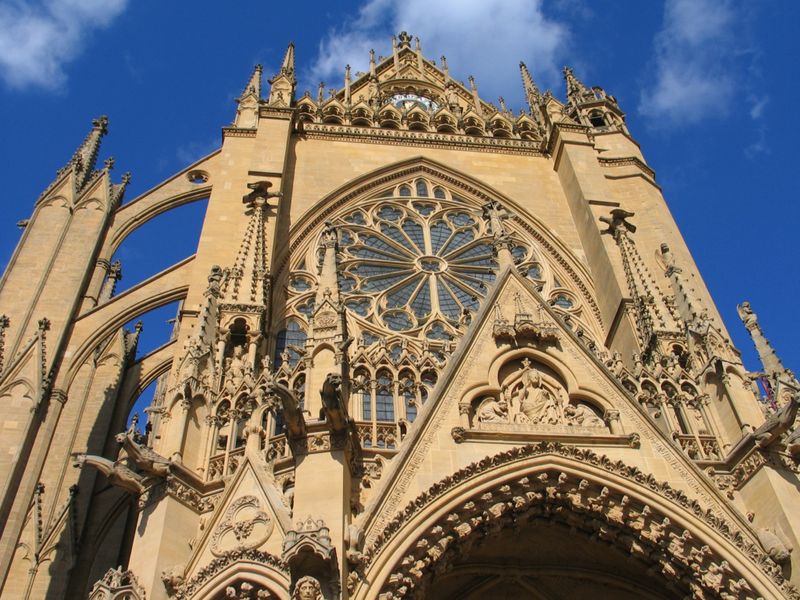
But looking at great cathedrals, I wonder if perhaps it might be the other way round – that God is mainly a pretext to make humanity create and experience a certain kind of beauty.


Metz Cathedral, nave

**

Hyacinth:

I like the phrase “ambushed by beauty.” I think also the way found objects send messages or enlighten us in ways we are so surprised by like the "Faith" ring you found at Twin Lakes.

We are ambushed often, though perhaps not often enough, by little things, by serendipitous occurrences. I wonder how many we even overlook and don't see at the time. When we do notice these occurrences, how uplifted our spirits are, how gifted we feel. I can't explain it, but I have experienced the little miracles once or twice and been  bowled over with astonishment and gratitude.

Oriana:

I am certainly open to the mystery of synchronicity. The objection to it is, Think of all the times there was no synchronicity. OK, it's not possible to think of all those times, because we simply don't remember them. So yes, these could definitely be mere chance events, but because we have a meaning-seeking brain, we receive synchronicities and other "little miracles" as a gift. And that's wonderful. Life is hard, and we need all the lifelines we can find.


In a different vein, in comments to the Dante post, I remarked that Milosz found it easier to pray in English, and wondered if it would be easier for me as well. I received a moving response from John Guzlowski.

John Guzlowski:

Praying in Polish?  I still remember my childhood Sundays, all the Poles praying out loud.  True prayer can only be prayed in Polish--there's a human raggedness and sincerity in it that I don't hear in English.  When people pray in Polish you hear their poverty, despair and hope.  Prayer in English?  It's what you see on TV--faces cleaned up and all the words stripped of their pain.

When my mother died, the funeral director found an old recording of a Little Wally, a Polka star big in Chicago in the old days, singing Serdeczna Matko.  It sounded like the first prayer spoken by the first man in a voice that didn't know what prayer was--the primal voice pleading for just a moment of understanding and doubting it would ever come.

My poem what my father believed had a stanza I cut about the way he prayed.  On his knees, even when he was an old man, who could barely raise himself to his feet.  And always out loud in Polish, out of a Polish prayer book.

Oriana:

This reminds me of how my Babcia prayed, on her knees even in old age, though usually not out loud. She had several ancient prayer books, with tissue-thin parchment in front of pictures. She also loved to sing religious hymns. In her youth, she sang in a church choir – the only outlet she had for her musical talent.

Serdeczna Mako can be translated as Loving Mother (in the vocative case – O Loving Mother).  Here is a Youtube link:


And here is a link to John Guzlowski’s superb poem, “What My Father Believed”

http://writersalmanac.publicradio.org/programs/2007/12/24/#friday

and his blog about his parents and their experiences in Nazi Germany, and related topics can be found at

http://lightning-and-ashes.blogspot.com/

Lucrezia:

Misread of the day: This tissue is strangely alive.


Oriana:

As long as our tissue is alive, let's live to the fullest.


By the way, I can't emphasize and repeat enough that I don't mean to be negative about Christianity. There is so much beauty in it, in all the old religions. Les Murray said that God is in the poetry that any religion manages to find/create. I've just ordered Honest to God, that classic of liberal Protestantism. When supernatural language is stripped away, there still remains the ideal of caritas, loving kindness toward others. Not that I want to do away with the stories of healing miracles, the Red Sea parting, and so on. These are still great stories, great literature from which we can cull insights.


THE SERPENT AS A SIREN

Lucas Cranach the Elder, The Garden of Paradise, 1530


I want to direct the viewer's attention to the upper left portion of the painting, where we see not just the angel expelling Adam and Eve from the Garden, but, to the right of that scene, the Tree of Knowledge and what is perhaps the most cute Serpent ever. Seretta Martin pointed out that this serpent looks like a mermaid. The word "mermaid" of course makes me think of a siren, in this case one with the face and upper body of Eve (a common tradition in the paintings of Garden of Eden). The serpent may not be singing a "siren song," but certainly has better lyrics than the Homeric sirens. 

Note the disembodied head of God in a wreath of clouds, seeing Adam and Eve trying to hide in the bushes now that they've eaten the Forbidden Fruit realize they are naked. Note also the graceful unicorn and the sexy lion. 

"Knowledge" is a left-hemisphere activity. If Jill Taylor is right, then the loss of Eden meant giving dominance to the left hemisphere. Dr. Taylor thinks the right hemisphere is the seat of bliss. In her book, The Stroke of Insight, she counsels "Step to the right" -- into right hemisphere activities -- whenever we are tormented by overthinking. 

Here are two poems from Linda Pastan’s sequence, “The Imperfect Paradise”

Seasonal

Which season is the loveliest of all?
Without a pause you smile and answer spring,
Thinking of Eden long before the fall.
I see green shrouds enclosing everything
And choose instead the chaos of the snow
Before God separated dark from light.
I hear the particles of matter blow
Through wintry landscapes on a wintry night.
You find the world a warm and charming place,
My Adam, you name everything in sight.
I find a garden of conspicuous waste –
The apple’s flesh is cold and hard and white.
Still, at your touch my house warms to the eaves
As autumn torches all the fragile leaves.


Somewhere in the Euphrates

Somewhere in the Euphrates, buried, lost
The rusted gates of Eden still remain,
And archeologists at awful cost
Search for a snakeskin or an apple stain,
Talk of Atlantis and the walls of Troy
As if they had to prove each legend real
Or else, like fools of science, must destroy
Geographies of what we only feel.
While sometime watching at the window here
I see you in the garden on your knees;
It is as close as you have come to prayer,
Planting the shadblow and the peonies,
Making azaleas, hollies, dogwoods grow,
Digging up Eden with a single hoe.

 ~ Linda Pastan, from The Imperfect Paradise

**