skip to main |
skip to sidebar

OLD MAN LEAVES PARTY
It was clear when I left the party
That though I was over eighty I still had
A beautiful body. The moon shone down as it will
On moments of deep introspection. The wind held its breath.
And look, somebody left a mirror leaning against a tree.
Making sure that I was alone, I took off my shirt.
The flowers of bear grass nodded their moonwashed heads.
I took off my pants and the magpies circled the redwoods.
Down in the valley the creaking river was flowing once more.
How strange that I should stand in the wilds alone with my body.
I know what you are thinking. I was like you once. But now
With so much before me, so many emerald trees, and
Weed-whitened fields, mountains and lakes, how could I not
Be only myself, this dream of flesh, from moment to moment?
~ Mark Strand, “Blizzard of One”
I found this poem among my recycled sheets of paper, and I was totally stunned. Not the kind of poem you read every day and then forget, so how could I have forgotten it? Ah, memory, if only you were a more intelligent resource . . . And another thought joins in: perhaps when I first read the poem, I was too young to really understand it.
At the literal level, the poem is astonishing enough, though it could be dismissed as not especially credible — surreal even. There’s a mirror somebody left leaning against a tree? And the octogenarian speaker, reflecting that he still had a beautiful body, simply begins to strip in the moonlight, to the applause of nature? Hmmm, we could say, perhaps some old people really are that eccentric.
Of course the poem needs to be read symbolically. It is an astonishing poem, as poems about old age go. It is not an elegy, not a meditation on diminishment and dying. I think it outdoes any of Jack Gilbert’s poems on the subject, though Gilbert also takes a very affirmative stance toward aging. The title is very much what we might expect from Gilbert, except that Gilbert would continue in the third person. But this poem is much more startling as the first-person confession. For the sake of authenticity and intimacy, it has to be in the first person. The speaker needs to make us believe him.
Just the title, “Old Man Leaves Party,” can have multiple meanings. But first, let’s note the omission of articles: it’s not “An Old Man Leaves the Party.” The terseness of “Old Man Leaves Party” suggests a newspaper headline, like “Man Shoots Family, Self” — men do those things, such a headline suggests. It’s not a special old man who leaves a special party. It’s everyman. Leaving the party is the human condition.

OK, let’s discuss the party. It can be a literal party, maybe in honor of the speaker’s most recent prize (and Strand has certainly had a few). But then there is always that memory of a party that we had to leave as children just because it was bedtime. But now, over the age of eighty, that big party is life itself. Others are still having a good time, but for a few guests it’s already time to leave. Or the “party” could mean the active part of life, when the future tense still made sense. One could argue that we become posthumous even before the ultimate leave-taking.
Now, Mark Strand (1934 -2014) really was quite a handsome man, even in his seventies (he didn’t live past eighty, alas). Not even Robert Pinsky was as handsome as Strand managed to be at any age (oh well, perhaps equally handsome; we don’t have to choose, though I'm somewhat pleased at the fantasy of a male poet beauty contest). As if his many prizes and jobs at prestigious universities were not enough, Strand was tall and had good hair. But let’s not be literal. The point is that the human body is endlessly interesting. We never tire of looking at paintings of nudes, though we’ve seen thousands of such paintings. The human body is a marvel, for all the sagging, brown spots, and other signs of aging. I keep thinking of a white-haired old Chinese woman painter I met in Vermont. She was so beautiful I couldn’t stop staring at her.
But let’s linger a bit on that shocking beginning:
It was clear when I left the party
That though I was over eighty I still had
A beautiful body.
In our much-bewailed “culture of youth,” the statement “I still had a beautiful body” is indeed shocking. The speaker is totally self-accepting. Perhaps the word “narcissistic” comes to mind, but is that not a culturally conditioned judgment? How dare he perceive himself as beautiful in old age? How dare he not apologize for being old, stating he’s no longer handsome, strong, sexy? Yet there it is: he finds his body beautiful. He doesn’t just accept his body; he celebrates it.
There is also an inescapable symbolism of taking off one’s clothes. Just as a party is a contrived social situation, so the clothes are a mask. They conceal. The old man is naked now, authentic, completely himself.
And nature approves. As is typical in poetry, the speaker projects his own mental state on nature. Thus, “the wind held its breath.” And when the speaker takes off his shirt, the flowers of bear grass nod with seeming approval (“moonwashed heads” is lovely). When the pants come off, magpies circle the redwoods — never mind that it’s night time. Even more dramatically, the previously frozen or half-frozen river is flowing once more!
It is a winter night — need we talk about symbolism? Yet as the man admires his own beautiful body, entirely without lamentations about aging, birds begin flying and the “creaking” river starts flowing.
If you’re thinking, “What??” the speaker has anticipated that too. He assumes you, the reader, are younger and know nothing about what it’s like to be in the last years of life — “I was like you once.”
And here comes the most marvelous and affirmative part of the poem:
. . . But now
With so much before me, so many emerald trees, and
Weed-whitened fields, mountains and lakes, how could I not
Be only myself, this dream of flesh, from moment to moment?
This is perhaps the best “comfort poem” I’ve come across. The speaker, though at the end of his life, does not feel old and pathetic, inadequate, fit only for dying. Again he startled us by saying he has “so much before me.” He doesn’t have much time, but he has a wealth of moments, and the beauty of nature to take in. He feels rich beyond compare.
Ambition is over; one more prize doesn’t mean anything. Simply existing is transcendent.
I will not babble about the power of now and living in the moment. Strand’s final lines are exquisite. It’s amazing that one needs to be past a certain age — past ambition — to be able to
Be only myself, this dream of flesh, from moment to moment

**
There is another Strand poem that I love. It’s interesting that Strand started out “on the dark side: — even the title of his early volume, the one that made him famous, announces it: “Darker.” It’s not his best volume. Strand become better the older and less trendy he grew, the more delighted with simply being alive, the joy of having a body, of being, in a way, the same boy that his mother used to kiss, her love never erased by time. I don’t know if any other poet wrote with greater affirmation about aging, though Jack Gilbert comes close.
THE COMING OF LIGHT
Even this late it happens:
the coming of love, the coming of light.
You wake and the candles are lit as if by themselves,
stars gather, dreams pour into your pillows,
sending up warm bouquets of air.
Even this late the bones of the body shine
and tomorrow’s dust flares into breath.
~ Mark Strand

All this year I’ve dealt with the dust of many yesterdays — which also made me aware that today’s wonders will also be dust in the infinity of tomorrows. As for the coming of love, there is nothing like love late in life: drop everything and dance that last dance.
Addendum, 1-5-2016
Cats know they need no self-improvement. And talk about "this dream of flesh, from moment to moment" . . .
H
OMELAND
Twenty years later I’m told I am foreign.
How naïve to have thought
I’d grow out of it. As if I could erase
my Columbus Day:
in the morning
I had a homeland;
in the evening
I had two suitcases.
Twenty years later under desert sky,
I remember the stencil
of drizzle in Warsaw.
On the sill of our old kitchen,
pigeons ruffle like small gray clouds.
My uncle and my father
raise a toast with żubróvka,
the buffalo vodka, the bottle lit
with a blade of buffalo grass.
I ought to remember
in more vivid color,
but I was carelessly young.
I tried so hard: changed my name,
ate only with my right hand —
eager to throw away extra vowels
and hands. Twenty years later
men still want me to touch them
in French, slide toward them
on slow Slavic looks:
“You know how to treat a man —
you’re from the Old World.”
I must be centuries old —
I am river and rain.
And the half-remembered
Warsaw park, a chapel of green dusk;
through a fence of shadows
I call after the long lost child.
Yet my homeland is not lilac
gardens, nor childhood’s palaces
of clouds — my true
homeland is the undefeated
republic of the mind.
Among statues in a museum,
no one says, as I used to,
“Excuse me, I’m foreign.”
No one is foreign.
~ Oriana © 2015
Yes, I'm willing to state it plainly: my true homeland is the republic of the mind, the world of ideas, of art, music, and literature. And yet, and yet . . . there is a power of the first landscape we came to know: it’s those trees that become the “real trees.” Palm trees and eucalypts can never their place — those are not “real trees.” There is supposed to be a river in the middle of the city, and lush parks and statues, and schools named after great writers, not generals. Not that this is objectively better; only normative; it’s what you grow up with that becomes your matrix, your model for what the world is supposed to be. There is no healing of that incongruency. If it’s May or June, then where are the lilacs?

THE HAPPY CHEMICALS OF LOVE
I especially liked the part about oxytocin, which has been dubbed the “love hormone.” So, both watching sports and participating in religious rituals releases oxytocin . . . Soccer instead of mass (especially now that the beautiful Latin liturgy is gone)? It’s happening.
And no wonder I love holding hands so much . . . No wonder many women say that holding hands is more important than having sex. And even a handshake cause a small release of oxytocin. Call it the “magic of touch.” Oxytocin is also the reason we adore petting dogs and cats so much.
Falling in love has been called dopamine addiction. I find that now there is more general interest in feel-good long-term relationships, and that’s where oxytocin becomes the most important neurochemical.
“Love triggers dopamine, serotonin, and oxytocin. That's why it's so motivating. But happy chemicals come in spurts. They do their job by turning off after they turn on. When your happy chemicals dip, you might interpret it as a loss of love. That turns a natural fluctuation into a crisis. You are better off knowing why love makes happy chemicals go up and down.
DOPAMINE brings about that great feeling you get when you find your missing keys. It's the neurochemical that evolved for seeking and finding. Animals sniff around for food and mating opportunities, and when they find something that meets their needs, dopamine surges. But the surge is brief. Dopamine does its job by dropping after it rises, so it'll ready to alert you to the next chance to meet your needs—and so you'll be sure to pay attention.
When you find your keys, you don't expect that great dopamine feeling to last. But when you find "the one," your body may produce so much dopamine that you assume you'll soar forever. When it finally subsides, you wonder what's wrong. You might even blame "the one" for having changed.
OXYTOCIN is the neurochemical that causes trust. It's released during orgasm, and in smaller amounts when you hold hands. In animals, it's released when mothers lick their babies. Oxytocin is the good feeling of a common cause, whether a political rally, a football huddle, or thieves with a plan.
Reptiles release oxytocin during sex, but mammals produce it all the time. That's why reptiles stay away from other reptiles except when mating, while mammals form long-term attachments to relatives and herds. The more oxytocin you release when you're with a person, the more attached you'll feel. More touch = more oxytocin = more trust.
Getting respect feels good because it stimulates SEROTONIN. In the animal world, social dominance brings more mating opportunity—and more surviving offspring.
Your brain always wants more respect to generate more serotonin. Your loved one may give you that feeling at first, by respecting you or helping you feel respected by others. But eventually your brain begins to take the respect you already have for granted. It wants more, so it can get more good feelings. That's why some people constantly make more demands on their loved ones, and why others constantly seek out higher-status partners.
Happy chemicals give us information that's hard to interpret. For example, if I watch a football game and burst with excitement when my team scores, I see thousands of others share my reaction. It feels like they understand me. Why doesn't my partner understand me when thousands of others do? The answer is simple. SPECTATOR SPORTS TRIGGER OXYTOCIN, AS DO POLITICS, RELIGION, AND OTHER GROUP ACTIVITIES. You get a good feeling of trust. Of course, trusting a large number of people in a limited way is not the same as trusting one person in a comprehensive way. But to your mammal brain, it's all the same oxytocin.
We want all the happy chemicals we can get. You expect some from romance, and some from other aspects of life. But no matter where you get them, happy chemicals sag after they spurt. When you know why, you can manage your behavior despite the confusing neurochemical signals.
There's good news here. Don't blame yourself or your partner if you're not high on a happy chemicals all the time. Maybe nothing is wrong. You are just living with the operating system that has kept mammals alive for millions of years.”
https://www.psychologytoday.com/blog/your-neurochemical-self/201203/why-love-is-roller-coaster

MORE ON OXYTOCIN
http://io9.com/5925206/10-reasons-why-oxytocin-is-the-most-amazing-molecule-in-the-world
 Caveat: the effects of externally administered oxytocin seem to vary according to how close we were to our parents. Adults who were harshly disciplined as children typically have relationship problems, and their oxytocin system may not be as reliable. Fortunately, change to the oxytocin system is possible, and may be as simple as getting a dog (an affectionate breed, that is).
ATLANTIS
We’re wreathed in robes of seaweed,
air bladders’ amber beads,
the hood of water
over the face of things.
Fish weave in rainbow veils.
Kelp sways like soundless bells.
we cannot tell one day
from a thousand years.
Here are our amulets, good-luck
crystals, diadems and crowns.
Here tilts the headless
statue of our god,
Lord of Mercy in whose name
we killed. Mudworm burrows
in palaces of our rare marble.
Our purses fill up with silt.
We remember pine forests,
resin scent of the wind.
We remember having held
someone’s hand.
This glitter on the waves
like bent echoes,
those are our last words:
Hold hands. Hold hands.
~ Oriana © 2015
 Minoan town, a Bronze Age fresco from Akrotiri
MILOSZ: HOW AND WHEN GOD CAME TO BE SEEN AS CRUEL
In one of his essays, Milosz says that “if, from one generation to the next, there is an increase in the purely human need for justice and order,” then human perception of god changes. “God changed into a malevolent, cruel demiurge, the tyrant Zeus, the tyrant Jehovah, because he was the god of nature, which contradicts and dissatisfies us; many people have opposed that god with a divine hero, a leader of men, namely, the rebel Prometheus, Lucifer (who often had the face of Christ), as did the Romantic poets. (Blake famously said, “The reason Milton wrote in fetters when he wrote of Angels & God, and at liberty when of Devils & Hell, is because he was a true Poet and of the Devil's party without knowing it.” The literary critic William Empson argued that "Milton deserves credit for making God wicked, since the God of Christianity is a wicked God.")
(my paraphrase:) It seems to me that if Milton had to strive at epic length to “justify God’s ways to man,” he must have felt that such justification was needed; he spared no effort trying to rationalize what must have begun to be perceived as god’s cruelty. The twisted logic of “felix culpa” that created the need for a “bloody ransom” also required complicated theological maneuvers.
But it wasn’t just the Romantics who had problems with the unpleasant character of Yahveh. To the Marxists, “the market [was] an extension of the struggle for existence and nature’s cruelty . . . The enemies of revolution loved to appear as the defenders of a religion threatened by atheists, while those atheists hated them as the priests of an inferior god, Zeus, Jehovah, otherwise known as the Devil.”
The Marxists advocated an economy based on cooperation, not competition. Milosz saw the opposing movement as “Americanization” -- a brilliant insight, I think, that goes beyond the outmoded duality of capitalism and communism. He also pointed out that certain intellectuals take perverse delight in visions of catastrophe and apocalypse. In my observation, it’s mainly Christian fundamentalists who are very big on apocalypse, and here again we see torture porn in the form of vividly imagined “tribulations.”
The Romantics’ sympathies with revolutionary movements, and Romanticism as part of the larger rebellion against the cruel god so vividly portrayed by Milton who was trying to “justify” him -- much material for thought there. (Milosz, Selected Essays, pp. 235-245.)
Oriana: I think that as the West continues to progress in ethical thinking, god will be seen as more and more cruel. Some have observed that Christianity should have dropped the Old Testament and made Jesus the only god, more plausibly merciful. And perhaps it's not too late, given the daring theological maneuvers in new definitions of heaven and hell proclaimed by JP2.
Culture and the concept of god: cruel men invent a cruel god, and then the cruel god makes men cruel — a vicious circle. Robert Wright wrote a fascinating book, The Evolution of God. The stress of hard times correlates with cruel deities; as life gets easier, god “mellows.” The higher the standard of living, including the social safety net, the less emphasis on hell, usually, until progressive denominations approach the hell-free status. As the need for revenge and punishment diminish, and our understanding of evil becomes more psychological and we view the perpetrators not as sinners but as emotionally damaged human beings in need of healing, not more cruelty dealt out to them, hell as pointless eternal torment becomes repugnant.
But can Christianity survive without hell, and thus no obvious need for salvation? Can the cruelty of the crucifixion remain its basis? It will be interesting to see.
For a fascinating essay about Christianity and the concept of eternal torture, see
http://www.patheos.com/blogs/godlessindixie/2014/10/07/absolving-god-from-hell-2/

(By the way, “Godless in Dixie” is one of the best blogs out there.)
ATHENS AND JERUSALEM MUST BE RECONCILED OR JERUSALEM WILL FALL OFF THE MAP. ~ Robert Wright
“What has Athens to do with Jerusalem?" asked the Christian theologian Tertullian . . . Having received the revealed truth via Christ, “we want no curious disputation.” Well that was then. Today science is so powerful that theologians can’t casually dismiss secular knowledge. Athens and Jerusalem must be reconciled or Jerusalem will fall off the map. ~ Robert Wright, The Evolution of God
That’s why the more enlightened religious leaders such as Pope Francis say it’s OK to believe in evolution. The worst possible mistake they could make is threaten excommunication if you believe in evolution, thus losing what educated followers they still have.

PLATO VERSUS ARISTOTLE IN WESTERN HISTORY
One of the most provocative books I’ve read is Arthur Herman’s The Cave and the Light, which presents the entire history of the West in terms of the competing ideas of Plato or Aristotle.
Plato gave us the myth of the cave (Book VII of The Republic). It encourages man to find a path out of the darkness of the cave of material existence, of being “merely human,” into the light of pure “ideas,” everlasting and changeless. Aristotle, the pragmatist, wants us to explore the world — which is not a dark cave, but is magnificent. Reality is “multiform and constantly evolving.”
Aristotle gave us “the US constitution, the Manhattan Project, and shopping malls. Plato gave us “the Chartres Cathedral, but also the gulag and the Holocaust.”
But the great cathedrals were not built because of religion alone; they were great feats of architectural engineering. So the easiest criticism of Herman’s book is that everywhere we see the fusion of both the Platonic and Aristotelian approach. He doesn’t deny it — in fact he instantly acknowledges this fruitful interaction. But he still wants to trace the two currents.
My instant reaction: the dark cave is religion, the recitation of invariant scriptures that are increasingly out of touch with the modern world; an insistence on blind obedience to doctrine in spite of lack of evidence, and denial of free debate. Science and rationality are the light — the candle in the dark. I don’t deny that this is a simplified picture: nothing is all good or all bad. Or almost nothing.
The phrase “merely human” has been a disaster, exemplifying religion’s contempt for humanity. We need to see the word “human” as the highest praise. Part of the meaning of life is to become more fully human.

LEONARDO DISCOVERED THE ROTATIONAL MOVEMENT OF THE HEART
During his investigations, Leonardo discovered several extraordinary things about the heart. “Up until and after his time, because of course he never published, the heart was believed to be a two-chambered structure,” Wells explains. “But Leonardo firmly stated that the heart has four chambers. Moreover, he discovered that the atria or filling chambers contract together while the pumping chambers or ventricles are relaxing, and vice versa.”
In addition, Leonardo observed the heart’s rotational movement.“If you look at a heart, it is cone-shaped,” says Wells. “But it’s a complex cone in a geometric sense, because it’s a cone with a twist. This is because the heart empties itself with a twisting motion – it wrings itself out, a bit like the wringing out of a towel. In heart failure it loses this twist.”
http://www.bbc.com/culture/story/20130828-leonardo-da-vinci-the-anatomist

ALCOHOL, HEART, ARTHRITIS
“In 1986, researchers surveyed a group of more than 50,000 male doctors in the US about their drinking and eating habits, their medical history and state of health over two years. They found that the more alcohol the doctors reported drinking, the lower their chance of developing coronary artery disease, despite their dietary habits.
Another large study published in 2000, also in male doctors, found a ‘U’ shaped relationship between moderate alcohol consumption and – in this case – death, rather than coronary artery disease. Subjects who drank one standard drink a day were less likely to die within the 5.5-year-long study than those who drank less than one a week, or those who drank more than one a day.
This suggested there was a ‘sweet spot’ for alcohol consumption; a healthy middle ground between too little or too much, where the benefit for cardiovascular health balanced the risk of death from all causes.
In 2005, yet another study in medical professionals – this time 32,000 women and 18,000 men – attempted to answer this question by looking at how their drinking habits affected not only their risk of heart attack, but also their physiology.
The people who drank one to two glasses of alcohol, three to four times a week, had a lower risk of heart attack, which the researchers hypothesized could be due to beneficial effects of alcohol on HDL cholesterol – the so-called ‘good’ cholesterol – as well as haemoglobin A1c (a marker of diabetes risk) and fibrinogen, an agent that helps the blood to clot. These three factors all play an important role in ‘metabolic syndrome’; the cluster of abnormalities that often heralds cardiovascular disease and diabetes. Other studies have found hints that alcohol might alter the balance of these factors for the better, which pointed to a possible mechanism by which alcohol in moderation could improve health.”
But later findings took a closer look at “tee-totalers,” and discovered that it was ex-drinkers who were the unhealthy ones; those who had always abstained for religious reasons, for instance, showed no increased risk of heart disease. So we are still not entirely sure about the benefits of alcohol. But this much has been confirmed
1. alcohol increases HDL, the protective cholesterol
2. alcohol decreases platelet aggregation, lowering the risk of clots
3. alcohol may have anti-inflammatory effects, as shown by reduced levels of inflammatory markers, and the benefits of light drinking for people with rheumatoid arthritis.
Since all arthritis is an inflammatory disease, and since alcohol tends to suppress the immune system, this makes sense.
And this last point brings us to this article:
“X-rays showed there was less damage to their joints, blood tests showed lower levels of inflammation, and there was less joint pain, swelling and disability in those patients [who drank frequently rather than infrequently or never], the researchers found.
Previous studies have shown that alcohol may reduce the risk of developing the disease in the first place.
Similarly, in the current study non-drinkers were four times more likely to develop RA than people who drank alcohol on more than 10 days a month.”
http://www.bbc.com/news/health-10776758

A (very) moderate intake of alcohol has also been found to lower the risk of osteoporosis and Alzheimer’s Disease. Is it really true that half a glass of wine a day can extend your life by five years? Future research may finally yield the answer. Of course dose is extremely important, since past a certain level, the toxicity of alcohol overwhelms its benefits.
**
THIS WOULD BE THE PRICE OF IMMORTALITY
From Alan Lightman's intricate 1993 novel Einstein's Dreams:
With infinite life comes an infinite list of relatives. Grandparents never die, nor do great-grandparents, great aunts…and so on, back through the generations, all alive and offering advice. Sons never escape from the shadows of their fathers. Nor do daughters of their mothers. No one ever comes into his own…Such is the cost of immortality. No person is whole. No person is free.
Dali design for a set curtains for Bacchanale, 1939
THE THIRD LANGUAGE
In high school I kept
a diary in English,
so if the teacher
caught me, and she did,
she wouldn’t understand.
I had a small vocabulary
and even less to say.
“The weather is getting warm,”
I confessed in a foreign language.
My first class in Los Angeles,
on June evenings,
in the palm-plumed dusk,
was a typing course.
For rhythm, the instructor played
“The Yellow Rose of Texas”
above the cross-fire
of night students pounding
on the jamming keys.
i machined a sinister idiom:
Dear Sir: Due to circumstances
beyond our control —
College was a subordinate clause.
I bartered my youth
for footnotes to Plato.
I was a mouse in the auditorium,
scribbling neat, useless notes.
One time I graded three hundred
freshman papers on the death penalty.
I didn’t want to graduate.
Life was penalty enough.
To survive I had to learn
a third language,
an on-off code in the brain
it takes nightmares to crack:
words husked from the grain of things,
Adamic names that fit
animals like their own pelts —
fluent as flowers,
rare as rubies,
occult atoms in lattice of sleep.
To be silent and let it speak.
~ Oriana © 2015
*
 Castle, lower Silesia
HISTORY, CULTURE
ARMAND HAMMER ON LENIN, FDR
The similarity between the US and Russia
Oriana: Soon after I arrived, the US seemed to me like the propaganda image of the Soviet Union in fancy magazines like Soviet Life, meant for foreign readers — a paradise of prosperity and pre-hippie wholesomeness — except more Orwellian (advertising being more sophisticated and scientifically tested than political propaganda).
T
he prosperity was a surface, I discovered almost immediately — though it was a large surface, endless square miles of suburbia — not a propaganda image, as with the Soviet glossie. What astonished me, though, was that Americans thought theirs was a classless society, while in every city and town the first thing I’d see was “good neighborhoods” and “bad neighborhoods”: the quiet tree-lined lanes and well-kept lawns, and half a mile away, black-walled liquor stores and rusty old cars, stained old mattresses rotting away in the weedy yards. That was beyond any poverty I witnessed in Poland. This kind was sinister, malignant, without hollyhocks and sunflowers planted in front of the humble windows.
Populism was like “proletariat” to the square power. The cowboy instead of Europe's aristocratic ideal, and the "new Soviet man." The cult of the pioneer. Dostoyevski thought that Russia's destiny lay in Asia, the East/Siberia being like the American West. Lenin, Trotsky, Stalin — they all actually had a lot of admiration for the US as a role model. They wanted to be like the US, to match its development, its conquest of the vacant continent.
Lenin

It’s odd that in spite of the official worship of Lenin -- at least given the abundance of portraits on the walls and carried in parades -- in school we were never told that he was warm and charming. And that's a repeated theme not only in Hammer's account: the warm smile, the jovial handshake, his ability to charm anyone, a peasant or an intellectual, have been noted by others as well, including H.G. Wells.
Hammer: “Lenin rose from his desk and came to meet us at the door. He was smaller than I had expected — a stocky little man about five feet three, with a large, dome-shaped head and auburn beard, wearing a dark gray sack suit, white soft collar and black tie. His eyes twinkled with friendly warmth as he shook hands and led me to a leather-cushioned chair beside his big flat desk. We sat so close that our knees almost touched.
The room was very small and unpretentious, full of books, magazines and newspapers in half a dozen languages. . . .
During the hour or more our conversation lasted, I was completely absorbed by Lenin’s personality. His powers of concentration were enormous. When he talked to you, he made you feel you were the most important person in his life. He had a way of holding his face close to yours, his left eye squinting but his right eye transfixing you as if it were trying to pierce your innermost soul. By the time we were through, I felt embraced, enveloped, as if I could trust him completely.
. . . Our two countries, the United States and Russia, Lenin explained, were complementary. Russia was a backward land with enormous treasures in the form of undeveloped resources. The United States could find here raw materials and a market for machines, and later for manufactured goods. Above all, Russian needed American technology and methods, American machines, engineers and instructors. Lenin picked up a copy of Scientific American.
“Look here,” he said, running rapidly through the pages, “this is what your people have done. This is what progress means: buildings, inventions, machines, development of mechanical aids to human hands. Russia today is like your country was during the pioneer stage. We need the knowledge and spirit that has made America what she is today.”
[they proceed to discuss a trade exchange between Russia and the West]
“In looking back over the years at this memorable interview, I have tried my hardest to recollect the most striking feature of it all. I think it is this — that before entering Lenin’s room I had been so greatly impressed by the terrific veneration which he aroused among his followers that I somehow expected to meet a superman, a strange and terrible figure, aloof and distant from mankind.
Instead it was just the opposite. To talk with Lenin was like talking with a trusted friend, a friend who understood. His infectious smile and colloquial speech, his sincerity and natural ways, put me completely at ease.
Lenin had been called ruthless and fanatical, cruel and cold. I refuse to believe it. It was his intense human sympathy, his warm personal magnetism and utter lack of self-assertion or self-interest, that made him great and enabled him successfully to hold together and produce the best from the strong and conflicting wills of his associates.”

Hammer on FDR:
“Nobody could equal the speed of his mind, the warmth of his character and the charm of his personality. Add to this an unmatched capacity for decisive executive action. FDR was the consummate “can-do” president.
I am often asked to compare Lenin with FDR. They shared many qualities — not the least of which was that they were both approachable, unintimidating men who did not stand for a moment on the dignity of their office. In the presence of both men I felt the same captivating excitement and the same alertness. No half-baked idea, no vagueness could be risked with either man: they would spot in a flash and dismiss it.
Both had a strong sense of humor, though Lenin did not laugh as much as FDR, who loved nothing more than a joke and who was always on the lookout for the ridiculous and the absurd; but then Lenin did not have much to laugh about. The condition of the Soviet Union and the colossal strains of his work did not leave much room for humor.
Like FDR, Lenin was capable of dazzling intellectual flexibility. People I meet today, especially journalists who interview me, are astonished to hear that Lenin told me, in effect, that Communism was not working and that the Revolution needed American capital and technical aid.
The world has largely forgotten how deeply the Bolsheviks admired the industrial achievements of America and how common it was to hear them say that they wanted to make Russia a “socialist United States.” Lenin was greatly responsible for promoting this attitude, and it is not appreciated how pragmatic and realistic was the cast of his mind. Perhaps I can best convey this by saying that my own father — who in many ways typified the idealistic Communist sympathizer of those times — was far more romantic in his socialism than Lenin. It remains one of the ironies of my life that I found the father of world Communism to be less pure as a Communist and more pragmatic than my own father. (pp. 119-120, “Hammer”)

**
The murderer kills because he seeks “justice." ~ Steven Pinker (in a lecture on the culture of honor versus the culture of dignity)
Humans are moralizing animals, with a curious need to pass judgment on others and see that they get punished. Pinker studied the causes of violence, including the most common motive for homicide. According to police records, it’s not material gain; it’s “justice.” The killer is carrying out capital punishment; his victim deserves to die for this or that reason. Likewise, wars tend to be justified using the language of moral principles. Pinker suggests we need to think of morality less in terms of blame and punishment, but in terms of minimizing harm and maximizing flourishing.
It seems to me that when progressives speak of justice, it’s likely to mean human rights, equal opportunity, equal pay, etc. When conservatives speak of justice, they mean punishment, vengeance. It’s not an absolute difference, but a tendency.
RELIGION/ATHEISM
WHAT? THERE WAS NO RELEASE OF BARABBAS?
“The story of Barabbas the criminal, whom Pilate offers to kill instead of Jesus, is predicated on the supposed Jewish custom of releasing a prisoner at Passover . . . BUT THERE WAS NO SUCH JEWISH CUSTOM. In fact, it flies in the face of deeply held Jewish (and, for that matter, Roman) beliefs about justice.” ~ Joel M. Hoffman, The Bible’s Cutting Room Floor, 2014

JOSEPHUS AND THE FORGED PASSAGE
“Though we expect to find copying mistakes and other variations in our current versions of Josephus’s writings, we don’t in general suspect that the message of his texts was purposely altered in any significant way, except concerning the pivotal Jesus, James, and John the Baptist. And here nearly ever conceivable position has been proposed by scholars, including that Josephus didn’t mention any of these people, but later Christians added texts about them; that Josephus converted to Christianity, but his texts were changed to hide his belief in Jesus Christ; and that we have nearly perfect copies of what Josephus wrote.
What we can do is work from the preponderance of the scholarly evidence. Fortunately, that points us in a relatively clear direction. The passages about James and John are mostly authentic. The passage about Jesus is not. . . . No one seems to have been aware of this particular passage until the fourth century.” ~ Joel Hoffman, The Bible’s Cutting Room Floor

God is dead; but given the way of men, there may still be caves for thousands of years in which his shadow will be shown. — And we — we still have to vanquish his shadow, too. ~ Nietzsche, The Gay Science
W
HY I DON’T CALL MYSELF AN AGNOSTIC
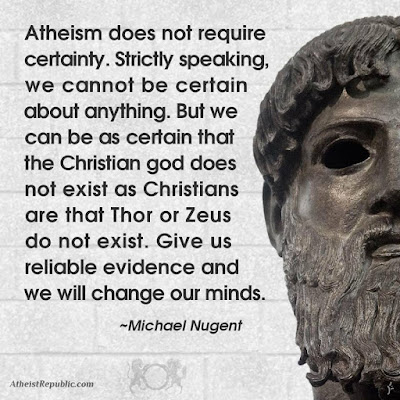 Like billions of other poeple, I don't believe in the existence of Zeus. That's why I don't call myself an agnostic. If you can be sure that Zeus doesn't exist, you can be sure that the Christian god doesn't exist. Basically that was the moment of insight that made me an atheist at 14. That was it: I understood that Christianity was just another mythology.
But my atheism also a very deep intuitive response. The emotional certainty is really primary, since intellectually I could at least weakly defend agnosticism. The emotional certainty hit me first in connection with the absence of the afterlife, because who wouldn't want some kind of afterlife to exist? And I do understand the longing for a "real god." One who would be a companion, who'd understand and guide without judging, like an ideal friend. But there is not even a definition of "it" (I think the pronoun for a "real god" would have to be "it"), much less evidence.
In practical terms, atheism in the West comes down to not believing in the Christian god any more than in Zeus. Mythology is mythology -- a fascinating field of study, by the way. In my teens, when I developed an interest in classical mythology, I had no idea where it would lead . . .
SCIENCE/PSYCHOLOGY
CHANGE IN SKULL SHAPE CORRELATES WITH HUMAN ‘CULTURAL EXPLOSION’
About 50,000 years ago, homo sapiens developed the capacities for “innovation, planning depth, and abstract and symbolic thought,” as a study published in Current Anthropology puts it. Until recently, not much was known about why our species veered toward more sophisticated sensibilities.
A group of anthropologists and biologists at Duke University had a theory: It’s because our skulls changed shape. This would have led to, as their study argues, a “change in average human temperament toward a less aggressive, more socially tolerant individual.”
To test their hypothesis, the team measured more than 1,400 skulls—1,367 modern ones from 30 ethnicities; 41 from between 10,000 and 38,000 years ago; and 13 ancient ones from more than 80,000 years ago—paying special attention to the brow ridge, face shape, and endocranial volume. “The study was motivated,” the researchers say, “by us trying to find a biological explanation—with evidence—of what could explain the huge explosion of culture around 50,000 years ago.”
After taking stock of their painstaking measurements, the researchers were surprised by how well their data supported their hypothesis. They found that there had indeed been a structural change in the human cranium—specifically, our brow ridges shrunk and the upper parts of our faces got shorter. It happened in the late Pleistocene era, and the shift indicated a lowered level of testosterone acting on the skeleton. This “feminization” of our heads made us less violent and more genteel.
The researchers think that sexual selection could have been what feminized our skulls.
http://www.psmag.com/nature-and-technology/homo-sapiens-changed-head-shape-changed-everything-88477

THE SECRET TO HAPPINESS AND COMPASSION: LOW EXPECTATIONS
“A new MRI study and University College of London indicates that the secret to happiness is low expectations. Author and neuroscientist Robb Rutledge says, “Happiness depends not on how well things are going but whether things are going better or worse than expected.”
This rings very true in my experience. I once expected to make it big, and when I didn’t, I eventually got over that expectation, and have been much happier ever since. Every little success these days is a surprise and delight.
Like happiness, compassion is always in part a function of lowered expectations. We’re happier to accept other people’s difficult behaviors when we expect less from them.
It’s all about managing the “aspirational gap,” the gap between what is and what could be, what you have and what you expect. It’s all about expectation management.
https://www.psychologytoday.com/blog/ambigamy/201408/the-secret-happiness-and-compassion-low-expectations
As my sole comment on this, let me repeat the second paragraph:
“This rings very true in my experience. I once expected to make it big [Oriana: in my case, gain a national recognition as a poet], and when I didn’t, I eventually got over that expectation, and have been much happier ever since. Every little success these days is a surprise and delight.”
And I’d add: THINK SMALL. Do less, and do it slowly, easily. Take small steps. Lie down.

HEALTH
BENEFITS OF XYLITOL, THE ALKALIZING SWEETENER
I’ve been using Xylitol for two years now. Aside from plain dextrose with its nice quick energy boost to the brain, Xylitol is my favorite sweetener. The only caveat: as with everything, MODERATION.
1. XYLITOL HAS ONLY A NEGLIGIBLE IMPACT ON BLOOD SUGAR AND INSULIN LEVELS. This means that unlike sugar, there are no highs and lows: no roller coaster for either your energy or your mood, and no subsequent cravings for more sweets and carbohydrates. No adrenal fatigue, no weight gain, no increase in cortisol levels. In fact, xylitol can help keep you hormonally balanced through its insulin stabilization factors. And as I learned in my training with endocrinologist Dr. Diana Schwarzbein, healthy insulin response is essential to healthy aging and healthy hormones, as well as effecting cholesterol levels, incidence of Type II Diabetes, high blood pressure, and much more.
2. Tooth & Gum Health XYLITOL ALKALINIZES THE MOUTH. It not only reduces bacterial growth but actually inhibits and interferes with development of plaque, and bad bacterial strains such as strep. The Journal of the American Dental Association said “Xylitol is an effective preventive agent against dental caries… Consumption of xylitol-containing chewing gum has been demonstrated to reduce caries in Finnish teenagers by 30-60%. Studies conducted in Canada, Thailand, Polynesia and Belize have shown similar results…” A study conducted at Harvard School of Dental Medicine concluded that “Xylitol can significantly decrease the incidence of dental caries.” – which is why more and more dentists are recommending it, in toothpastes, gums and candies. There is some indication that xylitol may work against biofilm, which would also be advantageous in the mouth. Sugar, of course, increases the acidity of the mouth and the body as a whole, as well as bacterial growth and the incidence of cavities.
3. Alkalinity XYLITOL IS ALKALINIZING, MAKING US LESS HOSPITABLE TO HARMFUL BACTERIA, VIRUSES, AND FUNGI. Keeping the body alkaline makes it easier and more likely for you to stay healthy and balanced in every way. Sugar, in contrast, creates an acidic environment, feeding destructive microbes and weakening the immune system.
4. Bone Health ANIMAL STUDIES SUGGEST THAT REGULAR CONSUMPTION OF XYLITOL CAN IMPROVE BONE STRENGTH DURING AGING, probably because of the increased consumption of calcium, as well as the alkalinizing effect. The more acidic your system, the more the body will leech calcium from bones and teeth to re-balance itself.
5. Yeast/Candida Xylitol is the only sugar that does not feed yeast. In fact, it contributes to its destruction. This means it is not only safe for those grappling with candida, it is actually beneficial. This is not true of any of the other sugars or sugar alcohols, including sorbitol, mannitol, maltitol, erythritol, as well as fructose, honey, maple syrup, agave, malt, molasses, coconut sugar, etc.
http://www.fransussman.com/the-surprising-therapeutic-benefits-of-xylitol/#.Vd4Aa3tUylN
**
Never again will I kneel in my small country, by a river,
So that what is stone in me could be dissolved,
So that nothing would remain but my tears, tears.
~ Milosz, “From the Rising of the Sun”
Photo: Edward Byrne
Ludovico Mazzolino, God the Father
THE LAUGHTER OF GOD
But the woman was growing restless.
You see, there was no
narrative. No verbs. Paradise
is all description. No subjunctive
sighs or regrets,
no frolicking future tense.
When time like a ruddy fruit
hung from the branches of the galaxy,
I told the woman the truth
with the two-way tongue of a snake.
All those fluent ribs,
opalescent scales — it was Me
undulating in the subtle serpent.
Oh let them be as gods!
I laughed for joy when I saw
the woman bite into the tart flesh.
The multitudes of Me whirled
a wild polka through the nebulas:
At last! At last!
I’ve managed to create
a being that could disobey Me.
Enough hosannas of flowers,
the beaky orange birds.
I did not curse my brave
children, nor did I strew
thistles before them in their path.
I blessed them. To the woman
I said, “You are the Tree of Life.”
To the man, “Love her —
she’ll be your strength.”
Yes I knew
suffering would happen.
Yes, because I love stories.
~ Oriana © 2015
I hope that this present a more pleasant — if still deeply problematic — Mr. Deity (in Polish children politely refer to god as “Mr. God”).
Problematic, but not out-and-out abusive. (By the way, that’s also a Jungian concept: god as trauma.) Not the god of "Acts of God" (actually a valid legal term that my insurance, for one, does use -- never mind that to them god is dead). 
Note the crown. Because most “holy scriptures” go back to an era of absolute kings, it’s understandable that phrases such as “heavenly king” came into being. Early paintings often show god on the throne. Sometimes it’s a double throne, for the father and the son. And sometimes it’s a double throne for Jesus and Mary. But below is a more tradition presentation, simply god the father on his throne (Germany, late 1400s), with Jesus and Mary clearly subordinate.

STUDY: HOW PEOPLE IMAGINE GOD
(for me the take-away message is that children see god as Superman, but later tend to drop the physical attributes. But I suspect that what people say and what they really believe may be different things — it’s hard to relate to a disembodied non-person.)
How people think about their god is actually of intense interest to psychologists. In particular, the human tendency to think about gods in anthropomorphic terms (think of all those pictures of God as a bearded white guy in the sky), in contrast with the ‘theologically correct’ Christian view of god as a disembodied force with few human characteristics.
For example, perhaps people think about god as being a kind of disembodied human mind. Or perhaps they find that difficult. Perhaps if put under time pressure they instinctively think of god as being more like a regular person. Or maybe they think of god as being something like a superhero – a regular person but with a few extraordinary powers (this is the idea that memorable supernatural beings are ‘minimally counter-intuitive’).
Andrew Shtulman (Occidental College, Los Angeles) and Marjaana Lindeman (University of Helsinki) They ran three studies with a similar set-up. Basically, they asked a bunch of people whether god has a variety of attributes – things like whether god can know things, make plans, be happy, or see things – as well as body-related things like breathe, exert force, has a brain etc.
What they found was that people tended to attribute psychological properties to god over physical properties. If you come from a Christian background, you might find that unsurprising.
What was surprising, however, is that they conducted one of the studies with Hindus in India. Hinduism embraces anthropomorphism much more than the Judaeo-Christian religions, but they found that Hindus were only slightly more likely to attribute physical properties to god – and, like the Finns and American in their study, they were much more likely to give their god psychological properties.
Strangely enough, they found that religious people were more likely than the non-religious to attribute both physical and psychological properties to god. It seems that being religious is not a guarantee of being more theologically correct!
They found similar results after putting people under time pressure (asking their subjects to give an answer as quickly as possible). The results clearly showed that people in both the USA and India find it easier to attribute psychological properties to god than physical ones. They quickly rejected most physical properties and, on the occasions when they accepted them, it took longer to make that decision.
Put together, these results show that people don’t tend think of gods in a ‘minimally counter-intuitive’ way. That’s interesting because it’s been shown that children do think about gods in this way. It seems to be something we are educated out of as we grow up.

But the results also show that people don’t have different instinctive and deliberative views of god. It’s not that they instinctively think in anthropomorphic terms, only to reject is on sober reflection.
And that’s odd, because people definitely do think about gods in anthropomorphic ways that are fundamentally incompatible with theologically correct ideas. For example, people frequently talk about god as if they have limited knowledge, or can’t be everywhere at once.
Shtulmanand and Lindeman explain it like this:
The logical inconsistency between (a) claiming that God is omniscient and (b) imposing limitations on God’s knowledge in a story-recall task may not be obvious to most people even at an explicit level. Barrett and Keil assumed that people could only make such a mistake if they held representationally distinct God concepts activated in cognitively distinct tasks, but our data suggest that many people are psychologically content to attribute logically incompatible properties.”
http://www.patheos.com/blogs/epiphenom/2015/08/what-do-people-think-god-is-actually-like.html?utm_source=SilverpopMailing&utm_medium=email&utm_campaign=Atheist+08+19+15+%281%29&utm_content&spMailingID=49359020&spUserID=MTEwMzMwODA5NzI1S0&spJobID=743056223&spReportId=NzQzMDU2MjIzS0
**
Human, all too human . . . I should have suspected that the Hindu don't really see Ganesha as having the head of an elephant.
 GOD AS A “GREAT, OBLONG BLUR”
“My idea of deity is a great, luminous, oblong blur” ~ an American evangelist in the nineteen thirties, quoted by Robert Hughes in “The Shock of the New”
“Oblong” still points to its origin in the human body, but already shows a tendency to see god in more abstract and cosmic terms.
The familiar image in Raphael’s Transfiguration (c. 1520), where Jesus is presumably already in his radiant form, given that Elijah and Moses can be seen, seems awkward and childish (and strangely heavy-thighed). An oblong blur would be more dignified, and not so out of keeping with the modern world.
Imagine such a figure appearing at Home Depot. He would not be seen as a home owner, and thus would be ignored by the staff.

Raphael, Transfiguration, c. 1520
WHY PSYCHOLOGY IS THE ENEMY OF RELIGION
 Then there is Abrahamic religions’ invariable assumption that humans are evil by nature. After a lecture by a “progressive” rabbi I saw that this applied to to “progressive” Judaism as well — why else would humans need a god? To be the “eye in the sky” and keep them behaving, since humans are evil. This condemnation of human nature as innately depraved is most extreme in Christianity. Humans are so evil that it requires the blood of Jesus to make them sufficiently “pure” to pass through the Pearly Gates.

True, there is the motto: “Hate the sin but love the sinner.” I’ve been combing my mind for memories of anyone who hated the sin but loved the sinner, and coming up blank. If we hate unreliability, for instance, we’ll at least dislike those who can’t be relied on to be there when they promised to show up, who don’t call back, who don’t do what they said they’d do. I don’t go out of my way to show my displeasure, but the possibility of a true closeness doesn’t exist. Life has taught me that unreliable people are chaos-makers and time-wasters.
Can psychology replace religion? I think the so-called “positive psychology” has a lot of potential that way. It tries to provide an affirmative, viable philosophy of life. It focuses on a person’s strengths, not flaws. It studies happiness, not pathology; optimal function, not dysfunction. Its founding father was Abraham Maslow (and, going farther back, I think Alfred Adler, with his emphasis on the pursuit of “mastery” rather than sex). It’s odd that positive psychology is still relatively obscure. My guess is that people conflate it positive thinking and self-help books, and thus it’s not taken seriously.

BEAUTY MAKES US HAPPY
The usual markers of happiness are colloquially known as the “Big Seven”: wealth (especially compared to those around you), family relationships, career, friends, health, freedom, and personal values, as outlined by London School of Economics professor Richard Layard in Happiness: Lessons from a New Science. According to the Goldberg study, however, what makes people happiest isn’t even in the Big Seven. Instead, happiness is most easily attained by living in an aesthetically beautiful city. The things people were constantly surrounded by—lovely architecture, history, green spaces, cobblestone streets—had the greatest effect on their happiness. The cumulative positive effects of daily beauty worked subtly but strongly.
In a paper titled, “Untangling What Makes Cities Livable: Happiness in Five Cities,” Abraham Goldberg, a professor at University of South Carolina Upstate, and his team conducted a statistical analysis of happiness in New York City, London, Paris, Toronto, and Berlin. They analyzed earlier Gallup happiness surveys and collected their own data, and found that people’s happiness was coming from an unexpected place.
The times that people recorded the highest levels of happiness and life satisfaction were during sexually intimate moments (on a date, kissing, or having sex) and during exercise (when endorphins are being released).
But the next three types of moments where people recorded the highest levels of happiness were all related to beauty: when at the theater, ballet, or a concert; at a museum or an art exhibit; and while doing an artistic activity (e.g. painting, fiction writing, sewing).
In The Architecture of Happiness, Alain de Botton weighs the feeling of walking into an “ugly” McDonalds in the Westminster area of London compared to the feeling of entering the “beautiful” Westminster Cathedral across the street. He says that because of the harsh lighting, the plastic furniture, and the cacophonous color scheme (all those bright yellows and reds), one tends to feel immediately “anxious” in the McDonalds.
What one feels in the Westminster Cathedral, however, is a calmness brought on by a series of architectural and artistic decisions: the muted colors (grays and bleak reds), the romantic yellow lighting that bursts out onto Victoria Street, the intricate mosaics, and the vaulted ceilings. Although the Westminster Cathedral has the same principle elements of architecture as the McDonald’s—windows, doors, floors, ceilings, and seats—the cathedral helps people to relax and reflect, where the fast food restaurant causes one to feel stressed and hurried.
It seems part of humans’ appreciation of beauty is because it is able to conjure the feelings we tend to associate with happiness: calmness, a connection to history or the divine, wealth, time for reflection and appreciation, and, perhaps surprisingly, hope.
People's physical beauty can help with dating and often it spells a path to economic success. But the beauty around us—the sky-high nave of the Westminister Cathedral, the ability to appreciate a simple lunch—offers hope that life can inch closer to perfection.
“So long as we find anything beautiful, we feel that we have not yet exhausted what [life] has to offer,” writes Nehamas. “That forward-looking element is … inseparable from the judgment of beauty.”
Beauty often starts with something small. For the participants in the Goldberg study, it is about the appearance of a city; in the Monet painting, it is the appreciation of eating in the countryside; for Plato and many other philosophers, beauty is about achieving knowledge. But just because beauty can begin with the appreciation of colors, cuisine, and colonnades does not make it a superficial pursuit. As the 18th-century French writer Stendhal wrote, “Beauty is the promise of happiness.”
http://www.theatlantic.com/health/archive/2014/08/the-beautyhappiness-connection/375678/?utm_source=SFFB
 For me beauty if far more than the “promise” of happiness; it’s happiness itself. I am made happy by beauty, and unhappy by ugliness.
Actually, the study confirmed that for most people, Freud was right: happiness is sex. But after that (and, surprisingly, after exercise) comes living in a beautiful place and enjoying beauty in various forms. That’s why, all along the California coast, crowds gather near the beach to watch the sunset. Sometimes I think if I were paralyzed and unable to write, life would still be worth living — if I could still watch another Pacific sunset.
GET A NICER COFFEE MUG. WE TASTE WITH ALL OUR SENSES
It matters!
“Imagine for a minute that you were at a coffee shop and were offered the option of being served coffee in either a lovely porcelain cup or in a not-so-lovely plastic cup. Which cup should you pick?
According to Aradhna, when we drink coffee—or for that matter, when we eat or drink anything else—we taste it not just with our taste-buds, but also with our other senses. The sense of smell, as most people know, is inextricably intertwined with the sense of taste. (Without being able to smell, for example, some people claim that we cannot distinguish between potato and apple. I’ve never checked this myself, but after seeing this video—particularly the latter half—, I have a good mind to try it out on my kids!) Indeed, Aradhna argues, it is not just the sense of smell that is intertwined with taste, but virtually all the other senses, including touch, sound, and sight are too, which is why the texture of chips (soft vs. crisp), the sound that it makes when we bite it (its “crunchiness”), as well as its color (golden yellow vs. white or brown), can all significantly affect our enjoyment of it.
According to Aradhna, the reason all of our senses matter is because all sensory inputs are ultimately combined into one overall evaluation in the part of our brain called the orbitofrontal cortex. In other words, we literally cannot distinguish the extent to which different sensory inputs contributed to our overall enjoyment of food. This may be one reason why people’s brains light up more—meaning there is evidence at the neurological level that people derive greater enjoyment—when they taste the same wine from a bottle that they think is more (vs. less) expensive.
A question that follows from the perspective of someone who wishes to maximize their pleasure from drinking a cup of coffee, then, is: should one attach importance to the cup? Or, put in more general terms, does “packaging” matter? Does the cover of a book matter for enjoying its content? Does a person’s physical attractiveness matter for enjoying their company?
The answer, according to Aradhna, would be resounding “Yes!” While she points to one reason why we enjoy something more when it is presented in a more pleasing manner—namely, that our brain combines all sensory inputs into one overall evaluation—findings from yet another stream of research, on “halo effects,” reveal another reason why superficialities matter. Halo effect findings reveal that, when something is more pleasing to our senses, we impute a whole bunch of other positive qualities to it. Thus, for example, a good-looking person is thought to be more intelligent, competent, and warm, which is why attractive people earn more money than their less-attractive counterparts. Halo effects seem to apply, within some limits, to inanimate stimuli as well, which is why we enjoy a shopping environment more when it looks and smells good.
In sum, presentation matters. The cup from which we drink matters, perhaps not as much as the coffee itself, but it can certainly add significantly to, or detract significantly from, our enjoyment of the coffee. Likewise, it stands to reason that we enjoy a book more when its cover is better-designed and a hotel room more when it is more put-together, etc.”
https://www.facebook.com/oriana.ivy.1/posts/675428982485194
Sensory pleasure really IS important for our health and well-being, both emotional and physical (there is really no separating those two). Beauty of our surroundings -- and presumably of the objects we use -- is in fact important for happiness. When it comes to matters like housing, it can be critically important. The so-called superficialities are not in fact entirely superficial: we do judge a book by its cover, among other things. A beautiful cover will attract readers. Oscar Wilde even said that beauty is more profound than truth.

THE IDEA OF HAPPINESS IS RELATIVELY RECENT
“The notion that happiness is actually attainable belongs to the second half of the 18th century, as Freud pointed out. Previously there had been a general consensus that no one can be called happy until he carries his happiness down to the grave in peace. Paradiso was strictly for the pages of Dante. In Greenland, for example, the Greenlanders bought into Christianity on account of its persuasive description of pain and suffering. The vale of tears was real. And then Captain James Cook, and his French counterpart, Louis-Antoine de Bougainville, embarked upon their great voyages. Bougainville’s Voyage autour du monde (1771) seems to suggest that this journey had less to do with discovery or French imperialism, than the pursuit of happiness. What’s more, Bougainville suggests that happiness was actually found—in Tahiti.
Bougainville stresses two things. First, that the Tahitians live a life of wellbeing, and don’t have to work too hard either. Second, that the women—and to some extent the men too—throw themselves willingly at French sailors, which adds significantly to the happiness of French sailors. There are of course darker strands to the narrative—Bougainville mentions at least one murder, and hints that in fact sexual bliss may actually have been obtained in exchange for a few nails or other useful items. But nevertheless, I think we can say that Bougainville was concerned less with the pursuit of happiness itself, than with the fact it had finally been located and lived out in the southern hemisphere. It was just a question of transporting the south back into the north (as Margaret Mead would ultimately argue, in her 1928 bestseller Coming of Age in Samoa). Captain Cook got there a little bit late in the day but it was his crew who were the first Europeans to witness surfing. Thus “the most supreme pleasure” (as surfing was described by Willliam Anderson, Cook’s surgeon on the Resolution) was just the ticket to “allay all perturbation of mind.”
These travelers' tales of transcendence had a powerful impact on subsequent thinkers. Freud, for one. His theory of the id and the ego transposes the 18th century map of the world, specifically the north/south divide, onto the map of the human psyche. The “southern” id was having all the fun—the pleasure principle—while the more northerly ego was reining in the hedonistic savage self with a good dose of the “reality principle.”
http://www.prospectmagazine.co.uk/philosophy/against-happiness-why-we-need-a-philosophy-of-failure

This article argues that equating happiness with hedonism is wrong. Personally, I need meaningful work and beauty. Freud said “love and work” — for me love and beauty and work are all fused. If I have beauty and the freedom to do the work I love, then every cell in my body gets the message I need to keep on living: “You are loved.”
BLAME: SELF OR CIRCUMSTANCES?
This is a society where it’s very easy to see oneself as a “loser.” I have suffered from self-blame immensely. Eventually I managed to see the broader context and redefine “success” -- but only after years and years of needless suffering, including suicidal depression.
“Ron Paul epitomized the spirit of blame in 2011 when he passionately argued in a televised debate that the decision to forego health insurance was a fundamental right of Americans. When the moderator asked him if this would mean that someone without health insurance who was critically injured should die rather than receive government help, audience members could be heard shouting, “Yeah!” Take a risk and succeed, and you are a hero. Take a risk and fail, and you are to blame—even if it costs you your life. Risk and blame are the hallmarks of worthy personhood in contemporary American society.
But the puzzling question is why people who do not benefit from a system of blame—that is, most Americans—cling so fiercely to its creed. Seeking an answer, I spent several years researching the American working class, the very people whose homes are underwater and whose college debt goes unpaid. I witnessed how blame was deployed in everyday life to solve problems—to anchor the self, judge worthiness, grant dignity, and make sense of failures. In short, I learned that blame is a strategy to make certain what is uncertain.
Self-blame is shored up by a multi-million dollar self-help industry. But its true power lies in its promise that we can will ourselves to happy and successful lives, in its ability to make a virtue out of failure, insecurity, and uncertainty. As Kelly, a line cook who has lived on and off in her car, explained, “Life doesn’t owe me any favors. I can have a sense of my own specialness and individuality, but that doesn’t mean that anybody else has to recognize that or help me accomplish my goals.” Those who embrace blame tend to have little empathy for those who cannot pull themselves up by their bootstraps. If I have to go it alone, the logic goes, then everyone else should, too.
As Fried argues, blame is costly, both socially and politically. Blame divides potential communities of solidarity into winners and losers. Even more worrisome, the quest for personal responsibility and the eagerness to blame oneself for failure obscures the larger forces that have weakened our social safety net, our communities, and our families. Doing away with gratuitous blame—directed at others and at ourselves—requires building institutions that restore, carefully and thoughtfully, our collective supply of meaning, trust, and dignity.
A reader’s comment:
Corporations should be required to have human resources that offer effective and LEGITIMATE support to employees, and are not just the corporations pathetic hiring/firing/chastising back-stabbing arm. As employees feel stronger and are actually trusted by corporations, they will take more initiative and pride in their work.... you know, like how it used to be in America in the 1950s! The worst thing to happen to the USA is libertarians and people who hate other people.
*
Another reader:
About welfare leading to unsustainable taxation: My view is that we could afford to pay out a good deal more welfare without so much as noticing the cost. The problem is that the 0.1% and multinational corporations are paying negligible taxes, and receiving enormous amount of welfare. The government -- until recently the Pentagon, now more NIH, because the cutting edge of the economy has shifted from technology to biology -- takes on enormous investment to produce innovations like the computer, and the Internet, and then gives those over to private interests to exploit. This is the socialization of risk and privatization of profit.
http://www.bostonreview.net/blog/why-people-blame-themselves

HISTORY:
IT’S LIKELY THAT STALIN POISONED LENIN
I can't help it, I'm still thinking of Lenin's strange death — most likely poisoned by Stalin, first using a small dose, which didn't do the job but caused an odd, medically unexplained pain in the eyes, and then the massive dose which caused convulsions (stroke doesn't cause convulsions, but many poisons do). There were orders not to do tissue toxicology. Lenin was planning to remove Stalin from power. He also had a plan to democratize (at least to a degree) the Central Committee. Imagine an alternate history . . .
This idea is haunting me again, along with the thought that throughout history, many rulers have been assassinated.
http://www.nytimes.com/2012/05/08/health/research/lenins-death-remains-a-mystery-for-doctors.html?_r=0
HEALTH:
ZUCCHINI, YELLOW CROOKED-NECK SQUASH, AND THE MIRACLE OF PECTIN: healing inflammatory intestinal disorders, protection against diabetes
We tend to think about squashes, both summer and winter, as starchy vegetables. This thinking is correct, since about 85-90% of the total calories in squashes (as a group) come from carbohydrate, and about half of this carbohydrate is starch-like in composition and composed of polysaccharides. But we also tend to think about polysaccharides as stagnant storage forms for starch that cannot do much for us in terms of unique health benefits. Here our thinking is way off target!
Recent research has shown that the polysaccharides in summer squash include an unusual amount of pectin—a specially structured polysaccharide that often include special chains of D-galacturonic acid called homogalacturonan. It's this unique polysaccharide composition in summer squash that is being linked in repeated animal studies to protection against diabetes and better regulation of insulin. We expect to see future studies on humans confirming these same types of benefits from consumption of summer squash.
**
BENEFITS OF PECTIN
~ lowers cholesterol
~ lowers high triglycerides
~ helps prevent colon cancer and prostate cancer
~ promotes stable blood glucose and lowers the risk of diabetes
~ helps relieve gastroesophageal reflux (“heartburn”)
~ alleviates both diarrhea and constipation
~ may help arthritic joints by stimulating the production of synovial fluid
~ may help prevent the formation of gall stones
~ may help lower blood pressure

**
~ and a nod toward my “years of perdition”
MY BIG BANG YEARS
“So did your Monday start with a bang?”
asks Tess, the phlebotomist.
I answer with an underwater stare
since I’m about to faint, having sat
for an hour on an empty stomach
in the waiting room, a parade
of humanity in wheelchairs
and their jumping-jack caretakers
surging to the little window, then back
against the wall. Tess inserts
another vial into the butterfly
needle. My veins are baby-fine
but my blood is dark red.
This worries me: my blood so dark
with the years, but silent about
the shipwreck of my life.
The phlebotomist ponders
my fish stare, pulls out the
needle with a kindly smile:
“I see. So this has been the bang.”
~ Oriana © 2015


